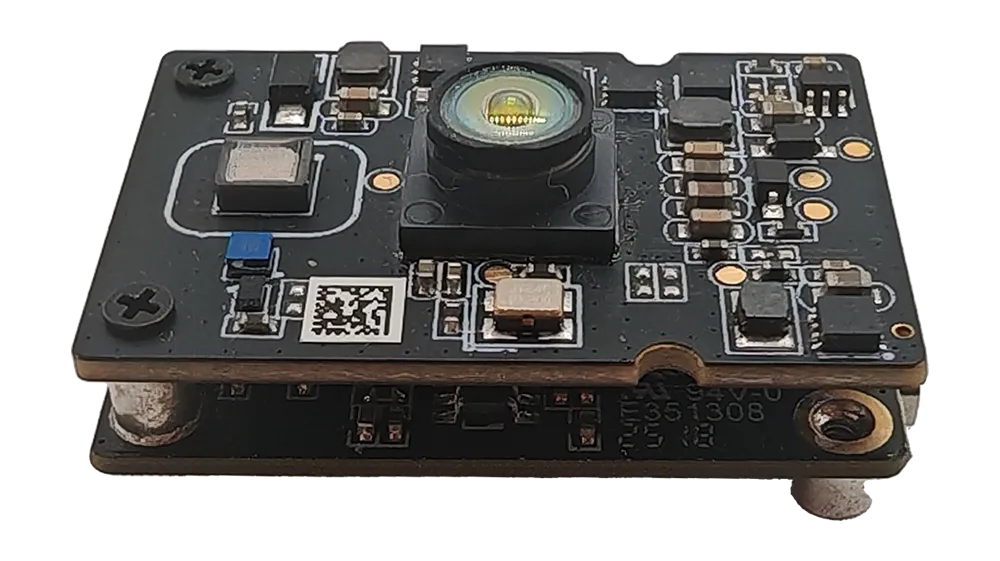
dToF: The Comprehensive Introduction
Table of Contents
dTOF ((direct Time-of-Flight) technology has become one of the core technologies in the new generation of intelligent perception technology systems, owing to its significant advantages such as excellent ranging accuracy, outstanding anti‑interference capability, and millisecond‑level response speed.
The Principle of dTOF
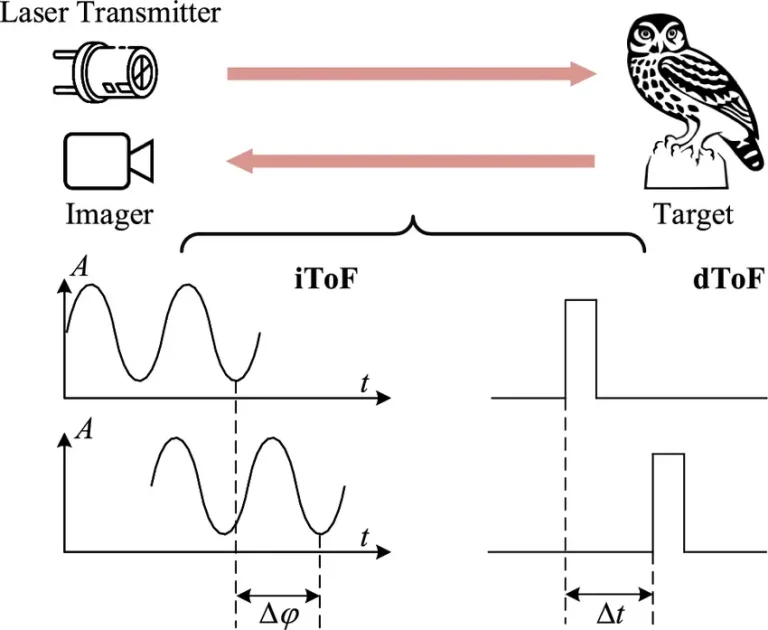
dToF (direct Time-of-Flight) technology directly measures the time difference between the emission and reception of light pulses. Due to laser safety restrictions and power consumption limitations in consumer products, the pulse energy emitted by ToF cameras is limited. The receiver relies on Single‑Photon Avalanche Diodes (SPADs), whose extreme sensitivity is essential for this direct‑measurement scheme.
A SPAD is a diode biased with a high reverse voltage during operation. When a photon is absorbed and converted into a free electron, the strong internal electric field accelerates this electron, which then collides to generate more charge carriers, creating an avalanche effect with geometric amplification. This ultimately outputs a large current pulse, enabling the detection of individual photons. The precise emission-reception time difference is recorded by a TDC (Time-to-Digital Converter).
Picosecond‑level precision is achieved via TCSPC (Time-Correlated Single Photon Counting) , in which the system repeats emission‑detection cycles of identical pulse signals thousands to hundreds of thousands of times, obtaining a statistical distribution histogram for each detection. This reconstructs the curve of the light pulse energy over time, thereby yielding the precise time of flight.
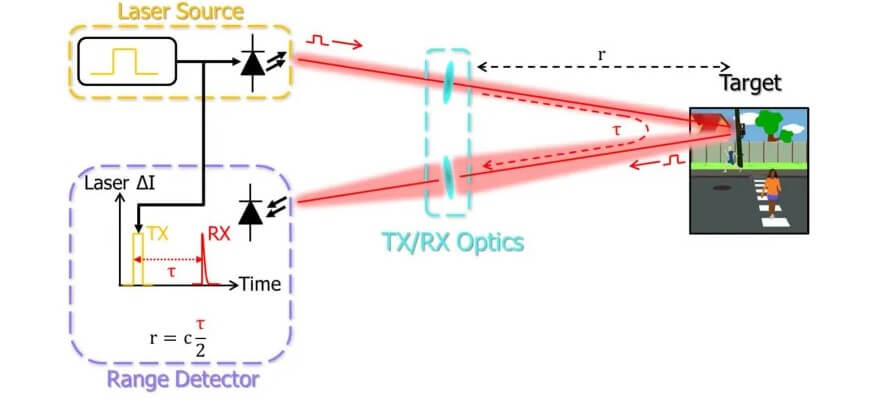
Basic formula: d = c × t / 2. Here, c is the speed of light (approximately 3×10^8 m/s), t is the round-trip time of the light pulse from emission to reception, and division by 2 accounts for the light traveling the distance twice.
Key Components
| Component | Functional Description |
| VCSEL Laser | Emits short pulses (typically 850nm or 940nm) with pulse widths at the ps~ns level. |
| SPAD Sensor | Single‑Photon Avalanche Diode with single‑photon sensitivity; outputs digital signals. |
| TDC Circuit | Time‑to‑Digital Converter with a resolution reaching tens of picoseconds. |
| Histogram Processing | Statistical histogram from multiple measurements; the peak position corresponds to the target distance (TCSPC). |
Advantages of dTOF
–Precision & Distance: The measurement accuracy of dToF does not decrease significantly as distance increases. Ranging precision is determined by the pulse width: ΔR = c × Δt / 2. For example, a 1 ns pulse width corresponds to 15cm accuracy, while 0.1 ns corresponds to 15mm accuracy. Consequently, dToF is inherently well-suited for long-range detection, reaching distances of over 100 meters.
–Power Consumption: Using a nanosecond/picosecond pulsed laser, the system requires only a single pulse per measurement. This keeps computational load and average power consumption low, making it ideal for mobile and robotic devices. Additionally, the low computational load enables extremely fast data output rates, typically 10-20fps or even 30-60fps, meeting the demanding real-time requirements of applications like robotic obstacle avoidance.
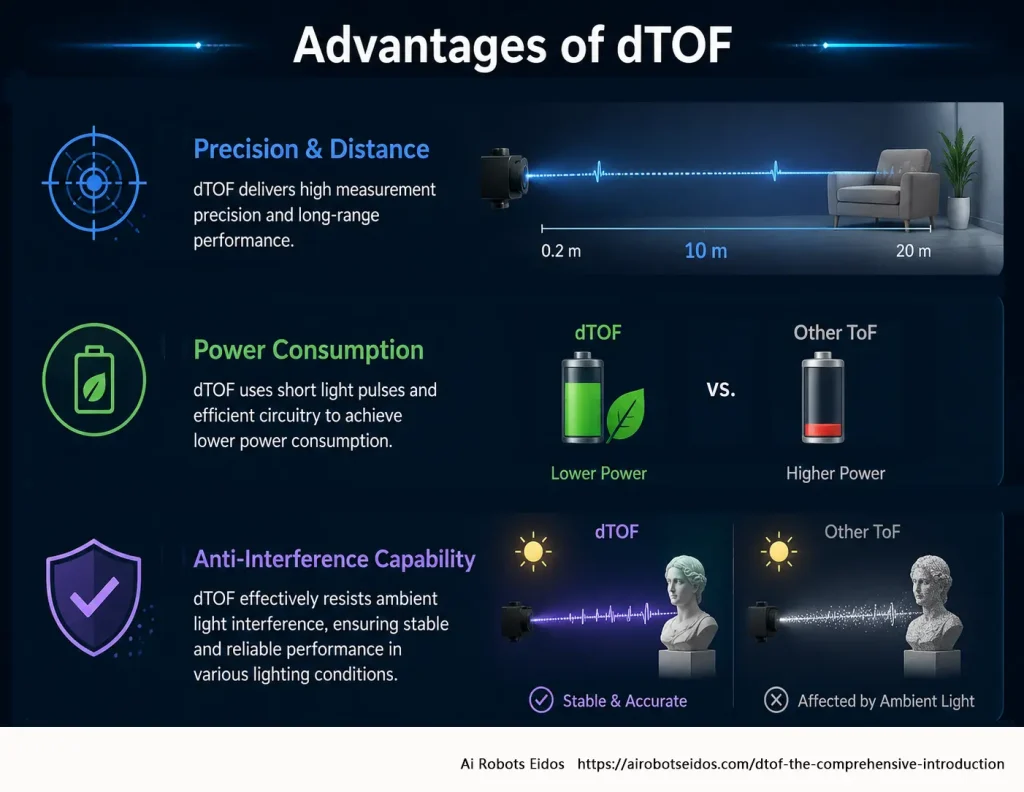
–Anti-Interference Capability: By utilizing histogram statistics, it can effectively distinguish between direct reflection and multipath reflection signals and can effectively filter out environmental light interference, demonstrating strong anti-interference ability.
Technical Challenges of dTOF
–SPAD Technology Complexity: dToF must detect light pulse signals (at the nanosecond or even picosecond level), thus demanding extremely high photosensitivity. Consequently, the receiver typically employs sensors like SPADs (Single-Photon Avalanche Diodes) or APDs (Avalanche Photodiodes). However, SPAD technology, which is core to dTOF, presents significant technical difficulties and complex manufacturing processes. Currently, very few manufacturers worldwide possess mass-production capabilities.
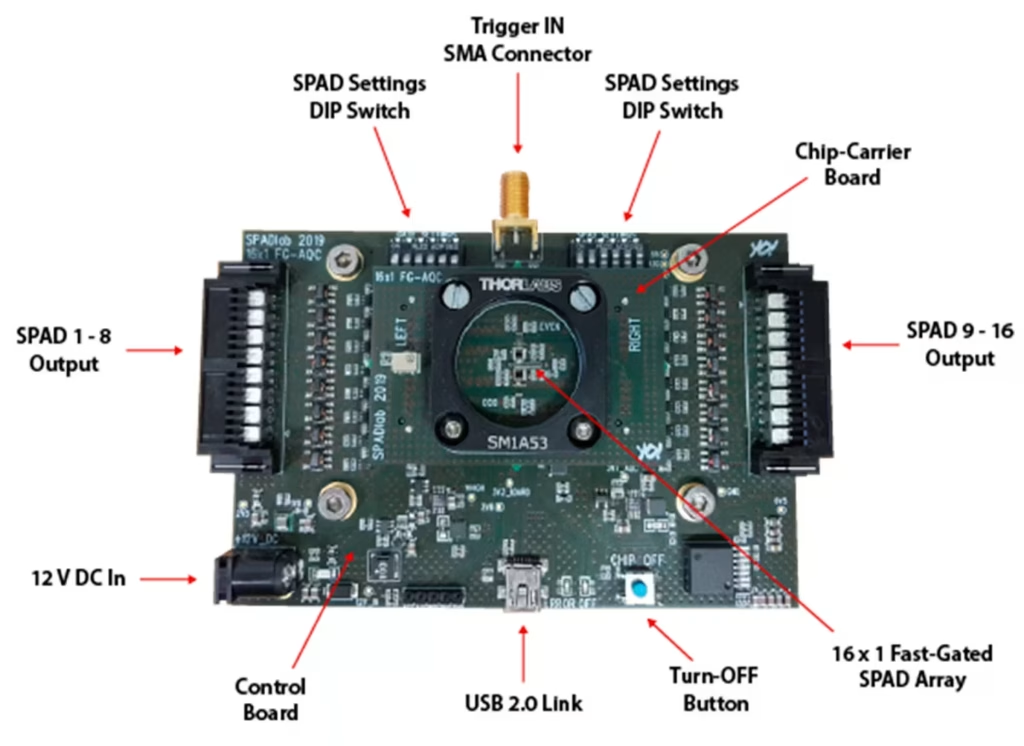
–Low Integration: The integration level of dToF is weaker than that of common CMOS image sensors. Pixel sizes are typically larger than 10μm, often resulting in lower resolution (generally less than 320×240 pixels) and higher costs. Due to its high integration difficulty, dTOF is challenging to miniaturize, making it difficult to apply in compact consumer electronics like smartphones. Apart from traditional applications like automotive LiDAR, currently only Apple has successfully commercialized dToF in the consumer electronics sector (first featured in the iPad Pro).
| Technical Challenge | Cause |
| SPAD array density | Due to relatively complex auxiliary circuits occupying a large area, and constraints from power consumption and chip size, the pixel count of the array is low. |
| SPAD photon detection efficiency | Each pixel requires a matching quenching circuit, which reduces the fill factor of the photosensitive area. |
| Dark current | Affected by factors such as material defects or thermal effects. |
| Power consumption and heat dissipation | SPADs require a relatively high operating voltage; device heating also affects the breakdown voltage of the avalanche region. |
| I/O | Each pixel needs to process a large number of pulse signals, resulting in a large overall data volume. |
| Multi‑layer stacking | To improve conversion efficiency, signal processing needs to be implemented on the chip, which requires multi‑layer wafer stacking processes. |
| Cost and supply | High technical barriers, complex processes, and high cost. |
Technical Specifications of the dToF Module (For Reference Only)
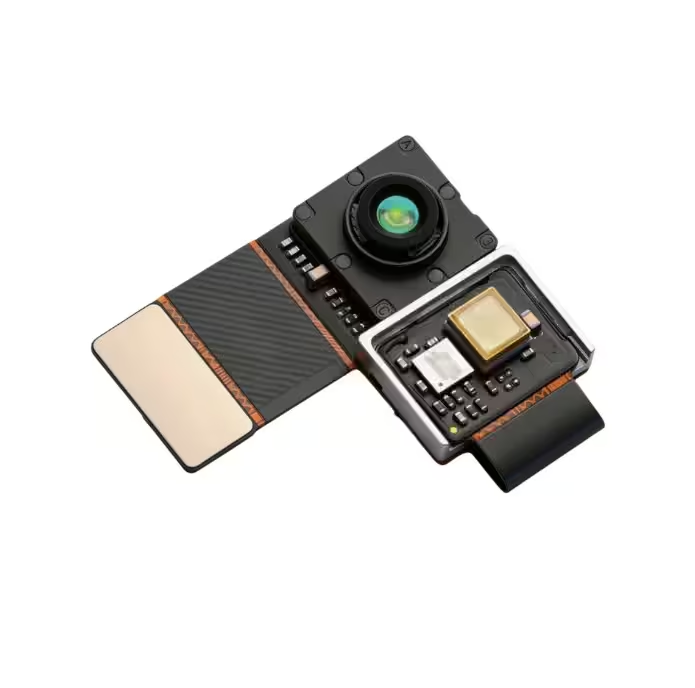
| Technical Specifications | Detector Type | SPAD |
| Resolution | 480 x 360 (supports Binning) | |
| Pixel Size | 10.08 x 10.08 μm² | |
| Performance | Range | 38.4m (2×2 Binning) |
| Photon Detection Efficiency (PDE) | 22%~32% @940nm | |
| Frame Rate | 10~20 fps | |
| Interference Resistance | PRBS-based random delay | |
| Ambient Light Tolerance | Stable output in strong light | |
| Interfaces | Data Interface | MIPI D-PHY |
| Control Interface | I²C | |
| Laser Trigger | LVDS | |
| Power & Packaging | Power Consumption | ≤ 1.3 W |
| Package | PLCC | |
| Operating Temperature | -40 °C ~ +125 °C |
Representative dToF Products
dToF Sensors
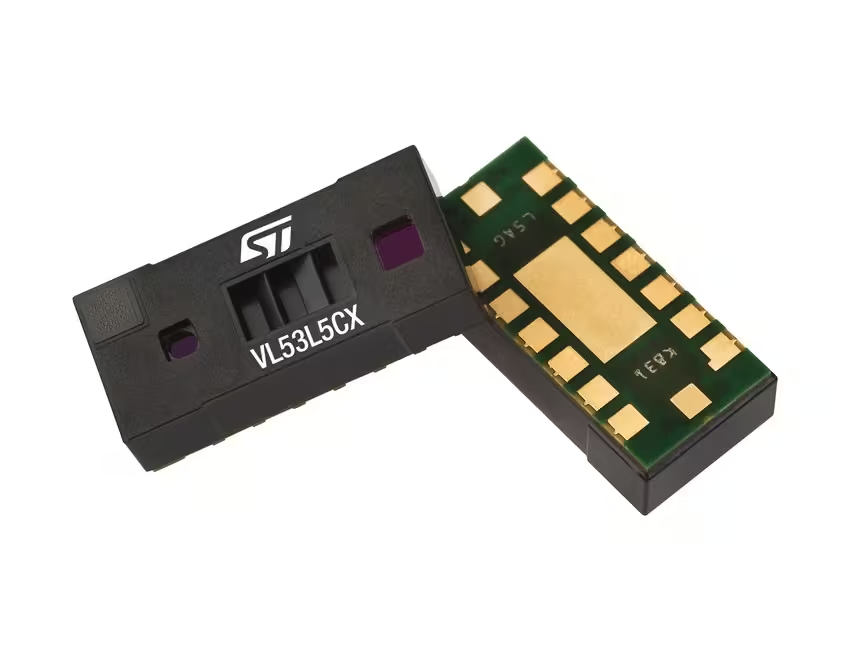
–STMicroelectronics: Its VL53 series (e.g., VL53L5, VL6180X) is among the most commonly used dToF sensors in mobile phones and consumer electronics for laser autofocus and proximity sensing.
–ams OSRAM: Offers a range of dToF modules, such as the TMF882x series, which enable multi-zone ranging for robotics and smart home applications.
–Apple: Integrates self-developed dToF LiDAR scanners (LiDAR) in its iPad Pro and iPhone Pro series to enhance AR experiences and assist with autofocus.
dToF Cameras
Technical Features: Directly measure the round-trip time of laser pulses. Advantages include long detection range, low power consumption, and good outdoor performance, but they typically offer lower resolution compared to iToF.
| Product Model | Key Specifications | Typical Applications |
| Apple LiDAR Scanner | Integrated into iPad Pro/iPhone Pro with SPAD array | Fast 3-Dimensional modeling, low‑light assisted autofocus |
| ST VL53L5 | 8×8 or 4×4 configurable zones, multi‑zone ranging | Smartphone laser autofocus, robot vacuum navigation |
| ST VL53L9 | 54×42 resolution (2,300 zones), 5 cm – 10 m range, 60 fps | Camera assisted autofocus, SLAM |
| Sony IMX611 | 140×170 pixels, SPAD structure, high photon detection efficiency | — |
dToF Lidar
| Product | Key Specifications | Typical Applications |
| Newsight NSI1000 | 32×1024 pixels, 0.2–100 m range, error <1% | Automotive LiDAR (ADAS), automatic parking |
Applications of dTOF
–Robotic Obstacle Avoidance and Navigation: 2-Dimensional laser scanners can only scan a single plane and cannot detect low-lying or overhead obstacles. dToF 3-Dimensional cameras can simultaneously acquire real-time 3D environmental information and RGB texture data, enabling the perception of low-lying and suspended obstacles. Combined with semantic recognition algorithms, they can not only identify the position and size of obstacles but also understand their type (e.g., people, shelves, walls).
Recommended Related Reading from AI Robots Eidos
Due to its balanced performance in measurement accuracy, ranging range, and environmental interference resistance, dToF technology has become a crucial ranging solution for RGBD cameras. For comprehensive knowledge on RGBD cameras, please read this article: RGBD Cameras: From Color to Distance
–Outdoor High-Brightness Operations: Scenarios like ports, mining areas, and photovoltaic power stations can experience illumination levels exceeding 100kLux. iToF solutions often fail under such conditions, whereas dToF, leveraging 940nm narrowband filtering and time-gating technology, can stably output high-precision depth data even in 100kLux strong light.

Logistics, Warehousing, and Volume Measurement: 3-Dimensional vision volume measurement solutions can efficiently measure complex environments, simultaneously acquiring 3-Dimensional data of multiple target objects with millimeter-level precision and millisecond-level speed. They are suitable for complex-shaped objects, highly reflective materials, and bulk cargo.
Technological Evolution of dTOF
Following the release of the Apple iPad Pro equipped with a dToF LiDAR in 2020, this technology entered a phase of rapid iterative development. Over the next few years, the technological evolution is expected to concentrate on the following areas:
–Continuous SPAD Process Upgrades: 3D stacking processes will further reduce the Dark Count Rate (DCR), enhance Photon Detection Efficiency (PDE), and minimize timing jitter, pushing detection ranges beyond 50 meters.
–Resolution Enhancement: Currently, mainstream dToF resolutions are at the QVGA to VGA level. With advancements in pixel size reduction and array integration technologies, high-definition dToF will become feasible.
–Solid-State and Chip Integration: Pure solid-state dToF solutions are gradually replacing traditional mechanical spinning LiDARs, offering comprehensive advantages in reliability, size, power consumption, and mass-production cost.
Market Forecast for dTOF
According to data from multiple authoritative market research institutions such as Yole Group, Mordor Intelligence, and IndustryARC, the depth sensing market is undergoing a structural transformation:
The market for 3D vision sensors for robotics was approximately $102 million in 2024 and is projected to reach $1.85 billion by 2031. dToF holds a significant advantage in medium-to-long-range applications such as robotics, autonomous driving, and industrial automation, driving its rapid growth.
The overall ToF sensor market is estimated at around $4.43 billion in 2025 and is forecast to reach $15.96 billion by 2030 (CAGR of 20.32%).
Insight from AI Robots Eidos
—The current resolution of dToF is far lower than that of RGB sensors, which is seen as a disadvantage from a traditional perspective. However, from a forward-looking viewpoint, the heterogeneous data fusion of low-resolution depth maps combined with high-resolution RGB will give rise to new algorithms such as “super-resolution depth reconstruction” and “semantic-guided depth completion.” In the future, the improvement of dToF resolution will not rely merely on increasing pixels (which is limited by manufacturing processes) but rather through AI-driven “hardware-software co-design,” allowing algorithms to “imagine” high-precision depth maps.
—Currently, SPAD technology is complex, and there are very few manufacturers capable of mass production. However, as the dToF market expands from automotive applications into consumer electronics and robotics, it will create a significant scale effect. This will compel wafer foundries (such as TSMC and STMicroelectronics) to develop standardized SPAD process platforms, similar to the evolution path of CMOS image sensors.
—The low density of SPAD arrays, the complexity of stacking processes, and the challenges of dark current control—seemingly adverse technical challenges — actually create extremely high barriers to entry for the industry. Once leading companies (such as Apple and ST) break through first, they will create a patent lock, supply chain advantages, and software ecosystem binding, making it difficult for latecomers to replicate.
—Traditional iToF faces distance ambiguity, limiting its reliability in complex dynamic scenarios. In contrast, dToF directly measures absolute flight time, inherently supporting multi-target and multi-echo detection. This means that in crowded indoor environments with glass reflections and severe multipath interference, dToF can produce stable and unambiguous depth data, providing core perception support for the next generation of dynamic SLAM (such as port unmanned vehicles and warehouse AGV clusters).
Image Credits: St & Medium & Automatematrix & Domisensor & Mdpi & AI