Table of Contents
SCARA robots are a common type of industrial robot. They drive the transformation of manufacturing with their unique advantages and continuous technological innovation. As their application fields continue to expand and technology steadily advances, SCARA robots will play an even greater role in improving production efficiency and optimizing work environments, becoming a vital force in enhancing the productivity and capacity of future smart factories.
What Are SCARA Robots?
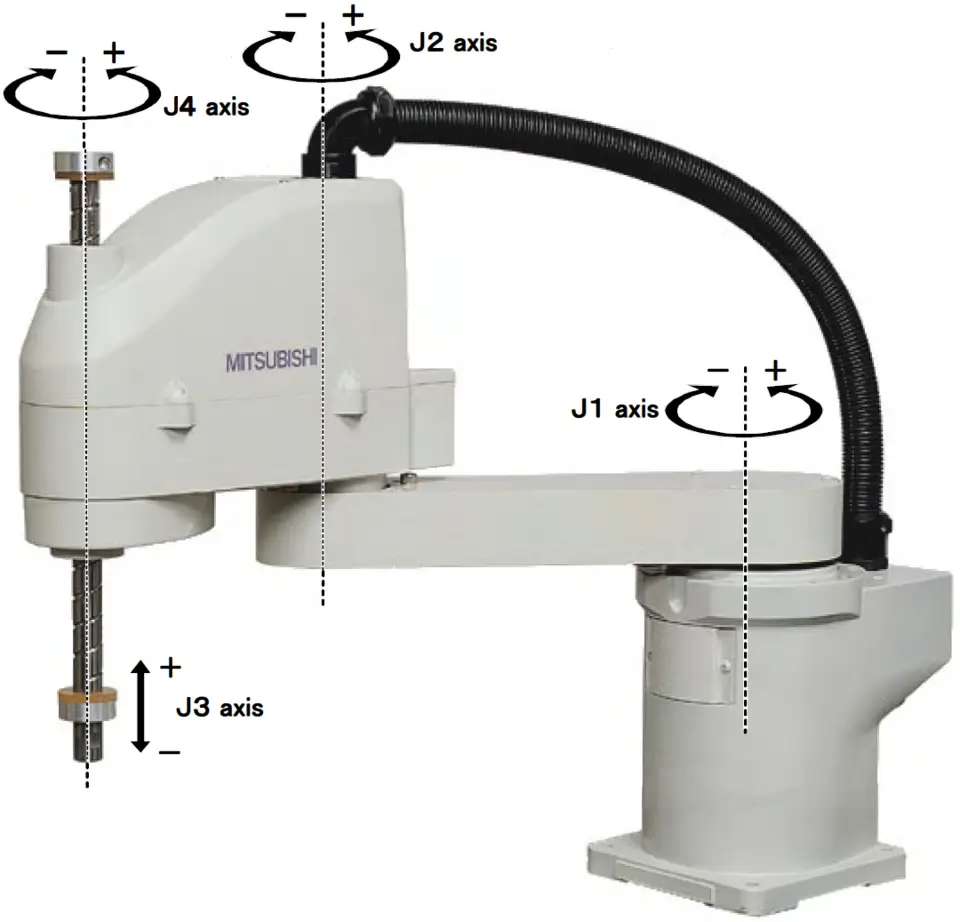
The SCARA robot is a specific type of industrial robot based on a cylindrical coordinate system. Its typical configuration features 4 degrees of freedom, which can be represented as an R–R–P–R joint configuration. The axes of the first two rotary joints (J1, J2) are parallel, enabling the positioning of the end-effector within a horizontal plane. The third joint (J3) is a prismatic (linear) joint for vertical movement. The fourth joint (J4) is a rotary joint around the vertical axis, used to adjust the orientation of the end-effector.
Disregarding the end-effector orientation, the position of the robot’s wrist reference point can be described by the joint variables φ1, φ2, and z, i.e., p = f(φ1, φ2, z).
The core design philosophy of the SCARA robot is “flexibility within the plane, rigidity in the vertical direction.” It originated in assembly applications, and its name derives from its excellent performance in such tasks, where it is called the Selective Compliance Assembly Robot Arm. This is the origin of the name SCARA.
Structure of SCARA Robots
| Base: The foundational support of the robot, typically fixed to the floor or a workbench. It provides stable support for the entire robot, bearing its weight and operational loads.
| First Joint (J1 Axis): Usually a rotary joint responsible for the robot’s rotation within the horizontal plane, allowing 360-degree rotation around the base for horizontal positioning. This joint is typically driven by a servo motor paired with a harmonic reducer or planetary gear reducer to provide high precision and high torque output.
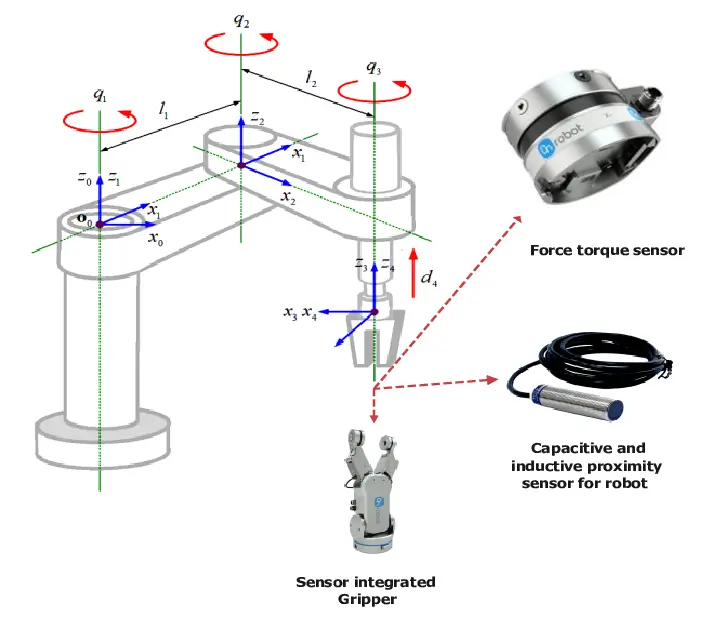
| Second Joint (J2 Axis): Also a rotary joint, with its axis parallel to the first joint’s axis. It controls the extension/retraction and swing of the robot’s upper arm, working in coordination with the first joint to achieve end-effector positioning within the horizontal plane. Its drive method is similar to the first joint, usually a combination of a servo motor and a reducer.
| Third Joint (J3 Axis): A prismatic (linear) joint used for the vertical lifting and lowering motion of the end-effector. This joint typically employs transmission mechanisms like ball screws or spline shafts, driven by a motor for up/down movement to adapt to workpieces of different heights.
| Fourth Joint (J4 Axis): Usually a rotary joint responsible for rotating the end-effector within the vertical plane, allowing the robot to adjust the tool orientation for operations like grasping and assembly. The drive method for this joint varies and may include timing belt drives, gear drives, or direct drives.
| End-Effector: Mounted at the end of the robot’s fourth joint. Depending on the application, various types of end-effectors can be equipped, such as grippers, suction cups, welding torches, spray guns, etc., to perform specific tasks.
Additionally, the structure of a SCARA robot may include auxiliary components like cable management systems, sensors (e.g., encoders, force/torque sensors), and protective devices to enhance performance, safety, and reliability.
Key Technical Parameters of SCARA Robots
To select a suitable SCARA robot model, it’s essential to understand its various parameters.
| Payload: Refers to the maximum load the robot can carry within its workspace. Common payloads for SCARA robots range from a few kilograms to over twenty kilograms, with some heavy-duty models reaching higher capacities. For a robot with a 50kg payload rating, you must confirm that the actual load weight (considering the load curve, the weight of the gripped object + the weight of the robot gripper) is within 50kg.
| Degrees of Freedom (DOF): Directly reflects the robot’s motion flexibility. For complex scenarios requiring multi-angle movement, a robot with more axes is needed. For simple pick-and-place tasks, a 4-DOF SCARA robot is usually sufficient. More axes mean greater flexibility but also higher cost. Selection should be based on actual requirements and budget.
Recommended In-depth Reading from AI Robots Eidos
Degrees of freedom are a core element in robot design and performance, as they determine not only the robot’s motion capabilities and task adaptability but also influence the robot’s level of intelligence and the human-machine interaction experience. In practical applications, it is essential to design degrees of freedom reasonably according to specific task requirements and cost constraints to achieve a balance between flexibility, stability, and economy. If you are interested in this topic, please read the in-depth article on degrees of freedom
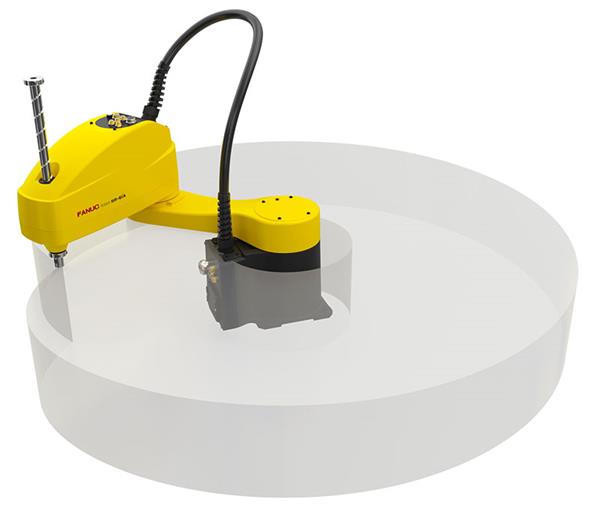
| Maximum Working Envelope: The robot’s operational reach. It’s crucial to confirm if the robot’s tasks can be fulfilled within this envelope. Generally, it includes the horizontal reach and maximum vertical stroke. The maximum vertical stroke (Y) is the distance from the lowest point the robot can reach to the highest point its wrist can reach. The maximum horizontal reach (X) is the distance from the robot base center to the farthest point the wrist can reach horizontally.
| Repeatability: Measures the robot’s ability to return to the same position repeatedly. For applications like PCB assembly, LED placement, or other high-precision tasks, repeatability is a critical parameter. Generally, high-precision applications require repeatability within ±0.05mm.
| Maximum Speed: Indicates the shortest cycle time the robot can achieve for a task. The robot’s actual operating speed is ≤ its rated maximum speed and is affected by the weight of the gripped object.
| Weight: The robot’s own weight. When designing equipment that integrates a SCARA robot, knowing the robot’s weight is necessary to design appropriate load-bearing structures.
| Brakes and Moment of Inertia: Robot manufacturers typically provide information about their robots’ braking systems. Some robots have brakes on all axes; others do not. To ensure precise and repeatable positioning within the workspace, a sufficient number of brakes is necessary. Additionally, in the event of a power failure, robot axes without brakes and under load will not lock, posing a potential safety risk.
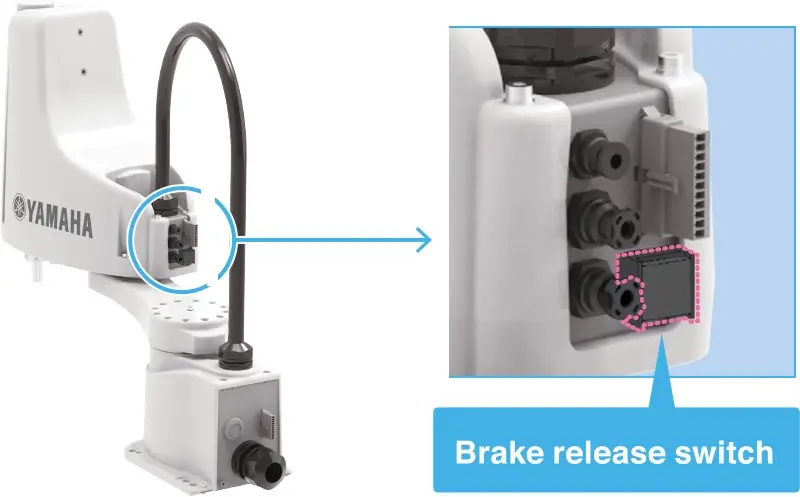
| IP Rating (Ingress Protection): Indicates the robot’s ability to resist environmental factors like water, dust, sunlight, or other strong interferences, represented by a code. The IP rating generally consists of two digits or supplementary letters. The first digit (0-6) indicates protection against solid objects (from large particles to dust). The second digit (0-8) indicates protection against liquids (from vertically falling drops to immersion under pressure). Common ratings are between 1-5. Higher ratings offer better protection but also increase housing cost. IP44 and IP54 are common industrial standards, while IP55 is typically specified for special industries and environments.
Control Algorithms For SCARA Robots
To achieve high precision and speed, SCARA robots rely on various core control algorithms, each suited for different operational requirements.
| Control Method | Control Objective | Path Requirements | Sensor Dependency |
| PTP (Point-to-Point) | Position (end-point only) | None | Encoders (joint position) |
| CP (Continuous Path) | Position, velocity, and path | Strict | High-precision encoders |
| Force/Torque Control | Contact force/torque or dynamic impedance | Typically combined with position control | Six-axis force sensor or current-loop estimation |
| Teach Programming | Path recording and playback | Determined during teaching | Encoders |
| Adaptive Control | Maintaining consistent performance | Enhances other control methods | Encoders, potentially with torque sensing |
Advantages of SCARA Robots
| High Speed: Due to their fewer joints and shorter kinematic chain, SCARA robots can achieve high acceleration and speed while maintaining performance in tasks with strict tolerance requirements. In the goalpost test (a typical assembly motion consisting of 25mm vertical up, 300mm horizontal, and 25mm vertical down), a SCARA robot can complete this cycle (including return) in as little as 0.3 seconds, significantly faster than an equivalent 6-axis articulated robot. This demonstrates its high efficiency and provides a reliable solution for high-precision, high-speed operations.
It should be emphasized that not all SCARA robots are classified as high-speed. In high-speed applications, this classification typically refers to models specifically designed for cycle times of 0.4 seconds or less.
| High Precision: SCARA robots generally offer high positioning accuracy. For example, SCARA robots produced by Japan’s Yamaha, with a minimum arm reach of 120mm and repeatability as high as ±0.005mm, can be widely used in ultra-miniature, high-precision applications such as mobile phone camera module assembly. Furthermore, due to precise motion control and a stable structure, SCARA robots can perform repetitive tasks consistently and efficiently.
| Compact Structure: SCARA robots typically employ a serial joint structure. The first two joints (J1, J2) rotate within the horizontal plane, the third joint (J3) handles vertical lifting, and the fourth joint (J4) rotates the end-effector. This layout provides a large working envelope in the horizontal plane while maintaining a compact connection between joints, minimizing space occupation. For instance, some models arrange the motors for J2, J3, and J4 axes in a triangular or linear configuration, optimizing motor placement and transmission to further reduce the in-plane structural footprint.
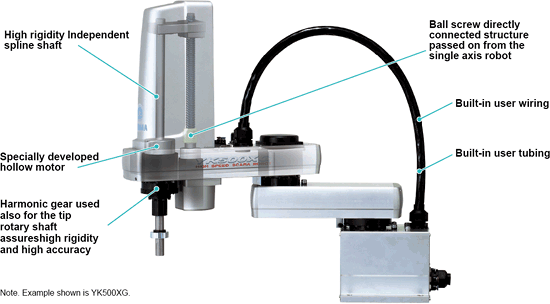
| Wide Range of Applications: SCARA robots are suitable for various scenarios, including assembly, packaging, material handling, spraying, dispensing, and other industrial production and manufacturing fields.
Disadvantages of SCARA Robots
| Limited Flexibility: With only four axes, and three primarily dedicated to horizontal rotation, their flexibility in complex spatial operations or on non-planar surfaces is inferior to 6-axis industrial robots. They are less adaptable to tasks requiring multi-dimensional, complex posture adjustments.
| End-Effector Motion Constraints: SCARA robots typically have 4 DOF (3 rotary + 1 prismatic), limiting the degrees of freedom of the end-effector’s motion. For example, while it can rotate about the vertical axis, it cannot achieve pitch/roll motions. This restricts their use in tasks requiring multi-dimensional manipulation, such as screw driving or complex assembly.
| High Environmental Requirements: They have certain requirements regarding the cleanliness, temperature, and humidity of the working environment. Harsh conditions can affect performance, necessitating additional protective measures.
Technological Innovations in SCARA Robots
With continuous technological advancement, SCARA robots are undergoing innovations that enable them to better adapt to rapidly changing industrial needs:
| Integrated Vision Systems: More SCARA robots are being equipped with advanced vision systems, enabling more complex operations like object sorting and precise placement.
| Increased Flexibility: Newer SCARA robot designs feature more flexible wrist joints capable of more complex rotation and tilting motions.
| Enhanced Human-Robot Interaction (HRI): Advanced control systems and user interfaces allow operators to interact with SCARA robots more intuitively and conveniently.
| Lightweighting and Energy Efficiency Improvements: The use of lighter materials and more efficient drive technologies is improving the energy efficiency and operational speed of SCARA robots.
SCARA Robot Applications
| Following and Grasping: The SCARA robot’s rotational joint structure within the plane results in a relatively simple kinematic model with strong decoupling in its inverse kinematics. This allows for efficient implementation of position feedforward compensation and trajectory synchronization control. Its low moment of inertia and high acceleration characteristics enable it to respond quickly to encoder feedback signals in following-and-grasping processes, achieving stable dynamic grasping.
| Precision Assembly: SCARA robots possess inherent structural compliance within the horizontal plane while maintaining high rigidity in the vertical direction. This “selective compliance” characteristic helps reduce assembly stress and improve the success rate of insertion tasks, making them particularly suitable for the precision assembly of electronic components and miniature parts.
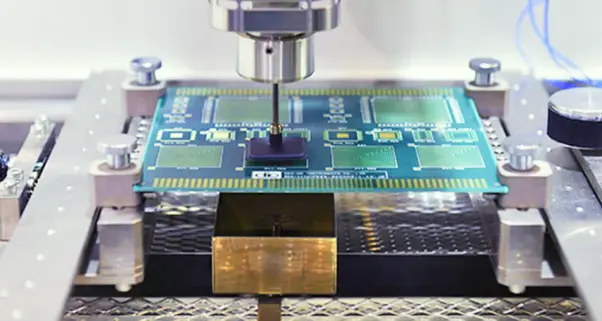
Dispensing: The SCARA robot’s Z-axis employs a linear prismatic joint, offering high structural rigidity that effectively suppresses vertical vibration. Simultaneously, its mature Continuous Path (CP) control in the plane maintains stable speed and path accuracy, thereby improving dispensing uniformity and reducing issues like stringing and overflow.
| Labeling: SCARA robots offer high repeatability within the horizontal plane. Their end-effector orientation often only requires adjustment around the vertical axis to meet labeling direction needs. Furthermore, their compact structure facilitates deployment in high-density production lines, enabling high cycle rates while maintaining precision.
| Packing/Case Packing: Due to their fewer joints and shorter kinematic chain, SCARA robots can achieve shorter cycle times in point-to-point transfer tasks. Their structural rigidity and control stability make them suitable for long-term continuous operation, effectively reducing system energy consumption and maintenance complexity.
Insight from AI Robots Eidos about SCARA Robots
| SCARA robots will evolve from ‘tools’ to ‘autonomous production units.’ Currently, SCARA robots mainly rely on external programming and fixed paths. In the future, by embedding edge AI computing modules and multimodal perception systems, they will be able to autonomously perceive environmental changes, recognize unordered workpieces, and plan paths in real-time, becoming intelligent production units capable of completing closed-loop ‘recognition-decision-execution.’ For example, in electronic product repair lines, SCARA can autonomously determine fault locations, select tools, and perform repairs at the micrometer level.
| ‘Dynamic compliance’ will become the core capability of the new generation of SCARA. The traditional SCARA’s ‘selective compliance’ is limited to mechanical structure design, while in the future, through real-time force control and variable stiffness drive technology, robots will achieve active compliance in the vertical direction and even dynamically adjust joint stiffness based on task requirements. This will allow them to actively compensate for errors in precision assembly (such as chip insertion) and dynamically buffer when handling fragile items.
| Modular joint designs will give rise to ‘reconfigurable SCARA robots.’ Drawing from the concept of modular robots, future SCARA may adopt standardized joint modules (integrating drive, sensing, and control), allowing users to quickly assemble variants with different arm lengths, loads, and degrees of freedom according to task requirements. For instance, by adding a rotational module, a 4-axis SCARA can be upgraded to a 5-axis model, enabling inclined assembly and overcoming existing posture limitations.
Image Credits: Researchgate & Wikipedia & Fanucamerica & Qviro & Automate & Imsystems