
Table of Contents
AGV Warehouse Automation can significantly increase storage efficiency and transform traditional logistics models. It reconstructs the operational modes of warehousing and logistics, truly introducing intelligence, unmanned operations, and data-driven practices into the warehousing and logistics industry.
The Meaning of AGV Warehouse Automation
AGV Warehouse Automation refers to the application of Automated Guided Vehicles (AGVs) and related control systems in the warehousing and logistics field. It automates and intelligently handles operations such as goods transportation, storage, and sorting to improve warehousing efficiency, reduce costs, and enhance management levels. It is a logistics technology application mode.
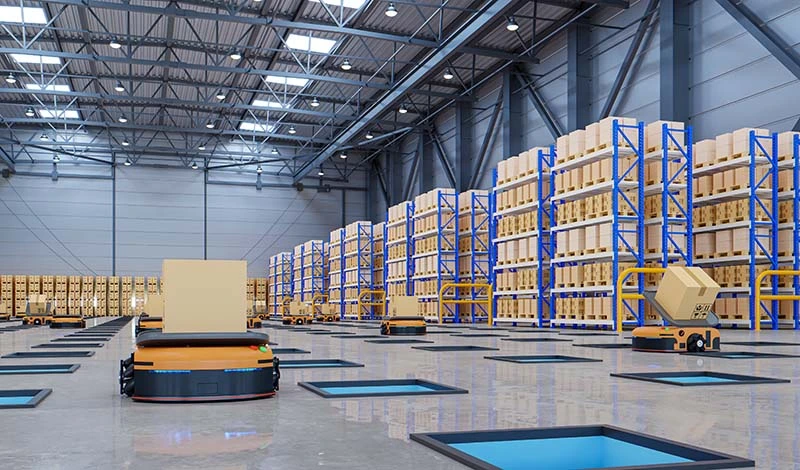
Classification of AGVs Used in AGV Warehouse Automation
| Forklift AGV: Forklift AGVs have two protruding fork arms and a ladder-like lifting mechanism. This design enables them to handle pallets and stacked goods, frequently picking and placing goods from the ground, racks, shelves, and conveyors. With the assistance of the forklifts, they also offer vertical lifting capabilities, making them highly convenient.
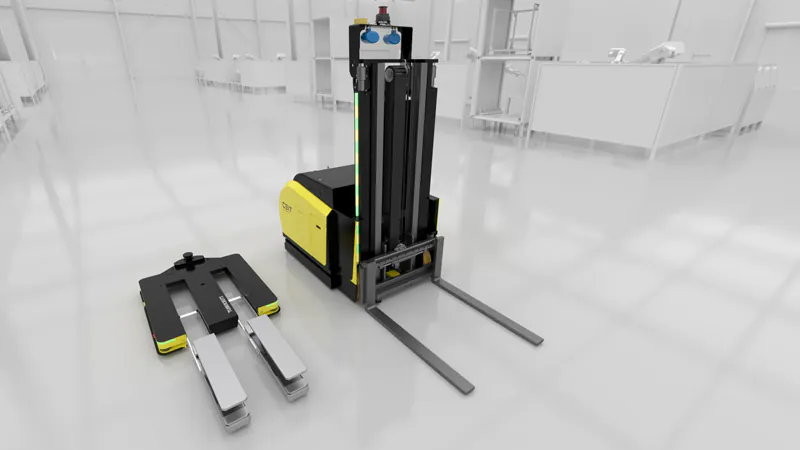
Applications: Suitable for scenarios requiring the transportation and stacking of various types of goods, such as large warehouses and logistics centers.
| Towing AGV: Towing AGVs are generally smaller in size compared to forklift-type AGVs, with a front section resembling a “locomotive.” Their most distinctive feature is a small protruding hook at the rear, commonly called a “towing hook,” which can connect to a towing line to drag goods.
Applications: Suitable for small to medium-sized factories, ports, docks, and other places where frequent goods transportation is required.
| Heavy-duty AGV: Heavy-duty AGV is typically equipped with multi-wheel drive systems to enhance their load-bearing capacity. Their core characteristic is the ability to carry loads far exceeding those of ordinary AGVs, generally referring to load capacities of 5 tons or more, with some definitions including equipment with capacities of 2 tons or more.
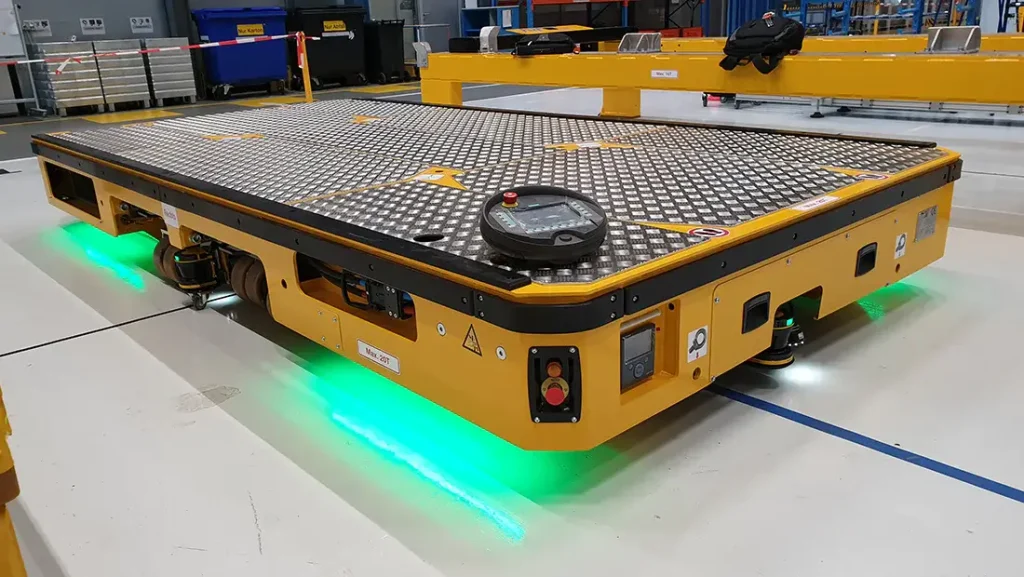
Applications: Suitable for industries such as engineering machinery, steel, and metallurgy, where heavy goods transportation is required.
Recommended In-depth Reading from AI Robots Eidos
AGVs are the core equipment of AGV warehouse automation. Through intelligent and flexible material handling and collaborative operations, they significantly enhance warehouse efficiency, reduce costs, and provide strong support for the digitalization and intelligence of warehouse management. If you want to learn more about AGVs, please read this article that provides an overall introduction to AGVs.
Operational Process of AGVs in AGV Warehouse Automation
After receiving instructions, the warehousing logistics AGV interfaces with the warehouse and automated storage systems, easily completing multi-point material distribution and transportation tasks. This achieves a high degree of automation in material outbound, transportation, distribution, and inbound processes, enabling flexible material storage.
The AGVs in warehouses travel autonomously along a pre-planned path, continuously sensing changes in the surrounding environment and adjusting their route based on actual conditions. When encountering obstacles, the AGVs will stop or detour promptly to avoid collisions.
Upon reaching the designated rack location, the AGV forklift adjusts its height and speed according to the rack structure and the position of the goods to ensure stable handling of the goods on the rack. After picking up the goods, the AGV forklift continues along the planned path to the target location.
Upon reaching the destination, the AGV forklift places the goods at the designated spot based on preset instructions or operator commands. After completing the placement, the AGV forklift sends a completion signal to the control system to confirm task completion.
Benefits of AGVs in Warehouses
| Elimination of Inefficient Transportation: By implementing AGV warehousing robots for “goods-to-person” picking, robots come to the workers, who only need to perform simple operations to complete the handover. This avoids inefficient transportation.
| Free Navigation: AGV warehousing robots operate at high speeds and possess functionalities such as moving forward, backward, turning left or right, and rotating in place. They can also lift pallets to carry materials. Free navigation primarily relies on technologies like SLAM. Due to space constraints, SLAM (Simultaneous Localization and Mapping) technology serves as an example here. Laser SLAM scans the environment using LiDAR to construct a 3D map within milliseconds, while visual SLAM, combined with AI image recognition, enables precise positioning even in complex lighting or dynamic obstacle scenarios.
| Real-Time Monitoring: AGV warehousing robots can connect to warehouse systems to update material statuses and locations in real-time. This is why AGV warehousing robots are widely used across various warehousing and logistics industries to improve work efficiency. Additionally, AGV warehousing robots are equipped with obstacle detection sensors to ensure the safe operation of the vehicles.
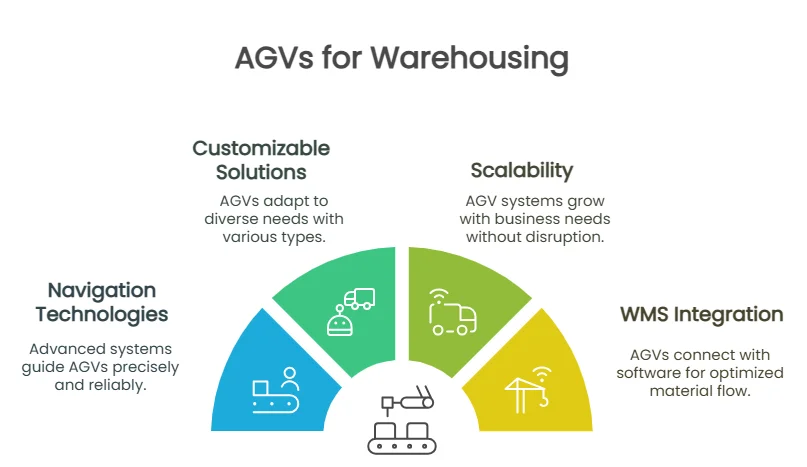
Advantages of AGV Warehouse Automation
| Automated Operation: By integrating with information systems such as Warehouse Management Systems (WMS) and Manufacturing Execution Systems (MES), AGVs can receive task commands, automatically plan paths, and execute operations like goods transportation, inbound, outbound, and sorting. For example, in e-commerce warehouses, AGVs can automatically transport goods from storage areas to sorting areas based on order requirements or deliver raw materials to designated workstations on production lines. This achieves a “goods-to-person” rather than “person-to-goods” operational model, significantly improving efficiency and accuracy.
| Intelligent Scheduling and Management: AGV systems are equipped with ground control systems and onboard control systems, enabling wireless communication for collaborative work and task allocation among multiple AGVs. The ground control system is responsible for task scheduling, path planning, and traffic management, ensuring AGVs avoid collisions, allocate tasks reasonably, and operate efficiently and orderly. Simultaneously, the system can monitor the status of AGVs (such as battery level, location, and task progress) in real-time and make dynamic adjustments based on actual conditions, such as automatic charging or task reallocation.
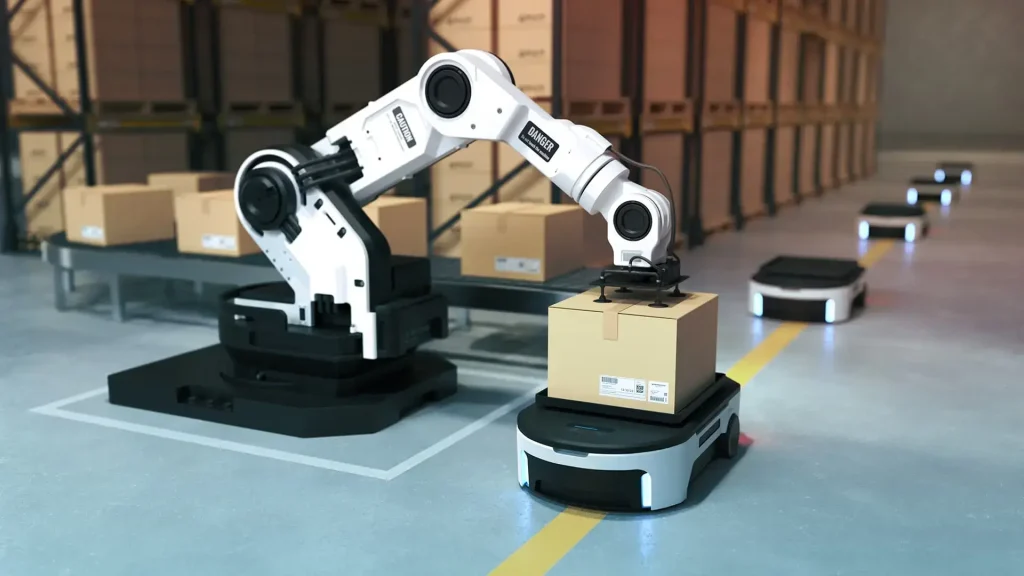
| Flexibility and Adaptability: The flexibility of AGVs is mainly reflected in their programmable paths. They can flexibly adjust routes and operational ranges according to warehouse layouts and business requirements. This flexibility allows them to adapt to warehousing scenarios of different scales and types, such as flat warehouses, automated storage and retrieval systems (AS/RS), and multi-floor warehouses. They are particularly suitable for warehousing environments with significant fluctuations in business volume and a wide variety of goods.
Practical Case Analysis of AGV Warehouse Automation
In the automation project of a Malaysian electrical motor company, AGV Warehouse Automation adopted a four-directional shuttle car AS/RS solution. By combining six four-directional shuttle cars with AGVs and elevators and seamlessly integrating the system with the ERP, the project achieved automatic material preparation, high-density storage, and intelligent transportation as an integrated process. The AGV Warehouse Automation solution effectively addressed several challenging issues through the combination of four-directional shuttle cars and AGVs:
| Complex Environment Adaptability Issues: Four-directional shuttle cars can navigate flexibly within narrow rack aisles, adapting to irregular warehouse layouts (such as beam or column limitations). AGVs, on the other hand, can move freely on the ground, achieving cross-floor and cross-region transportation. The combination of both can cover complex spaces, solving deployment challenges for traditional equipment in irregular warehouses or multi-floor scenarios.
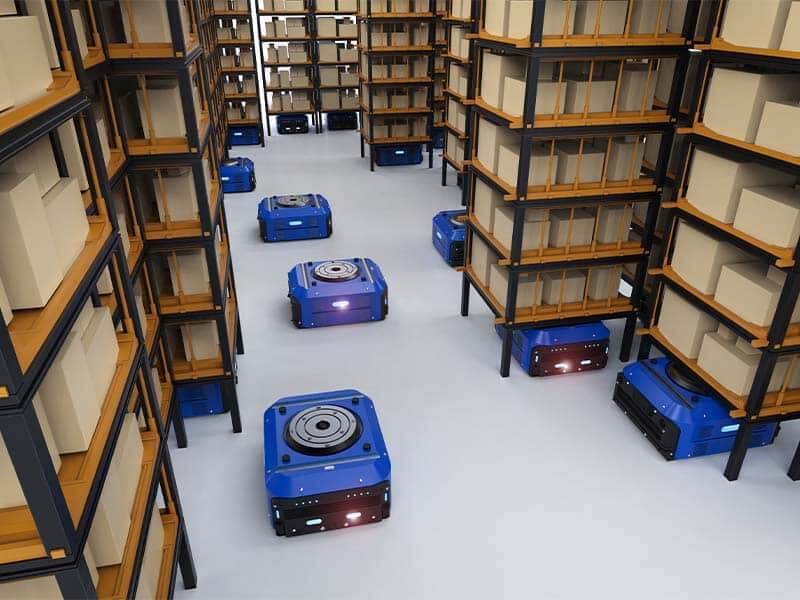
| Efficiency and Flexibility Issues: Four-directional shuttle cars are responsible for high-speed storage and retrieval within racks, while AGVs handle horizontal transportation and cross-region scheduling. This division of labor and collaboration improves overall operational efficiency while allowing flexible adjustments to equipment numbers and task allocations based on business fluctuations, meeting seasonal demand changes or peak order requirements.
| Space Utilization Issues: Four-directional shuttle cars maximize vertical space utilization through dense storage designs, while AGVs’ flexible path planning reduces aisle occupancy, further improving warehouse space utilization. This is particularly applicable in scenarios with limited land resources.
This AGV Warehouse Automation solution improved operational efficiency by 35% compared to traditional warehousing models and significantly reduced manual intervention costs.
Challenges Facing AGV Warehouse Automation
| The AGV Warehouse Automation industry is an emerging field, and while experiencing rapid growth and expansion, it has also exposed some issues: The intelligence level of AGV robots is insufficient. Taking LiDAR sensors as an example, LiDAR has detection blind spots at close distances (typically within 0.1-0.5 meters), making it difficult to perceive objects closely attached to the vehicle. Its detection capability for low-reflectivity objects (such as transparent glass) is weak, which may lead to missed detections. In strong lighting environments, distance measurement accuracy may decline, affecting obstacle avoidance performance. Although this issue can be addressed by combining LiDAR with visual sensors, it also increases the cost of AGV Warehouse Automation.
| Services primarily focused on e-commerce logistics limit the penetration of AGV Warehouse Automation into other industries. One of the current challenges for AGV Warehouse Automation is addressing the varying demands across different industries. Therefore, the products and solutions provided by AGV robot manufacturers must align with the warehousing and logistics needs of clients in different sectors. This is both a way for warehousing and logistics robot manufacturers to enhance their core competitiveness and an important pathway for AGV Warehouse Automation to expand into multi-domain applications.
Development Directions of AGV Warehouse Automation
| Deep AI Empowerment: Through deep learning algorithms, AGVs will possess stronger capabilities in environmental perception, path planning, and decision-making. They will be able to adapt to complex dynamic environments in real-time, achieving autonomous obstacle avoidance, task allocation, and collaborative operations.
| Human-Robot Collaboration: By integrating technologies such as voice interaction and gesture recognition, AGVs will be able to communicate naturally with operators, improving operational convenience and efficiency. Simultaneously, equipped with safety sensors and obstacle avoidance systems, AGVs will ensure safe coexistence with human workers, achieving human-robot collaborative operations.
Insight from AI Robots Eidos about AGV Warehouse Automation
| The future AGVs in warehouse automation systems will not merely serve as the “hands” and “feet” executing transport instructions; they will evolve into intelligent nodes equipped with edge computing capabilities and localized decision-making authority. Each AGV can be viewed as a mobile edge server, capable of processing local sensor data (such as vision, laser, inertial measurement units, etc.) in real-time for immediate environmental analysis and path adjustments.
They will be able to autonomously handle unexpected situations (such as temporary obstacles or path congestion) and engage in point-to-point (P2P) negotiation with neighboring AGVs, dynamically forming locally optimal traffic flows without fully relying on centralized instructions from a central dispatch system. This will endow the system with greater robustness, lower latency response, and scalability.
| Future AGV Warehouse Automation systems will no longer exist as information silos. The real-time status, task logs, and perception data of each AGV will converge in the cloud with data streams from transport trucks, port cranes, and factory line robots, collectively creating a dynamic virtual mapping that spans enterprise boundaries and runs through the entire supply chain. Within this framework, AGV scheduling will not only consider internal warehouse efficiency but will also respond to global optimization needs regarding upstream production rhythms and downstream logistics timeliness.
Image Credits: Processequipmentandcontrols & Asseco-ceit & A-vt & Helichina & Framos & Bluepathrobotics
Other Articles on The Topic of AGVs
Level A (Foundational )