
Table of Contents
Rail Guided Vehicle (RGV) is the core handling equipment in automated logistics systems, and its performance directly determines the system’s operational efficiency and response speed. In the context of smart manufacturing, RGV systems have evolved from single material handling tools into complex mechatronic systems integrating precise positioning, intelligent scheduling, and condition monitoring.
What Is A Rail Guided Vehicle (RGV)
A Rail Guided Vehicle (RGV) is a conveying device that carries unit loads and travels horizontally back and forth along a track. Regarding the transport of unit loads, it is primarily used in conjunction with chain conveyors. The chain conveyor smoothly transfers the unit load to the RGV, which, upon receiving the signal, travels along the track to deliver the unit load to the designated position, and then smoothly transfers the unit load to the exit chain conveyor.
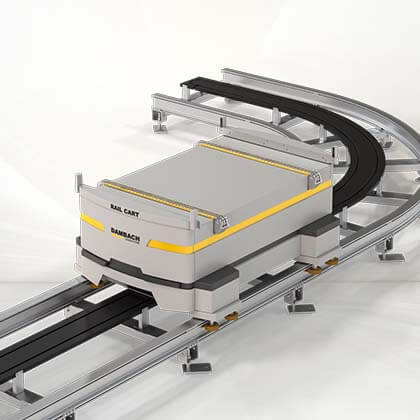
It can be easily and automatically integrated with other logistics systems, such as loading/unloading docks, various buffer stations, conveyors, lifts, and robots, to transport materials according to the plan. Furthermore, it not only requires no manual operation but also operates at high speeds, significantly improving production efficiency.
Classification of Rail Guided Vehicle (RGV)
Based on the mode of movement, Rail Guided Vehicles (RGVs) can be classified into circular track type and linear reciprocating type.
Circular track RGV systems allow multiple vehicles to operate simultaneously, typically using aluminum alloy tracks, resulting in higher costs.
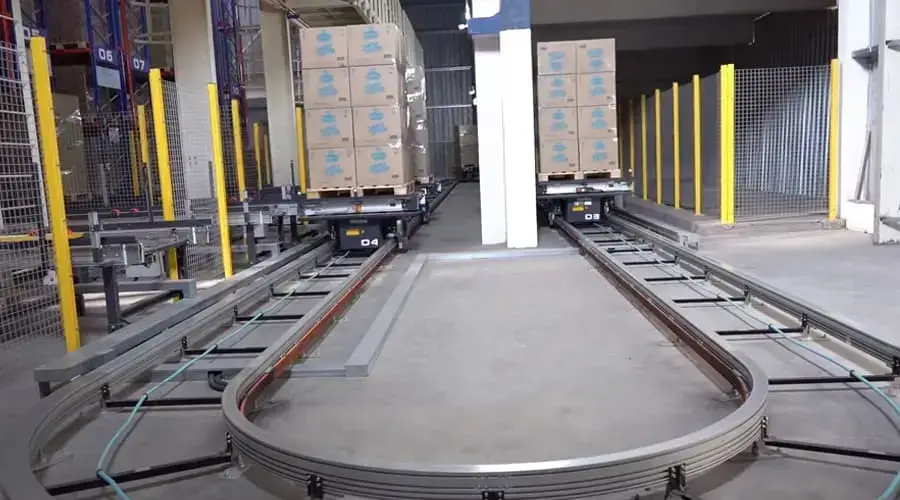
Linear reciprocating systems usually use a single Rail Guided Vehicle (RGV) for back-and-forth movement, typically employing steel rails as the track. Consequently, the cost is relatively lower, but the efficiency is lower compared to circular RGV systems.
| Type | Characteristics |
| Circular track type | Multiple vehicles operating in parallel, high efficiency, high cost, simple system, small footprint, reliability depends on individual vehicles |
| Linear reciprocating type | Single vehicle shuttling back and forth, low cost, relatively low efficiency, steel rail track, can be used independently or as peripheral equipment for automated warehouses |
| Dual-track reciprocating type | More stable structure, suitable for heavy loads |
| Transfer RGV | Capable of turning, branching, and autonomous track switching without a turnout mechanism, high efficiency, uses wireless communication, and barcode positioning |
Structure of Rail Guided Vehicle (RGV) System
Mechanical Structure
The Rail Guided Vehicle (RGV) mainly consists of a frame, modular box-type wheel sets, a variable frequency brake gear motor, a current conducting device (steel rail slider type), a rail cleaner, and other components.
The frame is the main structure of the Rail Guided Vehicle (RGV) and requires sufficient rigidity and toughness. It is generally designed for 150% of the rated load, and defects such as cracks, porosity, or slag inclusions must be avoided.
To ensure smooth operation of the wheels on the track and to overcome and compensate for the elastic deformation of the frame under no-load and full-load conditions, as well as deviations in the lateral parallelism of the tracks, one side of the wheel set typically uses a double-flange structure, while the other side uses a flangeless structure. Additionally, a gap is left between the bearing housing covers on one side of the wheel set bearing seats, allowing the bearing to move slightly axially within the housing. The hollow shaft gear of the Rail Guided Vehicle’s gear motor is directly fitted onto the drive wheel shaft and connected to the frame via an anti-rotation torque arm.
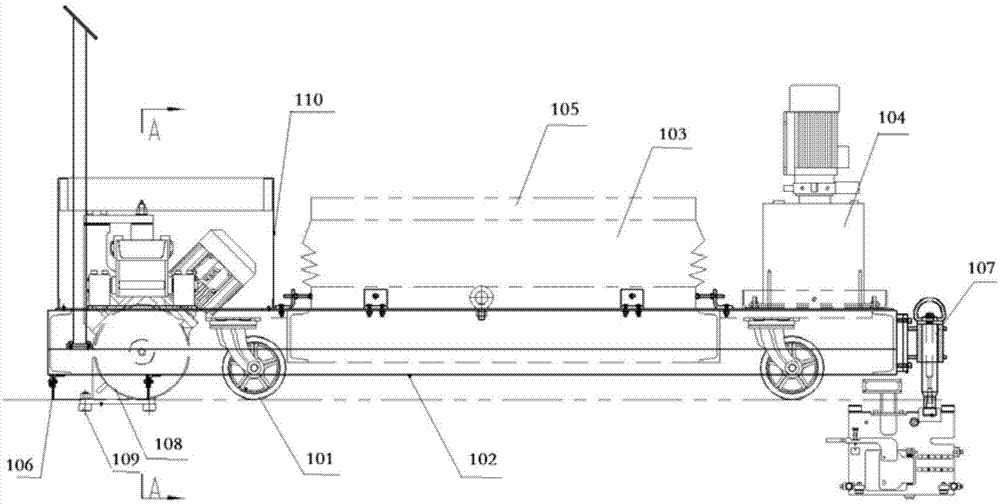
The mechanical assembly accuracy of the RGV must meet the following requirements: wheelbase limit deviation of ±2.0 mm; parallelism tolerance of the two wheel set axes of 2.0 mm; diagonal difference between the two wheel sets not exceeding 30 mm; and the gap between the passive wheel and the reference track surface not exceeding 2.0 mm. Furthermore, the repeated positioning accuracy of the Rail Guided Vehicle (RGV) in automatic control mode should meet ±20 mm.
Electrical Control Structure
The electrical control system of the Rail Guided Vehicle (RGV) is characterized by intelligence and environmental friendliness. The highly automated control system reliably performs various operational control actions and features comprehensive operational protection functions, operational prompts, operational warnings, and malfunction interlocking functions. It mainly consists of a ground power supply system, an on-board control system, and a remote automatic control system.
| Ground Power Supply System: Low-voltage track-powered Rail Guided Vehicles (RGVs) are equipped with a ground power supply system. AC380V power is stepped down via a step-down transformer to a safe three-phase AC36V voltage, which is then supplied to two insulated running conductive steel rails and a central conductive rail. Current collectors (pickup shoes) transfer power to a step-up transformer on the Rail Guided Vehicle (RGV), boosting the three-phase AC36V back to three-phase AC380V to supply the drive power for the rail guided vehicle.
| On-board Control System: The RGV’s on-board control system uses a variable frequency brake motor and a variable frequency drive (VFD) to achieve low-speed soft start and deceleration soft braking, meeting the acceleration requirements of the electric flat car’s travel mechanism and ensuring smooth and impact-free travel.
| Remote Automatic Control System: The RGV’s remote automatic control system consists of an on-board PLC, absolute encoders, a laser positioning system for the Rail Guided Vehicle, a wireless communication system, and automatic control software. This system effectively ensures the stable and precise operation of the Rail Guided Vehicle in automatic control mode. Except for emergency control and other shared utilities, all control signals and fault alarm signals are sent via the on-board PLC.
Key Technologies of Rail Guided Vehicle (RGV)
Positioning System
As an automated piece of equipment, the Rail Guided Vehicle (RGV) must ensure accurate arrival at task points repeatedly, thus demanding high repeatability. To guarantee accuracy, a combination of laser distance sensors and absolute encoders is typically used as a dual positioning strategy to ensure the RGV’s operational accuracy and terminal positioning.
Recommended In-depth Reading from AI Robots Eidos
Rail Guided Vehicles (RGVs) operate on fixed tracks, and their core technological advantage lies in providing high repeatability for material transfer. This high repeatability ensures that when a Rail Guided Vehicle (RGV) frequently travels between fixed stations, it can consistently achieve accurate docking with tooling fixtures, production lines, or entry/exit points without requiring additional error compensation.
If readers would like to learn more about repeatability, please read this in-depth article on repeatability.
Laser distance measurement serves as the primary positioning method, while the encoder acts as an auxiliary and calibration method. Several calibration zero points are set along the RGV’s total travel distance. The absolute encoder, serving as an auxiliary positioning device, updates position data based on data calibration points set on the travel track, feeding back position information to the on-board PLC at a rate of 2 ms/time, ensuring optimal accuracy and cross-referencing the laser measurement positioning data.
Network Communication System
As a mobile device, the Rail Guided Vehicle (RGV) needs to receive scheduling commands from the ground management system during operation, necessitating the establishment of a wireless network communication system to facilitate communication with the control server. Wireless network communication technology must meet a series of requirements, such as adapting to complex industrial environments and the geographical conditions of the location, including humid or rainy external conditions.
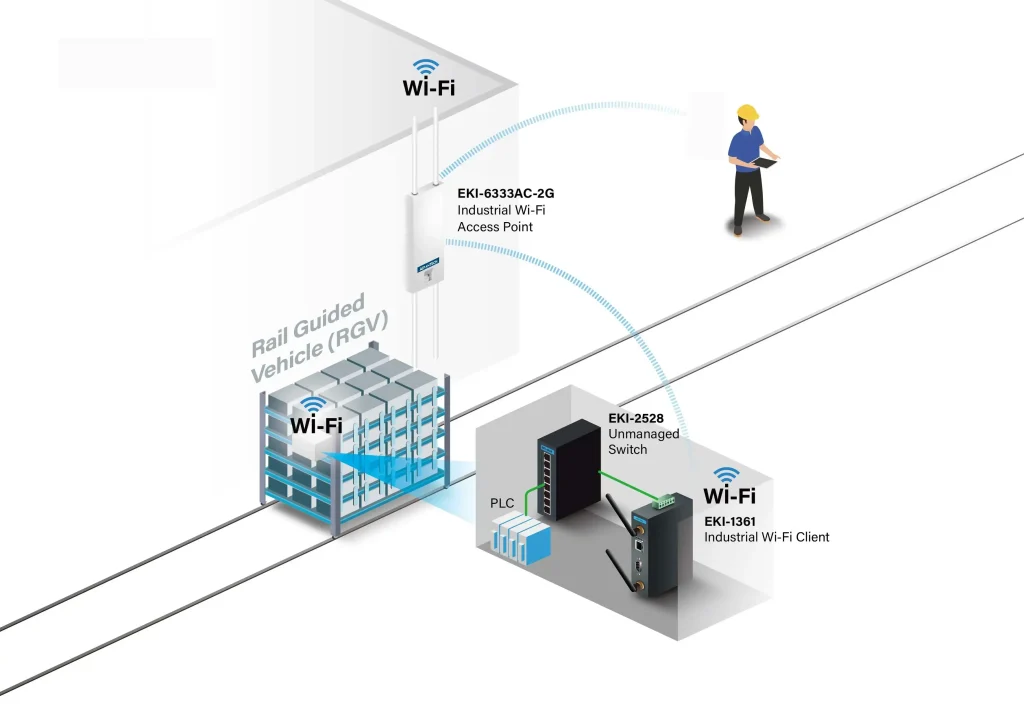
To ensure the operational stability of the Rail Guided Vehicle (RGV), real-time data transmission without interruption is essential. To avoid co-channel interference, the network communication system should support multiple standards such as 2.4GHz/5GHz.
Both wireless AP devices and client devices support PoE (Power over Ethernet) via network cables, making configuration and installation simple and convenient. Arranging a certain number of APs along the track at set intervals ensures data transmission stability during equipment operation.
Scheduling System
The RGV scheduling system resides within the on-board server. Its main responsibilities include data exchange with the higher-level automated material handling management system, interface management with other equipment within the automated material handling system, and interlocking functions for various safety devices. Its functions include receiving the RGV’s travel target and sending the RGV’s positioning information. The scheduling system primarily handles command decomposition, command calculation, and a small amount of data storage for commands issued by the higher-level management system.
RGV Applications and Basic Technical Parameters (For Reference)
High-Speed RGV
| Applications: Automated warehouses and production line material transfers requiring high response speed and short operation cycles, such as in the electronics manufacturing industry.
| Basic Technical Parameters:
| Parameter | Value | Unit | Remarks |
| Travel Speed | 160 | m/min | Equivalent to 2.67 m/s |
| Transfer Speed | 30 | m/min | Equivalent to 0.5 m/s |
| Travel Acceleration | 0.5 | m/s2 | Consistent acceleration and deceleration characteristics |
| Transfer Acceleration | 0.5 | m/s2 | Consistent acceleration and deceleration characteristics |
| Transfer Stroke | 1.4 | m | Load transfer distance |
| Rack Spacing | 1.45 | m | Distance between work units |
| Positioning Time | 2 | s | Time required for precise positioning |
| Communication Time | 3 | s | Time required for interaction with the control system |
| Conveyor Time | 7 | s | Auxiliary time for load conveying |
| Typical Load Capacity | 300 | kg |
Standard-Speed RGV
| Applications: Logistics systems with medium operational intensity and cost control requirements, such as in general machinery manufacturing, food processing, and other industries (such as rail guided vehicles in low-temperature cold chain).
| Basic Technical Parameters:
| Parameter | Value | Unit | Remarks |
| Travel Speed | 80 | m/min | Equivalent to 1.33 m/s |
| Transfer Speed | 12 | m/min | Equivalent to 0.2 m/s |
| Travel Acceleration | 0.5 | m/s2 | Consistent with the high-speed model |
| Transfer Acceleration | 0.5 | m/s2 | Consistent with the high-speed model |
| Transfer Stroke | 1.55 | m | Slightly longer than the high-speed model |
| Positioning Time | 2 | s | Consistent with the high-speed model |
| Communication Time | 3 | s | Consistent with the high-speed model |
| Conveyor Time | 7 | s | Consistent with the high-speed model |
| Typical Load Capacity | 300 | kg |
Heavy-Duty RGV
| Applications: Heavy material handling, such as in automotive manufacturing, heavy machinery, large parts warehouses, etc., requiring high load-bearing capacity.
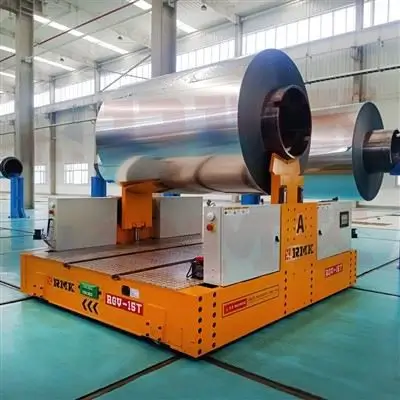
| Basic Technical Parameters:
| Parameter | Value | Unit | Remarks |
| Travel Speed | 120 | m/min | Equivalent to 2.00 m/s |
| Transfer Speed | 30 | m/min | Equivalent to 0.5 m/s |
| Travel Acceleration | 0.5 | m/s² | Optimized for heavy load characteristics |
| Transfer Acceleration | 0.4 | m/s² | Lower than travel acceleration to protect the load |
| Load Capacity | 700 | kg | Significantly higher than the previous two configurations |
| Conveying Distance | 30 | m | Long-distance operation capability |
| Transfer Stroke | 1.9–11.7 | m | Adjustable stroke to accommodate different scenarios |
| Positioning Time | 2 | s | Maintains high-precision positioning |
| Communication Time | 1 | s | Optimized communication protocol |
| Conveyor Time | 7 | s |
How to choose a Rail Guided Vehicle (RGV)?
| There is no such thing as an “optimal” configuration—only the “most suitable” one. Selection should be based on a careful trade-off among four core elements: logistics intensity (throughput), material characteristics (weight and dimensions), system layout (travel distance), and return on investment (ROI).
| System matching is crucial. The performance of an RGV depends not only on its own parameters but also on factors such as track flatness, scheduling system algorithms, network communication latency, and the synchronization rhythm of upstream and downstream equipment. The high-speed model, in particular, requires a highly stable operating environment and an intelligent scheduling system.
| Future Optimization:
Dynamic Parameter Configuration: Develop intelligent drive algorithms that automatically adjust acceleration and deceleration curves based on load weight and task urgency, achieving an optimal balance between efficiency, energy consumption, and operational smoothness.
Energy Recovery: Particularly for heavy-duty RGVs, research and implement regenerative braking technology to effectively reduce system energy consumption.
Predictive Maintenance Integration: Utilize real-time data such as motor current, vibration, and temperature rise for performance monitoring and health status assessment, enabling a shift from “time-based maintenance” to “condition-based maintenance.”
RGV Performance Comparison
| Dimension | High-Speed Model | Standard-Speed Model | Heavy-Duty Model |
|---|---|---|---|
| Core Advantages | Extreme efficiency, short cycle time, high throughput | Excellent cost-effectiveness, high value for money, mature and reliable technology | High load capacity, wide adaptability (adjustable stroke), fast communication response |
| Performance Limitations | Efficiency constrained over short distances; high precision requirements for control and rail guidance | Low absolute travel speed; lower efficiency for long-distance operations | High power consumption, high system cost, and high requirements for track foundation |
| Applications | High-turnover warehouses, JIT production lines, processes with tight cycle times | Medium-intensity logistics operations, limited investment budgets, retrofit projects | Heavy material handling in automotive, heavy machinery, aviation, and other industries; large-part transportation scenarios |
| Selection Keywords | Speed, cycle time, response | Cost, stability, practicality | Load capacity, flexibility, reliability |
Insight from AI Robots Eidos about Rail Guided Vehicle (RGV)
| The future Rail Guided Vehicle (RGV) will no longer be limited to cargo handling, but will gradually integrate functions such as grabbing, assembly, inspection, and charging and discharging, becoming a multifunctional operational platform capable of autonomous movement on tracks. In fields such as new energy, semiconductors, and high-end manufacturing, RGV will take on a triad role of “materials + information + operations,” achieving “cargo handling as processing, mobility as service.”
| As manufacturing scenarios develop towards larger sizes, longer processes, and greater variety, heavy-duty RGV is evolving from fixed travel, single-machine operation to models that cover large travel distances, adjustable travel for transplantation, and collaborative operation among multiple vehicles. By combining modular tracks and flexible scheduling systems, Rail Guided Vehicle (RGV) will be able to dynamically adapt to different workstation layouts, realizing a flexible manufacturing model of “tracks as production lines.”
| In the future, Rail Guided Vehicle (RGV) communication systems will go beyond merely serving as transmission channels for commands. They will integrate high-precision positioning, equipment status sensing, and environmental modeling into a spatiotemporal perception network. Utilizing new-generation communication technologies such as UWB and Wi-Fi 7, RGV can achieve sub-meter-level positioning and microsecond-level synchronization, supporting advanced functions such as multi-vehicle collaboration, dynamic obstacle avoidance, and virtual grouping.
Image Credits: Daifuku & Rmk-transfercart & Dambach-lagersysteme & Patsnap & Advantech
Other Articles on The Topic of Rail Guided Vehicle (RGV)
RGV vs AMR: A Quick Guide