Degrees of Freedom in Robotics: Defining Dexterity
Table of Contents
The degrees of freedom are a core and fundamental issue in robotics because they directly determine the efficiency of a robot in executing tasks and its ability to adapt to different environments. This article will provide an in-depth discussion of degrees of freedom.
What Are Degrees of Freedom?
In robotics, the degree of freedom refers to the minimum number of independent generalized coordinates needed to specify the position and orientation of a rigid body in space. Simply put, it is the number of independent movements a robot’s joint can perform.
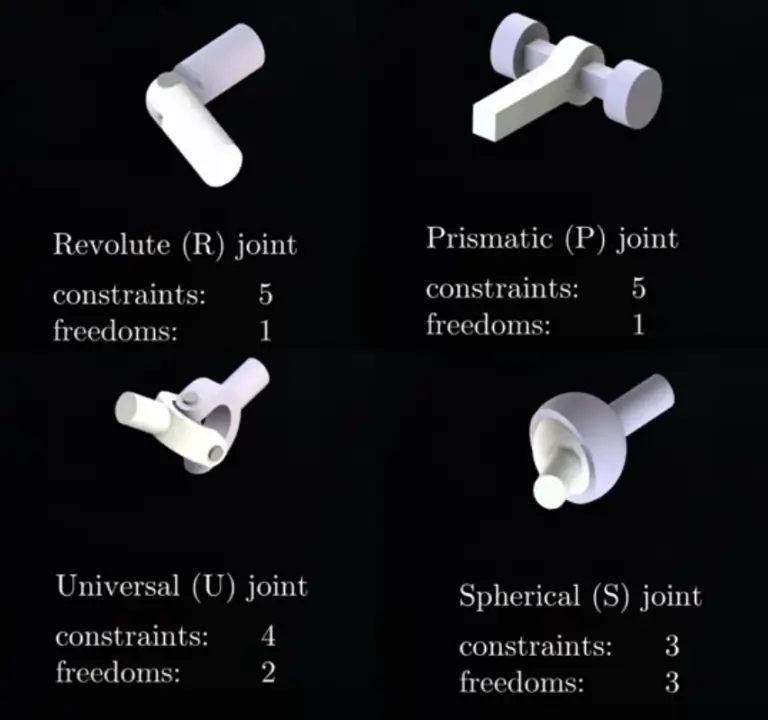
| A revolute joint provides one rotational degree of freedom.
| A prismatic joint provides one translational degree of freedom.
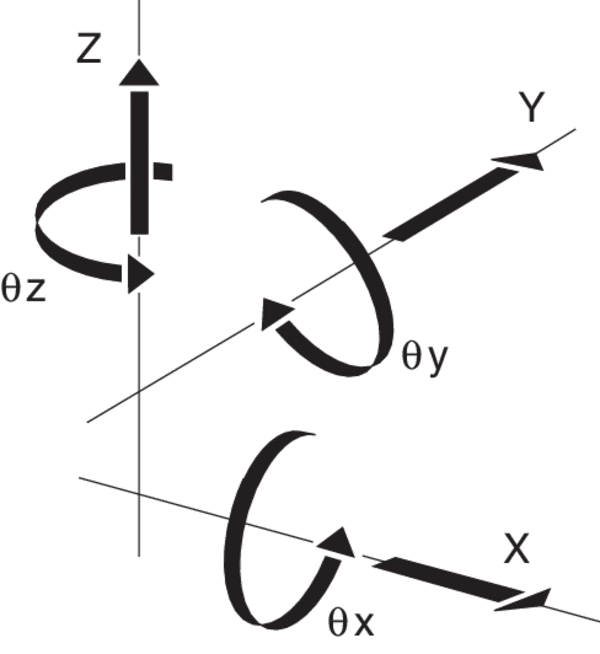
| A rigid body in three-dimensional space can have a maximum of 6 degrees of freedom: 3 for translation (moving along the X, Y, and Z axes) and 3 for rotation (around the X, Y, and Z axes).
For humanoid robots, this typically refers to the total number of independent rotational or translational movements that can be provided by the various joints in its kinematic chain (such as arms, legs, torso, head, and hands).
Common Types of Degrees of Freedom
| Rotational Degree of Freedom: Joints rotate around an axis, such as the elbow and shoulder joints in humans. This is the most common type of degree of freedom in robots.
| Translational Degree of Freedom: Joints slide linearly along an axis, which is relatively rare and mostly used in specially designed torso or finger joints.
| Spherical Degrees of Freedom: Allow rotation around three mutually perpendicular axes, effectively equivalent to three intersecting rotational joints, commonly seen in robotic shoulders or wrists.
Formula of Degree of Freedom for Robots
The formula of the degree of freedom for robots varies depending on the type of mechanism (planar mechanism or spatial mechanism). Below are the common formulas:
| Formula of Degree of Freedom for Planar Mechanisms
F = 3n – 2PL – PH
Where:
F represents the degrees of freedom of the planar mechanism.
n is the number of moving components (excluding the frame);
PL is the number of lower pairs (such as revolute pairs or prismatic pairs);
PH is the number of higher pairs (such as gear pairs or cam pairs).
| Formula of Degree of Freedom For Spatial Mechanisms
F = 6n – 5P5 – 4P4 – 3P3 – 2P2 – P1
Where:
F represents the degrees of freedom of the spatial mechanism;
n is the number of moving components (excluding the frame);
P1, P2, P3, P4, and P5 represent the number of 1-5 degree-of-freedom pairs, respectively. (For example, P1 represents the number of pairs with 1 degree of freedom, such as revolute pairs or prismatic pairs; P5 represents the number of pairs with 5 constraints, etc.)
Notes:
| The above formulas apply to open-chain mechanisms (such as serial robotic arms). For parallel mechanisms or hybrid mechanisms, the calculation of degrees of freedom is more complex due to the presence of closed-loop constraints, and higher-level theories or specific structural analyses may be required to determine the degrees of freedom.
| If a mechanism has redundant constraints (i.e., some constraints are not independent), the result obtained from the formulas may represent the lower bound of the degrees of freedom, while the actual DOF may exceed the value.
The Importance of The Degree of Freedom
| Motion Capability: The more degrees of freedom, the more refined the robot’s movements can be, approaching that of a human being. For example, a robotic arm with only 3 degrees of freedom can only reach certain points in space, making its movements relatively stiff. In contrast, a robotic arm with 6 or 7 degrees of freedom (mimicking a human arm: 3 at the shoulder, 1 at the elbow, 2 or 3 at the wrist) can more flexibly reach different points in space and manipulate objects in any orientation, resembling human dexterity.
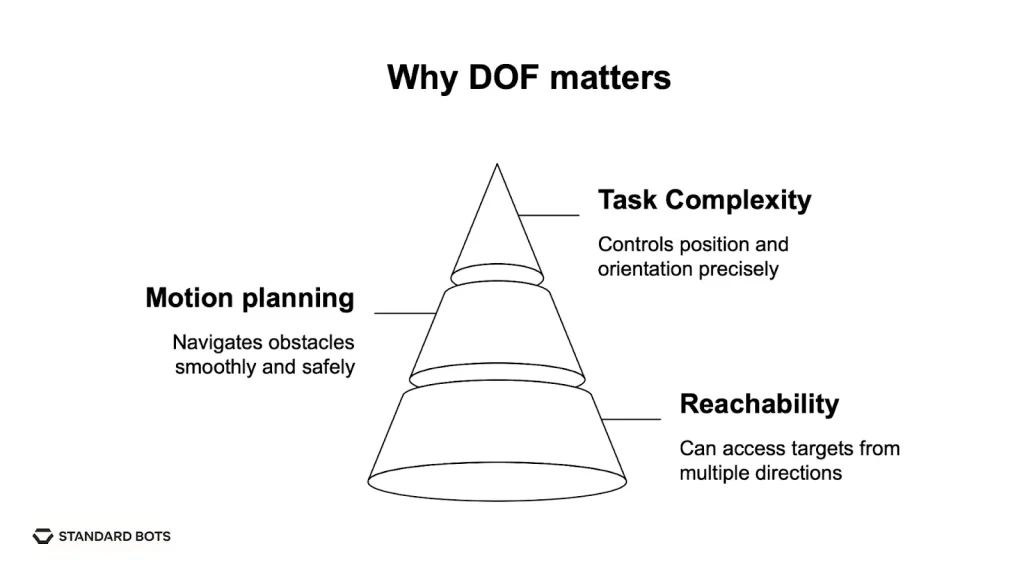
| Task Complexity: High degrees of freedom are essential for completing complex tasks, such as operating fine tools, navigating complex terrain, maintaining dynamic balance, and mimicking human actions.
| Balance and Stability: Bipedal walking requires coordination among the degrees of freedom of the legs, torso, and even arms to maintain dynamic balance. The more degrees of freedom, the theoretically greater the ability to adjust posture, although control also becomes more complex.
| Human-like Abilities: The number and distribution of DOF are one of the key factors determining whether a robot appears and moves like a human.
The Relationship Between Degrees of Freedom And The Motion Capabilities of Robots
The Number of DOF Dictates The Motion Space And Flexibility
| Degrees of Freedom < Required Dimensions: The robot cannot complete certain poses. For example, a SCARA robot with only 4 degrees of freedom (3 rotational + 1 translational) can usually rotate around the Z axis, but because of posture limitations, it cannot perform actions requiring rotation around a vertical axis, such as screwing.
| Degrees of Freedom = Required Dimensions: The robot may just be able to complete a specific task, but its flexibility is limited. For example, a 6-degree-of-freedom industrial robotic arm can, in theory, reach any position and posture within its workspace (satisfying the 6-dimensional requirements), but it may have difficulties near singular points or in constrained spaces.
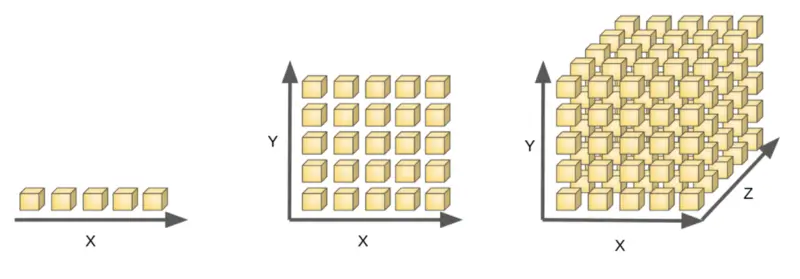
| Degrees of Freedom > Required Dimensions: The robot has redundant degrees of freedom, allowing it to complete primary tasks while optimizing other performance aspects, such as minimizing joint torque or mimicking human postures. For example, a 7-degree-of-freedom or more collaborative robot has redundancy, enabling more flexible movements.
The Distribution of DOF Determines Motion Patterns
The same total number of degrees of freedom using different types of joints and spatial arrangements results in entirely different motion capabilities for the robot:
| Serial Configuration: A 6-degree serial robot arm is common (RRR + RRR configuration) and can achieve any position and orientation in three-dimensional space with its end effector.
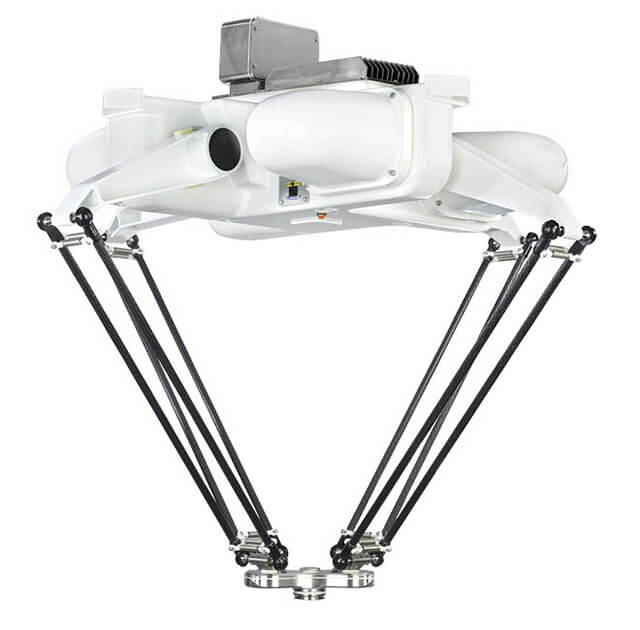
| Parallel Configuration: Delta parallel robots (3 or 6 degrees of freedom) also have 6 degrees of freedom, but all motors are mounted on the base, with the end platform driven concurrently by multiple support chains. This structure allows for rapid movement and high stiffness, but the working space is typically a truncated cone, and the end effector cannot perform a complete 360-degree rotation. Its motion patterns differ completely from those of serial robotic arms.
How The Degree of Freedom Helps Robots Accomplish Payload Movements
A complex movement by a robot can be decomposed into multiple levels, with degrees of freedom playing an indispensable role:
| End Effector Pose Control (Task Space): This requires controlling the position (x, y, z) and orientation (roll, pitch, yaw) of the end effector in three-dimensional space. A minimum of 6 independent degrees of freedom is needed for unconstrained position and orientation control.
| Coordinated Joint Motion (Joint Space): This requires coordinating the movement of multiple joint motors to achieve the desired trajectory of the end effector. Here, the number and type of degrees of freedom dictate the complexity of inverse kinematics (solving joint angles from the end effector’s pose) and the number of solutions. For redundant robots (with actual degrees of freedom exceeding the necessary degrees), inverse kinematics may have infinite solutions, requiring additional optimization goals (such as maintaining central joint positions or minimizing energy consumption) to select the optimal set of joint commands from countless solutions.
| Implementation of Specific Functions: If localization is needed, only 3 translational degrees of freedom are required to achieve positioning at any point in space. Here, the role of the mobile platform must be considered, as the total degrees of freedom of a mobile robotic arm = mobile platform degrees of freedom + robotic arm degrees of freedom. Thus, a low-degree-of-freedom robotic arm can still accomplish a wide range of complex tasks with the assistance of a mobile platform.
Factors Influencing Degrees of Freedom
The core components affecting a robot’s degrees of freedom are its joints and actuators. The degree of freedom is essentially determined by the quantity, type, and connection of units providing independent movement within the physical structure of the robot. Below is a detailed analysis of the main components and factors influencing degrees of freedom:
Joints
| Joint Types
Spherical Joint (S): Provides three rotational degrees of freedom (e.g., rotation around axes X, Y, Z). It is essentially equivalent to three intersecting rotational joints and is common in robotic shoulders or wrists (though in industry, three continuous rotational joints are often combined to approximate this).
Cylindrical Joint: Provides two degrees of freedom (one rotational + one translational).
| Number of Joints
The total degrees of freedom of a robot is typically equal to the sum of the number of its independent actuated joints (for serial robots). For example, a serial robotic arm with 6 independent rotational joints has 6 degrees of freedom.
Structural Configuration and Connection Modes
The way components are connected, or the robot’s configuration, determines whether the degree of freedom provided by these joints is independent, redundant, or how they can be combined.
| Serial Structure: Joints and links are connected end to end like a chain. The total free ends usually equal the simple sum of the degrees of freedom of each joint. The vast majority of robotic arms belong to this type. Calculations are simple, kinematics intuitive, but end errors can accumulate step by step.
| Parallel Structure: Multiple independent motion chains (support chains) simultaneously connect the end effector and base (e.g., Delta robots, Stewart platforms). In parallel structures, total degrees of freedom do not equal the simple sum of the support chain joint counts. For example, a classic 6-degree Stewart platform has multiple joints on each support chain, but the total degrees of freedom of the end platform are still 6. The DOF in parallel structures is usually fewer than their total joint number because many joint movements are coupled and non-independent. This structure has high stiffness, strong load capacity, and fast speeds, but a relatively small workspace.
| Hybrid Structure: A combination of serial and parallel structures. Its degrees of freedom are a combination of the degrees from both parts, making the analysis more complex. For example, installing a serial robotic arm on a parallel mobile platform.
Drive and Transmission Systems
Although they do not directly increase the degree of freedom, they are critical supporting components that determine the quality and performance limits of degrees of freedom.
| Actuators: Motors (servo motors, stepper motors) provide power to each joint. An independently controlled motor usually corresponds to one active degree of freedom.
Recommended In-depth Reading from AI Robots Eidos
Servo motors are the core components that enable robots to achieve precise, efficient, and flexible movements. Their performance directly affects the quality of work, production efficiency, and reliability of robots, making them one of the key factors driving the development and application of robot technology. If you would like to learn more about servo motors in robots, please read this in-depth article about robot servo motors.
| Transmission Mechanisms: Gearboxes (RV, harmonic, planetary gears): Convert the high-speed, low-torque output of the motor to the low-speed, high-torque required by the joints, essential for achieving precise motion. Screws/guides: Convert rotational motion to precise linear motion, which is fundamental to achieving translational degrees of freedom. Linkage mechanisms: Used for power transmission, sometimes changing the direction of the degrees of freedom movement or amplifying the stroke.
End Effector and Tools
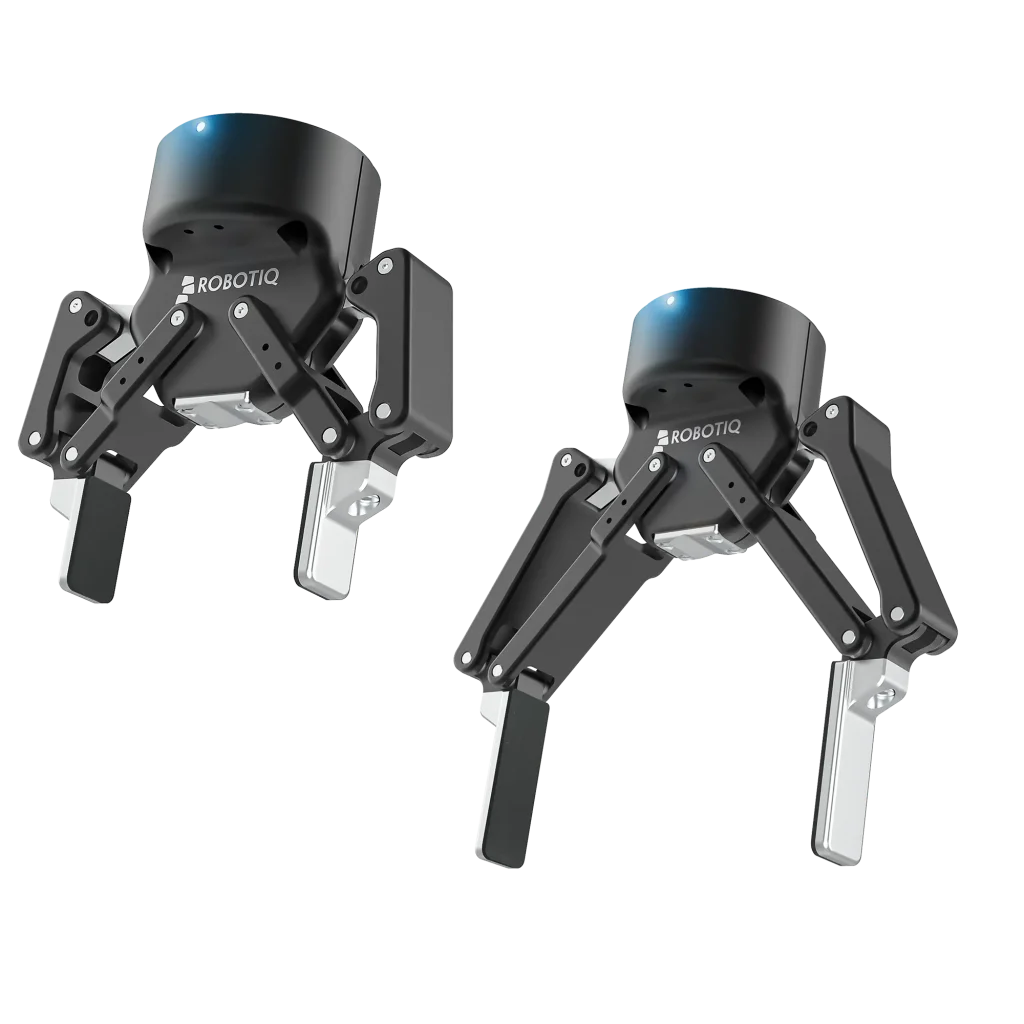
| Grippers: Typically only have an opening and closing action (1 degree of freedom), not changing the end pose, but still being an independently controlled degree of freedom.
| Dexterous Hands: May have several or even dozens of degrees of freedom, with multiple joints in each finger, capable of performing complex operations such as grasping, pinching, and twisting. In this case, the total degrees of freedom for the robotic system = robotic arm degrees of freedom + dexterous hand degrees of freedom.
Mobile Platform
For mobile robots (such as AGVs and mobile robotic arms), their mobility also contributes to the degree of freedom, termed mobile degrees of freedom. For instance, omnidirectional mobile platforms (like those using mecanum wheels or omni wheels) have 3 planar degrees of freedom (translation along X, Y, and rotation around Z), allowing them to translate and rotate in any direction.
Motion Control Algorithms
They are just hardware potential. To transform this potential into precise, smooth, intelligent motion actions, one must rely on kinematic modeling, trajectory planning, motion control algorithms (such as PID, force control), and sensor feedback. The “effectiveness” of degrees of freedom depends not only on quantity but also on the motion range, speed, precision, stiffness, and load capacity of each degree. A poorly designed high-degree system may be less practical than a well-crafted low-degree system. When designing and selecting robots, it is crucial to first analyze task requirements (how many position and orientation dimensions are needed) and then determine the minimum or optimal degree of freedom configuration that meets these needs.
Robot Degree of Freedom Examples
Industrial Robots:
| 3-axis CNC Machine (3 DOF): Can only perform precise 3D translational processing, with the tool orientation fixed.
| 4-axis SCARA Robot (4 DOF): Excels in high-speed planar pick and place and assembly, but the end pose is fixed or can only rotate around the vertical axis.
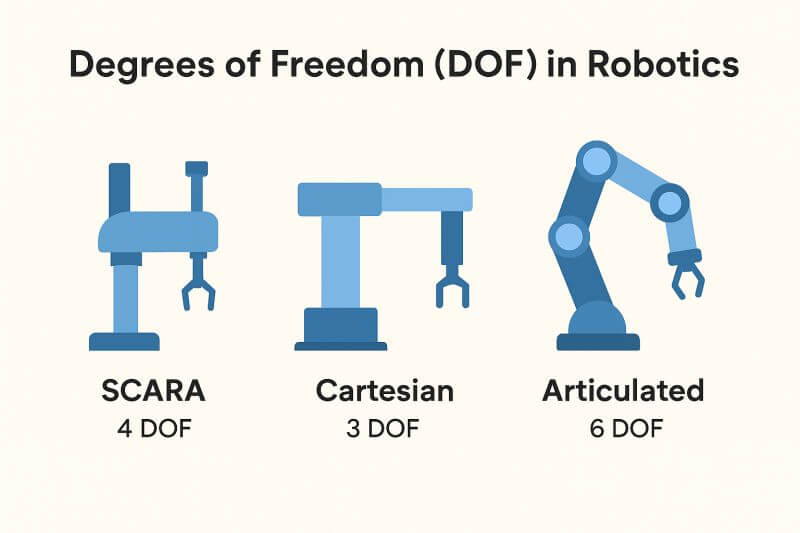
| 6-axis Industrial Robotic Arm (6 DOF): Highly versatile, capable of performing tasks requiring any posture, such as welding, spraying, and complex assembly.
| 7-axis Collaborative Robot (7 DOF): Adds a redundant joint at the “elbow” on the basis of 6 axes, allowing it to “maneuver around” obstacles or adjust elbow postures while keeping the end effector stationary, much like a human arm.
Humanoid Robots:
| Boston Dynamics Atlas: Has 28 DOF (hydraulic drive). This includes 7 DOF for each arm (3 at the shoulder, 1 at the elbow, 3 at the wrist) and 6 DOF for each leg (3 at the hip, 1 at the knee, 2 at the ankle), plus 3 DOF at the waist (pitch, roll, yaw).
| Honda ASIMO: Possesses 57 DOF (electric drive), with notably high degrees of freedom in its hands (13 DOF for each hand).
| Tesla Optimus: Public information indicates it has over 28 DOF (electric drive), with specific distribution not fully disclosed, but it emphasizes that there are 11 degrees of freedom in the hand (five-finger drive).
Are More Degrees of Freedom Always Better for Robots?
| As the number of DOF increases, the computational complexity of coordinating the movement of all joints to achieve the desired posture or trajectory grows exponentially, making control algorithms (such as inverse kinematics, dynamics, and balance control) extremely complex.
| Drive and Sensing: Each degree of freedom requires motors (actuators), gear reducers, position/force sensors, etc. Increasing degrees of freedom means more hardware, greater weight, and higher costs.
| Modeling and Energy Consumption: Developing accurate dynamic models and real-time simulations for high-degree robots is quite challenging, and actuating numerous joints demands a significant amount of energy.
Directions for the Development of The Degree of Freedom
| There is an awareness that more degrees of freedom in robots do not necessarily mean better performance. Modern robotics is shifting toward “completing more tasks with fewer degrees of freedom.” This involves not only simplifying hardware structure but also innovating control strategies. Perception of the surrounding environment is key to unlocking the potential of high-degree robots. Without environmental perception and real-time feedback, high-degree robots struggle to perform tasks effectively in complex environments. In the past, to address complex environments, robots often increased the number of joints to enhance flexibility. Now, more and more designs focus on efficiency driven by algorithms.
| With the development of methods such as imitation learning, reinforcement learning, and behavior cloning, robots can adapt to their environments and optimize execution of tasks without relying solely on high-degree structures. Algorithms empower robots with “decision-making capabilities,” enabling them to quickly filter the most cost-effective action paths in high-dimensional states. This reflects a new shift in design logic: moving away from pursuing “motion redundancy” as a safety net to making strategies smarter and structures cleaner.
| The transition from “structural redundancy” to “strategic redundancy,” from maximizing “motion ability” to maximizing “task efficiency,” illustrates a trend in modern robotics that emphasizes system collaboration and intelligent decision-making. Degrees of freedom are no longer just the rotational angles of a robotic arm but represent the free space between perception, understanding, and execution in intelligent systems.
Insight from AI Robots Eidos about The Degree of Freedom
The core competitiveness of future robots will no longer be the quantity of physical degrees of freedom but rather “functional degrees of freedom”—the ability of robots to perform diverse and adaptive tasks through software, algorithms, and perception systems, utilizing a limited number of physical degrees of freedom. A robotic arm with six degrees of freedom, when combined with visual servoing, force control, and AI task planning, may accomplish tasks with a complexity far exceeding that of a more physically flexible robotic arm that is programmed with fixed instructions. Future design priorities will shift from increasing joint count to enhancing the “intelligent utilization rate” of each joint.
Redundant degrees of freedom will be key to constructing predictable, interpretable, and human-expectant motion behaviors, fostering deep mutual trust in human-robot collaboration. In close human-robot collaboration, humans are not only concerned with whether robots can complete tasks, but also with “how” they are completed. Redundant degrees of freedom allow robots to choose a path among countless trajectories to complete a task, selecting one that aligns most with human movement intuition and is least likely to cause tension or misunderstanding (such as placing the “elbow” in a non-threatening position).
This means that the optimization goals for redundant degrees of freedom will expand from traditional energy minimization and short time frames to include social and psychological metrics, making robotic movements not only efficient but also “natural” and “friendly.”
Image Credits: Linearmotiontips & Linkedin & Standardbots & Freecodecamp & Automate & Robotiq & Engineersgarage