Robotics Servo Motors: Powering Motion
Table of Contents
The robotics servo motors play a crucial role among the many components in robotics. This article will delve into the important functions of servo motors in robotics.
What Is A Servo Motor
A servo motor, also known as an actuator motor, is a type of motor that can precisely control position, speed, and torque. It reacts quickly by receiving instruction signals sent from a controller and achieves closed-loop control through feedback from an encoder, converting the input voltage signal into angular displacement or angular velocity output on the motor shaft, thereby driving load devices to achieve the desired motion. Servo motors can achieve extremely high precision in movement requirements.
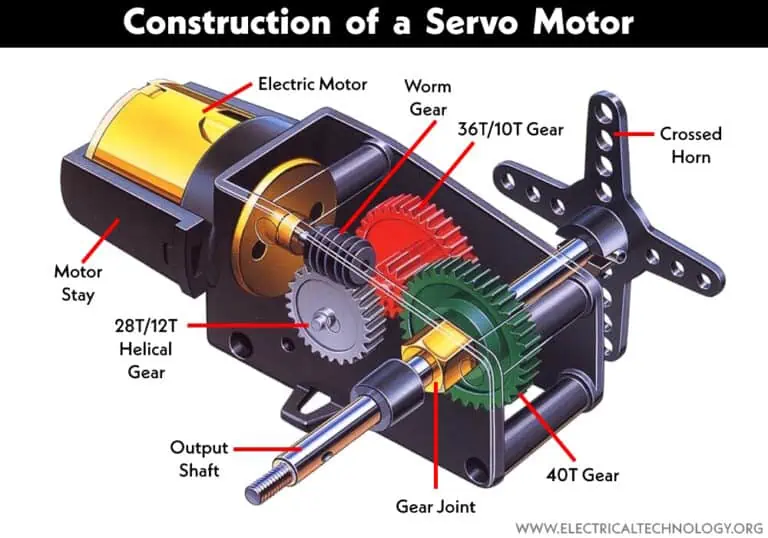
Due to their characteristics of high precision, high speed, and high reliability, servo motors are widely used in fields such as robotics and aerospace.
The Importance of Robotics Servo Motors
In the robotics industry, the role of robotics servo motors is particularly significant. Humanoid robots need to simulate human movements, including walking, running, grasping, and other complex actions, all of which rely on the precise drive of servo motors. By accurately controlling the rotation angle and speed of the robotics servo motors, the movements of the robot joints can be driven, enabling coordinated motion of all joints in humanoid robots to perform various complex actions.
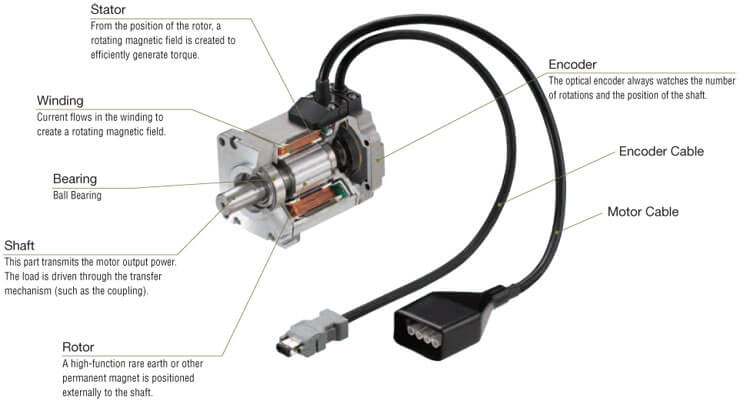
For robots, the performance of robotics servo motors directly determines the performance of robots :
| Precision: Whether the robotic arm can accurately move to target points at the millimeter or even micron level.
| Response Speed: Whether it can start and stop quickly, adapting to high-speed and high-frequency production cycles.
| Stability: Whether it can maintain smooth operation without shaking and losing steps under load and long-term operation.
| Torque Output: Whether it can provide enough “force” to grasp and transport workpieces.
Recommended Reading from AI Robots Eidos
Motors are a core component of robotics technology, and their performance and quality directly determine the overall performance, functionality, and application range of robots. They are one of the key factors driving the development and application of robotics technology. If you want to gain a deeper and more comprehensive understanding of the motors used in robots, please read this article.
Types of Robotics Servo Motors
Coreless Motor
Coreless motors, or hollow cup motors, are a specific type of permanent magnet robotics servo motor that feature significant advantages in compact size and lightweight, making them very adaptable to scenarios where space is limited and precise control and flexible movement are critically required, such as in robotic dexterous manipulator applications.
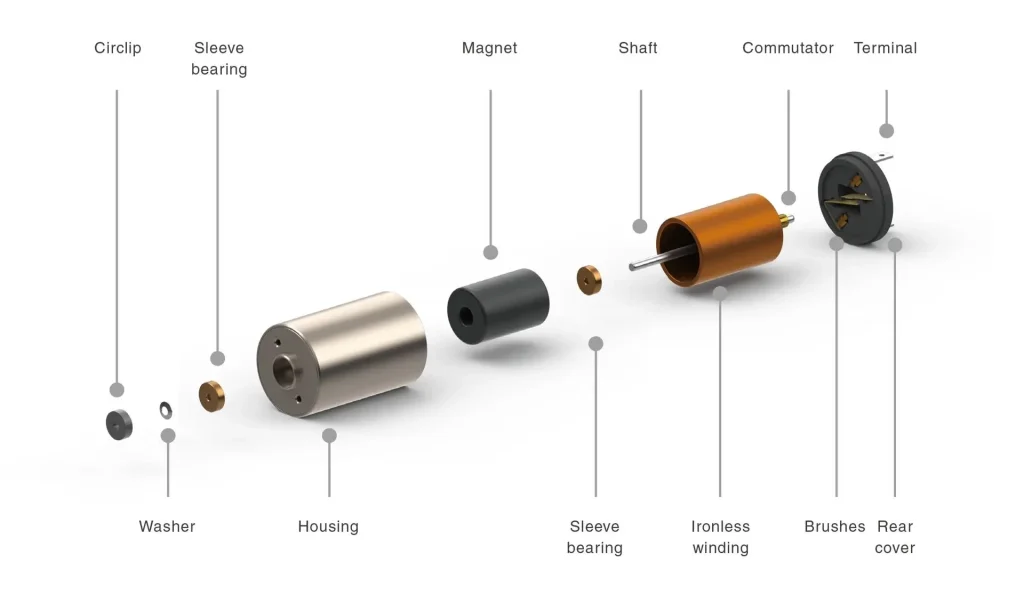
Coreless motors come in both brushed and brushless types, with the brushless products also lacking a rotor iron core; the armature is directly wound into a cup shape and supported by an armature bracket. Because the rotor of the coreless motor consists of an ironless cylindrical winding, its mass and inertia are small, and it does not experience iron losses or cogging torque. Thus, coreless motos boast low torque fluctuation, stable operation, high efficiency, and good dynamic responsiveness.
Frameless Torque Motor
Frameless torque motors are compact, lightweight, and high-performing, making them highly suitable for the structural needs of humanoid robots. They consist only of two core components: the rotor and stator, with no independent output shaft, dedicated bearings, or traditional end-cap structures. Integrated based on the concept of mechatronics with other components, they form integrated joint modules.
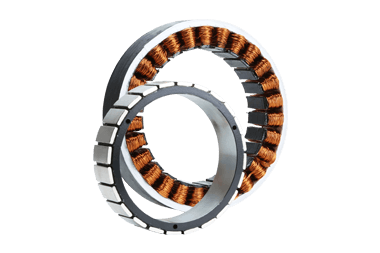
The rotor can be directly integrated with components such as joint output shafts and gearbox input sides, effectively shortening axial length, reducing weight, while enhancing torque density and response speed, capable of high-precision and high-torque output installed within joint link cavities.
Axial Flux Motors For Servo Applications
Axial flux motors for servo applications are high-performance robotics servo motors that combine axial flux motor technology with servo control functions, featuring unique structural and performance advantages.
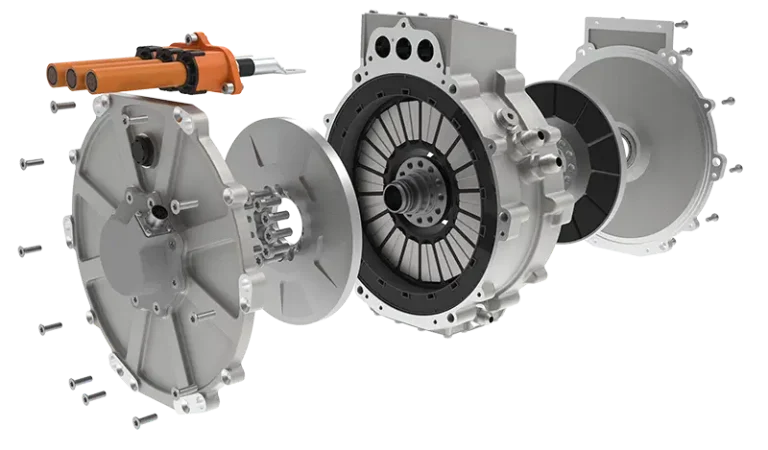
Common configurations for axial flux motors used in servo applications often adopt a dual-rotor single-stator (S-R-S) or dual-stator single-rotor (R-S-R) topology. This design allows for self-balancing of the axial magnetic force, reducing axial load on the bearings and improving operational stability. The stator typically employs a non-laminated design or segmented stator, while the rotor uses an array of permanent magnets to achieve high magnetic flux density and torque output.
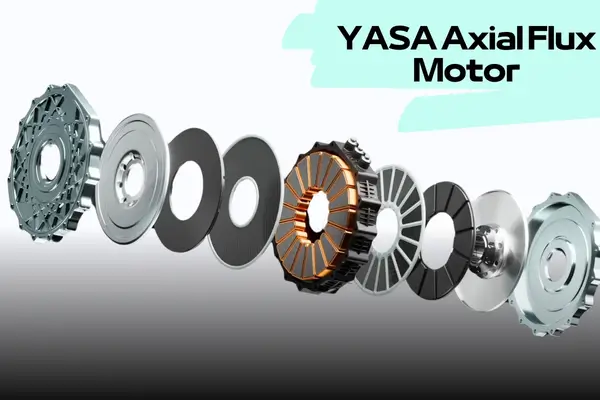
By integrating servo control technology, these motors can deliver quick responses and precise control over motor speed, position, and torque, featuring short response times and high positioning accuracy capable of meeting the stringent dynamic performance and precision requirements of servo systems.
Applications of Robotics Servo Motors
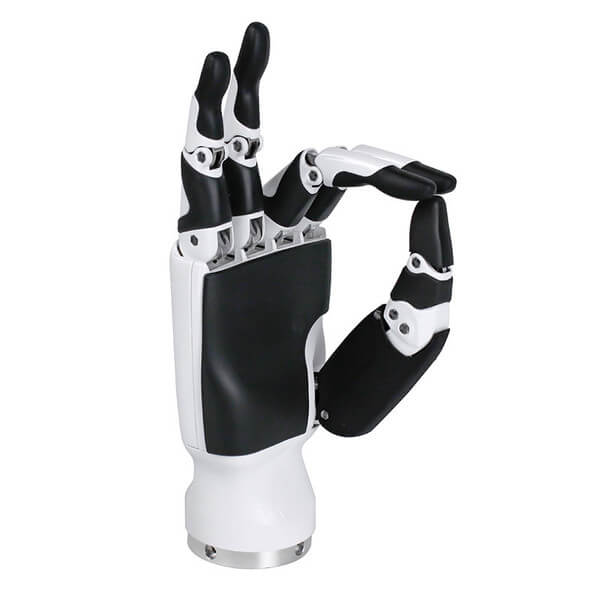
| Coreless Motors: Coreless motors boast advantages such as compact size, lightweight, high speed, high precision, and fast response. When combined with precision reduction mechanisms or harmonic reducers, they can enhance output torque, meeting the miniaturization and lightweight needs of dexterous manipulator motors while providing precise control of fingertip movements. These motors are core components of a humanoid robot’s dexterous hands.
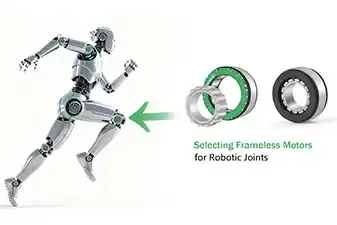
| Frameless Torque Motors: Frameless torque motors feature a compact size, high power, and high torque output at low speeds, making them a mainstream choice for humanoid robot joint drives. Compared to conventional motors, frameless torque motors align better with humanoid robot requirements. Their hollow design minimizes the space occupied by the motor, facilitating lighter robots. Additionally, they can deliver greater torque at low speeds and are unaffected by high-pressure or temperature environments, making them a superior option for joint drive motors in humanoid robots.
| Axial Flux Motors For Servo Applications: Humanoid robots have high-performance requirements for joint motors, necessitating high torque density, lightweight construction, and quick response capabilities.
| Leg Joints: Axial flux motors are primarily applied in leg joints (such as hips, knees, and ankles), which must withstand significant loads while achieving precise force control. For example, in Tesla’s humanoid robot, out of 28 joints, 12 in the lower limbs could utilize axial flux motors to reduce overall weight and improve dynamic performance.

| Waist Joints: Waist joints require multi-degree-of-freedom movement, with high torque and response speed demands on the motors. The flattened structure and high power density of axial flux motors can meet these requirements during actions such as pitching, lateral extension, and rotation, enhancing the overall movement flexibility of the robot.
Market Size of Robotics Servo Motors
| Coreless Motors: With mass production of humanoid robots expected to boost the coreless motor market, the upper limit of market size is projected to increase. According to the China Business Industry Research Institute, the global and Chinese markets for coreless motors are forecasted to reach approximately $870 million and $320 million in 2024, respectively, representing year-on-year growth of 7.41% and 10.34%.
| Frameless Torque Motors: Driven by the demand in the humanoid robot industry, the market size for frameless torque motors is on an upward trend. The global market for frameless torque motors was approximately $657 million in 2023. As the scale of humanoid robots scales up, demand will further increase. It’s projected that by 2030, the global market size for frameless torque motors will reach approximately $903 million, with a compound annual growth rate of 4.65% from 2023 to 2030.
| Axial Flux Motors For Servo Applications: Currently, publicly available data does not distinctly report the specific market size data for axial flux motors dedicated to servo applications. However, by analyzing the overall market size for axial flux motors and the robotics servo motor market, one can infer potential trends. According to QYResearch, the global market size for axial flux motors was approximately $142 million in 2023, with expectations for expansion to $14.48 billion by 2030. If axial flux motors gradually replace some traditional servo motors in the coming years, and their penetration rate rises from the current low level to a conservative estimate of 10%-20%, the market size could range from hundreds of millions to several billion dollars.
Insight from AI Eidos Robots about Robotics Servo Motors
| Algorithm: As motor hardware becomes standardized, performance differences will increasingly be defined by software algorithms. Adaptive control algorithms based on deep learning can enable the same motor to operate in different modes. In the future, a ‘motor application store’ may emerge, allowing developers to download different ‘performance configuration files’ for universal motor modules to achieve plug-and-play functionality.
| Green Servos: Future robotic servo motors may possess efficient bidirectional energy recovery capabilities. For instance, when humanoid robots lower heavy objects, the motor can function as a generator, returning kinetic energy to the bus capacitors or batteries, which is beneficial for extending battery life.
Image Credits: Electricaltechnology & Orientalmotor & Linengineering & Pranshu & Foxtech & Mosrac & AI