
Table of Contents
AGV charging is a critical link in ensuring the continuous operation of an AGV system. The choice of charging method needs to be comprehensively considered based on factors such as battery type and AGV operational efficiency.
Definition of AGV Charging
AGV charging refers to the process of replenishing energy for an Automated Guided Vehicle (AGV). An AGV is a battery-powered transport device that operates without manual driving and is widely used in logistics, manufacturing, warehousing, and other fields. As AGVs continuously consume electrical energy during operation, they require regular charging to maintain normal function.

Recommended In-depth Reading from AI Robots Eidos
AGV charging is not only the basis for maintaining operation, but also a key link in enhancing efficiency, reducing costs, ensuring safety, and achieving intelligent operations. It plays a decisive role in the widespread application of AGVs in the field of industrial automation. Readers interested in AGVs can read this in-depth article about Automated Guided Vehicles.
Types of Batteries Used in AGVs
| Lead-acid Batteries:
Characteristics: Mature technology, low cost, high safety, but low energy density, large volume, heavy weight, and long charging time.
Application: Suitable for AGVs that are cost-sensitive, have low range requirements, and operate in relatively simple environments, such as in small warehouses or simple logistics scenarios.
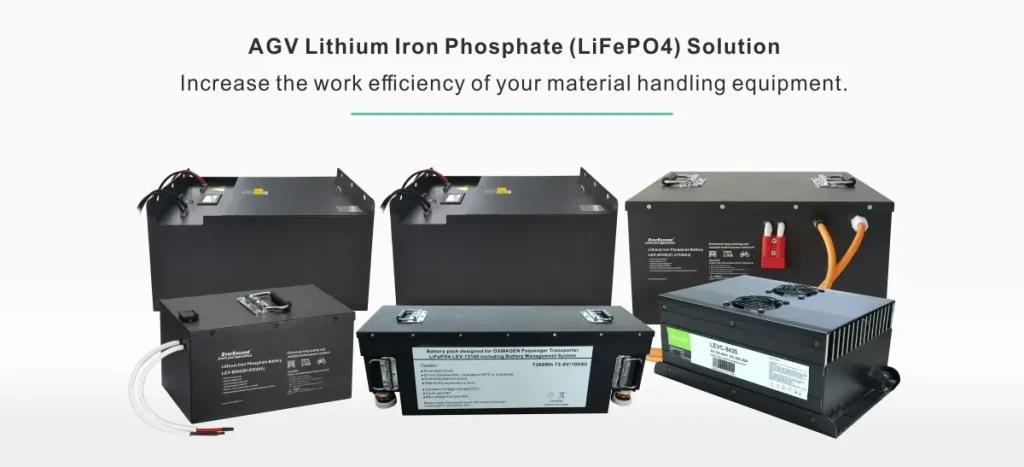
| Lithium Iron Phosphate Batteries:
Characteristics: High safety, long cycle life (up to 2000 cycles or more), good high-temperature performance, but relatively low energy density and poor low-temperature performance.
Application: Widely used in AGVs requiring high safety and operating in high-temperature environments, such as in industrial production and warehouse logistics.
| Nickel-Cadmium Batteries:
Characteristics: Low internal resistance, capable of high-current discharge, resistant to overcharge and over-discharge, but low energy density, memory effect, and significant environmental pollution.
Application: Due to environmental and performance limitations, they are currently less common in AGVs, primarily used in some special scenarios or older equipment.
Types of AGV Charging
| AGV Battery Charging
When an AGV has low power, the battery pack is replaced manually by dedicated personnel or by a robot. The AGV can be put back into service immediately after swapping. The removed battery pack is charged and kept as a spare. Its characteristic is simplicity and speed, but it requires dedicated supervision, needs twice the number of battery packs, and wastes manpower and financial resources. This method is often used in situations demanding high response times or when there is a shortage of AGV vehicles.
| AGV Manual Charging
When an AGV has low power, it is directed by the control center to a designated charging area. Dedicated personnel manually complete the electrical connection between the AGV and the charger for charging. After completion, personnel also disconnect the connection to restore the AGV to working status. Manual charging for AGVs is characterized by safety, reliability, and simplicity, but it reduces automation. It is often used in scenarios with lower automation requirements and standard work schedules.
| AGV Automatic Charging
Automatic charging is divided into two methods: automatic opportunity charging and automatic offline charging.
| Automatic Opportunity Charging: This involves the AGV automatically selecting to charge based on the production rhythm, usage intervals, and its operating system during its daily task execution. This method significantly increases utilization rates. Currently, especially with the use of lithium batteries, many customers choose this charging method. There are currently three main types of automatic opportunity charging:
Floor-mounted charging: Charging electrodes are placed facing downwards on the floor. The advantage is that it does not easily affect nearby assembly workers. The disadvantages include needing to dig trenches, lay cables, and make complex modifications; also, the brush plates can suffer severe deformation due to frequent vehicles running over them.
Side charging: Charging brush plates are installed on the side of the vehicle body. This method offers good flexibility. Disadvantages include severe wear of the brush contact surfaces due to frequent friction, and the exposed brush surfaces are prone to dust accumulation. These factors affect conductivity, cause heating, and pose safety risks.
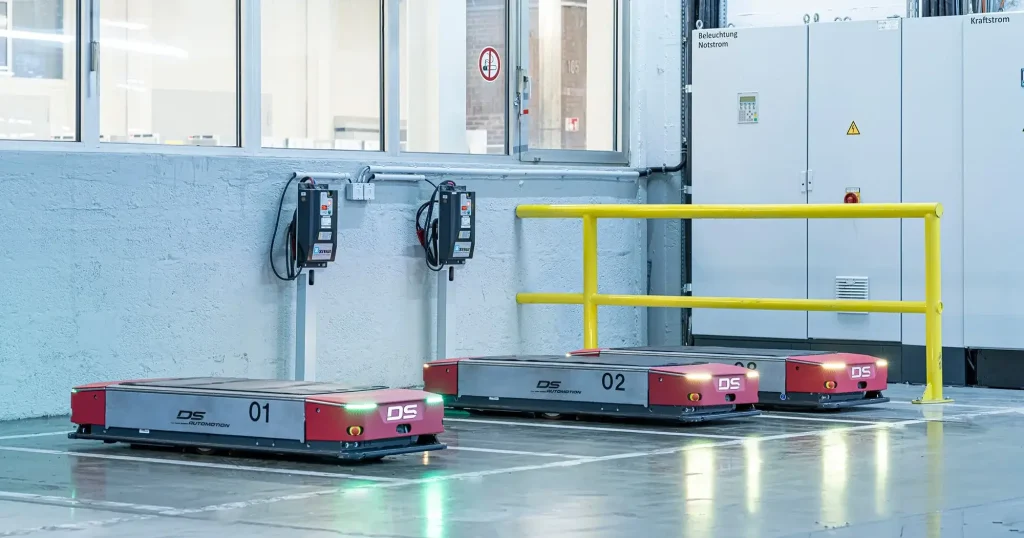
Charger with automatic retractable mechanism: The brush unit’s action is controlled via communication commands and sensors. AGVs can charge without electrical sparks during high-current charging, ensuring safety and preventing leakage. AGVs can charge whenever stopped (“opportunity charging”), efficiently utilizing fragmented time and greatly improving operational efficiency. This method also features easy installation, good coordination control, convenient troubleshooting, and high safety and reliability. It is gradually becoming the mainstream method for automatic opportunity charging.
| Automatic Offline Charging: This involves the AGV automatically choosing to charge until full during its standby time, either after completing its daily tasks or when there is a gap before new tasks. This method is more common in environments with a slower logistics work pace and lower workload.
| AGV Wireless Charging
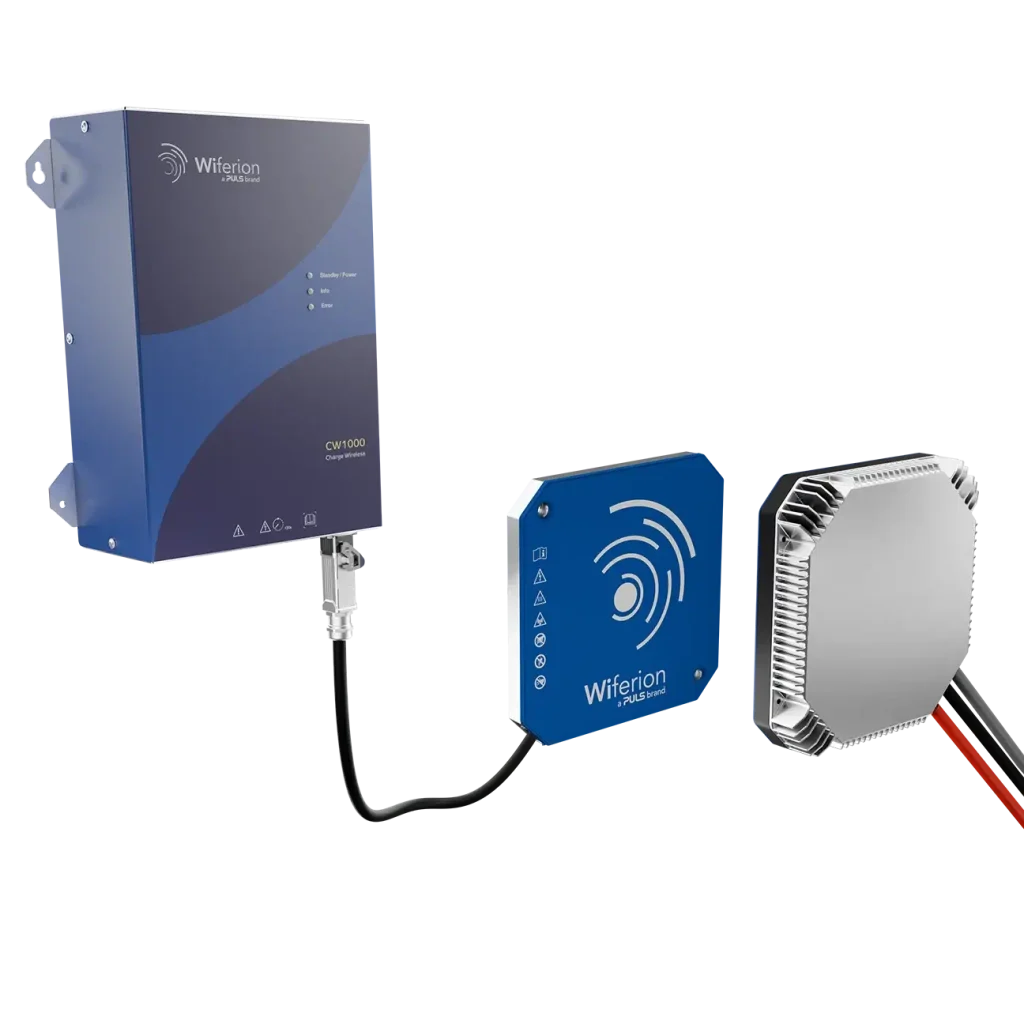
It is worth noting that as AGV intelligence levels increase, more and more wireless charging products are being applied in various types of small-scale AGVs. The biggest advantages of AGV wireless charging are the absence of exposed electrodes, making charging safer, and the need for precise alignment.
AGV wireless charging technology has moved from the concept verification phase to the initial stage of large-scale application. Its advantages are fully demonstrated in fields like smart warehousing and industrial inspection. However, limited by factors such as cost and standards, the overall application level still needs further improvement. In 2024, the global market share of AGV wireless charging did not exceed 10%, but its application scope is gradually expanding.
AGV Charging Process (Using AGV Automatic Charging as an Example)
The charging process for AGVs varies depending on the charging method. This article uses the automatic charging process as an example to introduce the AGV charging process:
| Battery Level Monitoring: The AGV’s built-in Battery Management System (BMS) continuously monitors the battery level. When the charge drops below a set threshold (e.g., 20%-30%), it triggers a charging request.
| Charging Station Selection: The AGV automatically selects the nearest or an available charging station based on a preset scheduling strategy. Some systems optimize the selection by considering factors like the charging station’s load and charging speed.
| Navigation to Charging Station: The AGV uses its navigation system (e.g., magnetic navigation, laser navigation, vision navigation) to automatically travel to the selected charging station location, ensuring precise stopping near the charging interface.
| Automatic Docking: The charging station is equipped with an automatic docking device. The AGV and charging station achieve automatic connection of the charging plug and socket through mechanical structures or electromagnetic induction, ensuring a reliable electrical connection.
| Charging Starts: After successful connection, the charging station automatically adjusts the charging voltage and current based on parameters such as the AGV battery type and charge status, and begins charging. During charging, the BMS continuously monitors parameters like battery voltage, current, and temperature to ensure charging safety.
| Charging Completion: When the battery reaches full charge or a preset charging time is reached, the charging station automatically stops the power output and disconnects from the AGV.
| Departing from Charging Station: After confirming that charging is complete and the charging interface is disconnected, the AGV automatically leaves the charging station and returns to the work area to continue its tasks.
Requirements for AGV Charging Stations
| Components of An AGV Charging Station
| AGV Charger: Converts AC power to DC power suitable for the AGV battery. It should have functions like overload protection, short-circuit protection, and leakage protection. A matching charger must be selected based on the AGV battery type and voltage.
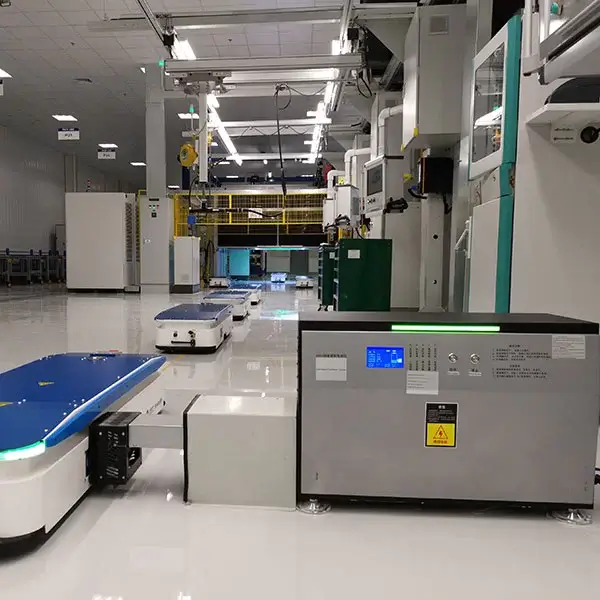
| Charging Pile: Fixed to the ground, providing the charging interface and mechanical support. The structure must be stable. The enclosure protection rating is generally required to be IP54 or higher, with some scenarios requiring IP65.
| Control System: Includes the Charging Management System and the Battery Management System (BMS). It monitors charging current, voltage, and battery status in real time, automatically adjusts charging parameters, and implements features such as overcharge protection, temperature monitoring, fault self-diagnosis, and alarms.
| Location Requirements For AGV Charging Stations
| Site Selection: Avoid high-temperature, humid, and densely populated work areas. It should not be located within vehicle or battery maintenance areas. In logistics buildings, it is preferable to arrange it near an exterior wall for easy ventilation and emergency handling. The net height of the charging area should not be less than 5m, and the safety distance from other areas should not be less than 5m.
| Environmental Requirements: Temperature range -10°C to 40°C, humidity 10% to 95% non-condensing. Maintain good ventilation; if natural ventilation is insufficient, mechanical ventilation is required, with an air change rate of not less than 8 times per hour. The floor should use fire-resistant materials. Doors, windows, and walls should use acid- and alkali-resistant materials or protective coatings.
| Maintenance and Management: Regularly inspect the connecting lines, charging modules, safety protection devices, etc., of the charging equipment. Timely replacement of aged or damaged parts. Clean dust from the surface of charging equipment to ensure good heat dissipation and prevent performance degradation due to overheating.
Requirements For AGV Charging
| Choose Charging Timing Wisely: Over-discharging lithium batteries used in AGVs can significantly damage battery life. It is generally recommended to schedule charging when the AGV battery has 20% – 30% remaining to avoid deep discharge. At the same time, avoid charging frequently when the battery level is still high. Maintaining a reasonable charge-discharge cycle is more conducive to the long-term health of the battery.
| Control the Charging Environment: The charging environment significantly impacts the performance and lifespan of AGV batteries. The suitable charging temperature is between 20°C and 30°C. Charging in high-temperature environments accelerates internal chemical reactions, potentially leading to increased heat generation and accelerated capacity degradation. Low-temperature environments reduce battery activity, affecting charging efficiency and battery performance. Therefore, try to charge AGVs in a cool, dry, and well-ventilated environment, avoiding direct sunlight and dampness.
| Avoid Overcharging: Overcharging is the “silent killer” of batteries. Although most modern AGV charging systems have overcharge protection, connecting the charger for extended periods can still cause some damage to the battery. When the AGV indicates the battery is full, the charging connection should be disconnected promptly to avoid keeping the battery in a prolonged float charge state. This is particularly important for lithium batteries, which typically use CC/CV (Constant Current/Constant Voltage) charging. After fully charged, the charging circuit should be cut off, and lithium batteries should not be kept on a float charge.
Precautions For AGV Charging
| Regularly Inspect Charging Equipment: It is crucial to regularly inspect equipment such as charging piles and charging cables. Check if the indicator lights on the charging pile are normal and if there is any abnormal heating or odor. Inspect charging cables for damage or aging. If any problems are found, immediately stop using the equipment and perform repairs or replacements to prevent safety accidents caused by charging equipment failure.
| Standardize Operating Procedures: Whether manual or automatic charging, strictly adhere to operating procedures. For manual charging, always turn off the AGV power supply before connecting the charging cable. For automatic charging, ensure the AGV travels accurately to the designated charging area to avoid damaging the charging interface or causing poor contact due to docking misalignment. Additionally, it is strictly forbidden to stack flammable or explosive items in the charging area; keep the area clean and unobstructed.
| Prepare for Emergency Response: Necessary firefighting equipment, such as fire extinguishers, should be provided in the charging area, and relevant personnel should be familiar with how to use them. Develop a comprehensive emergency plan for charging safety so that in case of an emergency, actions can be taken quickly and effectively to minimize losses.
Future Development Directions of AGV Charging Technology
| High-Power Charging: Continuously increasing power. As AGV application scenarios demand higher efficiency, high-power charging technology will continuously break through power limits, advancing from the current hundreds of kilowatts towards the megawatt level. This will enable faster energy replenishment, shorten AGV charging waiting times, and improve equipment utilization.
| Energy Storage Charging: For example, photovoltaic-storage-charging integration. Energy storage charging stations will be deeply integrated with renewable energy sources like photovoltaic power and wind energy, forming an integrated “PV-storage-charging” system. By storing energy during off-peak hours using energy storage devices and releasing it during peak hours, self-sufficiency and optimal allocation of energy can be achieved, reducing operating costs and dependence on the power grid.
| Standardization of Charging Interfaces and Components: Main components of the charging device should adopt a modular design, allowing for easy capacity expansion and significantly shortening maintenance and repair time. Charging connectors need to transmit larger currents in smaller sizes while ensuring safe and reliable connections. A single charging device should be able to connect to multiple docking stations, enabling simultaneous charging of multiple mobile robots. This offers a flexible combination and more efficient use of space.
| Integration of Energy Management System (EMS) with Upper-Level Scheduling Systems (WMS/MES): The EMS exchanges real-time data on AGV battery levels, charging progress, and battery health with the WMS/MES. This allows the scheduling system to dynamically adjust task allocation and path planning based on actual battery levels, avoiding task interruptions due to low power. Simultaneously, the WMS/MES, based on order requirements and production plans combined with AGV battery status, intelligently arranges charging times and locations. This achieves seamless integration of task execution and charging, improving overall operational efficiency.
Insight from AI Robots Eidos about AGV Charging
| With the deep integration of Energy Management Systems (EMS) with Warehouse Management Systems (WMS) and Manufacturing Execution Systems (MES), the timing of AGV (Automated Guided Vehicle) charging will no longer be triggered simply by the “remaining battery threshold.” Instead, it will be dynamically determined by production schedules. The system will proactively arrange for AGVs to undergo “strategic charging” based on future order volumes, task urgency, and traffic congestion forecasts, maximizing the utilization of low electricity prices and operational downtime while ensuring that tasks are not interrupted.
| As charging interfaces, communication protocols, and battery modules become standardized, independent “AGV charging service operators” may emerge in the future. Factories will no longer need to purchase charging equipment and maintain batteries; instead, they will pay for charging based on usage or battery swaps, similar to renting shared power banks. This model will significantly lower the initial investment threshold for AGV systems, driving their adoption in small and medium-sized enterprises.
Image Credits: Wiferion & Engineerlive & Everexceed & Ds-automotion & Evaisun
Other Articles on The Topic of AGVs
Level A (Foundational )