AI World Models: Cognitive Bridge
Table of Contents
AI World Models are the critical bridge that moves AI from “perceptual intelligence” to “cognitive intelligence,” giving AI the ability to predict “what the world will become after performing an action.” They are the key technological foundation that moves AI from “passive response” to “active planning,” driving the deep integration of AI with the real physical world and the realization of Artificial General Intelligence (AGI).
What Is A World Model in AI?
The core idea of world models can be traced back to cognitive science. From birth, humans continuously perceive the world through vision, touch, and hearing, gradually building an implicit rule base of the world in their brains. This internalized cognitive model is the human “world model.”
World models in AI are inspired by this human cognitive logic. AI should not be merely a conditioned reflex; it should establish an internal model capable of simulating environmental dynamics to predict the consequences of actions.
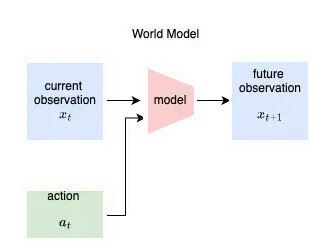
–Narrow definition of world model: refers to a compressed representation of the system’s internal environmental dynamic evolution. It predicts future state changes based on the current state and the action to be taken. It can be colloquially understood as a “realistic physics engine” trained from data.
–Broad definition of world model: refers to AI’s overall understanding of the operating rules of the real world (physical laws, causal relationships, common-sense reasoning). The current industry enthusiasm largely points to this broader definition.
| Dimension | Large Language Model (LLM) | VLA Model | World Model |
| Core Task | Text‑to‑text | Vision + language → action | State + action → predict future state |
| Core Capability | Linguistic logic and co‑occurrence statistics | End‑to‑end perception‑action loop | Simulation of physical laws |
| Analogy to the Human Brain | Language center | Cerebellum and motor control | Prefrontal cortex (reasoning and planning area) |
| Shortcomings | Does not understand physics; relies on predicting the “next word”; prone to logical hallucinations | Lacks explicit physical reasoning; heavily dependent on data distribution; prone to failure in unseen scenarios | Long‑sequence prediction suffers from error accumulation; prone to generating “physical hallucinations” that violate common physical sense |
As shown in the comparative chart, LLMs understand language but do not understand the world; VLAs understand images but do not understand change; world models can comprehend a dynamic, rule‑based, and inferable real world.
Recommended Related Reading from AI Robots Eidos
Readers should not misinterpret this comparison table as suggesting that world models and VLA models are substitutes for each other. In fact, they are complementary and integrative.
VLA enables robots to “take action,” while world models enable robots to “think” and “predict.” The combination of the two allows robots to not only understand complex semantics and scenes but also comprehend the laws of the physical world, thereby achieving more robust and generalizable robotic capabilities.
This article primarily focuses on world models. If readers wish to learn more about VLA models, please refer to the article on VLA models.
Levels of AI World Models
–Level 4: Perfect World Model – a fully accurate physical simulation that can predict everything at any granularity (currently non‑existent, and may never be achievable).
–Level 3: Generative World Model – visually realistic but physically imprecise (e.g., Sora, Genie 2), capable of relatively long‑term future prediction.
–Level 2: Latent‑Space World Model – learns dynamics in a compressed representation (e.g., Dreamer), suitable for planning and decision‑making within specific task domains.
–Level 1: Statistical Association Model – the most basic pattern recognition, learning correlations rather than causation, e.g., “if A happens, B may happen” but without understanding why.
The Importance of World Models
Given the broad significance of world models, this section, written by AI Robots Eidos, discusses their important value mainly from the perspective of robotics. Readers should keep this in mind.
–Internal pre‑play and low‑cost trial and error: World models enable robots to predict the consequences of actions in their “mind,” shifting high‑cost, high‑risk physical trial‑and‑error to internal virtual rehearsals, greatly improving sample efficiency and safety.
–Understanding physical laws: World models go beyond pure visual recognition; they allow robots to internalize physical laws such as gravity, collision, and friction, so they truly understand what physical changes will occur in the environment after performing an action.
–Forward‑looking planning and autonomous decision‑making: By building a computable representation of environmental dynamics, object relationships, and constraint boundaries, robots can simulate outcomes of different action plans, evaluate costs and risks, and thus plan optimal action strategies in advance. Multi‑step future prediction upgrades robots from passive behavioral responses to active prediction of action outcomes.
–Handling long‑tail scenarios and generalization: Relying on an understanding of causal logic rather than just training data, robots can confidently cope with complex, varied, and unseen emergencies in the real physical world.
Drivers of AI World Models
–Model evolution: With the development of large language models (LLMs), their functions are gradually converging, and the industry needs new developments and new model types. World models, which involve 3-Dimensional environmental reasoning and physical modeling, are becoming the direction for AI to move from the digital world to the physical world.
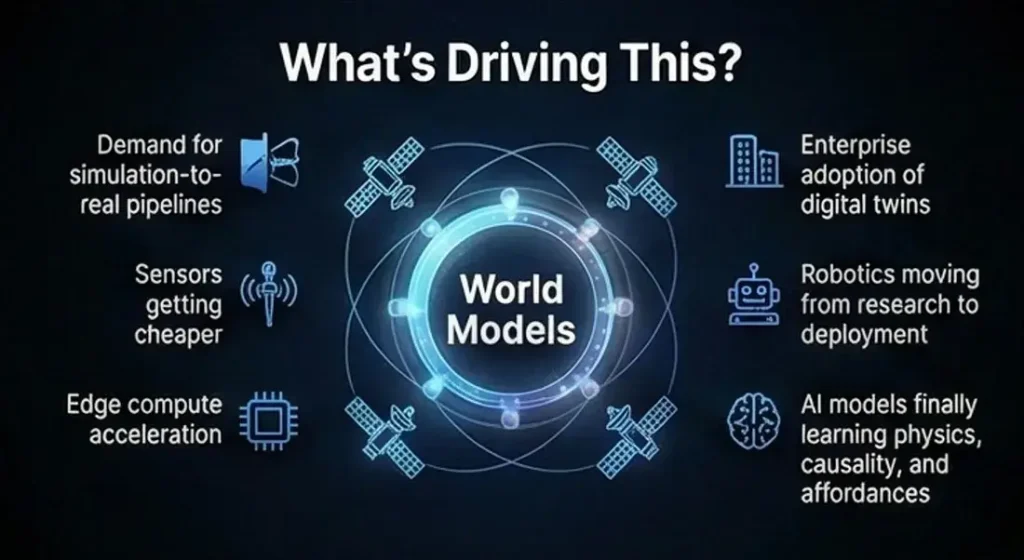
–Technological development: Embodied intelligence, especially humanoid robots, is shifting toward “end‑to‑end” technical architectures. When perception, prediction, and planning are integrated into a single neural network, the system urgently needs a “cognitive base” that understands global physical laws to support decision‑making. World models are emerging as a technological choice.
–Industrial impetus: The development of the humanoid robot industry hopes to enable AI robots to truly integrate into the real world. This cannot be done solely through data training; it requires a model that can infer physical consequences. Moreover, the AI industry commonly faces the problem that extreme‑scenario real data is too scarce and expensive. World models can generate infinite extreme scenarios in virtual worlds, allowing AI to learn at low cost.
–Milestone events: The release of video generation models like Sora, with their ability to predict future frames, made the industry suddenly realize that through massive video data, AI can indeed implicitly learn physical laws such as gravity, collision, and occlusion.
–Entry of top AI scientists: Many leading AI scientists have devoted themselves to world models, establishing the academic and industrial status of AI World Models. For example, Turing Award winner Yann LeCun founded AMI Labs, Fei‑Fei Li founded World Labs focusing on “spatial intelligence,” and DeepMind’s Demis Hassabis created Genie.
Introduction to the Three Technical Routes of World Models
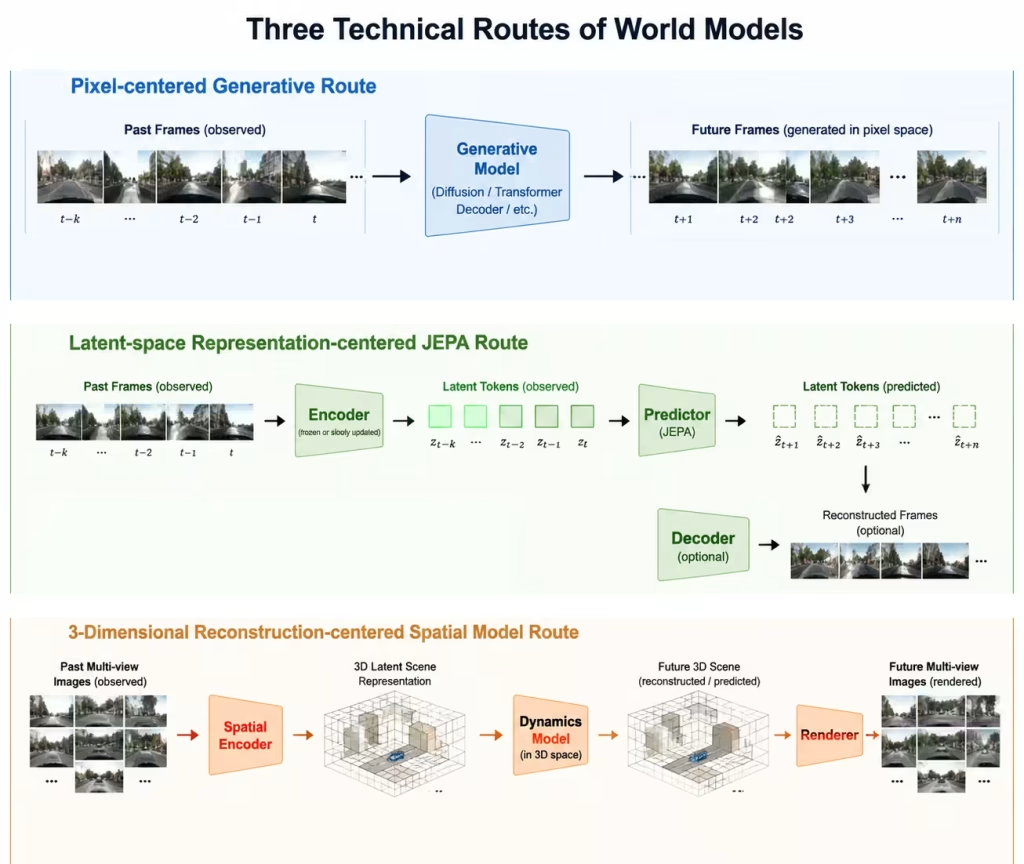
Pixel‑centered Generative Route
–Overview: This mainly uses AIGC video generation techniques to predict and generate pixel data that can depict the operating rules of the real physical world. Computer scientists believe that if a model can generate videos that are indistinguishable from reality, then it understands the real physical world.
–Representatives: OpenAI’s Sora, NVIDIA’s Cosmos, Dreamzero, ByteDance’s Sendance, etc.
Latent‑space Representation‑centered JEPA Route
–Overview: JEPA stands for Joint‑Embedding Predictive Architecture. It embeds training data (including vision, instructions, robot parameters, etc.) into a latent representation space, and then predicts causal changes in physical rules within that space, enabling the model to truly recognize the rules of the physical world. JEPA has been applied to video data representation prediction (V‑JEPA) and robot control representation prediction (VLA‑JEPA).
Of course, representing the physical world in latent space presents greater difficulties than pixel representation, such as representation collapse. Recent advances, such as the LE‑JEPA (Latent Eulerian JEPA) technique, address JEPA’s collapse problem.
–Representative: Yann LeCun’s Advanced Machine Intelligence (AMI) lab.
3-Dimensional Reconstruction‑centered Spatial Model Route
–Overview: This route equips machines with a persistent and accurate spatial physical model, giving them “depth” and “perception.”
It focuses on modeling objects and their spatial relationships in the physical world. The machine must understand three core elements: where objects are (precise 3D positions), how they move (dynamic physical trajectories), and what affordances they offer (e.g., a chair can be sat on). Such a 3-Dimensional spatial world model endows robots with spatial intelligence.
–Representative: The Marble model from Fei‑Fei Li’s World Labs.
Analysis of the Three Technical Routes
Pixel‑centered Generative Route
–Advantages: Mature technology; with massive video training data collected from the internet and tasks, combined with mature techniques like diffusion models, it can generate highly realistic cyber‑physical worlds with sufficient compute.
–Disadvantages: Requires enormous compute, and the generative route is always plagued by hallucination problems. It is essentially an upgrade of multimodal large models. In embodied task operations, this route is not aimed at “mastering real physical rules to guide robot manipulation.” Its core task is “generating realistic videos,” with robot control instructions produced as a by‑product. Therefore, this route is more suitable for content generation and less applicable to embodied intelligence scenarios like robot manipulation.
Latent‑space Representation‑centered JEPA Route
–Advantages: Very clear benefits—by using latent feature representations, it requires very little compute, memory, and training data to represent physical world rules.
–Disadvantages: Technological maturity is not extremely high. The accuracy and precision of latent space representations still need improvement. The JEPA route’s representation of physical reality is still primarily based on video data; in essence, it transforms the generative diffusion approach into a content‑reconstruction one. Currently, JEPA is mainly applicable to simple embodied control scenarios (e.g., VLA‑JEPA). Whether the JEPA route can achieve a true world model remains an open question.
3-Dimensional reconstruction‑centered spatial model route
–Advantages: Mature technology and the most practical industrial applications. For example, Fei‑Fei Li’s Marble model generates editable 3D virtual environments from text, photos, videos, etc. Its architecture is based on Real‑Time Frame Model (RTFM), uses a hybrid implicit‑explicit representation, and leverages Gaussian splatting for real‑time multi‑view rendering, with object permanence capability. The system provides AI editing tools for local object removal, inpainting, global visual style replacement, and structural reconfiguration. Such world models are well‑suited for visual effects and robot training simulations.
–Disadvantages: This route also aims to “generate realistic 3D cyber worlds,” but it mainly provides an “interactive cyber model space” for humans. Its purpose is not to directly reconstruct the operating rules of the physical world. Such models cannot be directly applied to physical interaction control in embodied intelligence; they only provide virtual training environments for other models.
Fusion of The Three Technical Routes
The three routes are not unrelated. In future development, they may integrate and collaborate. For example, 3-Dimensional reconstructed world models can provide training scenarios and data for pixel‑centered generative world models. Latent‑space JEPA‑based world models can also use data from the other two routes for latent representation learning.
Major Global AI World Models
–Tesla Neural World Model: Core base for FSD and Optimus humanoid robots. Real‑time input from 8 vehicle cameras predicts the dynamics of all vehicles and pedestrians on the road for the next few seconds. Virtual simulations complete millions of extreme road condition trainings, significantly reducing real‑world testing costs, simultaneously driving FSD iteration and Optimus training.
–NVIDIA World Model: The world’s first fully open multimodal model, using a Reasoner + Generator dual‑tower architecture. NVIDIA Cosmos is trained on 20 million hours of real‑world data, with Nano and Super versions open‑source and commercially available, specifically generating long‑tail scenarios like extreme weather, sensor failures, and unusual obstacles, serving automakers, industrial robots, and simulation platforms.
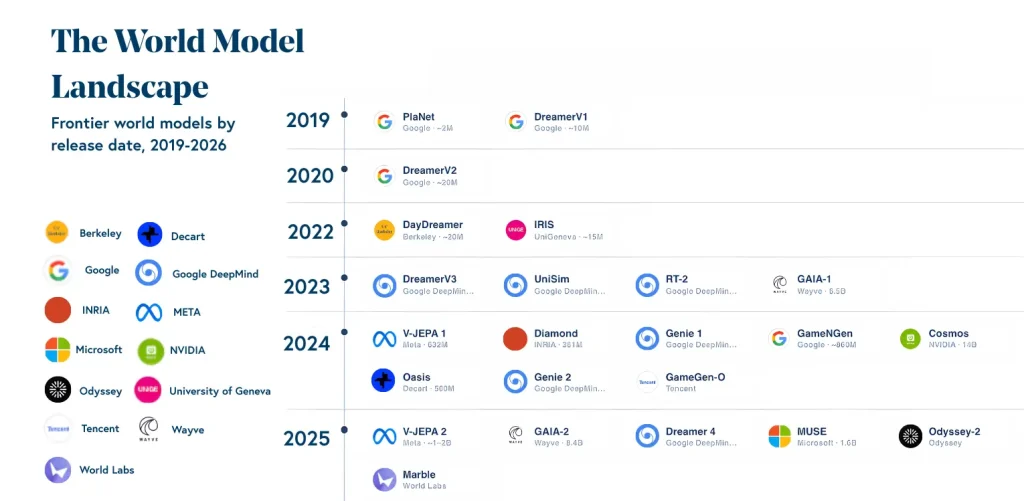
–Waymo World Model: Adapted from Google’s Genie 3 for autonomous driving simulation, generating city‑wide dynamic traffic flows and pedestrian interactions.
–Google DeepMind Genie 3: An interactive video world model that generates controllable dynamic scenes from text/image inputs, allowing users to control object movements in real time. Real‑time interaction reaches 720p/24fps and has been used for SIMA agent validation.
–OpenAI Sora: A video‑generation world model excelling in long‑sequence, multi‑object interactive videos, but with physical accuracy weaker than dedicated physical simulators.
–Meta V‑JEPA: Does not generate pixel frames; focuses on abstract and latent space prediction. Pre‑trained on 1 million hours of video and fine‑tuned on 62 hours of robot data. It follows LeCun’s promoted AGI route, being lightweight and data‑efficient, suitable for on‑device robot deployment.
Applications of AI World Models
–Autonomous Driving: Wayve GAIA and Waymo World Model actively generate corner cases to address long‑tail distributions; Drive‑WM provides counterfactual reasoning for accident reconstruction evidence chains; simulates multi‑agent interactions to solve urban NOA hesitation/stagnation issues.

–Humanoid Robots: For example, Agility Robotics’ Digit performs thousands of fall tests in Isaac Lab, using domain randomization and high‑fidelity dynamics modeling. NVIDIA’s Newton platform breaks through fine manipulation bottlenecks by encoding physical properties like center of gravity, friction, and inertia. NVIDIA Isaac GR00T N1 uses counterfactual reasoning to pre‑play action sequences and assess risks.
–Video Generation: OpenAI Sora automatically extracts key variables like gravity and fluids, replacing manual rule setting to achieve physical realism. Meta V‑JEPA 2 (via block causal attention) and Genie 3 (via visual memory modules) address long‑term temporal consistency issues.
Insight from AI Robots Eidos about AI World Models
—Simply stacking parameters and data can no longer break through the “cognitive ceiling.” The future of AI competition will no longer be about who has the larger model, but about who better understands fundamental physical common sense—such as how water flows. Whoever conquers this challenge first will hold the ticket to AGI (Artificial General Intelligence).
—The future world model will not merely be an observer, but a simulator endowed with “imagination.” This imagination, grounded in physical constraints, will allow AI to simulate thousands or even millions of possibilities in its mind. Such “zero-cost imagination” will unlock immense productivity.
—In the future, technological paradigms may converge based on cognitive division of labor: generative models handle realistic surface rendering (for human-computer interaction), JEPA handles abstract causal reasoning (for the decision-making brain), and 3-Dimensioanl reconstruction handles precise spatial anchoring (for physical execution). The three, working in synergy through a “cognitive bus,” represent the optimal solution for real-world deployment.
Image Source: Github & Bvp & Substack & AI & Medium