Vision Language Models Explained: The Essential Guide
Table of Contents
A Vision Language Model (VLM) is a type of large multimodal model whose core lies in enabling AI to both “see images” and “explain images in language.” This capability is the cornerstone of advanced reasoning, and its emergence has provided stronger technical support for many real-world applications.
What is a Vision Language Model?
Traditional computer vision (CV) models can recognize that there is a bag in an image, but cannot describe the bag’s characteristics using natural language. Meanwhile, natural language processing (NLP) models can understand the meaning of the word “bag” but have no idea what a real bag looks like. This disconnect leads to a serious problem: machines cannot establish semantic correspondences between visual content and linguistic descriptions.
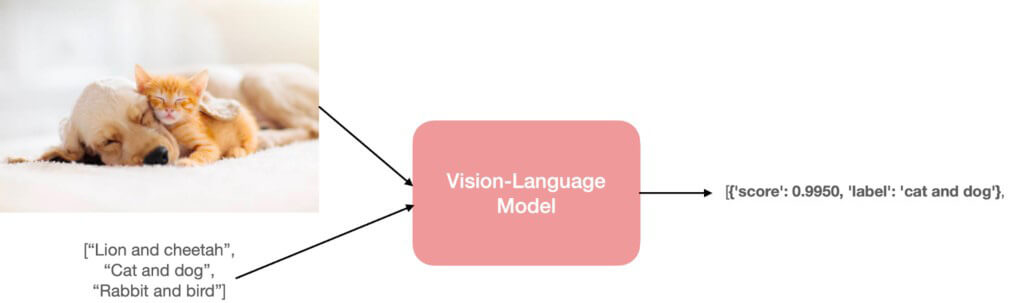
This is precisely the problem that vision language models (VLMs) aim to solve. Visual-Language Models (VLMs) are a type of multimodal AI model that integrates visual information with linguistic information. They are designed to simultaneously process visual data such as images and videos, as well as language data such as text and speech, to achieve deep understanding and generation of complex scenes. The core of these models lies in breaking down the modality barrier between vision and language, enabling machines to comprehensively use both visual and language capabilities to accomplish various tasks, much like humans do.
How Vision Language Models Work
Visual information is continuous, dense, and high-dimensional. A 224×224 RGB image contains 150,528 continuous numerical values, with each pixel’s RGB values varying continuously between 0 and 255. More importantly, visual information has strong spatial structure—adjacent pixels are often highly correlated in semantics, the outline of an object is composed of continuous edge pixels, and color gradients form textures and lighting effects.
Linguistic information, on the other hand, is discrete, sparse, and low-dimensional. Text is broken down into a sequence of tokens from a finite vocabulary, with each token corresponding to an integer ID. Unlike vision, language has a strict sequential structure.
Then, how do vision language models build a bridge between visual and linguistic information for machines? VLMs establish a unified multimodal representation space, converting information from different modalities into a unified token representation, and then perform joint modeling and reasoning within the same architecture.
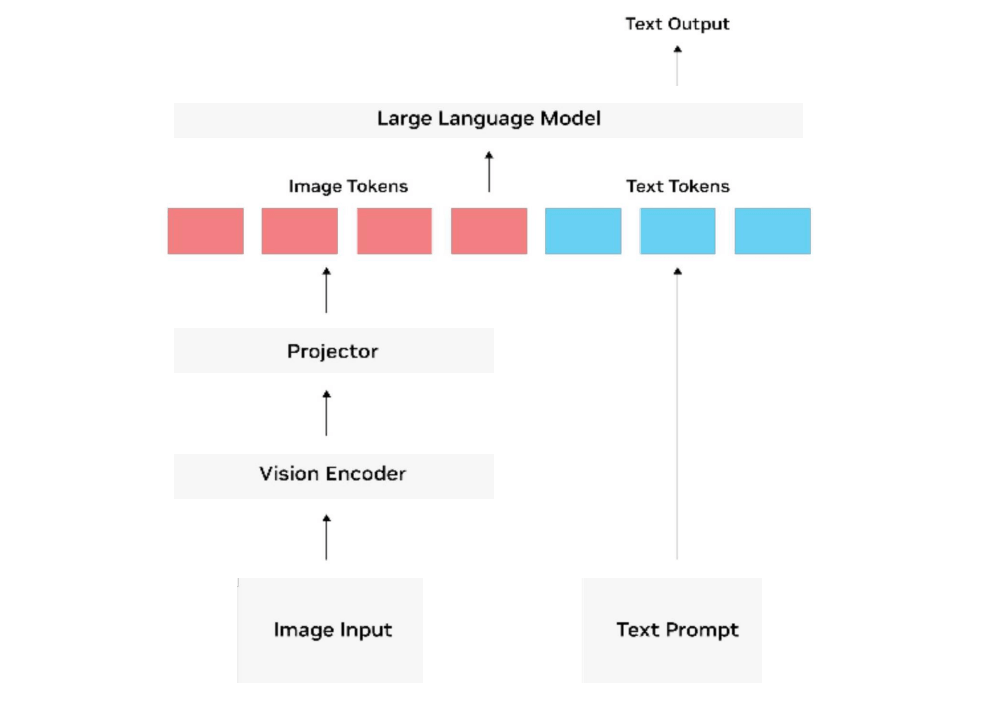
Visual tokens: The image is divided into fixed-size patches (e.g., 16×16 pixel blocks), and each patch is encoded as a visual token.
Language tokens: Traditional subword tokenization is maintained, with each vocabulary item corresponding to a language token.
Unified modeling: Visual tokens and language tokens are concatenated into a unified sequence and processed by the same Transformer architecture. This design allows the model to establish cross-modal attention connections at the token level, achieving true vision-language understanding.
Vision Language Models Architecture
Most vision language model architectures consist of three components:
–-Vision Encoder
Mainstream solutions: ViT (Vision Transformer) or the visual part of CLIP.
Logic: The image is sliced into many small patches, much like cutting tofu. Each patch is then condensed into a sequence of numbers (feature vectors).
–Projector
Mainstream solutions: Linear Layer or MLP (Multilayer Perceptron).
Logic: The vectors output by the vision encoder and the text vectors recognizable by the LLM are not compatible in the mathematical space. The Projector’s task is to map “visual features” into the “text feature space.”
–LLM
Mainstream solutions: For example, the core of LLaMA 3, GPT-4.
Logic: It receives: [Tokens translated from the image] + [Text tokens input by the user]. It processes this information, leveraging its powerful logical reasoning capabilities, to output the correct answer.
How to Train Vision Language Models?
Training a vision language model consists of pre-training and supervised fine-tuning.
–Pre-training: Pre-training aligns the vision encoder, projector, and LLM so that they essentially use the same language when interpreting text and image inputs. During this phase, massive web image–text pairs are utilized—for example, large-scale images and their corresponding captions or descriptions collected from the internet—to enable the model to first acquire general visual–linguistic correspondences. The goal of this stage is for the model to learn general visual and linguistic knowledge on large-scale multimodal data, giving it cross-domain foundational capabilities such as recognizing various objects, understanding common scenes, and generating natural expressions. This lays a solid foundation for subsequent fine-tuning and application.
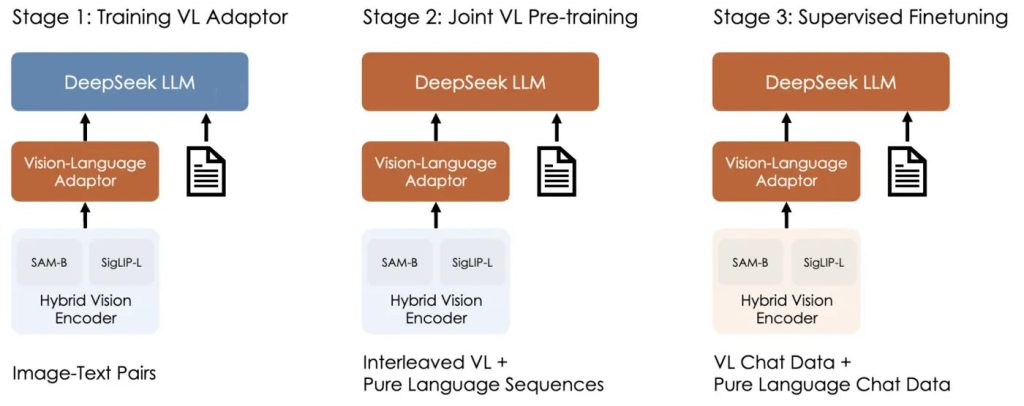
–Instruction Tuning: This stage is a key technique that enables the model to transition from “general visual understanding” to “precise task execution.” Its core significance lies in making the model “understand human instructions” and align with human intent, thus better adapting to complex, ever-changing real-world scenarios and generating high-quality responses that meet expectations. For example, the model is first given an image of a math geometry problem, then asked to calculate the angle of X in the figure.
What Is The Difference Between Vision Language Models and Vision Language Action Models?
Both VLMs (Vision Language Models) and VLAs (Vision Language Action models) are important technologies within the realm of large models, but what are their differences? Although both belong to the multimodal large-model family, they differ fundamentally in architecture, objectives, output types, and application scenarios.
VLMs (Vision Language Models) primarily address the association between images and language. Their core capability is semantic understanding of images and expressing that understanding through language, with outputs typically in natural language—for example, image captioning, visual question answering, image–text matching, and image–text generation.
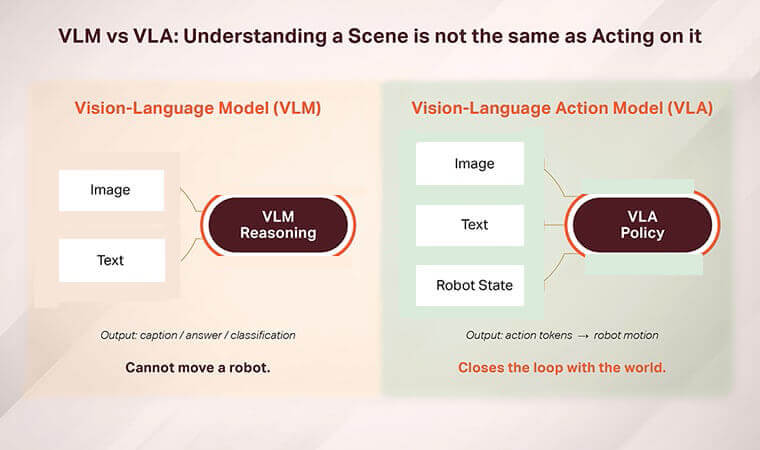
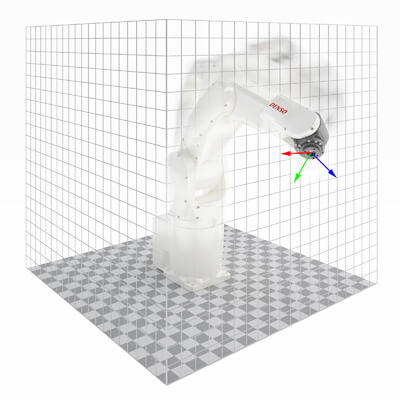
VLAs (Vision Language Action models) are a further extension of VLMs. They not only need to understand visual information and language instructions in an image but also fuse the two to generate executable action decisions. Their outputs are no longer text but physical control signals or action plans. Therefore, VLA models are not only responsible for perception and understanding but also need to complete behavioral decision-making and action control. They are a key technology for the “perception–cognition–execution” closed-loop system in the real world.
Recommended Related Reading from AI Robots Eidos
Readers who wish to learn more about VLA models can refer to this article for a detailed introduction.
What Are the Main Vision Language Models (VLMs)?
Closed-Source Vision Language Models (VLMs)
–GPT: One of the most advanced closed-source multimodal models, supporting multimodal inputs such as images, video, text, and audio. It possesses extremely strong complex reasoning, image understanding, and multi-turn dialogue capabilities, maintaining a leading position in multiple multimodal benchmarks.
–Gemini: Google’s natively multimodal model, supporting a unified architecture for text, images, video, and audio, with an extremely long context window (up to 1 million tokens). It performs exceptionally well in long-video understanding and complex reasoning.
–Claude: Supports multimodal input and performs excellently in tasks such as OCR, document understanding, and visual question answering, with strong long-text and visual comprehension capabilities.
Open-Source Vision Language Models (VLMs)
–Gemma: An open-weight VLM series from Google DeepMind, supporting a context window of up to 128K tokens. It performs well in OCR and multilingual understanding tasks and can be scaled to various deployment scenarios—from small-scale deployments to enterprise-level.
–Qwen: A high-capacity open-source VLM under the Apache 2.0 license. Qwen2.5-VL-72B-Instruct supports video input, grounding, and multiple languages. This model is primarily optimized for global application scenarios requiring versatile capabilities and free customization.
–LLaMA: A powerful open-source VLM with a very long context window for document understanding, including OCR applications and VQA applications. LLaMA 3.2-Vision offers high accuracy while maintaining flexibility for custom fine-tuning.
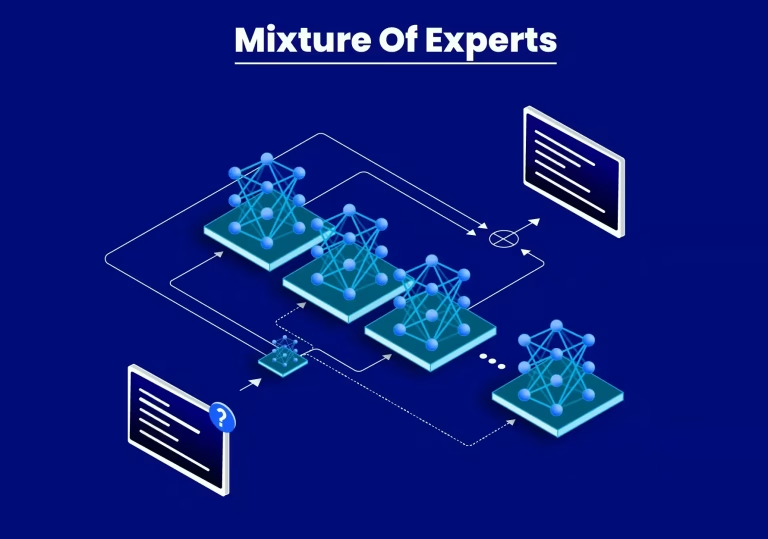
–DeepSeek: Adopts a Mixture of Experts (MoE) architecture, with the series potentially having 1 billion to 4.5 billion active parameters. This means that using the DeepSeek-VL2 model enables reasoning for technical and scientific tasks with extremely low latency. These models are ideal for deployment in laboratories, factories, or mobile environments.
–Falcon: Features 11 billion parameters and is pre-trained on 5.5 trillion tokens. It possesses VLM capabilities, converting visual input (images) into text output, enabling tasks such as image understanding, image captioning, and document analysis.
Open-Source Vision Language Models
| Model Name | Sizes | Vision Encoder | Key Features | License |
| Gemma 3 | 4B, 12B, 27B | SigLIP | Pan & Scan, high-res vision, 128k context, multilingual | Open Weights |
| Qwen 2.5 VL | 7B, 72B | Custom ViT | Dynamic resolution, 29 languages, video, object localization | Apache 2.0 |
| Llama 3.2 Vision | 11B, 90B | Vision Adapter | 128k context, strong document/OCR, VQA, captioning | Community License |
| Falcon 2 11B VLM | 11B | CLIP ViT- L/14 | Dynamic encoding, fine details, multilingual | Apache 2.0 |
| DeepSeek-VL | 1.3B, 4.5B | SigLIP-L | Strong reasoning, scientific tasks, Mixture of Experts | Open Source |
Challenges Facing Vision Language Models
–Resource Requirements: The development of Vision Language Models (VLMs)relies on large-scale multimodal datasets (including images, videos, and their corresponding text descriptions), and acquiring such datasets is itself a challenge. Training VLMs demands enormous computational resources. For example, training a 1-billion-parameter VLM requires multiple high-performance GPUs (e.g., NVIDIA A100) for weeks or even months of training, along with substantial power consumption.

–Scalability: As application scenarios grow in complexity and data volumes increase, VLMs need to continuously expand their capabilities and capacity. However, existing model architectures may encounter performance bottlenecks during scaling. For instance, when the model parameter count increases to a certain level, training and inference efficiency can significantly decline, and the model’s generalization ability may also be affected.
–Inference Speed: The inference speed of models is relatively slow. In some real-time application scenarios, there are strict requirements for inference speed. However, existing VLMs typically take tens of milliseconds or even seconds to generate results, which cannot yet meet real-time demands.
–Optimization and Tuning: Due to the complexity of Vision Language Models (VLMs), fine-tuning and optimizing them require extensive experimentation and debugging. For example, on different tasks and datasets, model parameters need to be finely adjusted—a process that is not only time-consuming and labor-intensive but also requires specialized knowledge and experience.
Future Directions for Vision Language Models
–Architectural Design: Most current Vision Language Models (VLMs) are based on the Transformer architecture, but as research deepens, more efficient and powerful architectures may emerge in the future. For example, integrating Transformers with other architectures such as CNNs to better capture both local features and global information of images. In addition, novel neural network architectures such as sparse attention mechanisms and dynamic architectures are also being explored, and these are expected to significantly improve computational efficiency and model performance.
–Multimodal Fusion Techniques: Future VLMs will place greater emphasis on deep integration of multimodal information. Beyond existing feature concatenation and attention mechanisms, researchers may develop more advanced fusion techniques, such as multimodal fusion methods based on Graph Neural Networks (GNNs), which can more effectively model the complex relationships between vision and language.
–Model Compression and Optimization: To improve the efficiency of VLMs in real-world applications, model compression and optimization techniques will become a future research focus. For example, knowledge distillation can transfer knowledge from large pre-trained models to smaller models, reducing parameter counts and computational complexity without significantly sacrificing performance. Additionally, quantization and pruning techniques will also be widely applied in VLM optimization to improve inference speed and storage efficiency.
Applications of Vision Language Models
–Industrial Scenarios: In industry, VLMs are more commonly used for visual inspection and guidance—for example, identifying parts with vision-language models, reading instruction manuals, and assisting automated equipment operations. They can also rapidly identify tiny surface defects on products through few-shot/zero-shot learning and generate quality inspection reports with semantic explanations.
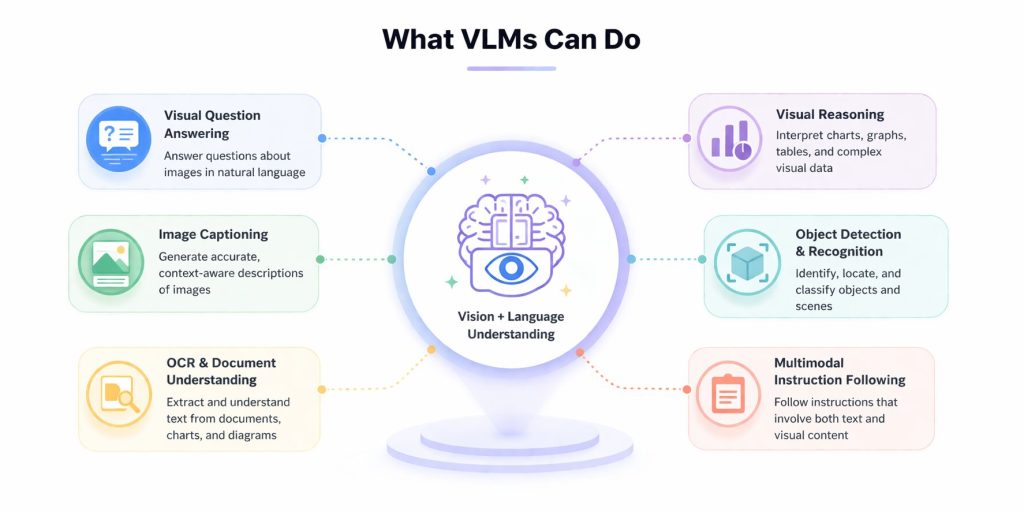
–Office Scenarios: By combining visual positional information (e.g., checkbox locations) with text content and layout, VLMs enable precise parsing, classification, and information extraction from complex documents, thereby improving document processing efficiency.
–Human-Robot Interaction Scenarios: VLMs provide robots with visual understanding capabilities. Combined with language instructions, they enable visual question answering and scene understanding in complex environments, assisting robots in performing tasks such as grasping and assembly. For example, a technician can use natural language to instruct the robot on its next operation; the VLM interprets the instruction and passes it to the lower-level control system.
Insight from AI Robots Eidos about Vision Language Models
Current patch-based methods essentially perform “lossy compression” of visual information, discarding a large amount of spatial detail. The future lies in dynamically aware visual tokenization: instead of rigidly dividing an image into a uniform 16×16 grid, the model adaptively allocates tokens based on image content—using finer granularity for detail-rich regions and coarser granularity for flat areas. This not only significantly improves processing efficiency for high-resolution images and HD videos.
Future Vision Language Models (VLMs) need to possess interpretable reasoning chains: when the model answers “the angle X in the figure is 45 degrees,” it should simultaneously output its reasoning process—”I recognized a triangle, identified two equal sides, and therefore inferred that this is an isosceles triangle…” Such transparent reasoning capability is crucial for scenarios like industrial quality inspection.
Future VLM models should be lifelong learners, capable of continuously acquiring new data and tasks while retaining knowledge of what was learned before. This requires introducing dynamic network architectures, memory replay mechanisms, and parameter-efficient update techniques.
The future Vision Language Model is not just the “eyes” and “mouth” of a robot, but rather the operating system kernel of an entire multimodal Agent. The Agent will center on the VLM, which uniformly orchestrates modules such as visual perception, language understanding, tool invocation, planning, and action execution. The VLM is responsible for “understanding the world,” while peripheral modules are responsible for “acting in the world,” with both communicating through a unified representation space. This architecture will enable the Agent to tackle genuinely open-ended, complex real-world tasks.
Image Credits: Opencv & Bsuir & Github & Shaip & AI & Code-b