Absolute Accuracy of Robots
Table of Contents
The pursuit of absolute accuracy is, in essence, the pursuit of “determinism.” This means using the certainty of algorithms and data to hedge against the uncertainties of machinery and the environment in a physical world full of variables. When accuracy breaks through the ±0.1mm threshold, robots will truly be able to enter fields once exclusively dominated by CNC machine tools, ushering in a new era of flexible precision manufacturing.
What Is Absolute Accuracy?
The absolute accuracy of a robot refers to the degree of agreement between the actual position and orientation (pose) of the robot’s end effector and the commanded pose when the robot is directed to a specific position. It is the difference between the actual pose and the commanded pose. Absolute accuracy represents the robot’s ability to reach a specified programmed position with minimal error and is particularly crucial in offline programming mode.

Levels of Robot Absolute Accuracy
Absolute accuracy is affected by factors such as the robot model, payload, working range, and environmental conditions. Specific accuracy must be based on technical specifications provided by the manufacturer or actual test data.
| Sub-millimeter Level (<0.1mm): This represents the highest precision level for current high-end industrial robots. It is typically achieved through high-precision sensors, advanced calibration algorithms, and precision mechanical manufacturing. For example, some high-end models from brands like Fanuc and ABB can reach this level after absolute accuracy calibration. They are suitable for scenarios with extremely high precision requirements, such as semiconductor manufacturing and precision optical assembly.
| Millimeter Level (0.1mm – 1mm): Most mid-to-high-end industrial robots typically fall within this range for absolute accuracy in an uncalibrated state. After absolute accuracy calibration, errors can be controlled within 1mm. This level is suitable for common industrial applications like automotive welding, gluing, and grinding.
| Multi-millimeter Level (1mm – 5mm): Some basic models or heavy-duty robots may have absolute accuracy in the multi-millimeter range due to factors like complex mechanical structures or long arm reaches. These robots are suitable for tasks with relatively low precision requirements, such as material handling and palletizing.
Open-Loop Measurement and Modeling for Robot Absolute Accuracy Calibration
| Laser Tracker: A laser tracker is used to precisely measure the actual position and orientation of the robot’s end effector in space. This data is compared against a theoretical model to calculate errors and perform compensation.
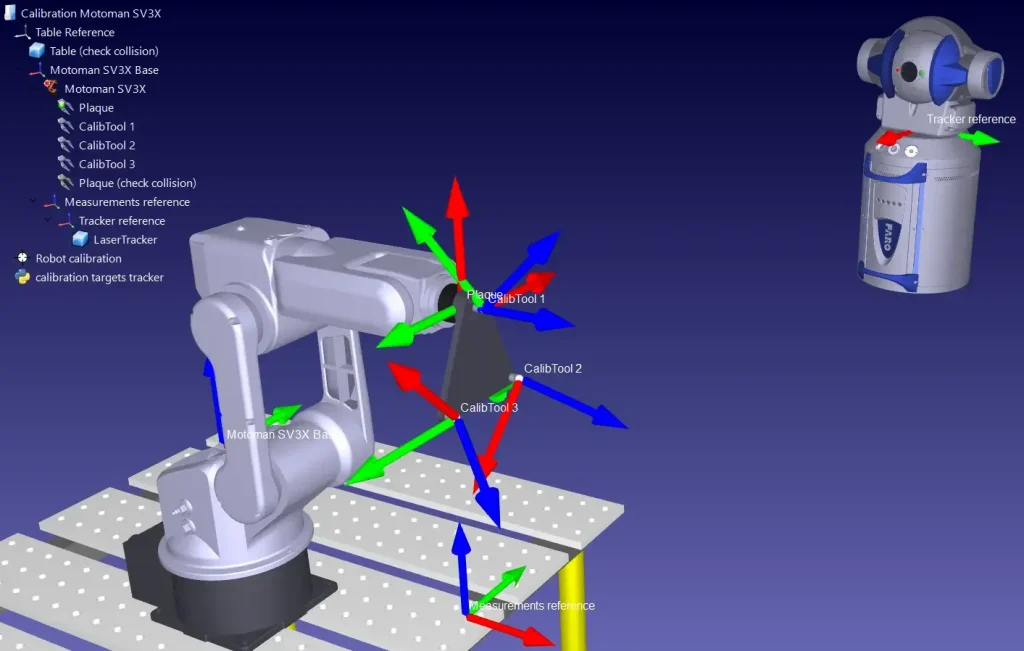
Advantages: High precision, capable of covering a large workspace, and can measure both position and orientation errors simultaneously.
Disadvantages: High equipment cost, complex operation, and stringent environmental requirements (e.g., temperature, vibration).
| Vision Measurement: A camera is mounted on the robot’s end effector. By capturing images of a fixed calibration board or target, computer vision algorithms (e.g., PnP algorithm) calculate the end pose. This information is then combined with a kinematic model for parameter identification.
Advantages: Lower cost, flexible equipment installation, enables online calibration, suitable for complex environments.
Disadvantages: Measurement accuracy is affected by camera resolution and calibration board precision; measurement range is limited; sensitive to lighting conditions.
| Ballbar Calibration: A ballbar measures the radial distance from the robot end effector to its base. Combined with a kinematic model, the end position error is calculated.
Advantages: Relatively low cost, simple operation, allows for quick measurement of end position accuracy, suitable for robots with high repeatability.
Disadvantages: Can only measure radial distance error, cannot directly measure orientation error; measurement range is limited.
| Coordinate Measuring Machine (CMM) Calibration: A CMM uses a probe to contact the robot end effector, precisely measuring its coordinates in space to calculate errors by comparing with theoretical values.
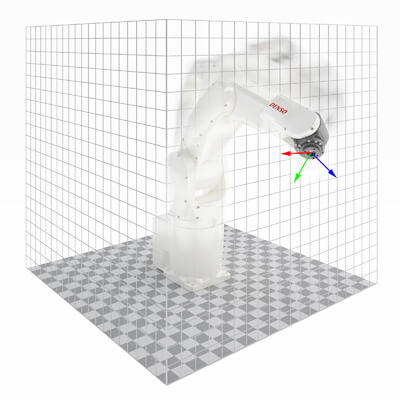
Advantages: High measurement accuracy, can measure end effectors with complex shapes, suitable for static accuracy calibration.
Disadvantages: Large equipment size, high cost, slow measurement speed, limited to static measurement, and cannot monitor dynamic errors in real-time.
| Dynamic Model Calibration: This method considers dynamic factors during robot motion (e.g., gravity, inertia, friction). A dynamic model is established, and forces and torques under different motion states are measured to identify dynamic parameters, indirectly improving absolute accuracy.
Advantages: Effectively compensates for dynamic errors, improving robot accuracy during high-speed, high-payload motions.
Disadvantages: Complex modeling, difficult parameter identification, high requirements for measurement equipment precision, and is computationally intensive.
| Neural Network Calibration: This utilizes the nonlinear fitting capability of neural networks to learn the mapping relationship between the robot’s kinematic or dynamic model and actual measurement data, automatically adjusting parameters to improve accuracy.
Advantages: Does not require a precise mathematical model, offers strong adaptability, can handle complex nonlinear problems, and is capable of online learning and adjustment.
Disadvantages: Requires large amounts of training data, has limited model generalization, consumes significant computational resources, and offers poor interpretability of results.
Factors Affecting Absolute Accuracy
| Geometric Errors: Geometric errors account for approximately 70% to 80% of the overall impact on absolute accuracy. They originate from joint manufacturing tolerances, link length deviations, joint axis misalignment due to assembly errors, and reducer backlash. These errors exist when the robot leaves the factory, representing an inherent deficiency.
| Non-Geometric Errors: Non-geometric errors account for about 20% to 30% of the impact but are more elusive. Thermal deformation causes metal to expand and contract; a robot’s effective “height” might differ between summer and winter. Load deflection causes the manipulator arm to bend and deform under the end load. Joint flexibility manifests as elastic deformation of gears and bearings during high-speed motion. For mobile robots, tire deformation and chassis attitude fluctuations caused by ground contact are even more difficult to predict.
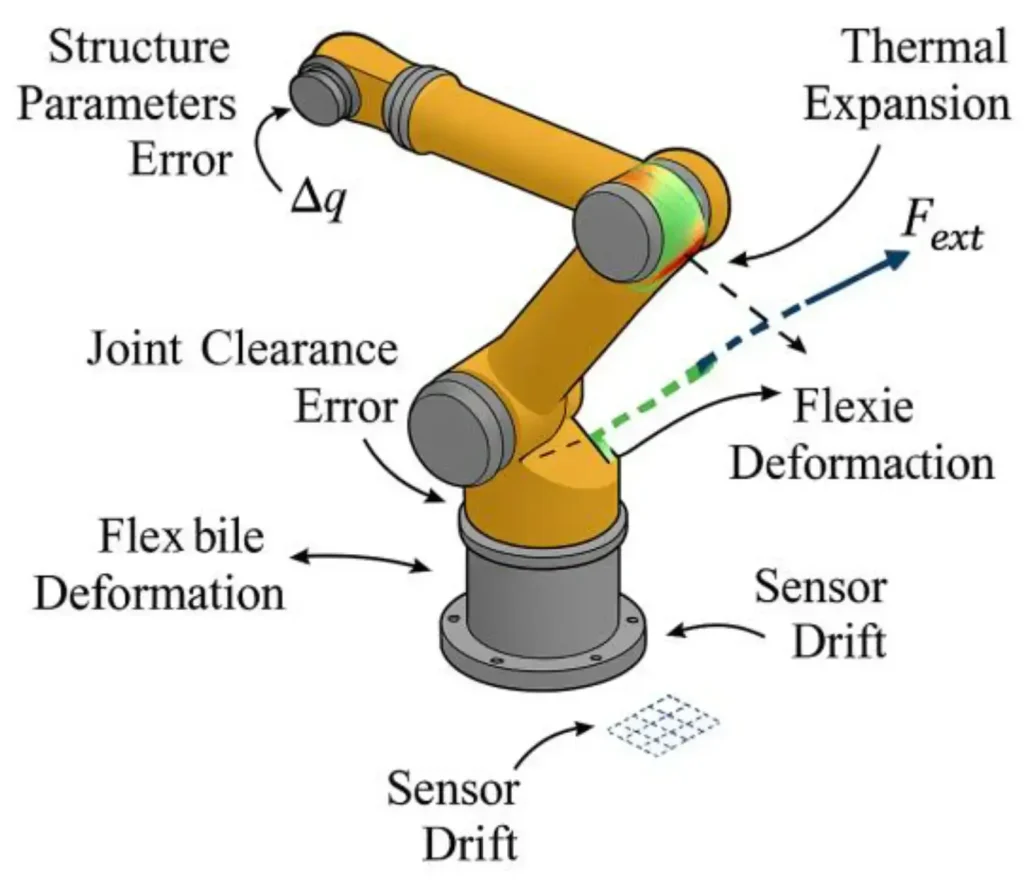
It is important to note that these error sources are coupled and interact differently across various working regions, speeds, and loads, forming a complex error field.
Closed-Loop Compensation and Control for Robot Absolute Accuracy
The industry has developed several mature solutions to address the challenge of robot absolute accuracy.
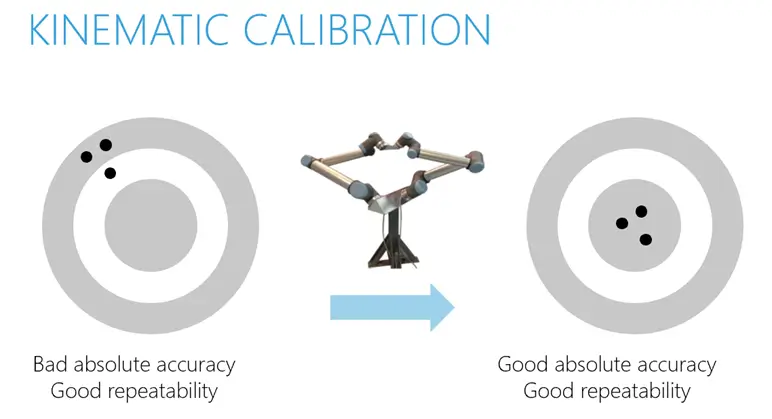
| Kinematic Calibration: Kinematic calibration is the most fundamental method for improving absolute accuracy. Using precision measurement equipment like laser trackers or ballbars, an actual kinematic model of the robot is established, and DH parameters are corrected. This method can reduce absolute positioning errors from approximately ±5mm to around ±1mm. However, it can only compensate for geometric errors and cannot address dynamic factors like flexibility deformation or thermal drift.
| Spatial Grid Compensation: Spatial grid compensation is an advanced solution for improving absolute accuracy. The robot’s workspace is divided into a 3D grid, and an error database is established at each grid point. During operation, compensation values are calculated by interpolation based on the current position. Key techniques involved include Kriging interpolation, which uses spatial correlation to predict errors at unmeasured points; neural networks such as the ELM algorithm, which build a mapping model between position and error; and the spatial similarity principle, which utilizes error correlation of adjacent points for intelligent compensation.
After spatial interpolation compensation, robot errors can be reduced to ±0.3mm, or even ±0.15mm. For example, after such compensation, a KUKA robot’s absolute positioning error was reduced from 1-3mm to a maximum of 0.386mm and an average of only 0.156mm, an improvement of nearly an order of magnitude.
| Real-Time Closed-Loop Feedback: Real-time closed-loop feedback is a high-level method for enhancing absolute accuracy. It involves integrating sensors like laser trackers, vision sensors, or inertial measurement units on the robot end effector to monitor the actual pose in real-time, forming a closed-loop control system.
Advantages: Can compensate for dynamic errors and adapt to environmental changes.
Disadvantages: High cost, complex system, and sensitivity to industrial field environments.
| AI Predictive Compensation: AI predictive compensation represents the cutting-edge direction for improving absolute accuracy. It combines finite element analysis with machine learning to establish a digital twin model. First, FEA simulates deformation under different loads and temperatures. Then, a hybrid model like CNN-GRU replaces the time-consuming FEA calculations, enabling millisecond-level output of compensation values. This offers both high precision and efficiency, making it suitable for mobile robots and outdoor operation scenarios. However, this method requires addressing the issue of data acquisition. For most factories, the cost of obtaining high-quality training data that sufficiently covers temperature and load fields is extremely high, potentially exceeding the cost of a laser tracker.
Applications of Absolute Accuracy
| Offline Programming: Particularly in fields where robots perform laser cutting, laser welding, gluing, grinding, and polishing, trajectories are complex and must be generated offline. This necessitates absolute accuracy.
Recommended Reading from AI Robots Eidos
Absolute accuracy is a key factor for laser welding robots to achieve high precision and high-quality welding. It plays an important role in ensuring welding trajectory precision, improving the stability of welding quality, and supporting offline programming and program reuse.
If readers are interested in laser welding robots, they can read this article about laser welding robots.
| Robot Replacement: If a robot needs to be replaced in the future and the original programs are to be used for production without reteaching, absolute accuracy is required.
| Program Reusability: To reuse a program across different robots without reteaching, absolute accuracy needs to be configured.
Insight from AI Robots Eidos about Absolute Accuracy
The future of absolute accuracy is to make robots smarter.
| With the deep integration of finite element simulation and machine learning, future robots will possess a “living digital twin.” This twin not only includes geometric parameters but also maps temperature fields, load conditions, and wear states in real time. When a robot performs a task, it is not “compensating for errors,” but rather “running a simulation in a virtual world” first, sending corrected instructions to the physical entity. This signifies that accuracy compensation will evolve from “passive correction” to “active rehearsal.”
| Using the DETMAX algorithm for optimal pose point selection can significantly enhance calibration efficiency and stability. This means that calibration is shifting from being “experience-based” to “algorithm-driven.” In the future, robots may be delivered with only basic accuracy guaranteed, with true “absolute accuracy” achieved through a quick cloud calibration service once they arrive at the customer’s site. This is similar to Tesla’s “shadow mode”—the data collected by each robot during operation can feed back into the cloud model, optimizing the accuracy of the entire fleet. A “precision subscription model” may emerge: need sub-millimeter precision? Pay a monthly fee, and the system will remotely optimize the parameters for you.
Image Creidts: Pix-pro & Universal-robots & Denso-wave & Robodk & Preprints