Laser Welding Robots: Precision, Speed, Consistency
Table of Contents
Laser welding robots are a deep integration of laser technology and industrial robotics, bringing comprehensive upgrades in efficiency, precision, and cost to industrial manufacturing.
What Are Laser Welding Robots?
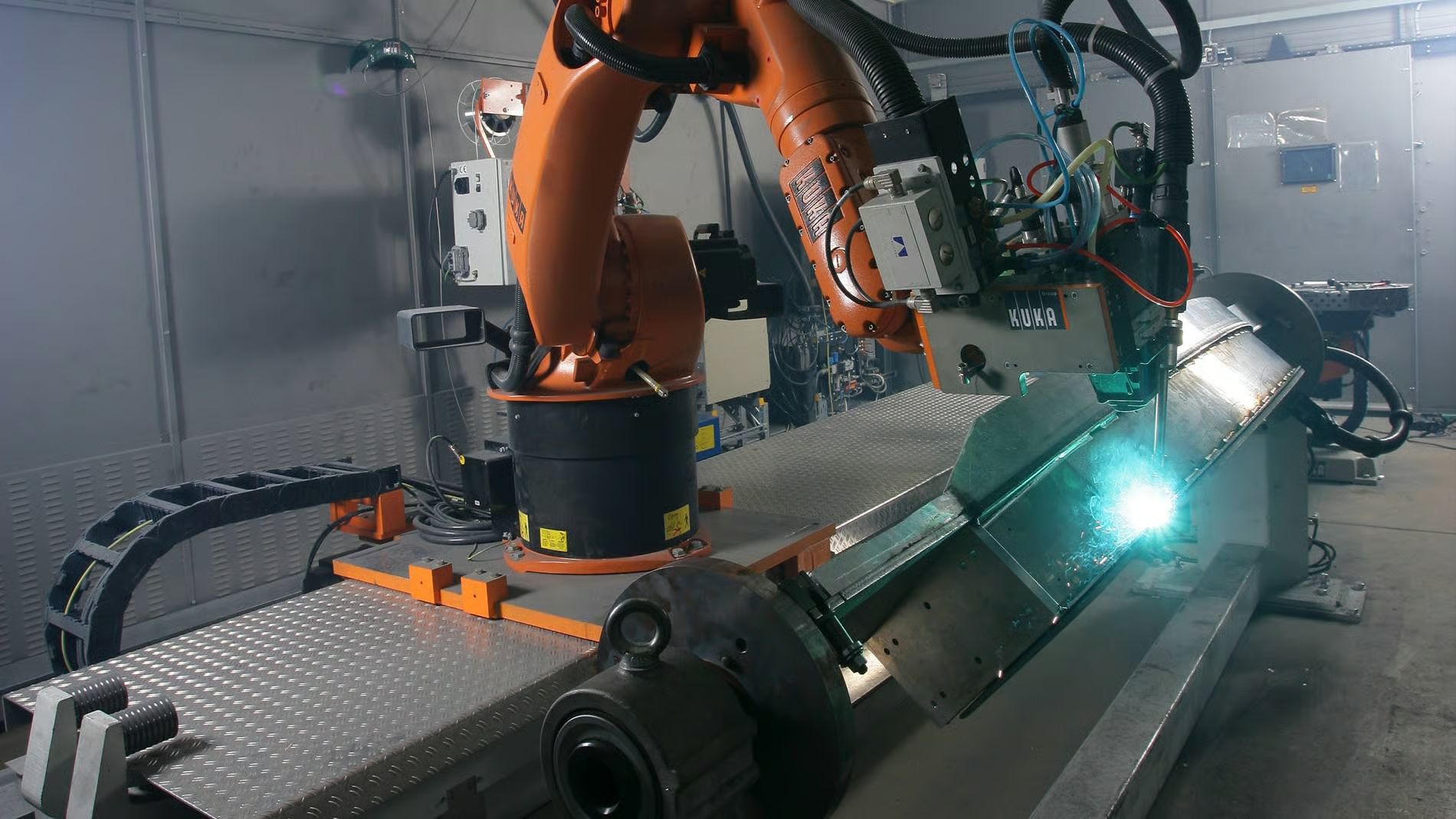
Laser welding robots are industrial robots that use a semiconductor laser as the welding heat source, combining a multi-axis robotic arm with a welding torch and power supply to perform various welding operations.
Laser welding robots can achieve intelligent welding of workpieces without human intervention. Their intelligent control system acts like the responses of a skilled welder, allowing flexible application to workpieces of different specifications. The robot uses a laser as the welding heat source. A high-energy-density laser beam is irradiated onto the two parts of the material, causing local heating and melting, which then cools and solidifies to form an integrated whole.
Components of Laser Welding Robots
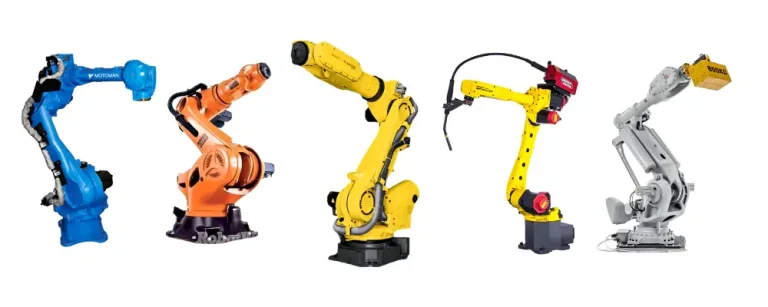
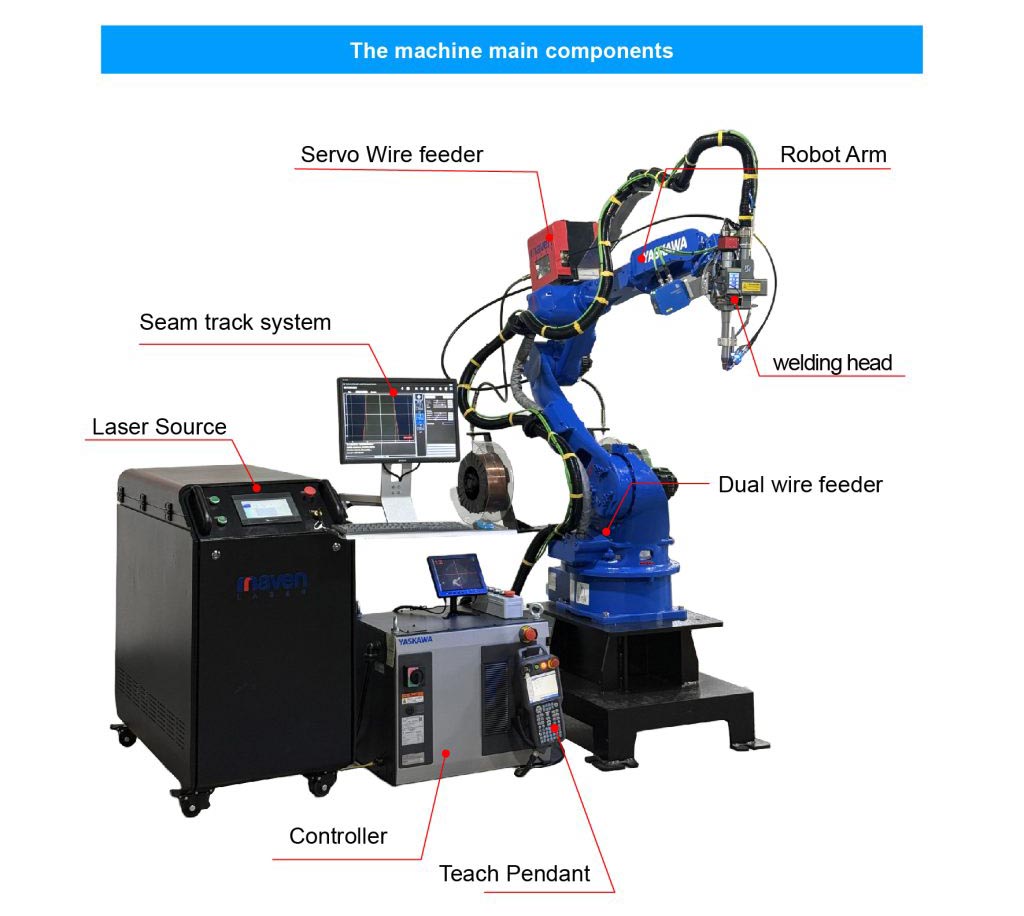
| Robot Body: The robot body is the mechanical structure of the robot, typically designed as a multi-joint type (such as six-axis or more degrees of freedom) to achieve flexible three-dimensional movement. It consists of the base, arm, wrist, and end-effector. Each joint is driven by servo motors to ensure precise and rapid motion.
| Laser Generator: The laser generator is the core component that produces the laser beam. It can be a fiber laser, a solid-state laser, a gas laser (like a CO₂ laser), etc. The type, power, and wavelength of the laser source are selected based on different welding requirements.
| Optical Transmission and Focusing System: Includes fiber optic delivery devices, mirrors, lens assemblies, and focusing heads. This system transmits the laser beam from the generator to the work position and focuses it onto a very small spot to increase energy density.
| Sensing System: Laser welding robots may be equipped with various sensors, such as seam tracking sensors, vision systems, torque sensors, etc. These are used to monitor welding status, workpiece position, and orientation in real-time, enabling automatic correction and adaptive welding.
| Control System: The control system is responsible for the precise control of the entire welding process. It includes hardware controllers and software programming, enabling the planning of robot motion paths, adjustment of laser output power, control of welding speed, and other process parameters based on preset programs.
| External Equipment and Auxiliary Facilities: These mainly include:
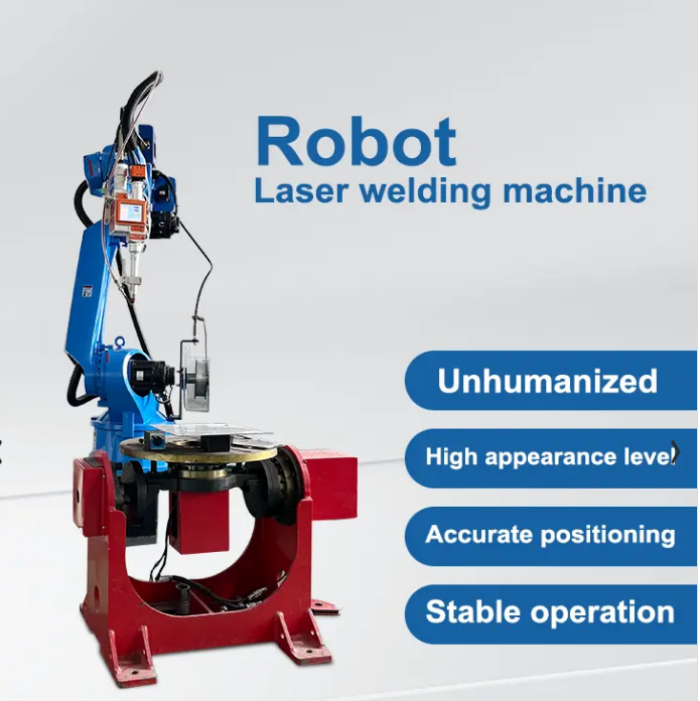
| Positioner: Used to fix and rotate workpieces.
| Shielding Gas Supply System: Provides inert gas to prevent oxidation in the weld zone.
| Cooling System: Cools the laser generator and other components requiring heat dissipation.
| Safety Protection Equipment: Such as safety fences, light curtains, etc., to ensure operator safety.
| Human-Machine Interface (HMI): Through touchscreens or other visual operation panels, operators can set and monitor welding programs, view real-time data, adjust parameters, and receive fault alarm information.
| Welding Head or End-Effector: Used to mount the laser focusing head, nozzle, and possibly shielding gas conduits. It acts directly on the welding area, ensuring effective coupling between the laser and the workpiece.
Advantages of Laser Welding Robots
| Enhanced Welding Precision: The laser beam’s energy is highly concentrated, resulting in a small heat-affected zone. The weld depth-to-width ratio can reach 10:1, with porosity below 0.3%. Taking new energy vehicle battery trays as an example, post-weld sealing is excellent, weld strength increases by 30%, and lifespan exceeds 20,000 cycles.
| Improved Production Efficiency: Laser welding robots can perform continuous operations and long-duration welding tasks. Through offline programming or teach pendant operation, they achieve automatic welding across multiple stations and paths. Robots with auxiliary equipment can automatically flip thick workpieces and handle repetitive production, all enhancing welding efficiency.
| Improved Product Consistency: Laser welding robots feature a high degree of automation. Integrated with AI vision sensing and dynamic compensation algorithms, they correct welding paths in real-time, controlling deviations within ±0.1mm. The system automatically recognizes micron-level deformations, ensuring weld uniformity up to 99.9%.
| Reduced Welding Costs: In traditional welding, defects such as under-welding, off-seam welding, and over-welding can occur, resulting in increased material costs for companies. Welding robots can precisely deposit welding material based on the seam, utilizing material fully while ensuring precise welding. One operator can manage two to three welding robots simultaneously, reducing labor costs.
| Strong Production Flexibility: Laser welding robots can flexibly adjust welding paths and parameters based on different workpiece shapes and materials, adapting to complex structures and irregular part welding needs. They can weld various materials, including combinations of different thicknesses and material types. They are also suitable for welding demands across many fields like industrial manufacturing, automotive production, and aerospace.
Limitations of Laser Welding Robots
| High Precision Requirements for Part Assembly: The laser’s focus spot is extremely small (typically just a few tenths of a millimeter), and the weld seam is narrow, necessitating high assembly precision of the workpiece. The position deviation of the beam on the parts must be controlled within a very small range. If there are assembly errors or insufficient positioning accuracy, it can easily lead to defects such as weld misalignment, lack of fusion, or undercutting, imposing strict requirements on the machining precision of the parts.
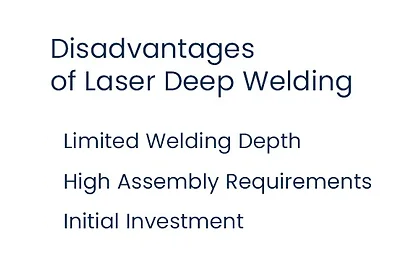
| Limited Welding Thickness: The penetration depth of laser welding is limited and is generally suitable for thin plate welding (usually less than 19mm). For medium to thick plate welding, higher power lasers and complex processes are required, which can easily result in welding defects such as lack of penetration and porosity, limiting its application in the welding of large structural components.
| Limited Material Adaptability: Welding high-reflective materials (such as aluminum, copper, and their alloys) and high-thermal-conductivity materials presents significant challenges, requiring higher power density and specialized process parameters. These materials are prone to defects such as porosity, thermal cracks, and lack of fusion.
Key Parameters Affecting Laser Welding Robots
| Welding Speed: Welding speed must match welding quality. Excessively high speed can compromise quality, leading to deviations, insufficient welding, or leaks. Excessively low speed can hinder the production process. Welding speed is a key indicator determining welding efficiency.
| Rated Payload: This refers to the maximum load the robot’s end-effector can bear. It determines the arm reach and the specifications of weldable workpieces. The payload includes the welding gun, cables, vision sensors, wire feeder tubes, etc.
| Number of Axes: This refers to the robot’s joints. The robot’s flexibility varies with the number of axes. Robots with more axes generally offer greater flexibility, can handle more workpiece specifications, and have wider welding applications.
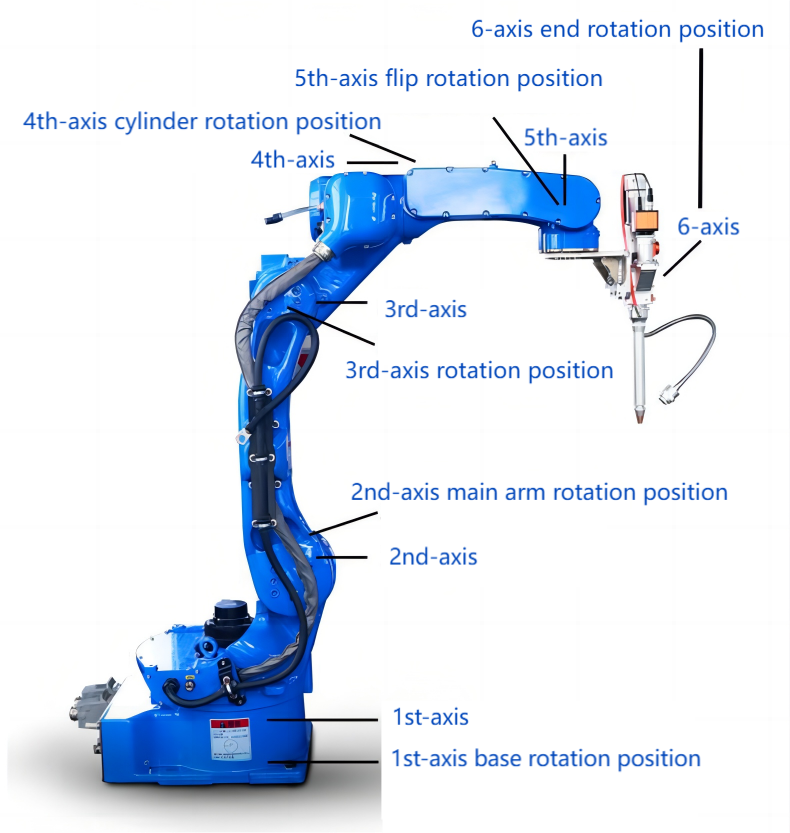
| Arm Reach: This reflects the robot’s welding radius. A longer arm reach means a larger welding radius and the ability to handle larger workpieces. Users can choose the robot’s arm reach based on their workspace, workpiece specifications, and welding requirements.
| Repeatability (Repeat Positioning Accuracy): This reflects the welding precision the robot maintains during repeated actions. Only qualified robots can maintain welding precision without deviation.
| Motion Speed: The robot’s motion speed is an important metric, requiring the ability to quickly complete multi-point positioning over small intervals (e.g., positioning after moving 30-50mm every 0.3-0.4 seconds). To ensure welding quality, high positioning accuracy is required (typically 0.25mm).
Applications of Laser Welding Robots
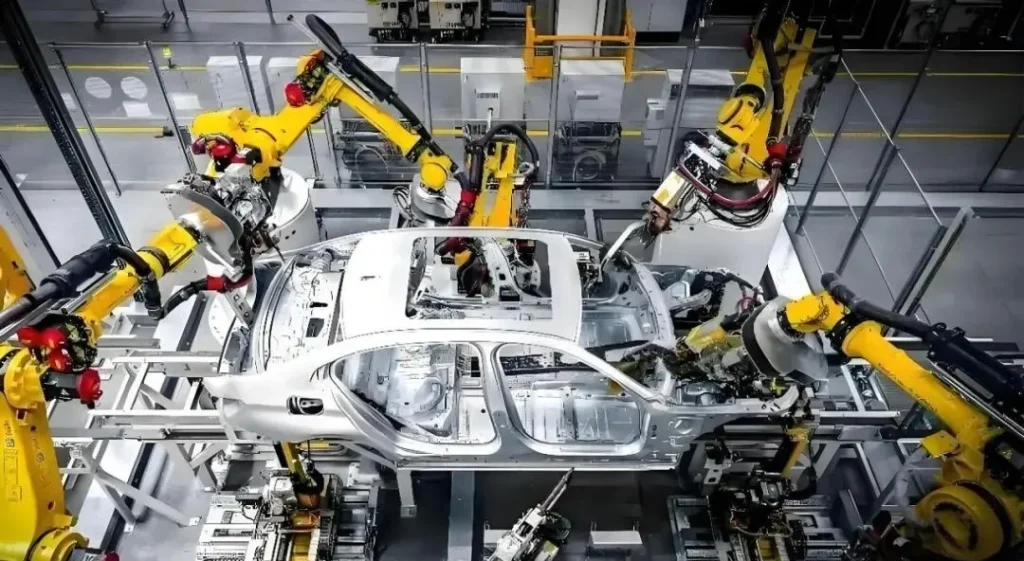
| Automotive Manufacturing: In recent years, the automotive industry has diversified to meet diverse market demands. Traditional welding often falls short of the high requirements for vehicle and component manufacturing. Laser welding robots can use welding materials precisely, achieving accurate and aesthetically strong welds. In many modern automotive plants, they are used for welding car bodies, frames, and other components.
| Electronics Industry: This field demands very high welding quality. Laser welding robots can ensure stable quality while maintaining production efficiency, achieving precise welding for electronic devices at three to four times the efficiency of manual work. In electronics, they are used for welding circuit boards, components, etc., capable of micron-level precision to ensure device sealing and conductivity.
| Aerospace: In aircraft and spacecraft manufacturing, laser welding is used for complex structures involving aluminum alloys, titanium alloys, and composites. It effectively controls the heat-affected zone, ensuring part strength and integrity. Laser welding robots are typically used for welding aircraft fuselages, engines, and other components.
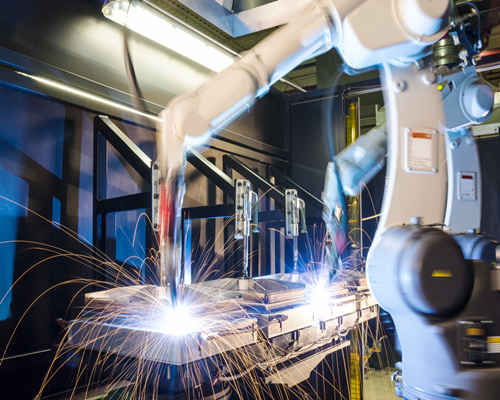
| Engineering Machinery Manufacturing: As welding tasks intensify in machinery manufacturing, welding—traditionally a hazardous job with poor conditions and high thermal radiation—poses challenges, especially with large equipment. Laser welding robots, as automated welding equipment, help improve automation levels in this sector.
| Shipbuilding: Ship structures involve nearly a thousand welded components and tens of thousands of parts. Most critical load-bearing structures are welded. Hulls endure significant pressure during operation, necessitating strict welding standards. Laser welding robots, via automatic seam tracking, flexibly set parameters to precisely weld various ship sections. They are commonly used for hulls, rudders, and other components.
Insight from AI Eidos Robots about Laser Welding Robots
With technological advancements, laser welding robots will possess more powerful capabilities.
| Smarter: The future of laser welding robots goes beyond current AI vision-based real-time corrections, aiming for full-process autonomous decision-making. Future systems will be capable of simulating welding effects in real-time through digital twins, predicting thermal deformations, and autonomously generating optimal welding parameters by integrating with material databases, truly achieving “automation in process design.”
| More sensitive: In addition to visual and positional sensors, future robots may integrate multi-dimensional information such as acoustic emission monitoring (real-time listening for abnormal sound waves indicating cracks during welding) and plasma spectral analysis (reverse engineering weld depth, width, and composition from the spectrum of the welding pool), forming a real-time closed-loop control and traceability system for welding quality.
| Broader Applications: With the application of new materials like composite materials, high-entropy alloys, and ceramic-metal heterogeneous connections, laser welding robots will no longer be limited to traditional metal welding. Forward-looking research directions include ultrafast laser welding (femtosecond/picosecond level) for brittle materials and laser-ultrasonic hybrid welding for challenging-to-weld materials like amorphous alloys.
Image Credits: Fortunelaser & Mavenlazer & Kuka & Jnctlaser & Alibaba & Semcoinfratech & Web