AGV or AMR: How to Choose
Table of Contents
AGV or AMR – this is a common question many enterprises face when procuring automation equipment. This article addresses this issue from the perspective of equipment procurement.
AGV or AMR: Assessing Enterprise’s Needs
Before procuring an AGV or AMR, enterprises need to carefully evaluate and understand their own requirements.
| Assess Required Functions: Determine the specific tasks to be automated and their complexity. If the primary need is to transport materials along fixed paths, an AGV may suffice. However, if tasks involve more advanced functions, such as picking items from shelves or sorting packages, an AMR may be more appropriate.
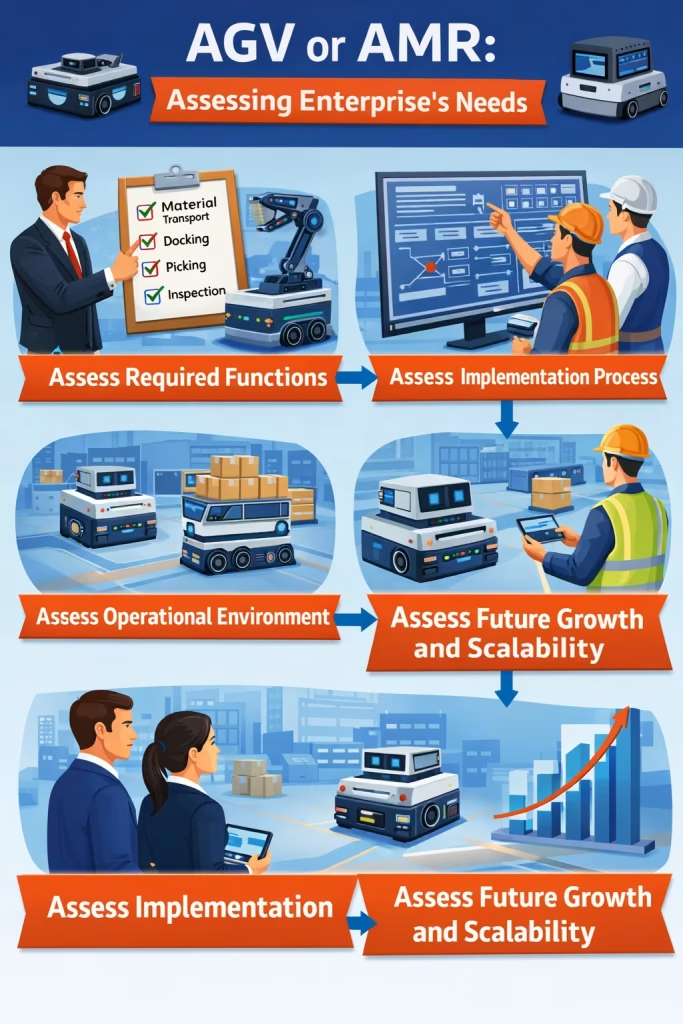
| Assess Implementation Process: Evaluate the ease of implementation for each technology, including installing physical guidance infrastructure, integrating software, and training employees. While AMRs often offer a more straightforward implementation process, enterprises should still consider potential challenges related to software integration and staff training.
| Assess Operational Environment: Consider the facility’s layout and dynamics. If the environment is relatively static, with fixed routes and repetitive material-handling tasks, an AGV may be a suitable choice. However, if the facility layout is dynamic or the tasks are more complex, an AMR may be the better option due to its flexibility and advanced capabilities.
| Assess Future Growth and Scalability: Consider potential growth and operational changes. AMRs offer greater flexibility in adapting to environmental or process changes, making them a more suitable choice for enterprises looking to scale operations over time.
AGV or AMR: Understanding the Core Differences
Difference between AGV and AMR
After gaining a clear understanding of their own needs, enterprises also need a clear understanding of the differences between AGV and AMR technologies.
| An Automated Guided Vehicle (AGV) is a self-driving vehicle that follows a predefined path, typically guided by ground-based infrastructure such as magnetic tape, QR codes, or lasers. It usually handles loads over 600 kg. AGVs are well-suited to scenarios with fixed paths and minimal environmental changes, and they perform reliably on repetitive handling tasks.
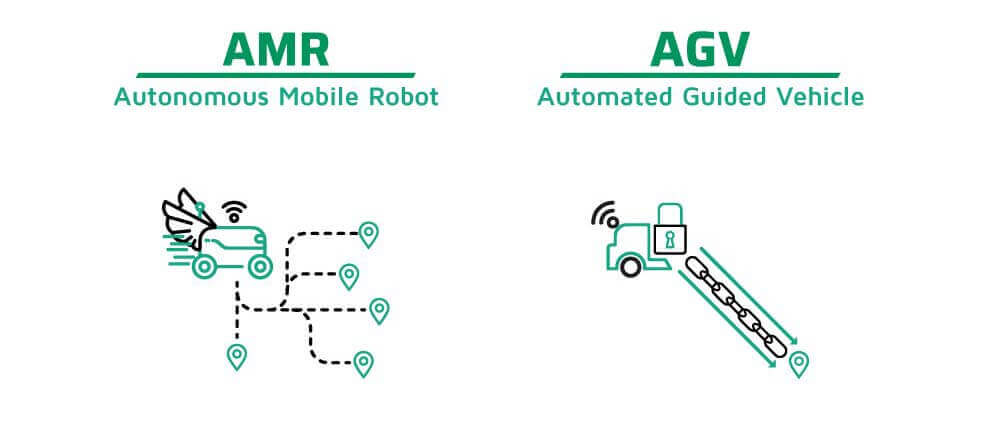
| An Autonomous Mobile Robot (AMR) uses sensors such as LiDAR and cameras, along with intelligent navigation technology, to perceive its environment in real time, autonomously plan paths, and dynamically avoid obstacles without requiring floor modifications. It typically handles loads under 600 kg. AMRs are better suited for dynamic environments and flexible manufacturing needs.
Recommended In-depth Reading from AI Robots Eidos
Regarding the differences between AGVs and AMRs, we have already provided a detailed explanation in another article. Enterprises or readers who are interested in gaining a better understanding of the distinctions between the two can dive deeper by reading the article AGV vs AMR.
AGV or AMR: Evaluating Core Technical Specifications
AGV
| Navigation Accuracy & Method
Accuracy: Determine based on application scenarios. General industrial scenarios require ±5mm to ±15mm. High-precision tasks (e.g., high-bay storage, precision assembly) require accuracy within ±3mm. For example, vision navigation offers flexibility but is susceptible to lighting variations; QR code navigation is easy to deploy with accuracy around ±10mm.
| Load Capacity
Select based on material weight and dimensions. Common ranges are from 500 kg to over 10 tons. Consider dynamic loads (impact on the AGV during travel and lifting) to ensure the rated load meets actual requirements.
Travel Speed & Efficiency
Typical travel speed is adjustable between 0-1.5 m/s, determined based on task cycle time and path length. High-efficiency scenarios must balance speed with stability to avoid positioning deviations or safety risks caused by high speeds.
| Battery Life & Charging Method
Battery life typically requires 8-12 hours of continuous operation. Calculate battery capacity based on operating duration and energy consumption. Charging options include automatic charging (e.g., inductive charging, charging station) or manual charging; automatic charging is more suitable for continuous long-duration operations.
| Drive Type & Maneuverability
Differential drive suits medium loads and flexible steering. Omnidirectional drive (e.g., Mecanum wheels) enables lateral movement and rotation, suitable for confined spaces or high-precision positioning. Steered wheel drive offers high load capacity but has a larger turning radius.
| Safety Features
Hardware should include collision sensors, emergency stop buttons, and safety bumpers. Software should support dynamic obstacle avoidance algorithms, tilt detection, and anti-tip functions to ensure safe operation in complex environments and human-robot collaborative scenarios.
| System Integration & Compatibility
Must support data integration with upper-level systems like WMS (Warehouse Management System) and MES (Manufacturing Execution System). An open API interface is essential for integration into existing logistics management systems, enabling functions like task scheduling and status monitoring.
AMR
| Navigation & Positioning Accuracy
Navigation Method: Prioritize AMRs supporting LiDAR SLAM, visual fusion, or hybrid navigation technologies, capable of adapting to complex dynamic environments and enabling autonomous path planning and obstacle avoidance.
Positioning Accuracy: The key metric is repeat positioning accuracy. Industrial scenarios typically require ±5mm or better. High-precision applications (e.g., precision assembly, narrow-aisle storage) may need ±2mm or even higher. Verify measured data provided by the manufacturer.
| Load Capacity & Motion Performance
Load Range: Select based on the application scenario, ensuring the AMR can stably handle the maximum load and meet transport needs.
Travel Speed & Acceleration: Balance speed and stability appropriately. Typical indoor AMR speeds range from 1-2 m/s. Select suitable parameters based on the operational scenario (e.g., fast transfer vs. fine manipulation), and pay attention to acceleration performance to ensure smooth starts and stops.
| Obstacle Avoidance & Safety
Obstacle Avoidance Capability: Requires a multi-sensor fusion obstacle avoidance system (e.g., LiDAR, cameras, ultrasonic sensors) capable of real-time detection and avoidance of static and dynamic obstacles. Emergency braking response time should be ≤0.1 seconds to ensure safe operation.
Safety Certification: Must comply with international safety standards like CE and UL. Should incorporate safety features such as collision protection, anti-tip mechanisms, and emergency stops to ensure safety in human-robot collaborative environments.
| System Compatibility & Scalability
System Integration: Supports seamless integration with existing management systems like WMS, MES, and ERP. Provides standard API interfaces for task scheduling, data exchange, and status monitoring.
Scalability: Modular design should support add-on functions such as robotic arms or RFID modules to accommodate future business expansion and customization needs.
| Energy Efficiency & Battery Life
Battery Capacity & Battery Life: Select appropriate battery capacity based on task duration and frequency. Generally needs to support 8-12 hours of continuous operation. Support for fast charging or battery swapping reduces downtime.
Energy Management: Incorporates intelligent energy management algorithms to optimize energy consumption, extend battery life, and lower operational costs.
AGV or AMR: Evaluating the Equipment Manufacturer
When selecting between an AMR and an AGV, criteria for evaluating the equipment manufacturer should comprehensively consider technology, product range, delivery capability, service, and other dimensions. Specific criteria include:
| Technical Capability: For AMRs, assess the advancement and stability of navigation technologies such as SLAM, visual fusion, and LiDAR, and their ability to achieve high-precision positioning (e.g., ±2mm) and autonomous obstacle avoidance in complex dynamic environments.
For AGVs, examine the reliability of navigation methods like magnetic tape, QR codes, and laser guidance, as well as path planning capabilities.
Note: The evaluation of a manufacturer’s technical capability regarding AGV or AMR specifics has been detailed in the previous sections and will not be repeated here.
| Product Range: Does the manufacturer offer a comprehensive product line covering various load capacities (e.g., light-duty, heavy-duty) and handling methods? Does their product range meet the enterprise’s diverse scenario needs?
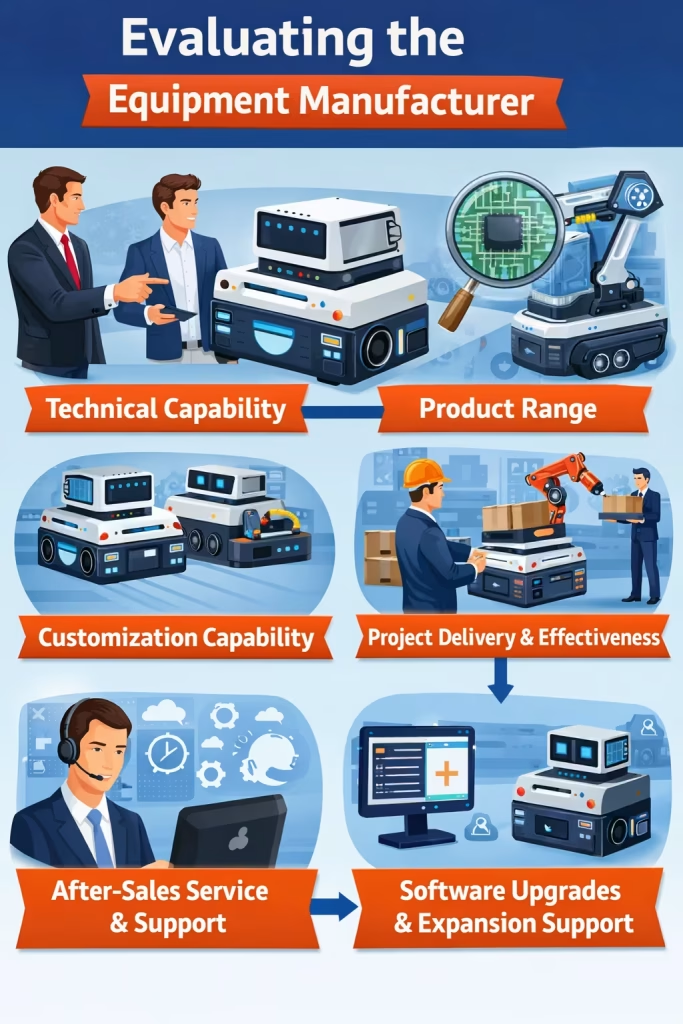
| Customization Capability: For non-standard scenarios, can the manufacturer quickly provide customized solutions, including adjustments to mechanical structure, sensor configuration, and software functionality?
| Project Delivery & Effectiveness: To ensure smooth project implementation, enterprises need to understand the manufacturer’s average deployment cycle for similar scenarios and the project’s one-time delivery success rate. If the supplier is a top-tier industry manufacturer, a delivery success rate of over 98% is typically expected.
| Benchmark Cases & Verifiable Benefits: Request benchmark customer cases similar to your own industry and scenarios. Verify that promised metrics such as cost reduction, efficiency improvements, and productivity gains are genuine and verifiable.
| After-Sales Service & Support: Response Speed & Maintenance Capability: Can they respond quickly and resolve issues promptly after a failure? Are warranty periods and maintenance costs transparent and reasonable?
| Software Upgrades & Expansion Support: Do they offer regular software upgrade services? Is equipment expansion and functional extension convenient, ensuring the system can continuously optimize as the business evolves?
AGV or AMR: Evaluating Procurement Costs
When selecting an AMR or AGV, procurement cost assessment requires a comprehensive consideration of multiple factors. Key points include:
| Base Equipment Procurement Cost
AGV: Typically lower in cost. Basic models (e.g., magnetic tape or QR code guided AGVs) are priced at approximately $10,000–$20,000 per unit. If advanced features such as laser navigation are required, the price may rise to $20,000–$40,000.
AMR: Due to the need for sensors such as LiDAR and cameras, as well as complex navigation algorithms, the unit price generally ranges from $20,000–$40,000. High-end models or heavy-load AMRs may exceed $40,000.
| Deployment & Integration Costs
AGV: Deployment costs can be high if guidance infrastructure like magnetic tape, reflectors, or landmarks needs installation. In large or complex sites, guidance infrastructure costs can account for 20%-50% of the procurement cost. Integration with existing systems (e.g., WMS, MES) typically adds 10%-20% to the total procurement cost.
AMR: Deployment is relatively simpler, usually requiring only environment mapping and basic configuration. Deployment costs are typically lower, accounting for 5%-15% of the total procurement cost. However, integration costs may increase if deep integration with complex systems or custom development is required.
| Maintenance & Operational Costs
AGV: Maintenance costs are relatively low, primarily involving tasks like magnetic tape replacement and guidance infrastructure upkeep. Average annual maintenance cost is approximately 3%-5% of the equipment procurement cost. For laser-guided AGVs, maintenance costs for components like LiDAR can be higher, potentially reaching 10%-15% annually.
AMR: Due to complex sensors and navigation systems, maintenance costs are higher. Average annual maintenance cost is approximately 10%-15% of the equipment procurement cost, covering sensor calibration, software upgrades, battery replacement, etc.
| Long-Term Cost Effectiveness
AGV: Suitable for scenarios with fixed paths and stable environments. Long-term operational costs are lower. However, if business changes necessitate path adjustments or scenario expansion, redeploying guidance infrastructure can be costly.
AMR: Although initial procurement and operational costs are higher, AMRs adapt well to dynamic environments, reducing additional costs associated with path adjustments and scenario changes. This can lead to better long-term cost effectiveness, especially in scenarios with high frequency, multiple tasks, and frequent environmental changes.
Note: The pricing of AGV or AMR varies across different regions; the data presented here is derived from countries in the Asia-Pacific region, whereas prices in European and North American countries are generally higher.
AGV or AMR: Stay Updated on Equipment and Payment Methods
With the advancement of technology and innovation in business models, enterprises need to understand the development directions of both AGVs and AMRs when procuring these technologies. From a development perspective, companies should consult AGV or AMR manufacturers about the latest equipment and payment options to make better purchasing decisions.
| Trends in Technological Integration: The trend of technological integration is blurring the lines between AGVs and AMRs. AGVs enhance their flexibility by incorporating advanced technologies from AMRs, while AMRs solidify their decision-making and integration capabilities while also increasing their load capacities, thereby further reinforcing their advantages in complex scenarios. Currently, some high-end AGVs also possess SLAM navigation capabilities, and heavy-load AMRs (with capacities ranging from 1 to 5 tons) are gradually maturing.
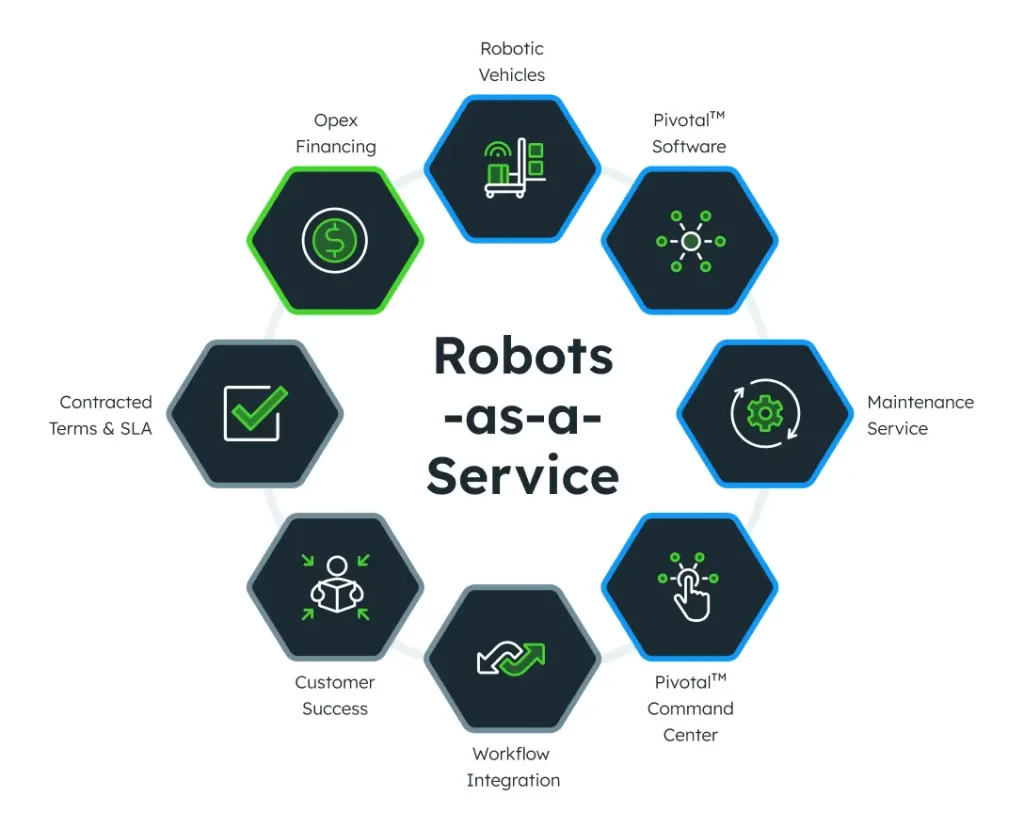
| Innovation in RaaS Business Models: For AMRs, due to their flexible deployment and the lack of required infrastructure modifications, a ‘usage-based or task-based leasing’ model can be introduced, allowing enterprises to pay as needed and lowering the initial investment threshold. AGVs can also explore a ‘basic leasing + path modification fee’ model to meet the needs of different scenarios.
Recommended In-depth Reading from AI Robots Eidos
RaaS is not only an innovation in pricing models but also a catalyst for the robotics industry’s transformation from a ‘product-oriented’ approach to a ‘service-oriented’ one.
By lowering the barriers to adoption, transferring technological risks, enabling data闭环 (closed-loop data feedback), and expanding application scenarios, it accelerates the evolution of robots from ‘specialized equipment for high-end manufacturing’ to ‘ubiquitous productivity tools.’ For enterprises, it effectively reduces the capital investment required for procuring automation equipment. For robot manufacturers, the ability to build mature RaaS operational capabilities is increasingly becoming one of the key metrics for measuring long-term competitiveness.
If enterprises or readers wish to gain a deeper understanding of the RaaS business model, they can read this in-depth article on RaaS (Robots-as-a-Service).
AGV or AMR: Standardized Procurement Process (For Reference)
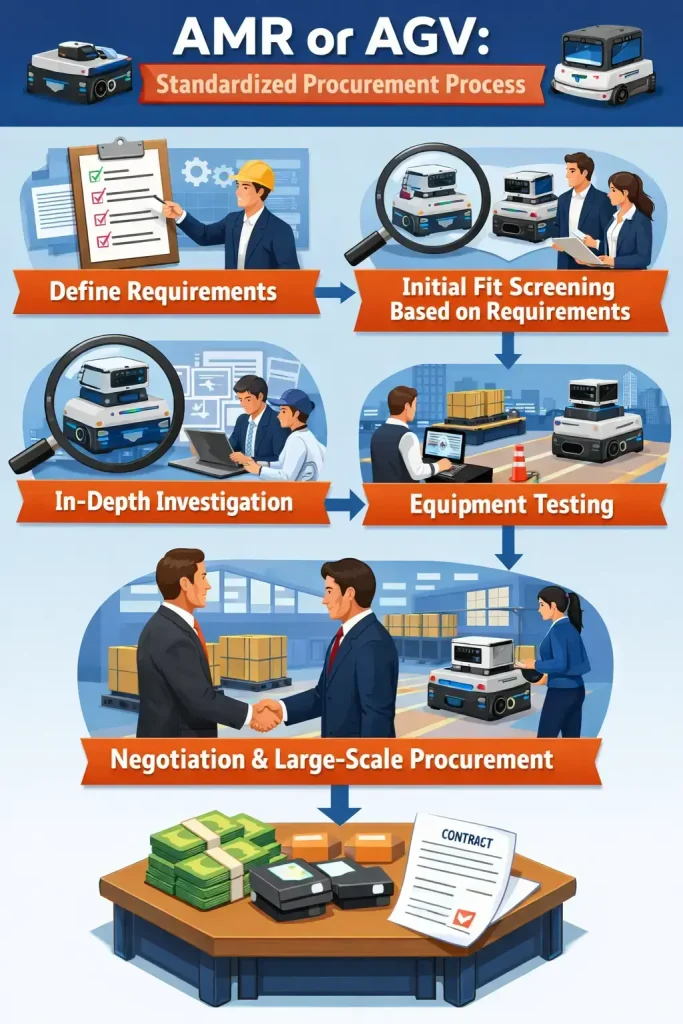
Define Requirements
Clearly define the application scenario, load requirements, navigation environment, travel speed, charging needs, and integration points with existing systems. Avoid over-specification unless absolutely necessary.
|
Initial Fit Screening Based on Requirements
Based on dimensions such as navigation method, system compatibility, industry experience, and product cost, select 3-5 candidate manufacturers that meet the technical requirements.
|
In-Depth Investigation
Request video demonstrations from manufacturers showcasing key functions like obstacle avoidance capability, path planning, and emergency braking. Some manufacturers may offer a remote API test environment.
|
Equipment Testing
Procure 2-5 units for trial runs in the actual operational scenario, rather than just conducting laboratory tests. Focus on the manufacturer’s response speed, problem-solving ability, and cooperation during small-scale trials – these often better indicate the quality of long-term partnership than specifications on paper.
|
Negotiation & Large-Scale Procurement
Once small-scale validation is successful, proceed to the large-scale procurement phase. At this stage, based on verified real-world performance, negotiate more confidently with manufacturers regarding volume discounts, delivery lead times (typically 15-50 days), payment terms, and after-sales support commitments.
Insight from AI Robots Eidos about AGV or AMR
| Future enterprise procurement should not focus solely on the individual prices of AGV or AMR, but rather assess their value as ‘data nodes.’ AMRs are not just carriers; they are mobile sensing terminals. Although their unit prices are relatively high (ranging from $20,000 to $40,000), they generate environmental data, path heat maps, and equipment interaction logs during operation, which can feed into digital twin systems. Therefore, the procurement costs for AMRs should be partially included in the enterprise’s ‘digital transformation capital expenditures’ rather than just categorized as ‘logistics equipment expenditures.’
| As AMRs become more widespread, the RaaS (Robotics as a Service) model will become mainstream. Future enterprise procurement will no longer be a one-off transaction. Enterprises can evaluate subscription services offered by suppliers that charge ‘per mileage’ or ‘per hour.’ This model transfers the risks of equipment depreciation and algorithm iteration to the manufacturers, allowing enterprises to only pay for ‘transport capacity,’ which is the optimal solution to avoid technology iteration risks in flexible manufacturing lines with frequent process changes.
| The smart factories of the future will not be a choice between AGV or AMR, but a symbiosis of heterogeneous robot clusters. Enterprises should select suppliers capable of providing a unified scheduling platform. Regardless of whether the underlying technology is AGV or AMR, the top-level scheduling system should be able to mask hardware differences and achieve ‘vehicle-cloud integration.’ This will be the ultimate guarantee for enterprises to avoid being ‘captured’ by specific hardware during future technological evolution.
Image Credits: Otsla & AI