
Table of Contents
AGV vs. AMR can be imagined as a car running on a fixed track versus a car equipped with an intelligent perception system. This article takes AGV vs. AMR as its theme, not to argue that AMR is superior to AGV, but to help companies better procure equipment that suits their specific needs, as these two play complementary roles in automated production.
What Are Agvs
Automated Guided Vehicles (AGVs) are automated devices that move by relying on a fixed path, such as magnetic strips, floor markers, or optical/electromagnetic guidance. They identify and pick designated items and transport them from point A to point B. Because their path and operational mode are pre-programmed, AGVs can perform tasks with considerable stability and efficiency within a fixed space. This makes them suitable for relatively simple environments and standardized workflows.
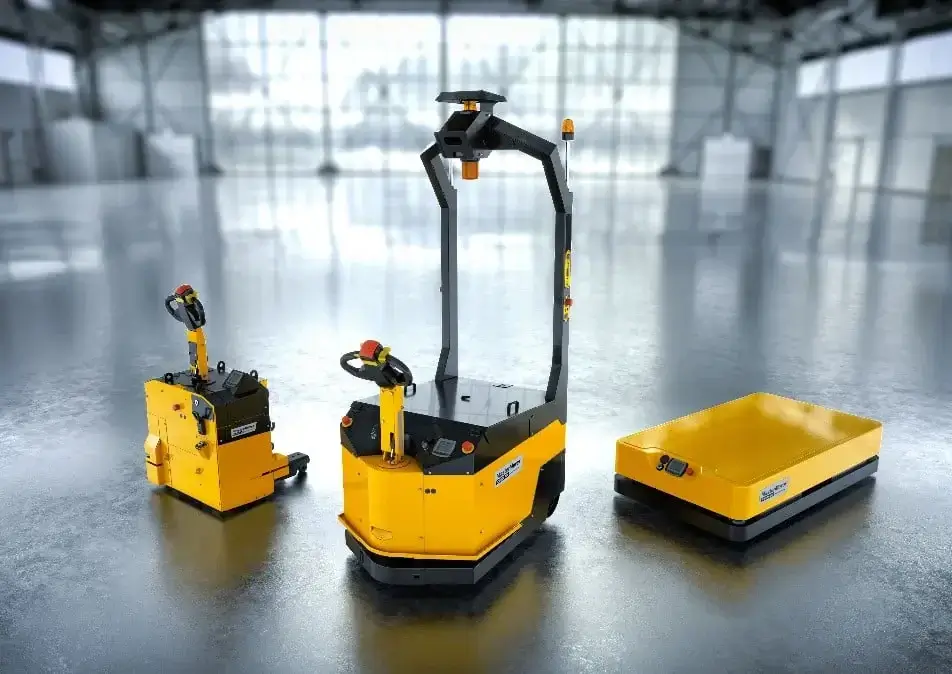
AGVs are commonly found in factories or warehouse logistics centers. By effectively identifying items of specific sizes or shapes (such as pallets, packages, or product parts), they can quickly complete the transfer or quality control tasks for various items. If equipped with a robotic arm or conveyor belt, their basic transport function can be upgraded to assist humans in product assembly tasks. Furthermore, integrating AGVs with machinery at different heights can provide factories with greater flexibility and possibilities for capacity expansion and production line changes.
What Are Amrs?
An Autonomous Mobile Robot (AMR) is a mobile device that offers greater flexibility compared to an AGV. While it also assists humans with transport and object identification tasks, its key difference lies in its movement. An AMR’s movement does not depend on a pre-set path. Instead, it uses vision sensors to perceive its surroundings, rapidly synchronizing the acquired environmental information with a central system to make real-time, dynamic path decisions, enabling autonomous navigation and obstacle avoidance.
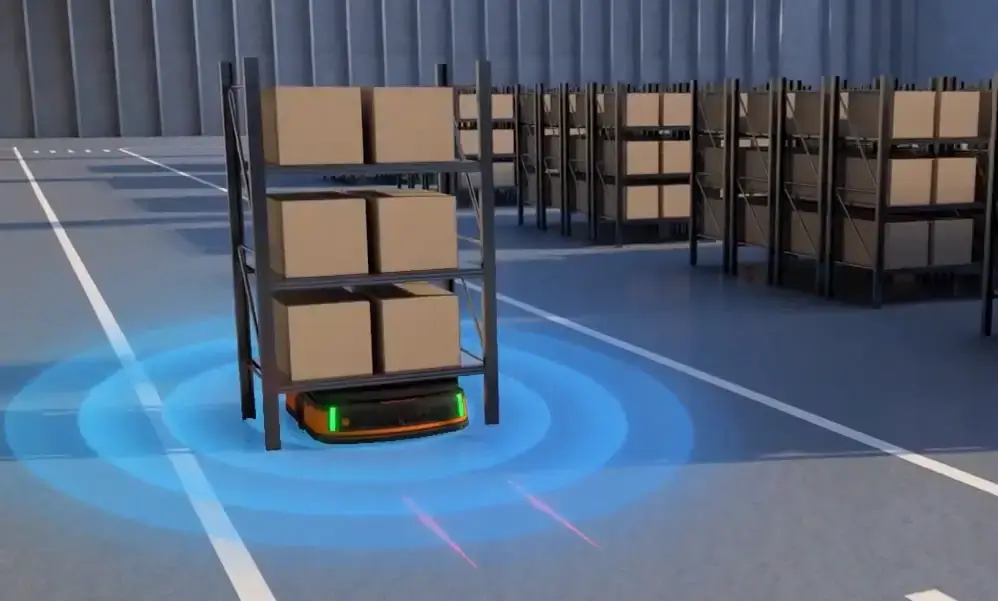
An AMR’s path planning, object recognition, and obstacle avoidance speed are highly dependent on the detail captured by its vision sensors. Since environmental factors are uncontrollable and subject to change or unexpected events, AMRs excel in handling complex scenarios and dynamic changes. This makes them ideal for environments involving human interaction. Service robots like food delivery robots in restaurants, concierge robots in hotels, or customer service robots in retail stores are all built upon the AMR model.
Recommended In-depth Reading from AI Robots Eidos
A comprehensive and systematic understanding of AGV and AMR is the foundation and prerequisite for a comprehensive comparison between the two, helping to analyze their differences from multidimensional perspectives such as technology, functionality, and application scenarios, thus providing a basis for selection in practical applications.
If readers are interested, they can refer to related articles about AGV and AMR.
AGV vs. AMR: Performance Comparison
AGV vs. AMR: Navigation
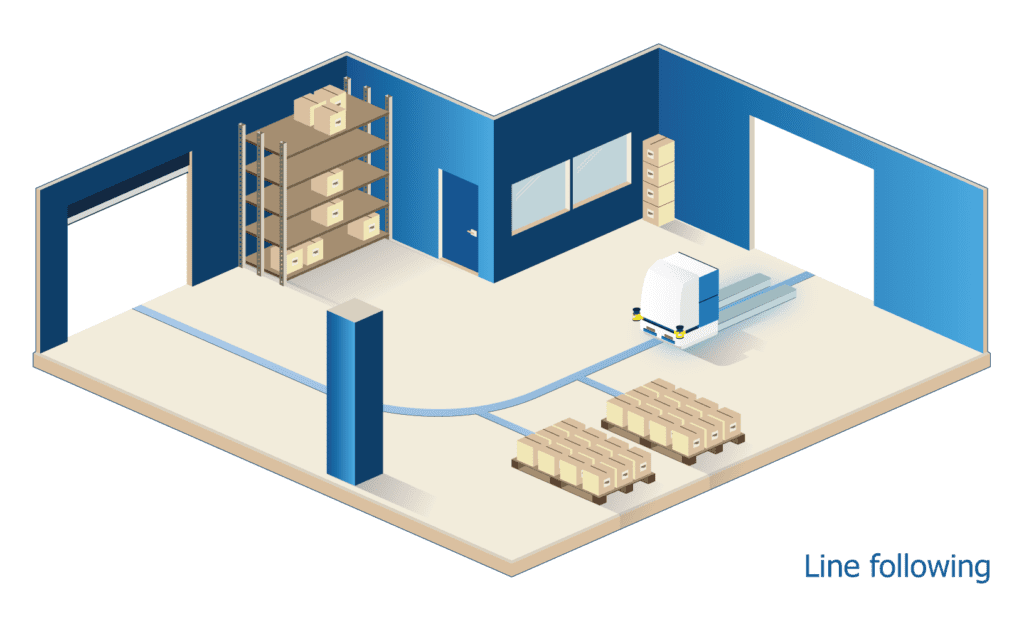
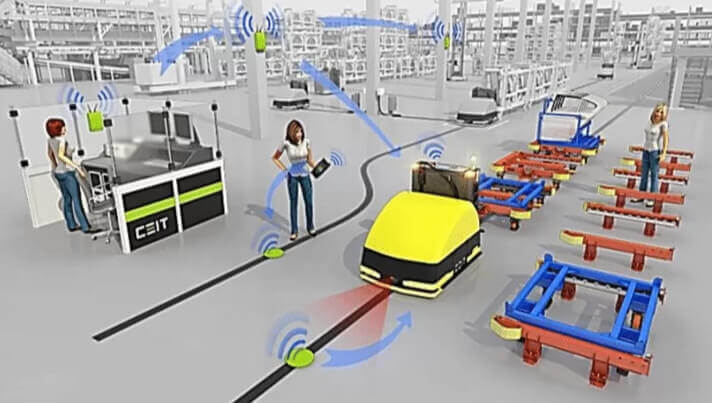
| AGVs rely on external guidance infrastructure, such as magnetic strip/tape navigation, QR code/color tape navigation, or laser reflector navigation. This navigation method is characterized by high precision but poor flexibility. For example, with magnetic strip/tape navigation, the AGV uses onboard electromagnetic sensors to identify magnetic field signals and travels along a pre-set path. The path is fixed. If a path change is required, new magnetic strips/tape must be laid down along the new route.
| AMRs primarily use methods like Visual SLAM navigation and multi-sensor fusion navigation. AMRs can autonomously build maps and navigate. For instance, with Laser SLAM navigation, they use LiDAR to scan the surroundings, build high-precision maps in real-time, and calculate their own position through feature matching and algorithms, requiring no external markers. However, autonomous navigation algorithms are complex and demand higher computing resources.
AGV vs. AMR: Path Planning
| AGVs determine their travel route via external guidance infrastructure like magnetic strips, QR codes, or reflectors. The path is fixed during deployment; changing it requires re-laying or adjusting the guidance infrastructure. Lacking autonomous path planning capabilities, AGVs typically stop and wait when encountering an obstacle, only resuming travel once the obstacle is removed. They cannot proactively detour. AGVs struggle to adapt to complex, changing environments or temporary task adjustments, resulting in low flexibility.
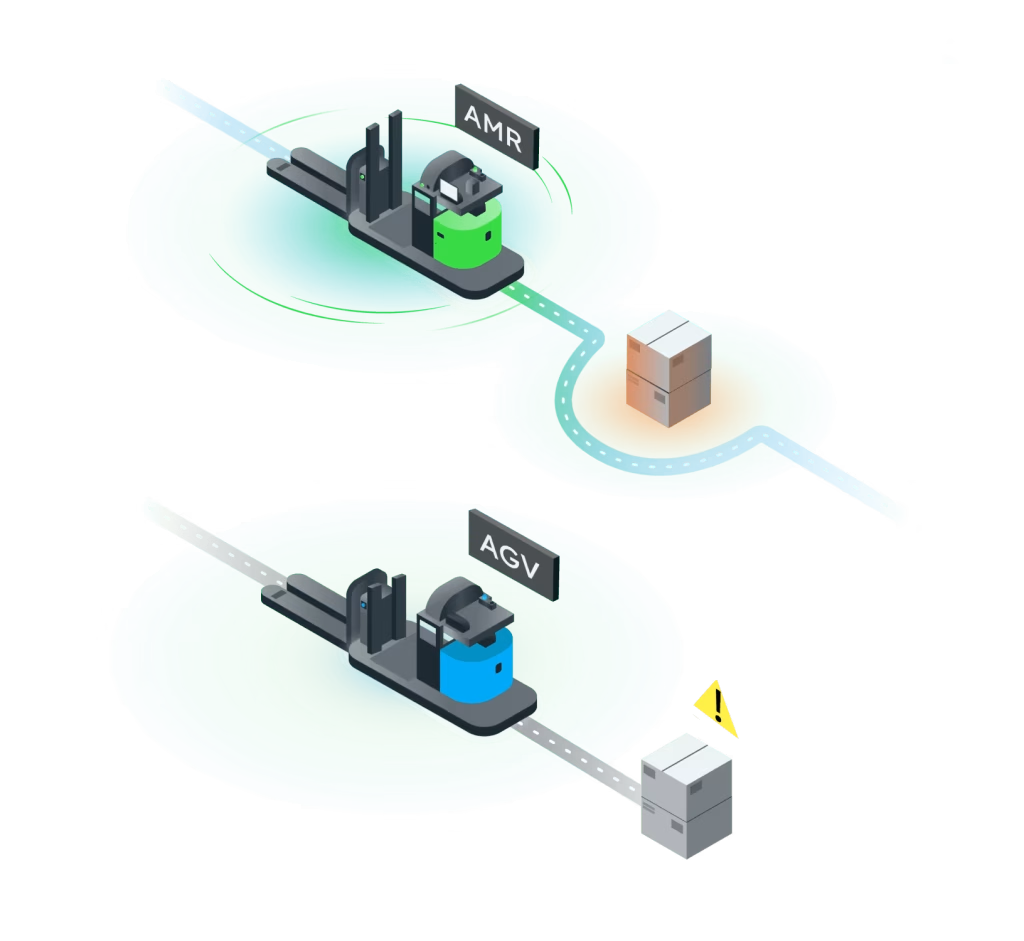
| AMRs use SLAM technology combined with sensors (like vision sensors) to autonomously build maps and plan paths. These paths can be dynamically adjusted based on the environment. When an AMR detects a static or dynamic obstacle, it can use algorithms to autonomously calculate a detour path, achieving dynamic obstacle avoidance and continuing towards its target. AMRs can support multiple path selections and optimization based on task requirements and environmental changes.
AGV vs. AMR: Environmental Perception Capability
| Most AGVs rely on single or a few sensors, such as magnetic strip/marker sensors, QR code readers, or laser reflectors. Their perception range is limited, primarily focused on simple obstacle detection near the pre-set path. They struggle to perceive detailed surroundings comprehensively. They generally only detect the presence and location of physical obstacles, lacking semantic understanding of the environment—they cannot distinguish between different types of objects or scene states.
| AMRs typically feature multi-sensor fusion systems, including LiDAR, cameras, and Inertial Measurement Units (IMUs), enabling 360-degree environmental perception. Through image recognition and machine learning, AMRs can achieve semantic understanding of the environment, such as identifying object categories (e.g., person vs. cargo) or judging scene states (e.g., whether an aisle is clear), providing richer information to the control system.
AGV vs. AMR: Deployment Speed
| AGVs require physical modification of the operating environment, such as laying magnetic strips or tape, to provide navigational references. The larger the operational area, the greater the deployment workload. This implies a longer deployment period; completing installation and commissioning for large projects can take weeks or even months. Constrained by the guidance system, multi-robot coordination for AGVs often relies on a central control system, which can lead to issues like queuing and lower coordination efficiency.
| AMRs typically require no physical environment modification. Using SLAM technology, the robot autonomously scans the environment to generate a map, requiring minimal changes to existing facilities. This enables rapid deployment, usually taking hours to days to complete map building, edit stopping points, and configure tasks, allowing for quick operational startup. AMRs can achieve multi-robot coordination through intelligent algorithms, allocating tasks and avoiding conflicts more efficiently.
AGV vs. AMR: Safety
| AGVs, due to their reliance on fixed paths, offer relatively stable safety performance but have limited ability to handle unexpected situations in complex environments.
| AMRs, equipped with more advanced perception and decision-making systems, can better ensure the safety of personnel and equipment in complex environments, although there might be potential risks related to software malfunctions.
AGV vs. AMR: Level of Intelligence
| The intelligence level of AGVs is lower than that of AMRs. However, due to their performance stability and lower procurement cost advantages, AGVs are more suitable for use in fixed-path, highly repetitive, and structured environments.
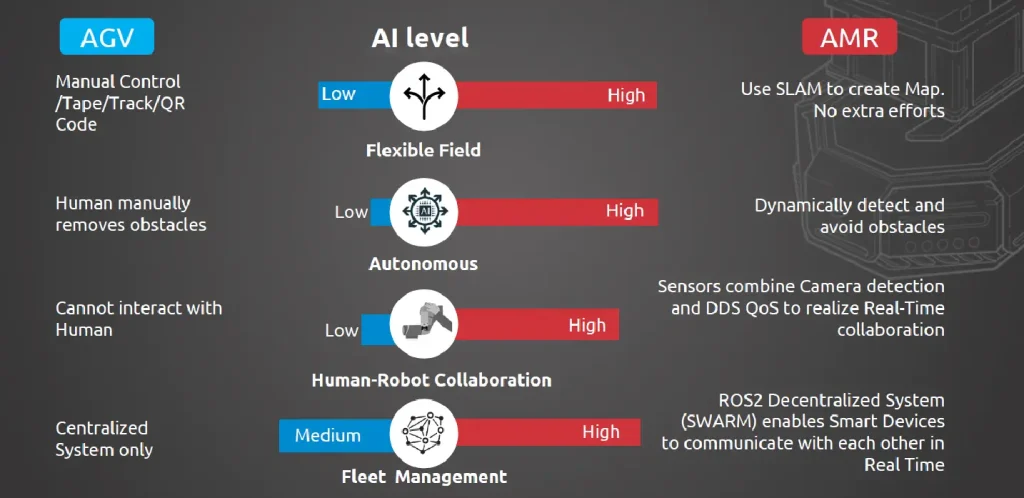
| AMRs are significantly superior to AGVs in environmental perception, path planning, decision-making ability, and collaborative operation. They represent a higher level of intelligent mobile robot and are better suited for complex, dynamic scenarios requiring flexible responses.
AGV vs. AMR: Price & Cost Comparison
Due to the fluctuating prices of AMRs and AGVs, the price comparison in this article is for reader reference only.
Product Price
| AGV: Entry-level AGV prices typically range from $10,000 to $20,000.
| AMR: Entry-level AMR prices typically range from $15,000 to $30,000.
Deployment Cost
| AGV: Requires laying guidance infrastructure like magnetic strips, markers, or laser reflectors. Deployment costs are relatively high, especially in large or complex sites, where facility modification costs can account for 20% to 50% of the equipment price.
| AMR: Primarily deploys through software setup for maps and task points, requiring minimal or no physical environment modification. Deployment costs are low, typically 10% to 20% of the equipment price.
Additional Costs
Additional costs mainly include brand premiums for different brands, equipment installation and commissioning fees (10%-20% of equipment price), personnel training costs, and annual equipment maintenance fees (5%-8% of equipment price).
It is also important to note that whether for AGV or AMR, procurement cost is associated with the product’s functionality.
| AGV: Functionality is relatively fixed. Adding other advanced features like automatic charging, robotic arms, or multi-robot dispatching will significantly increase the price (by 10%-30% or more).
| AMR: Due to inherent advanced features like autonomous navigation, dynamic obstacle avoidance, and intelligent path planning, AMRs are typically 10%-30% more expensive than AGVs with similar load capacity. If a certain degree of customization is required, such as integrating complex sensors, AI algorithms, or deep integration with existing enterprise systems, the price will increase further.
AGV vs. AMR: Applications
Typical AGV Applications
| Fixed Routes, Highly Repetitive Operations: Suitable for scenarios with stable production processes and long-term, unchanged material handling routes, such as material transfer between fixed assembly lines in large automotive manufacturing plants or goods movement between fixed racks in traditional warehouses. AGVs efficiently handle point-to-point transport.
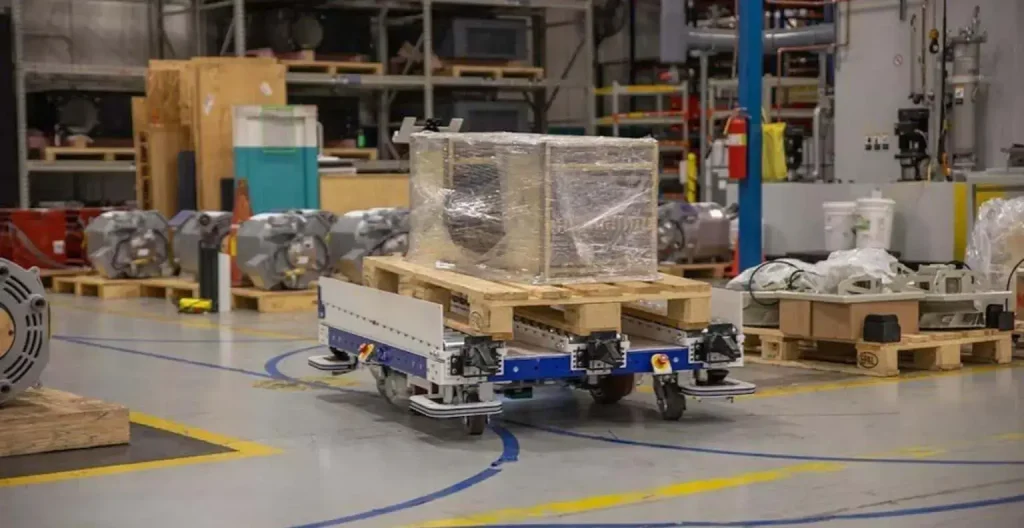
| Heavy Loads, High-Precision Docking: In scenarios requiring heavy payloads (e.g., large pallets, equipment components) or high-precision docking with specific equipment (e.g., machine tools, stacker cranes for automated warehouses), AGVs leverage their stable navigation and positioning capabilities to ensure docking accuracy and safety.
Typical AMR Applications
| Dynamic Environments, Need for Flexible Paths: Suitable for scenarios where the layout is frequently adjusted, or operation paths need dynamic changes, such as “goods-to-person” picking in e-commerce warehouses or mixed-model production in flexible manufacturing workshops. AMRs can autonomously plan paths, quickly adapting to new layouts or temporary tasks.
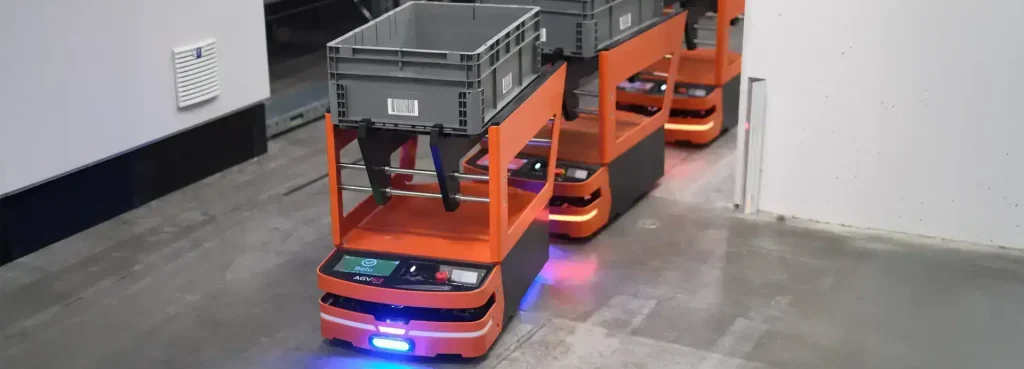
| Multi-task, Multi-node Operations: Ideal for scenarios requiring frequent switching between task points and executing various tasks, such as multi-zone replenishment, sorting, and distribution in warehouses. AMRs can achieve multi-robot coordination through intelligent scheduling, improving overall operational efficiency.
Insight from AI Robots Eidos about AGV vs AMR
| The future distinction between AGV and AMR will no longer be about how they move, but rather what data they can contribute to the industry. AGV serves as the ‘execution endpoint’: the data it generates is singular (such as ‘arrived at point A’), representing passive data points in the industrial IoT. AMR operates as the ‘perception endpoint’: equipped with multiple sensors (cameras, radar), it continuously scans and models the physical world during its movement.
| When companies procure AMRs, they are buying not just a transport vehicle, but a sensor platform capable of moving within the factory and continuously collecting real-time environmental data to update digital twin models. The core value of AMR will extend beyond merely ‘moving items from A to B’ to optimizing the allocation of ‘spatial and temporal resources.’ With strong environmental comprehension (semantic SLAM), AMRs can understand that ‘the consumption rate of materials in this process is accelerating.’ They transport not only goods but also ‘time’ (reducing waiting) and ‘information’ (predictive replenishment).
AGVs address logistical automation issues, while AMRs will ultimately resolve the dynamic optimization of production rhythms, evolving from execution tools into participants and regulators of production pace.
| In the future, AGVs and AMRs will complement each other and move towards deep integration. A hybrid scheduling system will emerge: in structured scenarios, low-cost, high-precision AGVs will be deployed for point-to-point repetitive transports, akin to highways in factories. In areas where interaction with humans and environmental complexity is present, AMRs will serve as shuttles connecting these highways.
Future intelligent logistics solutions will no longer be about choosing AGV or AMR, but rather how to design scheduling algorithms that allow AGVs’ ‘muscles’ and AMRs’ ‘brains’ to work together seamlessly.
Image Credits: Rozitek & Mastermover & Bluebotics & Vecnarobotics & Roboticstomorrow & Phenikaa-x & Safelog
Other Articles on The Topic of AGVs or AMRs
Level A (Foundational )