Time of Flight Cameras: Spatial Sense For Devices
Table of Contents
Time of Flight Cameras provide various smart devices with “spatial perception capability” at relatively low cost, enabling them to perceive three-dimensional space in real time and with high accuracy, thereby significantly enhancing their intelligence.
What Is A Time of Flight Camera?
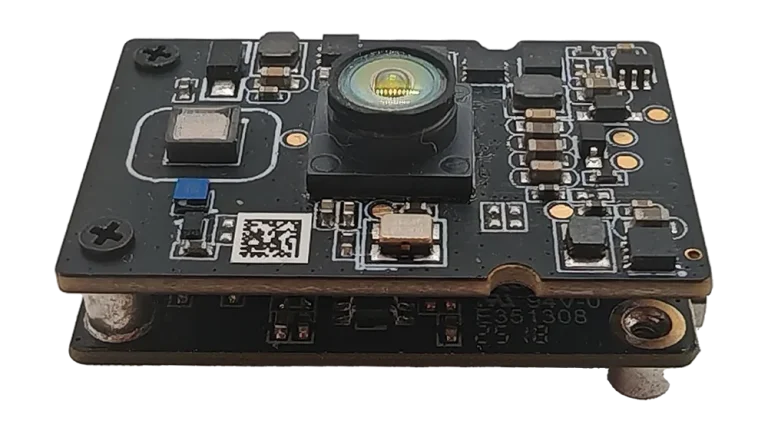
Devices that utilize Time of Flight technology for imaging are called Time of Flight Cameras (ToF Cameras). A ToF camera is mainly composed of several units, including a light source, optical components, a sensor (ToF chip), control circuits, and processing circuits.
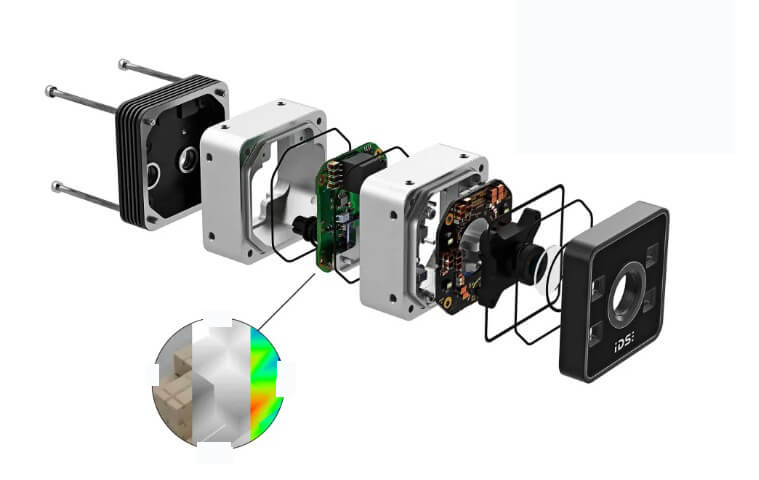
Time of Flight technology employs an active light detection approach. Unlike general lighting requirements, the purpose of the ToF illumination unit is not illumination but to use the differences between emitted and reflected light signals for distance measurement. Therefore, the illumination units of ToF cameras all emit light after high-frequency modulation of the optical signal. ToF cameras can simultaneously measure intensity and distance for each pixel.
Classification of Time of Flight Cameras
Time of Flight Cameras can be classified by measurement principle into direct Time of Flight (dToF) cameras and indirect Time of Flight (iToF) cameras. iToF technology can be further divided into Continuous-Wave modulation (CW-iToF) and Pulsed modulation (P-iToF).
dToF Cameras: The system emits extremely short laser pulses, and the receiving end uses high-precision timing circuits (such as TDCs) to capture the arrival time of the echo signal. The time of flight (Δt) is determined by identifying the peak or leading edge of the signal waveform, from which the distance is directly calculated. The core principle lies in the time-stamping of individual photon events.
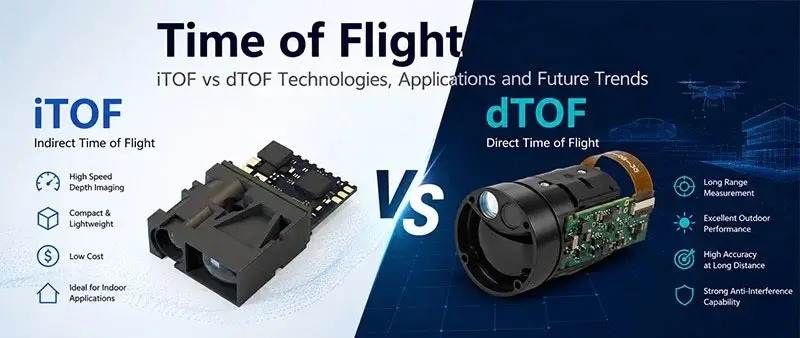
iToF Cameras:
CW-iToF: The system emits a continuously modulated sinusoidal (or square wave) optical signal. The receiving pixels accumulate charge (integration) from the reflected light within specific integration windows. By sampling at multiple windows with different phases and comparing the integrated values, the phase difference (Δϕ) between the transmitted and received signals is calculated, from which the distance is indirectly derived.
P-iToF: The system emits repetitive pulse signals and analyzes the phase of the pulsed signal to obtain depth. Unlike the four-phase sampling of CW-iToF, P-iToF employs a dual-sampling technique: the laser transmitter is modulated into two phase energy maps (0° and 180°), and additionally, sampling is performed with no light pulse emitted to collect only background light signals for compensation.
Recommended Related Reading from AI Robots Eidos
Understanding iToF (indirect Time of Flight) and dToF (direct Time of Flight) is the key to gaining a deep understanding of Time of Flight (ToF) cameras. ToF cameras calculate distance by measuring either the time of flight of light pulses (dToF) or the phase difference (iToF). The fundamental difference between these two principles directly determines the hardware architecture, performance characteristics, and applicable scenarios of ToF cameras.
If readers are interested, they can refer to the following two articles for more detailed information.
dToF: The Comprehensive Introduction
iToF: A Complete Technical Overview
Advantages of Time of Flight Cameras
–High Frame Rate: Since ToF cameras can rapidly scan an entire scene in a single exposure, they can output depth data at rates of up to 30 frames per second. This feature makes ToF cameras (primarily iToF cameras) excel in high-speed or real-time applications that require continuous, immediate feedback, such as mobile robotics.
–Strong Environmental Adaptability: ToF cameras are relatively resistant to ambient light interference and can operate under various lighting conditions. This capability allows them to be deployed in a wide range of lighting environments, such as indoor factories or outdoor vehicles. It should be noted that ToF cameras can work stably under most bright-light conditions, but they may still experience some interference in scenarios with extreme direct strong light or close-range high-reflectivity surfaces.
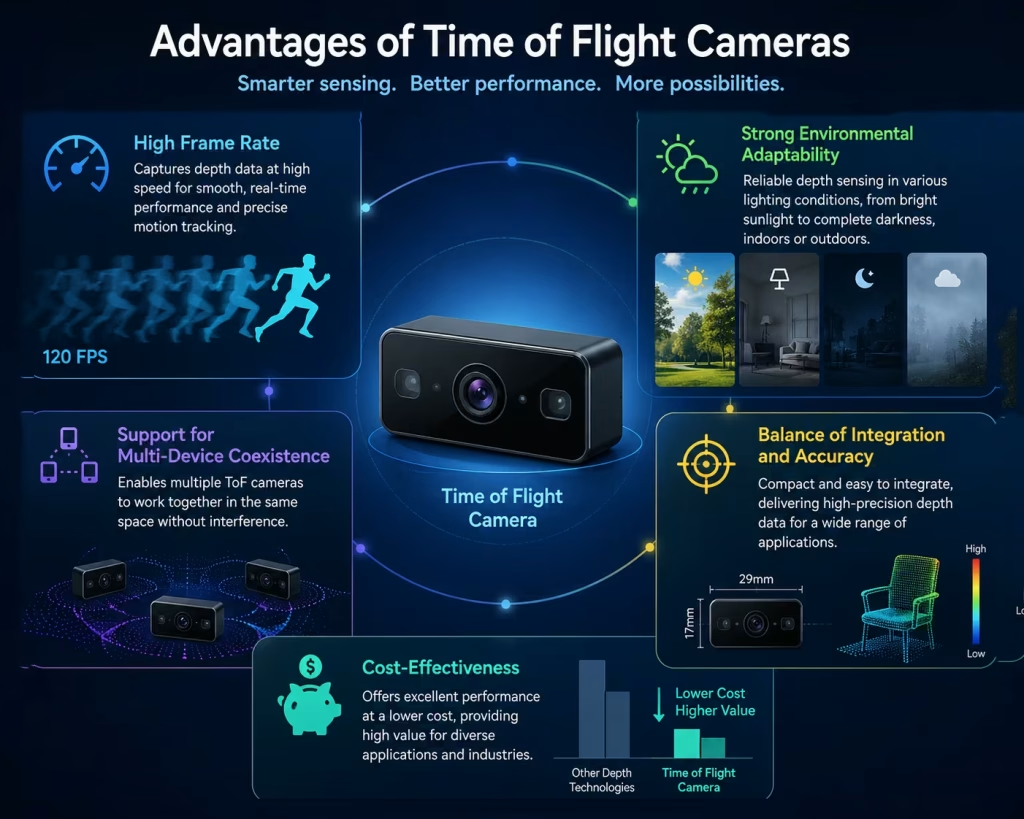
–Support for Multi-Device Coexistence: ToF cameras (especially iToF cameras using pulsed-wave technology) employ unique optical modulation and signal processing techniques to effectively avoid mutual optical interference (crosstalk) when multiple cameras operate simultaneously in the same space. This enables multiple mobile robots (AGVs/AMRs) in the same area to work together seamlessly without the need for complex physical isolation or strict frequency synchronization, greatly improving deployment efficiency in high-density automation scenarios.
–Balance of Integration and Accuracy: Since the operating principle is not complex and does not involve any moving parts, ToF cameras offer high integration and a compact form factor. In terms of accuracy, ToF cameras can achieve millimeter-level precision, which meets the requirements of the vast majority of industrial automation applications.
–Cost-Effectiveness: Affordable cost is a prerequisite for large-scale adoption of any technology. The manufacturing and procurement costs of ToF cameras are lower than those of structured light cameras and other depth-sensing cameras, making them more accessible to both enterprises and individual consumers. This further expands their applications in both professional industrial fields and consumer-grade products.
Disadvantages of Time of Flight Cameras
–Susceptibility to Surface Characteristics of Objects: ToF cameras are sensitive to highly reflective materials (e.g., mirrors). Strong reflections can cause abnormal light behavior, disrupt the received signal, create multipath interference, and lead to depth calculation errors. They also perform poorly on low-reflectivity and transparent materials, as these materials absorb or transmit light, preventing the camera from accurately receiving the reflected light and thus failing to obtain accurate depth information.
–Decreased Accuracy at Long Range: At long distances, ToF cameras are constrained by physical limitations (light intensity attenuation) and ranging principles (trade-off between accuracy and range). When the measurement distance exceeds 10 meters, the camera’s accuracy degrades significantly.
Comparison Between Time of Flight Cameras and Other Depth Camera Technologies
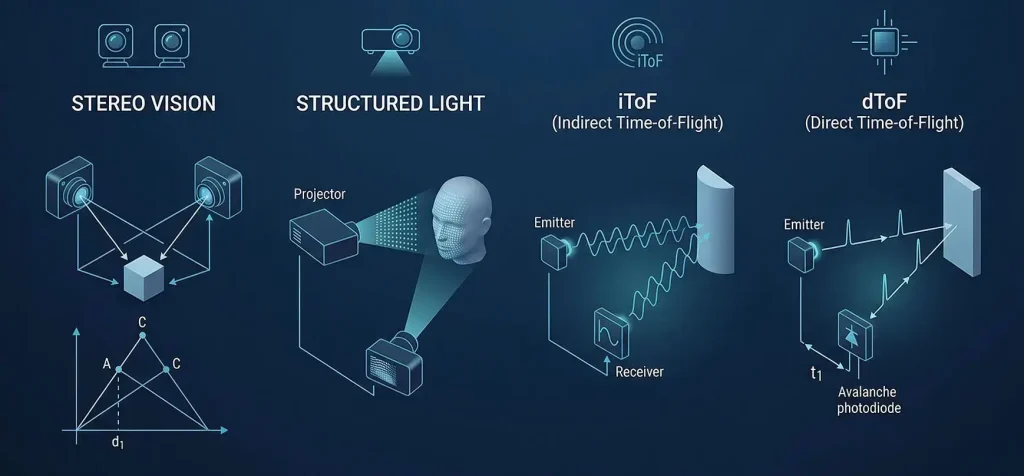
| Comparison Dimension | Stereo Vision | Structured Light | i-ToF | d-ToF |
| Applicable Distance | Short range | Short range | Medium to long range | Medium to long range |
| Core Principle | Parallax triangulation | Parallax triangulation | Phase-based ranging | Time-of-flight ranging |
| Sensor Type | RGB/IR CMOS | IR CMOS | i-ToF CIS | SPAD array |
| Manufacturing Complexity | Low | Low | Medium | High |
| Signal Type | Analog | Analog | Analog | Digital |
| Emitted Light Pulse | None | Low frequency | Medium to high frequency | High frequency |
| Accuracy Characteristics | High at close range, degrades with the square of distance | High at close range, degrades with the square of distance | Error is linearly related to distance | Stable error within operating range |
| Power Consumption | Low | Medium | Relatively high | Medium |
| Multipath Interference | Easy to resolve | Moderate difficulty | Difficult to resolve | Easy to resolve |
| Mass Production Calibration Complexity | Simple | Moderate | Complex | Moderate |
Key Parameters of Time of Flight Cameras
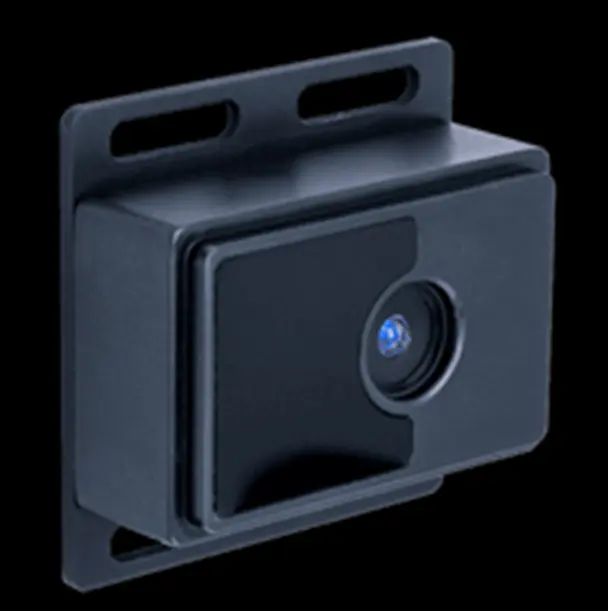
| Technology | Infrared Time-of-Flight |
| Resolution | 80 x 60 pixels |
| Range | Close range mode: 0.2m to 1.2m; Standard mode: 1m to 4m |
| Field-of-View (H x V) | 74° x 57° |
| Frame Rate | 30 fps |
| Depth Resolution | 1% of distance |
| Supply Voltage | 5V DC (USB powered) |
| Power Consumption | 4W |
| Operating Temperature | 0°C to 40°C |
| Storage Temperature | -20°C to 60°C |
| Interfaces | USB 2.0 Micro-B |
| Weight | 83g |
| Dimensions | 54 x 53 x 24 mm |
| Use Enviroment | Indoors |
| Supporting OS | Windows, Linux |
| Software | Terabee SDK (OpenNI 1.5/2.2 based), C/C++ samples, Python samples, ROS package |
Major Time of Flight Camera Manufacturers
–Sony: Holds a significant advantage in the consumer electronics sector. Its ToF camera technology is mature and widely used in smartphones and other products, featuring high frame rates and low power consumption, delivering a smooth user experience.
–Infineon: Possesses strong capabilities in the semiconductor field. Its ToF camera chips deliver excellent performance and provide core components to numerous device manufacturers. Their products stand out in terms of measurement accuracy and anti-interference capability.
Applications of Time of Flight Cameras
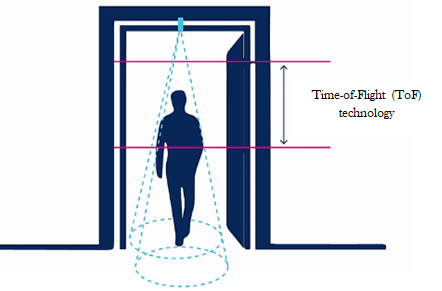
–People Counting / Passenger Flow Statistics: Time-of-Flight technology truly entered the public eye in 2020, and ToF cameras began to be used in people-counting software. The high frame rate of ToF cameras enables real-time people counting, providing managers with timely data support. Since ToF cameras capture only depth information and no personal imagery, they offer a non-participatory, non-intrusive method of people counting that effectively protects personal privacy.
–Smartphones: With ToF cameras, smartphones can improve the quality of photos taken. Because they can perceive depth, phones can use them to better understand the background in photos. Since they perform well in low-light conditions, they can also be used to take better pictures in areas without optimal lighting. ToF cameras are also used for motion detection and gesture recognition, allowing users to unlock their phones without touching them.
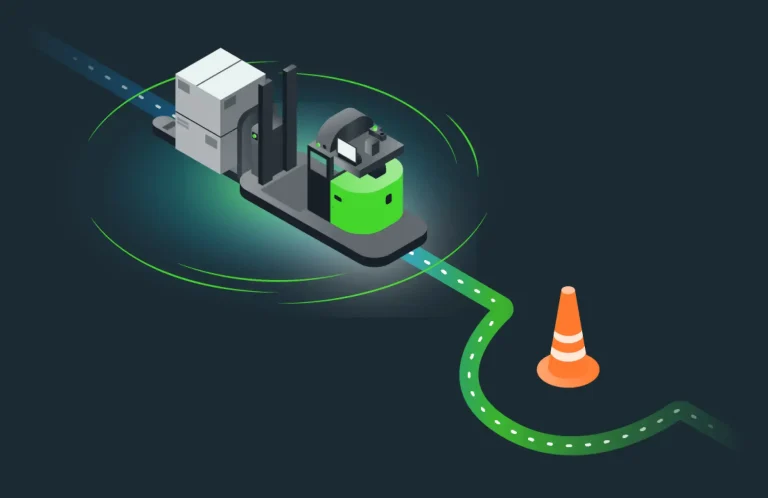
–Logistics and Warehousing: In logistics and warehousing, pallet recognition is a critical step in automated processes. The millimeter-level accuracy of Time of Flight Cameras is sufficient for pallet recognition, while their cost-effectiveness helps keep the overall cost of automated pallet recognition systems under control. ToF cameras are unaffected by lighting conditions and can operate stably in various illumination environments, ensuring the accuracy of pallet recognition. Their compact size and light weight also make them easy to integrate onto various autonomous mobile robots without adding extra burden.
Insight from AI Robots Eidos about Time of Flight Cameras
Against the backdrop of increasingly stringent data privacy regulations (such as GDPR and China’s Personal Information Protection Law), the “inherently privacy-friendly” nature of Time of Flight Cameras will become a huge differentiator. In the future, in places such as shopping malls where foot traffic analysis is needed but video surveillance is strictly restricted, ToF cameras are expected to become the preferred alternative to traditional RGB cameras, achieving a win-win scenario of “usable data without compromising privacy.”
Time of Flight Cameras are less expensive than other depth-sensing cameras such as structured light systems, while still delivering industrial-grade accuracy. This means that 3-Dimensional vision capabilities, which were previously affordable only to high-end automation systems, are now becoming a standard configuration within reach of small and medium-sized enterprises. ToF cameras are poised to drive the proliferation of automation from large production lines to smaller workshops, and from customized solutions to standardized deployments.
When the real-time, high-frame-rate depth data output by Time of Flight Cameras is deeply integrated with edge AI computing power, devices will evolve from “perceiving space” to “understanding scenes”—for example, a robot will not only detect an object ahead, but also determine its shape, posture, motion trajectory, and even material properties (via reflectivity information). This fusion of “depth + AI” will give rise to entirely new application paradigms.
Image Credits: 1stvision & Mrdvs & Lasersensor & AI & Web & Clarityiot