Coaxial Light Source: Key Specs and Smart Choices
Table of Contents
A coaxial light source uses a specialized optical design (such as a half mirror) to direct light vertically onto the object surface. This effectively eliminates shadows caused by surface unevenness, bumps, or tilts, reduces interference in the image, and makes target features clearer. We’ll introduce the Specs and selection criteria for coaxial lighting.
What Is A Coaxial Light Source?
The coaxial light source referred to here is a specialized light source for machine vision, not one used for general consumer lighting.
Recommended Related Reading from AI Robots Eidos
In machine vision / industrial vision, the significance of coaxial light sources lies in their special optical design, which addresses the imaging challenges posed by highly reflective, flat surfaces and minute defects, thereby significantly enhancing the detection accuracy, stability, and efficiency of machine vision systems.
Interested readers can refer to this article on machine vision.
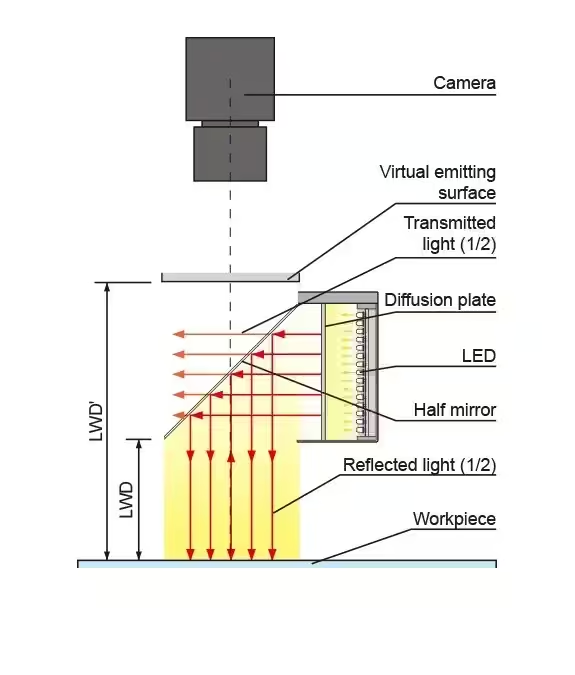
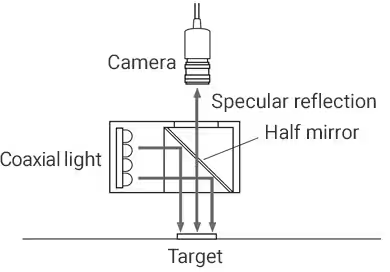
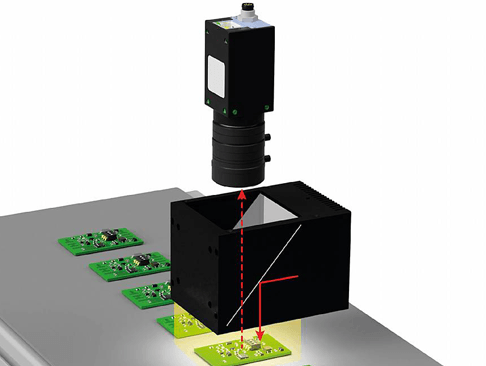
A coaxial light source is a box‑shaped device installed directly below the lens along the optical axis. It mainly consists of high‑density LEDs and a half mirror. The light emitted by the LEDs passes through the half mirror and aligns with the CCD and camera axes. A diffuser plate is placed in front of the light source to eliminate ghosting in the captured image, ensuring good uniformity. It highlights abnormal features on smooth surfaces and performs excellently for localized depressions or scratches.
The Difference Between Coaxial Light And Coaxial Light Source
Coaxial Light and Coaxial Light Source are often used interchangeably in the fields of machine vision and optical imaging. However, there are distinct differences between the two.
Coaxial Light emphasizes the illumination aspect and optical path effects, referring to a lighting method where the light is aligned coaxially (parallel) with the optical axis of the camera or lens.
Coaxial Light Source focuses on the hardware device and the shape of the light source, referring to the specific physical devices that achieve coaxial illumination.
In summary, Coaxial Light is an illumination concept, while Coaxial Light Source is the specific hardware that implements this concept.
Optical Specifications of Coaxial Light Source
Dimensions (Illumination Area)
The dimensions of a coaxial light source generally refer to the size of its effective illumination area. The light‑emitting area is typically rectangular or square, indicated by the length and width of the luminous surface. For example, the model “Coaxial Light Source‑50‑50” means an illumination area of 50 mm × 50 mm, and “Coaxial Light Source‑40‑30” means 40 mm × 30 mm. Some coaxial light sources have a circular illumination area, in which case the size is given by the equivalent diameter, e.g., “Coaxial Light Source‑40mm” means a luminous surface diameter of 40 mm.
Color
The color of a coaxial light source refers to the spectral wavelength of the emitted light. Common colors include red (R), blue (B), and white (W). Other colors such as green, yellow, ultraviolet (UV), and infrared (IR) are also available.
Conventional colors (red, green, blue, white, etc.) have a relatively small impact on cost – their prices are generally similar. However, colors like infrared and ultraviolet cost more than conventional colors. The cost increase is particularly significant for UV light sources with very short wavelengths. For example, a 365 nm UV light source used for curing is far more expensive than a standard blue light source.
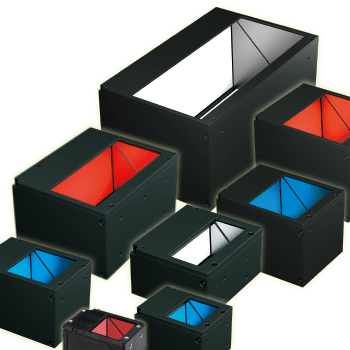
The color of the light source also has a noticeable effect on illumination. When illuminating the same object with different colors, the results can vary considerably. Generally speaking, because blue light has a shorter wavelength, it is less prone to diffraction (the shorter the wavelength, the weaker the diffraction effect), which can produce a sharper image.
Electrical Specifications of Coaxial Light Source
Power
The power of a coaxial light source depends on the number of LEDs and circuit losses. The more LED chips installed and the longer and wider the light source, the higher its power. Small coaxial light sources may have a power of less than 1 watt, while large ones can reach tens or even hundreds of watts.
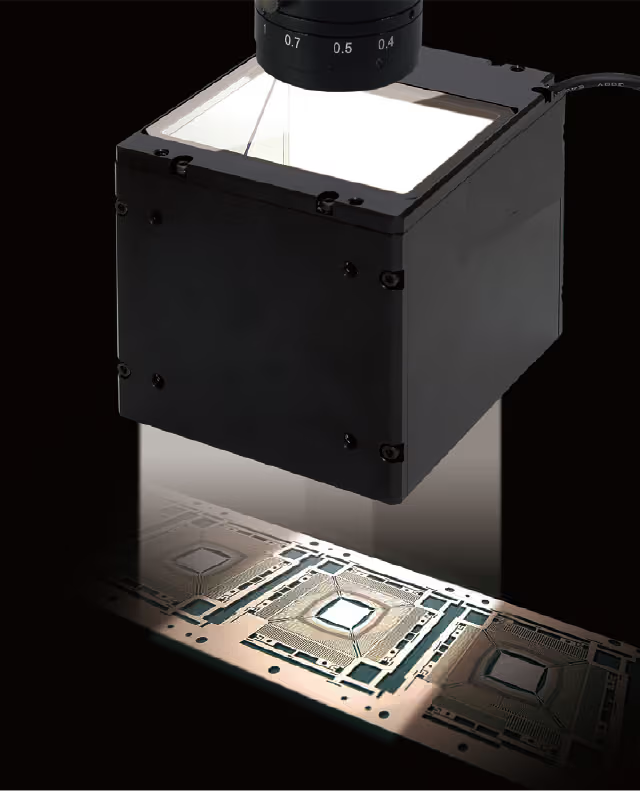
Power is usually proportional to brightness: for the same light source, higher power means greater brightness. Because a coaxial light source uses a half mirror positioned at 45° to the horizontal, the light emitted from the source is reflected by the half mirror onto the object, then reflected through the half mirror to the lens. During this process, a beam of light undergoes two splitting/reflection steps, so the actual luminous flux is less than one‑quarter of the original (assuming the half mirror has a reflectance of 50%). Consequently, coaxial light sources are generally not very bright, but their power consumption is often relatively high.
Voltage
The most common voltage for machine vision light sources is DC 24 V. Some light sources use 12 V, while high‑power ones may use 48 V. For a single‑LED light source (e.g., a spot light), the voltage might be 3 V, 5 V, 9 V, 14 V, etc.
High‑quality, reputable light sources usually have connectors that indicate the voltage and are meant to be used with dedicated controllers. Engineers who use the light source without its matching controller should pay attention to the voltage specification to avoid damaging the equipment.
Mechanical Dimensions of Coaxial Light Source
Thickness
Because the manufacturing methods and LED types used for coaxial light sources are largely the same, their thickness dimensions are generally similar or close. For example, common thicknesses are 20 mm, though some are 19 mm or 24 mm. If a heat sink is added to the back of the light source, its thickness can increase significantly.
The thickness of a coaxial light source can sometimes affect installation. For instance, in applications with very limited working distance, a light source that is too thick may not fit.
Mounting Dimensions
The mounting dimensions are very important because the light source must be properly attached to the machine or equipment to function. Therefore, when purchasing, one needs to know the mounting dimensions. Manufacturers typically provide a dimensional drawing of the light source, showing the locations of mounting holes.
Cable Length
Different manufacturers provide different default cable lengths for their light sources – for example, 800 mm, 500 mm, or 300 mm.
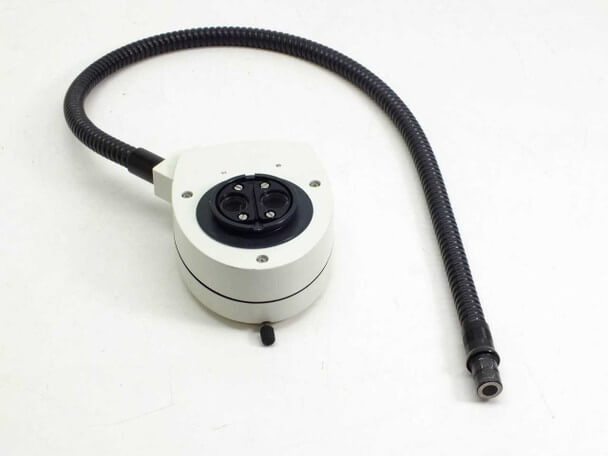
In a typical machine vision setup, the light source is placed above the work table, while the light controller is located below or inside the machine stand. The distance between them can sometimes be considerable. In such cases, an extension cable can be used; machine vision light source manufacturers usually offer matching extension cables.
LED Type
For coaxial light sources, most LEDs are surface‑mounted devices (SMDs), though some use through‑hole LEDs. Coaxial light sources that use through‑hole LEDs tend to have a greater overall length.
Coaxial Light Source Product Parameter For Reference
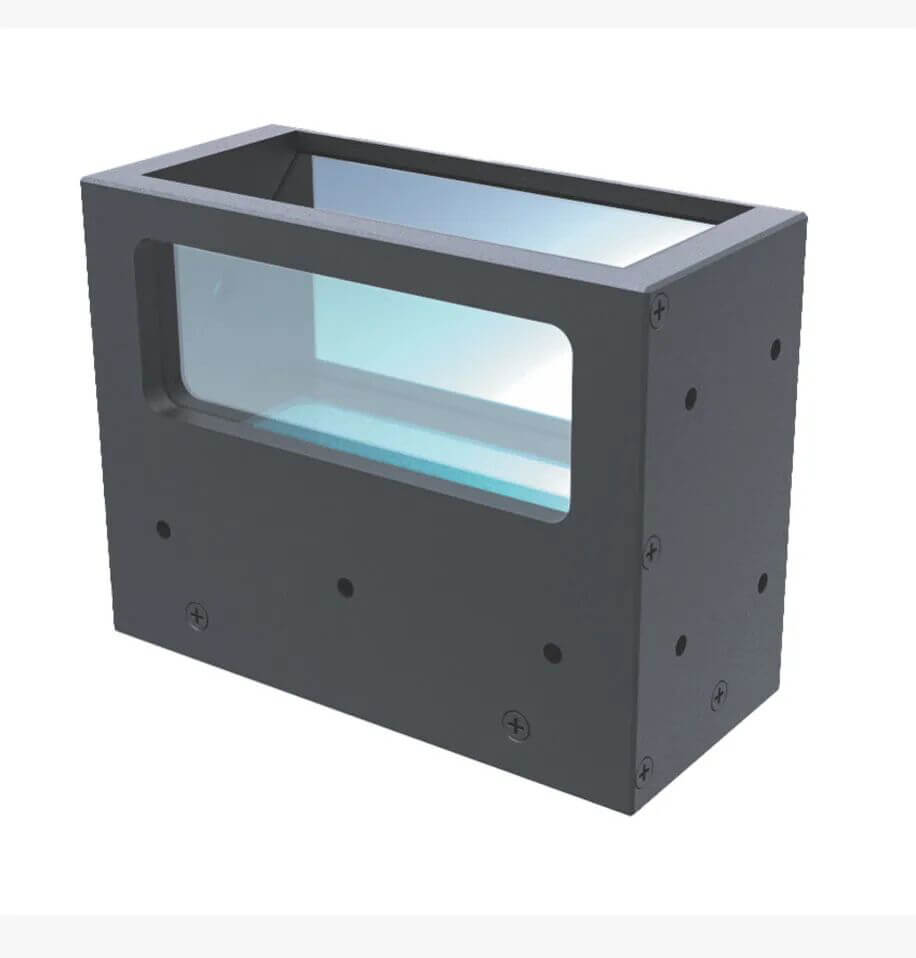
| Model | Color Options | Power (W) – R | Power (W) – G/B/W | Illumination Area (L×W, mm) | Overall Dimensions (L×W×H, mm) |
| 1 | R/G/B/W | 0.9 | 1.8 | 20×20 | 41×28×25 |
| 3 | R/G/B/W | 2.3 | 4.6 | 24×24 | 45×40×36 |
| 25 | R/G/B/W | 2.3 | 4.6 | 32×25 | 45×40×36 |
| 40 | R/G/B/W | 2.7 | 5.4 | 40×40 | 135×50×48 |
| 60 | R/G/B/W | 7.2 | 7.2 | 60×61 | 90×70×70 |
Notes:
R = Red, G = Green, B = Blue, W = White.
Power (W) – R refers to the power consumption when the light source is configured with red LEDs;
Power (W) – G/B/W refers to the power consumption for green, blue, or white versions (the same value applies to each of these colors unless otherwise specified).
Selection Criteria For Coaxial Light Source
When selecting a coaxial light source, the following three key points should be considered:
–Uniformity: Uniformity refers to the ability to illuminate the entire field of view evenly from center to edge. Non‑uniform brightness on the emitting surface can have serious consequences. If the illumination is uneven, the field of view will receive uneven light, resulting in uneven image brightness, which directly affects detection accuracy.
–Light Leakage Prevention: When a coaxial light source is used, light passes through the diffuser plate, emitting uniform light from horizontally mounted LEDs. A half mirror then bends the light 90° to illuminate the object below. However, some light emitted from the sides may exit without passing through the half mirror, affecting the final image. It is necessary to prevent direct light leakage from the side-emitting surfaces, because such leakage can cause unwanted bright spots or halos in the image, interfering with the extraction of target features.
–Size: When selecting a light source, ensure that its illumination area can fully cover the field of view of the object being inspected. A coaxial box light source is box‑shaped and generally larger than a point source or a ring light. Because it must be installed in the limited space between the lens and the object, a compact coaxial box light source is easier to mount and offers greater flexibility for fine adjustments (such as changing the distance to the object).
Insight from AI Robots Eidos about Coaxial Light Sources
—The future coaxial light sources will no longer be single-color or fixed-wavelength devices, but instead will integrate multi-spectral tunable LED arrays. Coupled with AI algorithms, these light sources will be able to dynamically adjust output wavelengths and intensity based on the material and surface condition of the measured object, achieving optimal adaptation through “illumination as algorithm,” rather than relying on engineers’ experience for trial and error in selecting parameters.
—As metasurface optics and polarization splitting technologies mature, coaxial illumination structures with “zero light loss” or “adjustable splitting ratios” will emerge in the future. This will not only significantly reduce power consumption and heat generation (addressing thickness issues) but also enable coaxial light sources to replace traditional high-power ring lights in high-speed inspection processes (such as lithium battery and photovoltaic production lines).
—By monitoring the real-time power consumption, voltage fluctuations, and internal temperature of the light source, combined with the contrast data of images returned by the camera, future coaxial light sources will possess “self-sensing” capabilities. They will proactively detect decreases in uniformity caused by LED aging or temperature drift and automatically perform power compensation or notify maintenance before detection accuracy declines, transforming the light source from a passive “consumable” to an active “quality assurance node.”
Image Credits: Ccs-grp & Web & Recycledgoods & Keyence & Optex-fa & Intelgic