Mainstream Industrial Camera Interfaces (Data Interfaces)
Table of Contents
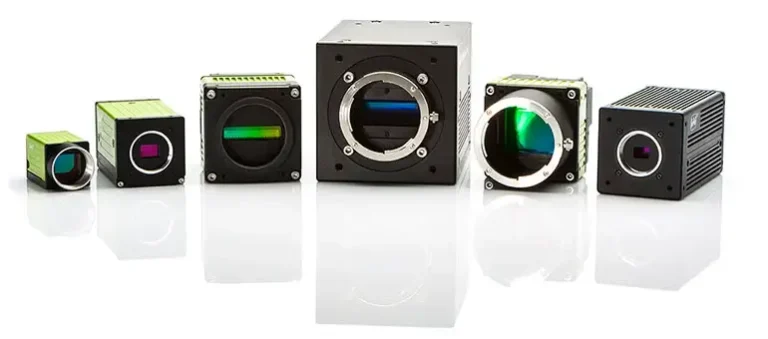
The data interface of an industrial camera is a critical component that connects the camera to the data processing system (such as a computer or frame grabber). By understanding the different types of industrial camera interfaces, one can select the appropriate interface for a project’s specific needs, thereby effectively meeting actual requirements.
Definition and Role of Industrial Camera Interfaces
An industrial camera interface is the connection point or interaction point between the camera and the industrial PC/ frame grabber, responsible for image data transmission, camera control, and communication. Digital signals offer many advantages over analog signals, such as strong anti-interference capability and ease of subsequent processing. Therefore, almost all industrial cameras today use digital interfaces.

The roles of the industrial camera interfaces are to enable image data transmission, control, or communication, thus fulfilling the needs of various application scenarios. It has a significant impact on the transmission speed, stability, real-time performance, and scalability of industrial vision systems.
Evaluation Dimensions of Industrial Camera Interfaces
In industrial vision, the industrial camera interface defines the entire data flow architecture. Evaluating an interface requires assessing it from multiple dimensions.
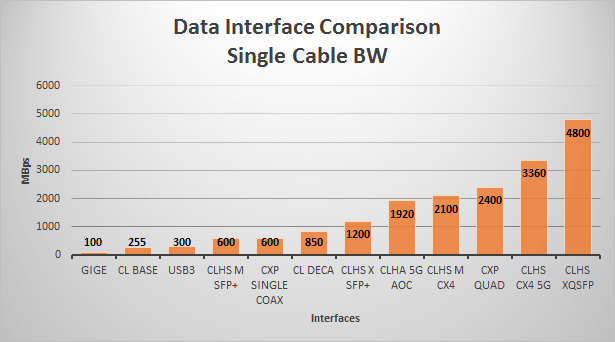
–Bandwidth (Speed): Determines how much data can be transmitted per second, directly affecting the maximum resolution and frame rate the system can support. The unit is typically Gbps (gigabits per second).
–Stability and Noise Immunity: In complex industrial environments, the ability to ensure long-term, error-free data transmission.
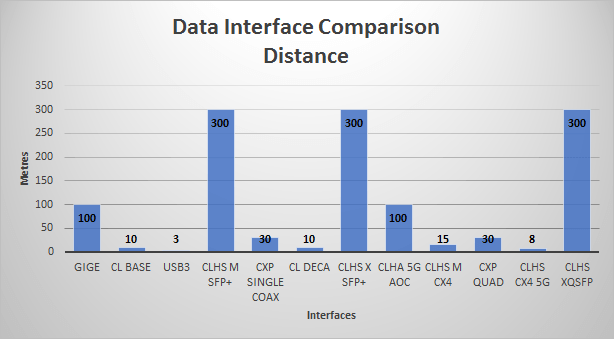
–Transmission Distance: The maximum distance for reliable transmission without using repeaters. This determines how far the camera can be installed from the host.
–Cabling Complexity and Cost: Includes the cost of the cable itself, interface card (if any), connectors, as well as cable flexibility, thickness, and whether it supports power delivery.
–Multi-Camera Synchronization: Ease of building multi-camera systems, driver maturity, software compatibility, and plug-and-play convenience.
Classification of Mainstream Industrial Camera Interfaces
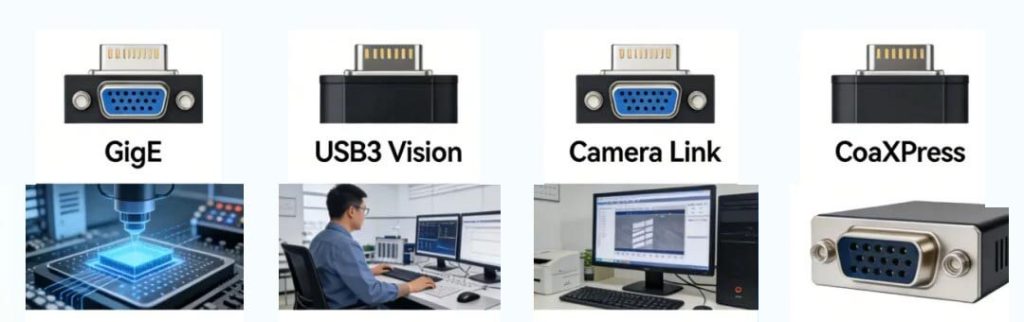
In industrial vision scenarios, the commonly used industrial camera interfaces include: GigE (Gigabit Ethernet), USB3 Vision, Camera Link, and CoaXPress.
GigE
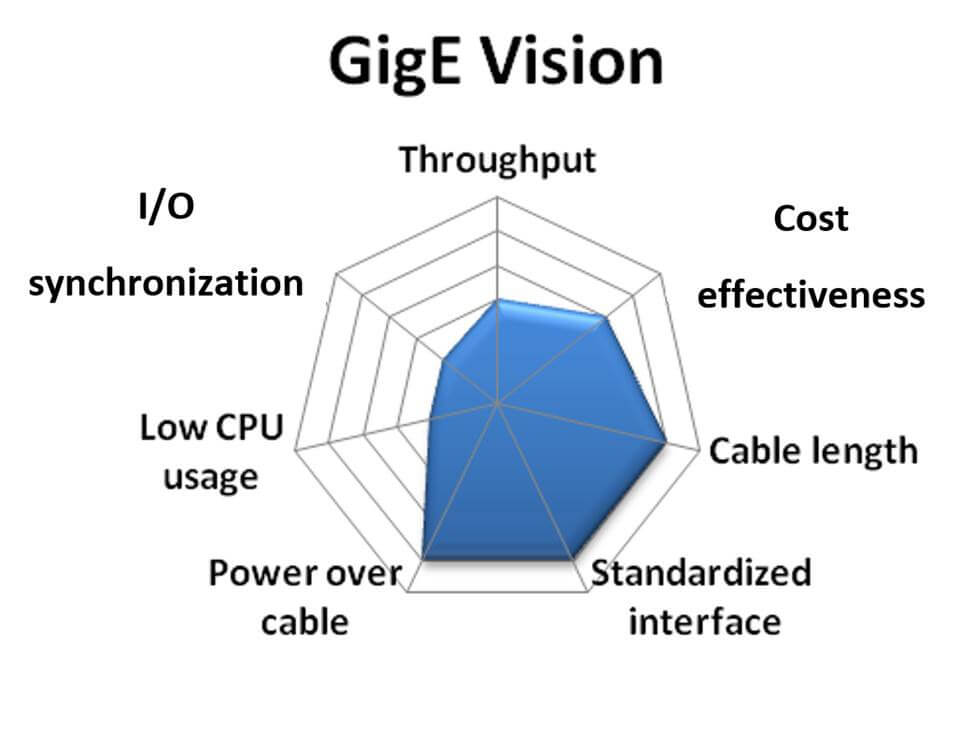
This is the most widely used interface in industrial vision today. The GigE industrial camera interface offers excellent cost-performance and strong versatility, adapting to almost all scenarios, especially small to medium-sized projects.
Advantages of GigE:
–Long transmission distance: Standard transmission distance up to 100 meters (using quality network cables), ideal for factory layouts (e.g., automotive manufacturing, logistics sorting) without needing short-distance cabling.
–Strong compatibility: Using standard network switches, flexible networking allows low-cost connection of multiple cameras (up to 254), making later expansion convenient.
–Low cost: Standard Ethernet cables (CAT5e/6) and switches are inexpensive and readily available. No dedicated frame grabber is needed; a standard industrial PC can interface, reducing project costs.
–High stability: Power can be supplied directly to the camera over the network cable (PoE), simplifying cabling. Moreover, GigE Vision is a standard protocol with good compatibility.
Disadvantages of GigE:
Based on the Ethernet protocol, there is inherent, minor packet transmission latency, making it unsuitable for scenarios with extremely stringent timing requirements (microsecond-level synchronization).
Bandwidth bottleneck: Standard Gigabit Ethernet has a theoretical bandwidth of 1 Gbps (approx. 120 MB/s), which may become a bottleneck for ultra-high resolution or ultra-high frame rate applications.
Application Scenarios for GigE
Suitable for the vast majority of factory automation projects, especially those requiring medium-to-long distance transmission, multiple cameras, and cost sensitivity, such as 3C component inspection, general PCB inspection, and logistics dimensioning.
USB3 Vision
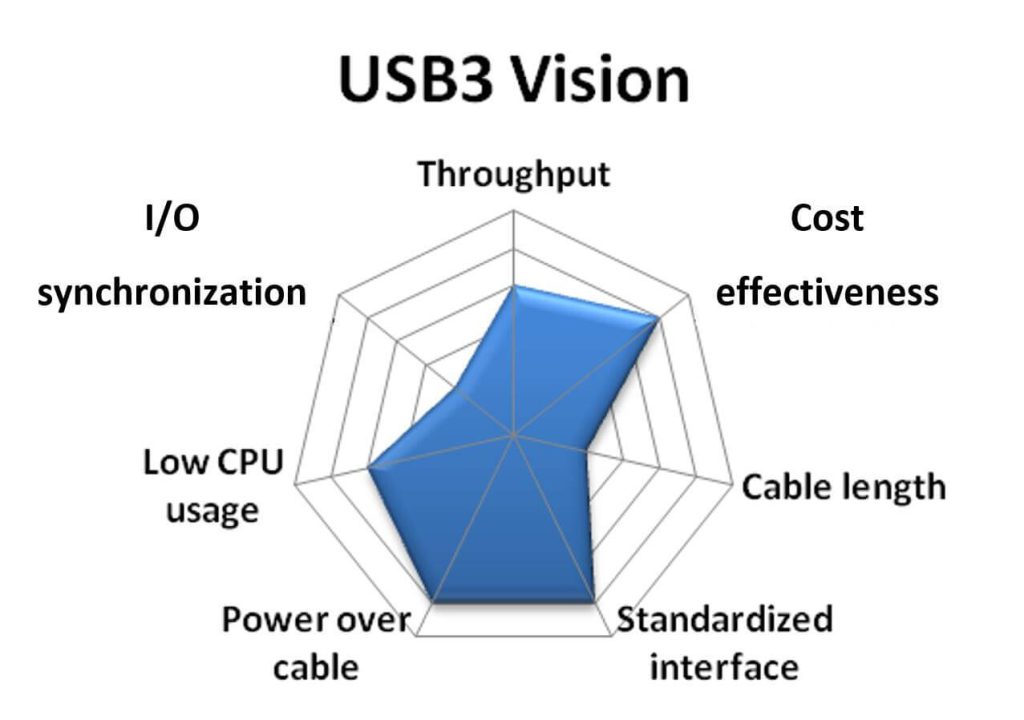
USB3 Vision is an industrial interface optimized on the basis of USB 3.0, featuring high speed and convenience, suitable for small, high-frame-rate projects over short distances.
Advantages of USB3 Vision:
–High transmission speed: USB 3.0 theoretical bandwidth of 5 Gbps (approx. 500 MB/s) with high actual transmission efficiency, meeting the needs of most high-speed cameras.
–Small size, easy cabling: The compact interface allows for a more compact overall camera size, suitable for space-constrained scenarios (e.g., 3C assembly lines).
–Plug-and-play: No complex configuration; simple connection and easy driver installation. It can be used with a standard industrial PC’s USB 3.0 port, offering high debugging efficiency.
–Low cost: No frame grabber required; simple cabling, suitable for small projects and laboratory settings.
Disadvantages of USB3 Vision:
–Short transmission distance: Reliable transmission distance typically does not exceed 5 meters; even with good active cables, it is difficult to exceed 10 meters, severely limiting installation flexibility.
–Weak anti-interference capability: In industrial electromagnetic environments, long USB cables are susceptible to interference. The bus bandwidth is shared among all USB devices, potentially causing conflicts.
–Weak multi-camera support: When connecting multiple high-speed USB3 cameras to the same host controller, bandwidth and addressing can become problematic.
Application Scenarios for USB3 Vision
Close-range inspection stations, e.g., precision 3C inspection. Not suitable for production lines with strict installation distance requirements.
Camera Link
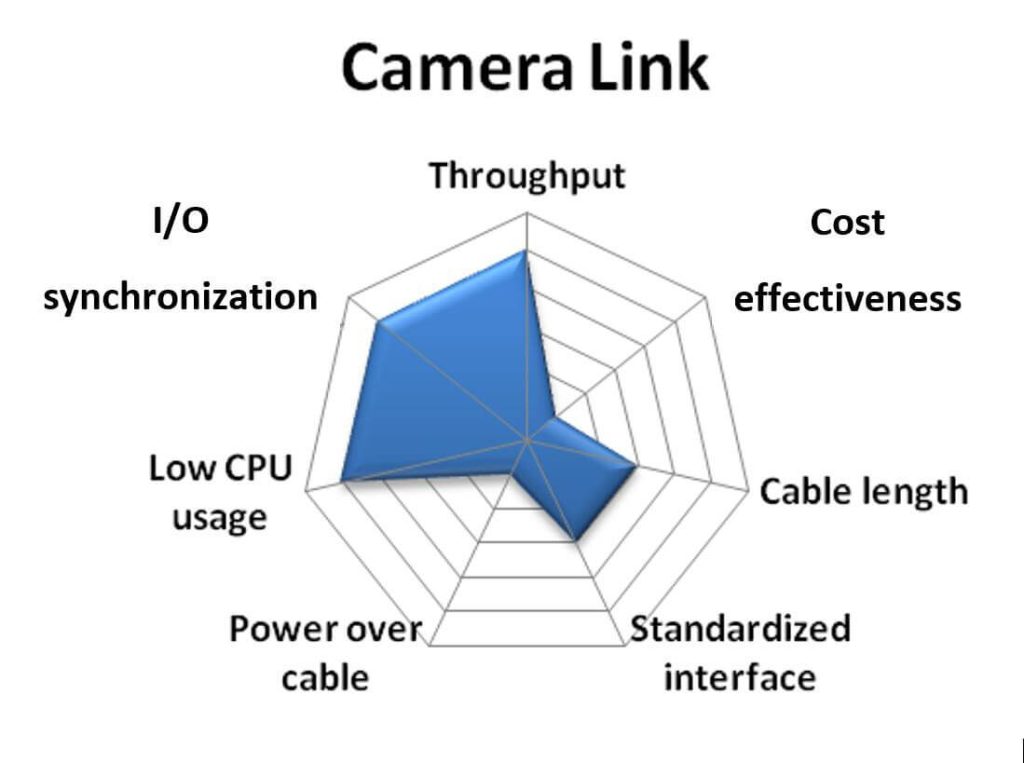
Camera Link is a high-end industrial camera interface characterized by high speed, high bandwidth, and low latency.
Advantages of Camera Link:
–High transmission speed: Single-channel speed up to 2.0 Gbps, with multiple channels stackable (up to 10 Gbps), effectively handling image transmission of tens of megapixels at high frame rates.
–Low latency: Extremely low and deterministic data transmission latency with excellent real-time performance, suitable for scenarios demanding high real-time response (e.g., high-speed sorting, laser welding, vision guidance).
–High stability: Dedicated frame grabber, cables, and protocol provide strong noise immunity, suitable for harsh industrial environments.
–Supports multi-camera: Frame grabbers can precisely synchronize multiple cameras.
Disadvantages of Camera Link:
–High cost: Requires a dedicated frame grabber, complex cabling (specialized cables).
–Short transmission distance: Standard cable length does not exceed 10 meters; inconvenient to extend.
–Declining market share: With the rise of newer industrial camera interfaces like CoaXPress, Camera Link’s share in new projects is declining.
Application Scenarios for Camera Link:
Traditional high-speed vision inspection (e.g., high-speed cap inspection) or specific applications with extreme timing synchronization requirements.
CoaXPress
CoaXPress is a high-end industrial camera interface that has emerged in recent years. It is a point-to-point interface standard that uses coaxial cables for high-speed data transmission and has been developing rapidly in the high-end market.
Advantages of CoaXPress:
–Balances speed and distance: Achieves transmission rates from 1.25 Gbps to tens of Gbps over a single coaxial cable, suitable for ultra-high-speed cameras with 4K, 8K, or even higher resolutions. Transmission distance can reach up to 100 meters (depending on the rate), outperforming Camera Link.
–Strong real-time performance: A single standard coaxial cable simultaneously transmits data, control signals, and power (PoCXL), simplifying cabling.
–Good compatibility and scalability: Supports multi-channel bonding to multiply bandwidth, suitable for large-scale, high-end applications.
Disadvantages of CoaXPress:
Requires a dedicated CXP frame grabber; both the card and cables are expensive, resulting in a high initial investment.
As a relatively newer industrial camera interface, supplier options are fewer compared to GigE. This also leads to a higher technical barrier and greater debugging difficulty.
Application Scenarios for CoaXPress:
Ultra-high-resolution area scan cameras, high-speed line scan cameras with extreme bandwidth demands, and demanding applications requiring long-distance transmission of high-speed data (e.g., flat panel display inspection, high-speed printing inspection).
Comparison of Mainstream Industrial Camera Interface Performance
| Parameter | GigE | 10GigE | CoaXPress 6/10/12 | Camera Link | USB 3.0 |
| Resolution | Medium | High | Extremely High | High | Medium |
| Frame rate | Medium | High | Extremely High | High | Medium |
| Transmission distance | Longest (100m) | Long (60-80m) | Medium (35-100m) | Short (≤10m) | Shortest (5m) |
| Stability | High | High | Extremely High | High | Fair |
| Cost | Low | Medium | High | Medium-High | Low |
| System complexity | Low | Medium | High | High | Low |
| Deployment flexibility | High | Medium-High | Medium | Low | Highest |
| Multi-camera support | Excellent | Excellent | Good | Fair | Poor |
| Anti-interference capability | Medium | Medium | High | High | Low |
Comparison of Technical Specifications for Mainstream Industrial Camera Interfaces
| CoaXPress 1.x | CoaXPress 2.0 | Camera Link | GigE Vision | USB3 | |
| Single Speed | 1.25 – 6.25 Gbps | 1.25 – 12.5 Gbps | 2 Gbps (Base, 1 Cable) | 1 Gbps | 1.7Gbps |
| Max Speed | N x 6.25 Gbps (N cables) | N x 12.5 Gbps (N cables) | 6 Gbps (Full, 2cables) | 1 Gbps | 1.7Gbps |
| Link Cost | Medium | Medium | Medium | Medium/High | Low |
| Power consumption | Medium | Medium | Medium | Low | Low |
| Complexity | Medium | Medium | Low | High | High |
| Cabling | Coax | Coax | Custom | Cat-6 | Custom |
| Multi-Core | Standard | ||||
| Length at full rate | 45 m | 35 m | 10 m / 7 m | 100 m | 3 m |
| Data Integrity | CRC | CRC | None | CRC / Resend | None |
| Real Time Trigger | Yes | Yes | Yes | No | No |
| Power over Cable | 13 W/ cable | 13 W/ cable | PoCL: 4 W | PoE: 13 W | 5 W |
Selection Process for Industrial Camera Interfaces
–Define project requirements for resolution and frame rate:
This is the core of the selection: higher resolution and faster frame rate require higher transmission speed from the industrial camera interface.
Low resolution (≤2 MP) + low frame rate (≤30 fps): Choose GigE for best cost-performance.
Medium-to-high resolution (2–5 MP) + high frame rate (30–100 fps): Choose USB3 Vision (short distance) or GigE (long distance).
High resolution (≥10 MP) + high frame rate (≥100 fps): Choose Camera Link (short distance) or CoaXPress (long distance).
–Define project requirements for transmission distance:
Determine the distance between the camera and the industrial PC based on production line layout to avoid signal attenuation due to insufficient transmission distance.
Distance ≤ 5 meters: Prefer USB3 Vision for convenience and speed.
5 m < distance ≤ 100 m: Choose GigE (low to medium speed) or CoaXPress (high speed).
Distance > 100 m: Need repeaters; prioritize GigE (low cost).
–Evaluate cost and scalability:
Small to medium projects, limited budget, need for later expansion: Choose GigE for flexible networking and low cost.
Small, high-speed projects, short-distance layout: Choose USB3 Vision for convenient debugging and good cost-performance.
High-end projects with extreme speed and stability requirements: Choose Camera Link (short distance) or CoaXPress (long distance); though costly, they ensure system stability.
Selection Examples for Industrial Camera Interfaces
Inspection of a high-speed phone screen dispensing machine
–Analysis: The dispensing head of a high-speed dispenser moves 100 times per second; the camera must capture over 120 frames per second to keep up, with a resolution of at least 4 MP to clearly see the glue dot size.
–Solution: USB 3.0’s actual bandwidth can only support about 60 fps; GigE’s Gigabit Ethernet port can achieve at most 80 fps. Neither meets the requirements. Only Camera Link or CoaXPress interfaces with a frame grabber can simultaneously achieve high resolution and high frame rate.
Lithium battery surface defect inspection
–Analysis: Lithium battery electrodes and separators must be inspected during high-speed continuous motion (linear speeds up to tens of meters per minute) for edge burrs, holes, and other defects. The industrial camera needs to capture images from 200 meters away, requiring 4 MP resolution and 60 fps.
–Solution: GigE’s transmission distance can reach 100 meters, but its bandwidth is only 1 Gbps, resulting in low frame rate and stuttering at high resolution. In contrast, the CoaXPress interface, using dedicated coaxial cables, can stably transmit over 300 meters while maintaining 12.5 Gbps bandwidth, thus meeting project needs.
Insight from AI Robots Eidos about Industrial Camera Interfaces
—With the widespread adoption of 8K and 16K resolutions, as well as ultra-high-speed cameras (>500fps), some existing industrial camera interfaces, such as standard GigE and USB 3.0, will soon become “bottlenecks” in high-end applications. Future competition will no longer be a contest of interface types, but rather a race towards “physical layer transmission technologies.” Industrial camera interfaces will integrate mature optical module technologies to achieve “100Gbps+ kilometers” transmission, effectively breaking the trade-off between distance and bandwidth.
—The functionality of high-performance industrial camera interfaces will gradually generalize. The choice of interface may no longer be a fixed hardware decision; instead, it will dynamically configure the camera’s transmission protocols and data processing flows via software based on real-time task requirements. For instance, switching to high-bandwidth mode when detection accuracy is critical, or switching to low-power, long-distance GigE mode during inspection modes.
—In the future, GigE industrial camera interfaces, through the integration of time-sensitive network standards, will enable deterministic, microsecond-level data transmission while retaining their advantages of long-distance, low cost, and scalability. This will directly encroach upon application areas that have traditionally been dominated by Camera Link and CoaXPress, which have extreme real-time requirements.
Image Credits: Pleora & Adept & Ni