
Area Scan Camera vs Line Scan Camera
Table of Contents
Area scan camera vs Line scan camera could help engineers select the most suitable camera type for specific applications and design more effective vision systems.
Definition of Area Scan Camera
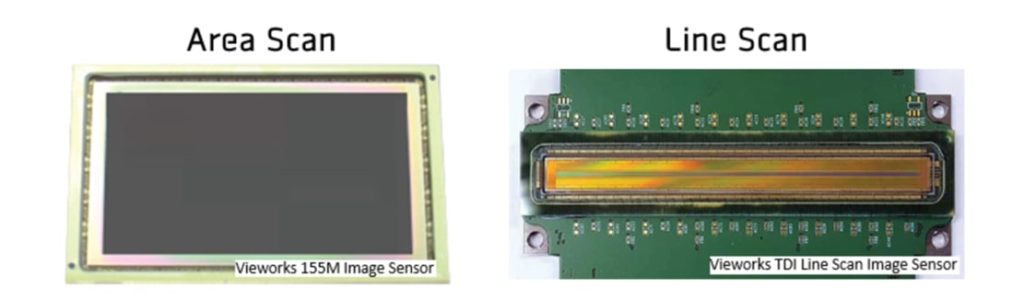
An area scan camera captures a complete image in a single exposure using a two-dimensional pixel array. It acquires a full two-dimensional image within the entire field of view in one shot. It transmits the image data to backend algorithms for processing and analysis, without relying on object motion or multiple scan stitching.
Definition of Line Scan Camera
The photosensitive elements of a line scan camera are arranged linearly in the horizontal direction, typically with only one row (or a few rows) of sensing units in the vertical direction. Each exposure captures only a single line of image data. The resulting image resembles a line; although it is also a two-dimensional image, it is extremely long, several thousand pixels in length, but only a few pixels in width. Line scan cameras are generally used when the inspection field is a long, narrow strip (e.g., inspection on a roller) or when a very large field of view or extremely high resolution is required.
Recommended In-depth Reading from AI Robots Eidos
An in-depth understanding of area scan and line scan cameras is the foundation for comparing the two, enabling multi‑dimensional analysis from principles, performance characteristics, cost, and application scenarios, thereby providing a scientific basis for camera selection in practical engineering applications.
by reading these two articles about area scan cameras and line scan cameras, readers can gain a comprehensive understanding of them.
With the definitions of both camera types established, the following section therefore provides a side‑by‑side comparison of their underlying principles, focusing on what makes area scan camera vs line scan camera fundamentally different in terms of image acquisition and sensor architecture.
Area Scan Camera vs Line Scan Camera: Principle Comparison
Area Scan Camera
Captures images using a pixel matrix. Image detail is determined by resolution, which is defined by the lens focal length and sensor size. The same camera with different focal length lenses yields different resolutions. Pixel count is unrelated to sharpness.
The pixels on an area scan camera’s image sensor are arranged in a two-dimensional matrix, similar to the principle of everyday digital cameras or smartphone cameras. During a single exposure cycle, all effective pixels on the area scan sensor sense light simultaneously (or according to a specific shutter mode), producing a complete two-dimensional image in one shot. To achieve better results, area scan cameras generally use area light sources.

Line Scan Camera
The sensor structure of a line scan camera differs from that of an area scan camera. Its pixels are typically only one row (or a few rows) arranged linearly. A line scan camera cannot directly obtain a two-dimensional image by itself; it requires precise relative motion between the camera and the object under inspection.
During motion, the camera continuously exposes line by line at a fixed line rate (e.g., 80 kHz means the camera can capture up to 80,000 lines of image data per second). Each line records the profile information of the object at the “scan line” position at that moment. Finally, through an image acquisition card and software, these successive one-dimensional image lines are stitched together into a complete two-dimensional image.
Area Scan Camera vs Line Scan Camera: Advantages
Area Scan Camera
Intuitive: A single exposure captures all information within the full field of view (FOV), consistent with human vision, making images easy to understand and process.
Mature technology, wide selection: Rich combinations of product models, resolutions, frame rates (frame rate refers to the number of frames an area scan industrial camera can capture and output per second, often related to the sensor chip and data output interface bandwidth; e.g., 181 fps means the camera can capture up to 181 frames per second), interfaces, etc., enabling easy integration.
Less stringent motion control requirements: Suitable for static objects.
High efficiency: High‑pixel cameras offer a large single‑shot field of view, reducing the number of shots and improving inspection efficiency.
Line Scan Camera
Ultra‑high resolution in the motion direction: The resolution in the motion (stitching) direction is determined solely by the line count and motion precision. In theory, it can produce infinitely long, hundreds‑of‑megapixel ultra‑high‑resolution images. Line scan cameras typically have 1024, 2048, 4096, or 8012 pixels per line, whereas common area scan cameras have only 640, 768, or 1280 pixels per line; area scan cameras with more than 2048 pixels are rare. This feature makes line scan cameras ideal for inspecting continuous web or sheet materials such as paper, film, and glass panels.

Large photosensitive area: Line scan camera pixels are usually elongated, providing a larger photosensitive area in the scanning direction. Combined with TDI (Time Delay Integration) technology, they are particularly suitable for low‑light or high‑speed scenarios.
Area Scan Camera vs Line Scan Camera: Disadvantages
Area Scan Camera
Inherent conflict between FOV and resolution: At a fixed working distance and lens, the field of view (how large an area is seen) and resolution (how clearly details are seen) in a single frame are determined by the total pixel count of the camera. Wanting to “see wider” may sacrifice fine detail, and vice versa.
Limited efficiency for high‑speed continuous scanning: For high‑speed moving continuous materials (e.g., film) requiring 100% inspection, area scan cameras demand extremely high trigger frequencies and data processing capabilities, making it difficult to achieve seamless full‑coverage without missing areas.
Line Scan Camera
Dependence on high‑precision synchronization: Image quality heavily depends on perfect synchronization between the line rate and object motion speed. Any speed fluctuation can cause the image to be stretched or compressed (trapezoidal distortion) in the motion direction, requiring an encoder to provide real‑time position feedback for triggering.
Complex system, high setup difficulty: Involves motion control, precise triggering, and image stitching, demanding higher expertise from system integration and commissioning engineers.
Demanding illumination requirements: Requires long strip‑shaped line lights and ensures uniform and stable illumination across the entire scan line.
Area Scan Camera vs Line Scan Camera: Cost Comparison
The cost of area scan camera vs line scan camera considers both initial investment and long‑term maintenance.
Area Scan Camera
–Initial investment: Camera cost is relatively stable, with a wide price range for common resolutions (e.g., 1–50 megapixels). Typical industrial area scan cameras cost between several thousand and ten thousand US dollars. System integration costs are low, generally requiring only a lens, light source, and basic acquisition card, with no additional motion control equipment.
–Long‑term maintenance cost: Mainly involves light source and lens calibration. Maintenance costs are low, approximately 5–10% of the initial system cost per year.
Line Scan Camera
–Initial investment: Due to technical complexity and high‑resolution requirements, the camera itself is usually more expensive than an area scan camera of the same class—potentially 1.2–1.5 times higher at equivalent resolution. Additionally, extra motion control mechanisms (e.g., motors, encoders), specialized acquisition cards, and industrial PCs are required, making the total system cost 2–3 times higher than an area scan solution.
–Long‑term maintenance cost: Requires regular calibration of motion mechanisms and encoder accuracy checks. Maintenance costs are higher, approximately 1.5 times that of an area scan system per year.
Area Scan Camera vs Line Scan Camera: Application Comparison
Area scan camera
Area scan cameras are widely used for measurements such as area, shape, size, and position. They can quickly and accurately capture two‑dimensional image information and provide intuitive measurement images. However, the number of pixels per line is smaller than that of line scan cameras. They are suitable for objects that are static or moving at low to medium speeds.

Line scan camera
Line scan cameras are mainly used in industrial inspection fields that require continuous scanning of high‑speed moving objects or ultra‑high resolution. Examples include continuous high‑speed film inspection, solar panel inspection, and web surface inspection.
Ultimately, the choice between an area scan camera and a line scan camera is never absolute — it depends on your specific application, speed, resolution, and budget. By returning to the question of area scan camera vs line scan camera, engineers can understand that the trade‑offs are the key to designing more robust and cost‑effective vision systems.
| Scenario | Camera |
| Static inspection | Area scan |
| Small field of view inspection | Area scan |
| Large field of view inspection | Line scan |
| Web (roll-to-roll) inspection | Line scan |
Insight from AI Robots Eidos about area scan camera vs line scan camera
—In the future, area scan camera vs line scan camera will no longer be a topic. The future industrial cameras will no longer be strictly either/or, but will feature hybrid imaging architectures—where the same camera can dynamically switch or simultaneously operate in two modes.
For example, in high-speed continuous inspections, a line scan mode may be used to scan a large area, and if suspicious defects are detected, it can instantly trigger a local area array mode for high-resolution detail confirmation. Alternatively, a cylindrical lens combined with a reconfigurable sensor could facilitate a hardware-level on-demand switch between area and line scan modes. This will break the limitation of “equipment determines usage,” allowing visual systems to adjust imaging strategies in real-time based on tasks, significantly enhancing flexibility and depth of detection.
—As event-based vision and deep learning motion estimation technologies mature, line scan cameras will be able to deduce speed fluctuations from the content of consecutive frames and correct stretch/compression distortions in real-time at the software level. In the next 3-5 years, low-cost line scan systems may no longer require external encoders but instead use embedded AI to predict speed curves, greatly reducing system costs and debugging difficulties.
Image Credits: 1stvision & Voltrium & Jai & Researchgate & Lano-tech