Coaxial Lights: Uniformity, Stability, and Contrast
Table of Contents
Coaxial lights, through their unique optical design, address the challenges of imaging highly reflective, flat surfaces in industrial vision. They are one of the preferred illumination solutions for improving the accuracy and efficiency of machine vision inspection.
Principle of Coaxial Lights
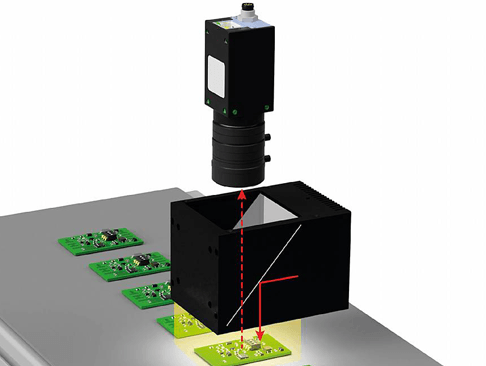
Coaxial lights adopt a coaxial optical path structure of “light source – half-silvered mirror – object – lens.” A diffuser plate first homogenizes light, then illuminates the object surface vertically, and the reflected light returns along the same optical path into the lens.
More specifically, high‑brightness, high‑density LED arrays are arranged on a circuit board to form a square or rectangular light‑emitting area. This area, through a diffuse reflector plate, produces a high‑intensity, uniform area light source. The illumination rays, formed by a half‑silvered mirror, are coaxial with the lens’s viewing angle—hence the name “coaxial lights.”
Types of Coaxial Lights
–External Coaxial Lights: The structure of external coaxial lights is relatively simple. LED beams perpendicular to the optical axis of the lens are reflected by a 45° half‑silvered mirror to illuminate the object surface. The light returning from the object passes through the same half‑silvered mirror and finally enters the lens for imaging.
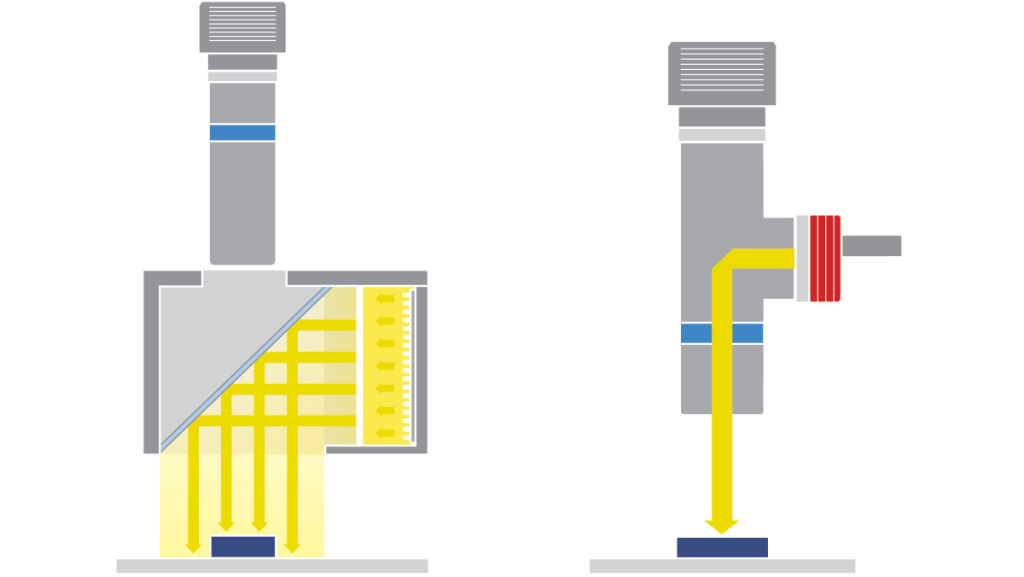
–Internal Coaxial Lights: In internal coaxial lights, an LED point light is installed at the internal coaxial connector to achieve higher brightness. Optical fibers homogenize the light, which is then collimated and shaped through corresponding lens groups to form Köhler illumination. Finally, the illumination path is refracted via a prism into the imaging path, illuminating the target and producing precise coaxial illumination.
Under the same optical accuracy requirements, internal coaxial imaging has higher quality, but the costs also increase correspondingly.
| Internal Coaxial Lights | External Coaxial Lights | |
| Suitable Applications | Wafer, FPC, etc. | Plastics, printing, etc. |
| Lens Magnification | High magnification (≥1X) | Low magnification (≤1X) |
| System Size | Smaller | Larger |
Components of a Coaxial Light Assembly
–Coaxial light source: Uses a high‑density LED array combined with high‑transmission dust‑proof glass and a half‑mirror plate; alternatively, it can be composed of small, high‑brightness LED beads with a condenser lens to achieve high‑intensity illumination over a small area, often used in conjunction with a coaxial lens.
Recommended In-depth Reading from AI Robots Eidos
The coaxial light source is the optical foundation for the coaxial optical components to perform at their best. Proper selection and matching of the coaxial light source significantly impact the imaging quality and detection accuracy of the entire coaxial system.
Readers interested in coaxial light sources can refer to this article on coaxial light sources.
–Beam‑splitting device: Generally, larger coaxial lights (e.g., >40 mm) use a half‑mirror to effectively reduce weight; for sizes below 40 mm, an optical prism is preferred for better imaging quality. The half‑silvered mirror (or prism) is typically placed at 45° to reflect source light onto the object and transmit the reflected light from the object back to the camera.
–Imaging section: The lens and camera receive the reflected light transmitted through the beam splitter for imaging. The combination of coaxial lights with a telecentric lens and a high‑resolution area‑scan camera is the optimal solution for high‑precision measurement and micro‑defect detection. For routine appearance inspection, a more economical pairing of a fixed‑focal lens and area‑scan camera can be chosen based on the actual budget.
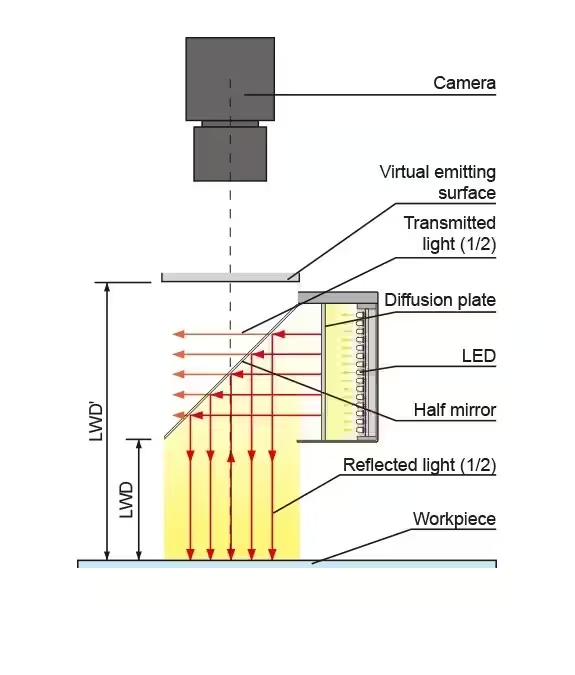
–Mechanical and auxiliary structures:
Housing (with heat dissipation, thermal materials, aluminium alloy): Designed as one‑piece or modular, it protects internal optical components and effectively dissipates heat generated by LEDs, ensuring optical stability during use.
Diffuser plate: Mounted at the front of the light source, it uses micro‑holes or a frosted structure to perform secondary diffusion of light, making the illumination more uniform. It is suitable for inspecting flat surfaces that require even lighting.
Dust‑proof window: Primarily protects the lens and optical system from dust, particles, mist, and other contaminants, while maintaining optical imaging quality. It must provide effective sealing without introducing additional optical distortion or light loss.
Calculation of Coaxial Lights / Illumination
Coaxial lights can be understood as open‑area lights without a hole, so they can be equivalently treated as area light sources with the same emitting surface.
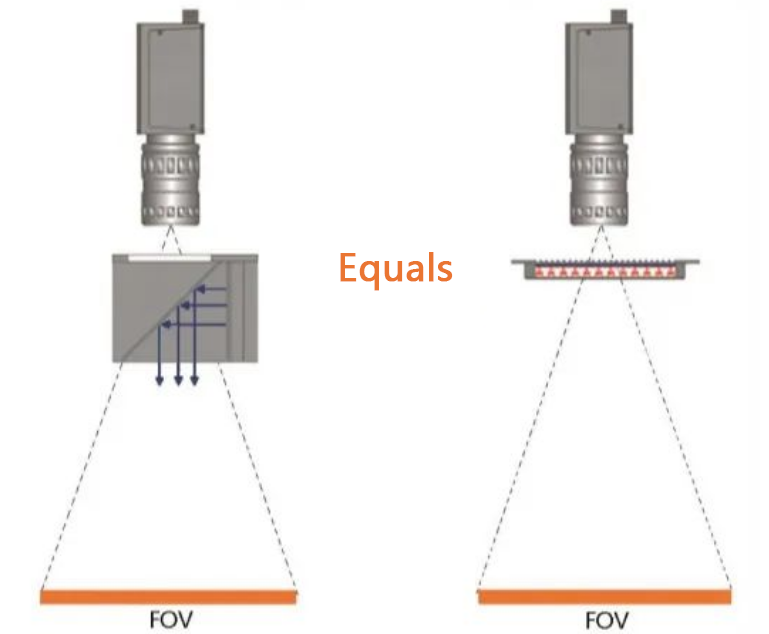
The geometric model of a backlight (L) is used here to calculate coaxial lights because they share the same perspective geometry principle.
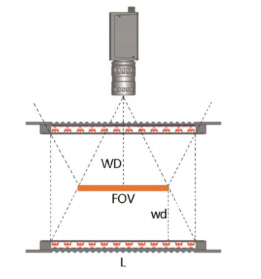
L ≥ (FOV × (WD + wd)) / WD
Definitions:
FOV (Field of View): The camera’s field of view.
WD (Working Distance): The distance from the lens to the target object.
wd: The distance from the target object to the backlight below it – in this context, the vertical distance from the test object to the centre point of the internal 45° beam‑splitter mirror inside the coaxial light.
L: The length (or width) of the backlight – here, the effective light‑emitting surface size of the coaxial light.
Special cases:
Conventional lenses: Due to the perspective effect, the light source must be larger than the field of view (following the formula above).
Telecentric lenses: When using a telecentric lens, light rays enter in parallel; therefore, the light source only needs to be slightly larger than the FOV to meet imaging requirements.
Advantages of Coaxial Lights
–Elimination of reflections: The LED light from coaxial lights is reflected vertically onto the object, and the reflected light from the object travels vertically upward through the half‑silvered glass into the camera. This eliminates both reflections and camera shadows in the image. Therefore, coaxial lights are widely used for inspecting highly reflective objects such as glass.
–Uniform illumination: Illumination uniformity can reach over 90%, meeting the requirements for precision measurement. Because coaxial lights illuminate flat areas evenly, flat regions appear bright, while defects such as scratches, dents, and cracks scatter light and appear dark. This contrast makes coaxial lights excellent for detecting micro‑defects, scratches, and pits.
–High brightness: Coaxial lights use densely packed LEDs to significantly increase brightness. Moreover, with high‑quality coated beam splitters, light loss is effectively reduced, compensating for the loss caused by splitting and ensuring sufficient brightness in the captured images.
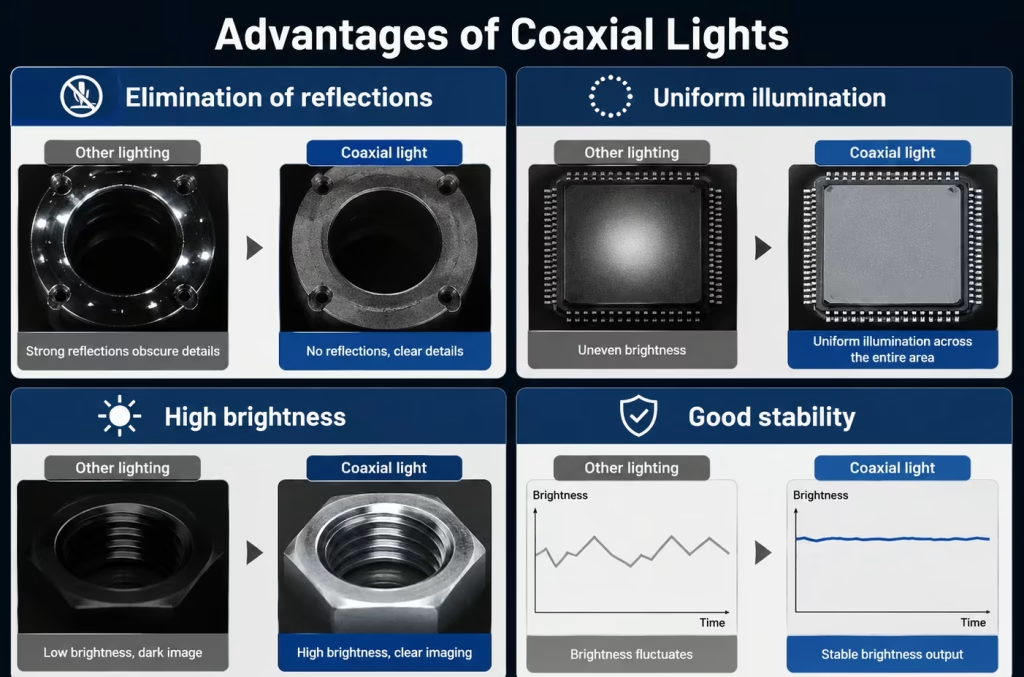
–Good stability: Coaxial lights are typically equipped with independent heat‑dissipation structures (e.g., heat sinks) to prevent overheating, thereby extending the lifespan of the light source and improving illumination stability. Better stability reduces the replacement cost of components in industrial vision applications.
Disadvantages of Coaxial Lights
–Limited illumination range: Since the beam direction of coaxial lights is parallel to the camera optical axis, the illumination area is relatively small, making it difficult to uniformly cover a large field of view. At large fields, the luminous flux drops significantly due to beam spread, resulting in insufficient illumination at the edges, which negatively affects the overall system.
–High requirement for surface flatness: Due to their characteristics, coaxial lights only reflect well from flat surfaces into the lens; light striking uneven defects is scattered elsewhere, creating contrast in the image. If the entire surface of the object (e.g., wood) is uneven, large shadows will form, rendering the inspection ineffective.
–Complex structure: Coaxial lights have a relatively complex structure, including beam splitters, diffusers, reflectors, etc. To achieve good performance, high precision of optical components is required, and the light source and beam splitter must be accurately positioned; otherwise, the bright spot may not be centred. A deviation of more than 2° can cause failure.
Applications of Coaxial Lights
In machine vision inspection, coaxial lights, with their unique optical path design, effectively suppress reflections from object surfaces and are widely used in inspecting highly reflective, flat, and transparent objects.
Electronics Manufacturing Industry
–PCB component hole positioning: In PCB assembly, the positioning accuracy of component holes directly affects soldering quality, requiring deviation ≤ ±0.01 mm. The solder mask and metal plating on PCB surfaces tend to produce stray light, often blurring hole edges with conventional lighting. With coaxial lights, vertical light penetrates the solder mask, creating clear black‑hole‑with‑white‑ring features. Using a machine vision system to locate hole centres, positioning repeatability is improved to ±0.005 mm.
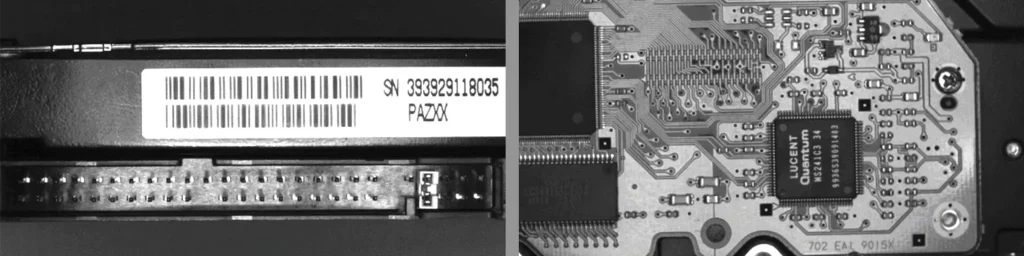
–Fingerprint module glue dispensing positioning: The bonding of fingerprint modules to phone housings requires precision dispensing with glue lines only 0.1 mm wide; deviation >0.05 mm leads to poor adhesion. The glass cover and metal frame of the module are highly reflective, making it difficult for traditional lighting to distinguish glue paths. Coaxial lights produce a stable grayscale difference between the glue and substrate, controlling dispensing errors within ±0.02 mm.
Automotive industry
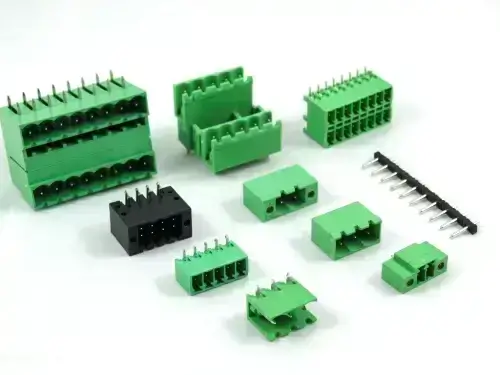
–Connector pin inspection: Automotive wire harness connectors have pin pitches of 0.8 mm; pin misalignment >0.1 mm causes poor mating. Metal pins and plastic housings have very different reflective properties. Coaxial lights, with adjustable brightness, create a clear boundary between pins and the housing, achieving inspection speeds of 300 parts per minute to match production line cycles.
Packaging And Printing Industry
–Character inspection: In packaging, especially cosmetics, characters on curved transparent acrylic bottles must be free of defects and skew. Traditional side lighting causes glare, reducing character recognition accuracy to below 85%. Coaxial lights illuminate vertically from above, creating diffuse reflection differences at character edges, making them sharply defined and preventing defective packaging from reaching the market.
Display Panel Industry
–LCD panel Mark positioning: Processes like panel cutting rely on precise Mark positioning (Mark diameter typically 0.3–0.5 mm, tolerance ≤ ±0.003 mm). The ITO conductive layer on the panel surface can cause reflections that shift Mark centre recognition. Coaxial lights generate a characteristic pattern of “central bright spot + annular dark ring” on Marks, enabling sub‑pixel algorithms to achieve positioning accuracy of ±0.001 mm.
Insight from AI Robots Eidos about Coaxial Lights
—In the future, AI image feedback and programmable LCD dimmers can be combined to analyze the reflective characteristics of inspected surfaces in real-time, dynamically adjusting the light source intensity, uniformity, and slight tilt angles to achieve “adaptive coaxial illumination.” This approach will significantly reduce installation accuracy requirements and expand the applicability of coaxial light to curved or slightly uneven objects.
—Currently, coaxial lights are mostly independent modules with a large size. By adopting the trend of “optomechatronics,” LED arrays, beam-splitting prisms, and image sensors can be encapsulated into a single-chip coaxial illumination module, directly integrated into smart cameras or probe-type detection heads. This will enable handheld detectors and collaborative robots to perform online detection at their endpoints, greatly expanding the applications of coaxial light in on-site maintenance and assembly verification.
—Emerging fields such as photovoltaic cells (velvet structures), lithium battery separators (coating uniformity), and Micro-LED mass transfer (tiny chip positioning) have a much higher demand for detecting highly reflective and micro-rough surfaces than traditional electronics. Developing wide-field coaxial lighting (to overcome light flux attenuation) and deep ultraviolet coaxial lighting (to enhance fine scratch contrast) will be key technological breakthroughs.
Image Credits: Opto-e & Web & Ccs-grp & Advancedillumination & AI & Oupiin