Synthetic Data vs Real Data: Perfect Partnership
Table of Contents
Synthetic data vs real data is intended to help readers understand that these two types of data are not substitutes but complements to each other. By combining the strengths of both, we provide data support for the efficient development and wide application of artificial intelligence.
Synthetic Data vs Real Data: Definitions
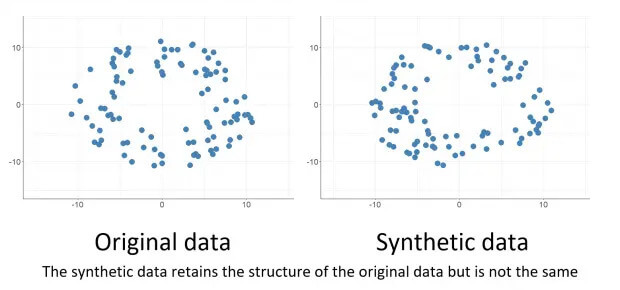
–Synthetic data: data generated artificially through algorithms, mathematical models, or generative AI techniques. It mimics the statistical characteristics, patterns, and relationships of real data but is not derived from direct observation or measurement of the real world. For example, data generated by models such as Generative Adversarial Networks (GANs) or Variational Autoencoders (VAEs) falls into the category of synthetic data.
Recommended Related Reading from AI Robots Eidos
The definition of synthetic data provides a theoretical basis and evaluation framework for understanding synthetic data vs real data, helping us to more scientifically weigh the pros and cons of both in data selection, model training, and practical applications, thereby maximizing the advantages of each.
For example, based on the definition, the evaluation of the comparison between synthetic data and real data can revolve around dimensions such as “statistical similarity,” “utility,” and “novelty.” For instance, the distribution differences between synthetic data and real data can be quantified by calculating metrics such as KL divergence and Jensen-Shannon divergence, or the effectiveness of synthetic data can be validated through performance comparisons of models on both types.
Interested readers can refer to the article: Synthetic Data Companies: The New Data Builders.
–Real data: Real data is collected through direct observation, experimentation, measurement, or from real-world systems. It reflects the characteristics and states of actual phenomena, events, or objects. For example, user feedback data from market research is a type of real data.
Synthetic data is artificially created “simulated data”, while real data is “raw data” obtained directly from the real world.
Synthetic Data vs Real Data: Comparison & Differences
| Dimension | Synthetic Data | Real Data |
| Generation Method | Generated via mathematical models / physical rules (e.g., finite element, system dynamics, machine learning models), relying on prior knowledge. | Directly collected from physical world observations (e.g., temperature, pressure, images, signals) using sensors or experimental equipment. |
| Cost & Efficiency | Enables rapid generation of large‑scale, multi‑scenario data (including extreme / hazardous scenarios) with low cost and high efficiency. The cost of generating 1 million synthetic images for autonomous driving is approximately a few hundred dollars | Collection is limited by physical conditions (time, space, equipment) and labor cost; extreme scenarios (e.g., accidents) are hard to reproduce. The cost of collecting 1 million real road test images may exceed one million dollars. |
| Accuracy | Depends on model fidelity (assumption validity, parameter calibration); may deviate from the real world (“model error”). | Reflects actual physical processes but may contain noise, measurement errors, or unmodeled random factors (e.g., environmental interference). |
| Controllability | Allows precise control of variables (e.g., adjusting wind speed, fault types) to isolate single factors. | Variables are often coupled and complex, making full control difficult (e.g., multiple factors changing simultaneously in natural environments). |
Synthetic Data vs Real Data: Synthetic Data Cannot Do Without Real Data
–Domain shift: If synthetic data is not constrained by real data over the long term, the model may learn patterns that are based on the synthetic data rather than objective laws. The red dots represent part of the real data distribution, while the orange dots represent synthetic data. Synthetic data often has regular shapes, simple patterns, and a distribution that significantly differs from real data, indicating that the synthetic data does not cover many possible real-world cases and focuses mostly on a small portion of the real data distribution.
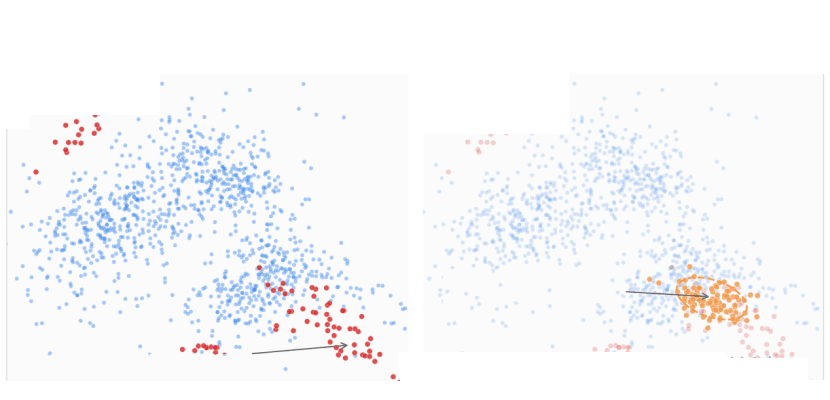
When a model learns from such simple, anomalous synthetic data, it is highly likely to misjudge samples that fall outside the orange region (i.e., not covered by the generated data) in real situations. Specifically, synthetic data lacks the nuance and diversity inherent in real datasets, which can result in trained AI models being overly simplistic and lacking practicality
–Distribution collapse: The generator itself needs to be trained on data. If one generation of the generator is trained on synthetic data, the data it produces already contains bias. When the next generation of the generator learns from this generated data, the bias may increase further.
After several rounds, the originally complex, diverse, long-tail real distribution becomes compressed into an increasingly homogeneous distribution. This further degrades the variation in the training data. In simple terms, as data is generated round after round, it becomes more uniform and deviates further from reality. Training models on such data leads to a decreasing number of correctly recognized new samples, i.e., model performance deteriorates.
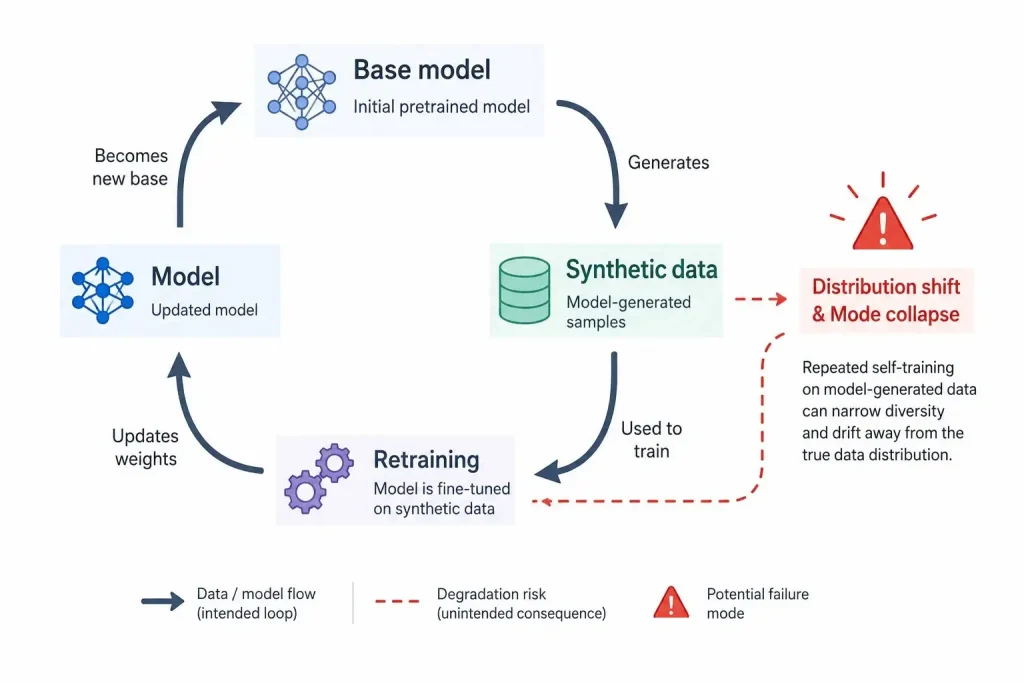
For example, early versions of GPT-2 generated data used to train GPT-3. After multiple rounds of training, the model began to repeatedly output meaningless sentences like “I like eating pizza” because “pizza” appeared too many times in the “valid data” the model had seen.
Synthetic Data vs Real Data: In The Era of Large Models, Real Data Cannot Do Without Synthetic Data
–Expanding large model training datasets: Currently, the demand for data by large models is growing exponentially. Epoch AI made an important prediction in 2022: high-quality text data is expected to be exhausted by 2026, and low-quality text data as well as visual data are expected to be exhausted by 2030. Synthetic data compensates for the scarcity of real data, mitigates the risk of data exhaustion for large model training, and provides a stable source of training data.
–Improving the quality of large model training data: Data synthesis techniques can generate precise, diverse data for specific scenarios, avoiding data bias issues and improving overall model accuracy. Phi-3, a 3.8 billion parameter model released by Microsoft, saw significant performance improvements in reasoning tasks after incorporating synthetic data, even outperforming models with much larger parameter counts.
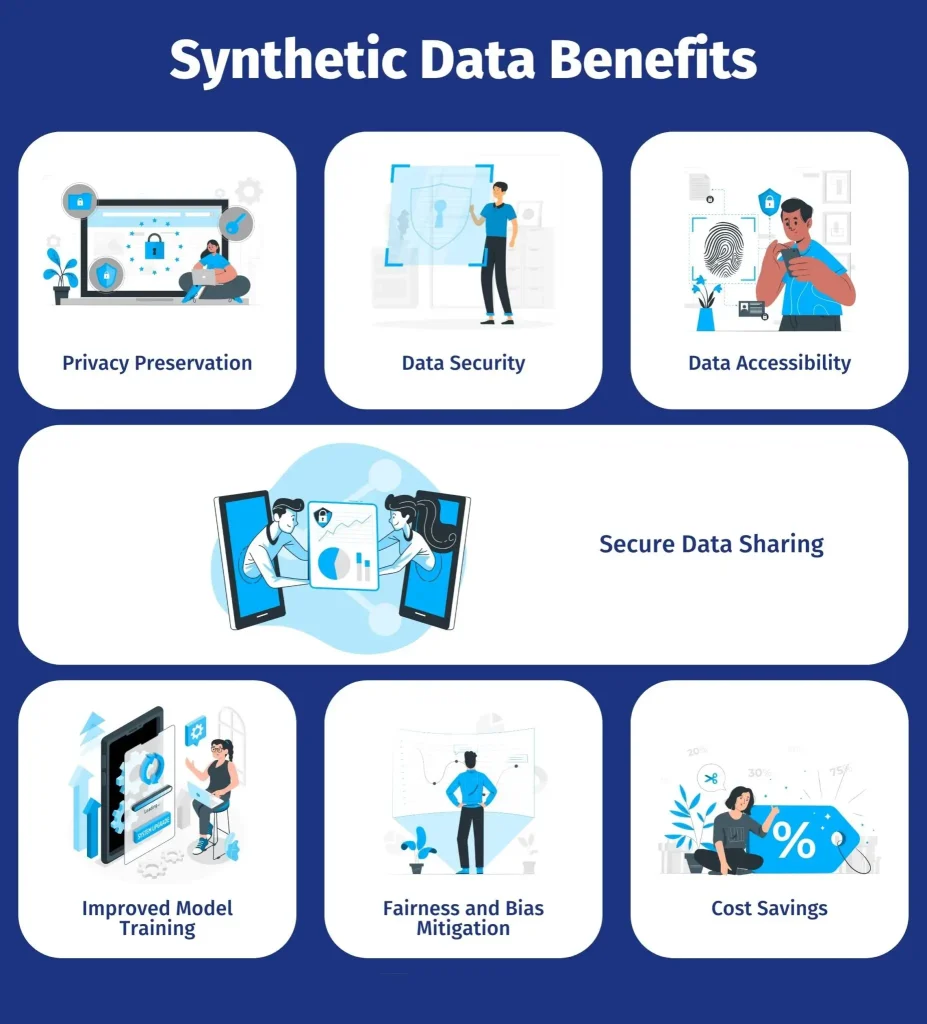
–Enhancing large model scenario coverage: Data synthesis techniques can simulate edge cases that are difficult to capture in reality, such as extreme weather conditions in autonomous driving or abnormal transaction patterns in financial risk control. This allows the model to cover various possible inputs during training and testing, learn more comprehensive features and patterns, and improve adaptability to complex real-world situations.
–Avoiding privacy and compliance risks: Synthetic data, generated through anonymization, complies with regulations such as the General Data Protection Regulation (GDPR) and avoids the risk of privacy leakage associated with directly using real personal data. For example, differential privacy (DP) techniques can obscure individual characteristics while preserving the distributional features of the original data, making it impossible to identify individual information in the output, thereby protecting personal privacy.
–Anti-fragile training: “Anti-fragile” refers to a system that not only maintains its functionality under shock but also becomes stronger due to those shocks. Training with high-intensity extreme events in a synthetic environment (which occur at a frequency far exceeding that of the real world) can stimulate the model’s adaptive mechanisms.
In reinforcement learning or supervised training, normal samples can be replaced with extreme synthetic samples at a certain ratio (e.g., 10% to 30%). At the same time, using risk-sensitive loss functions (like CVaR loss) encourages the model to focus on tail performance rather than average performance. This type of anti-fragile training is especially valuable for its inherent characteristics, such as financial trading AI practicing “not to panic sell” in synthetic market crash scenarios, enabling it to seize mispricing opportunities when a real crash occurs.
Synthetic data vs real data: Mutual synergy
Simulated data cannot completely replace real data, but it can serve as an efficient, low-cost data supplement in specific scenarios. The relationship between the two is closer to “synergy”:
Use simulation to expand data boundaries (covering extreme/scarce scenarios);
Use real data to calibrate simulation models (improving simulation credibility);
Finally, use real data to verify results (ensuring practical application reliability).
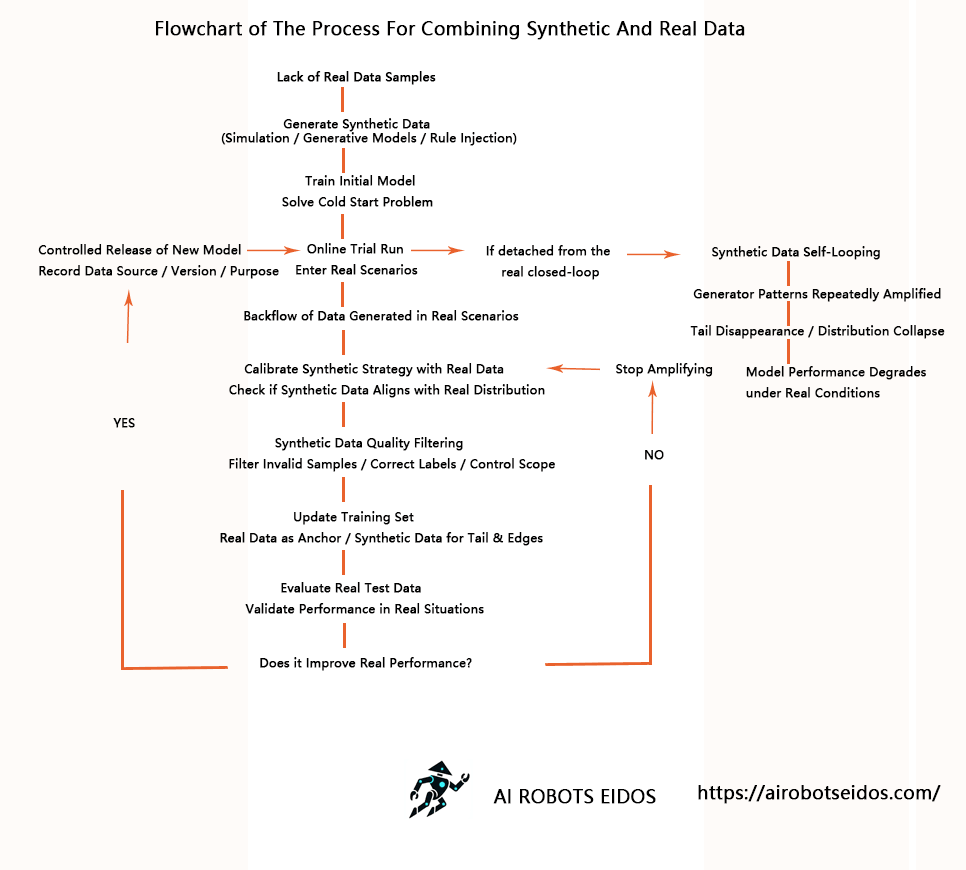
Typical strategy: In the R&D process, first use simulation for rapid iteration, then use real data to validate key milestones (e.g., a “simulation-to-real closed loop”), gradually approaching the requirements of real scenarios.
Flowchart of The Process For Combining Synthetic And Real Data
Frequently Asked Questions About Synthetic Data vs Real Data
Ai Robots Eidos has compiled a list of questions regarding synthetic data vs real data, hoping to help readers deepen their understanding of both.
In Which Scenarios Can Synthetic Data Partially Replace Real Data?
–Early R&D / model pre-training: When real data is scarce (e.g., new product design) or extremely expensive to obtain, simulated data can be used for preliminary algorithm validation and model training. For example, robot control algorithms can be debugged in simulation environments before being transferred to real robots.
–Coverage of extreme/dangerous scenarios: Extreme conditions that are difficult to reproduce in the real world (e.g., earthquakes) can be generated through simulation to produce data for robustness testing. Examples include simulations of aero-engine failure under high temperature and pressure, or simulations of cascading failures in power grids.
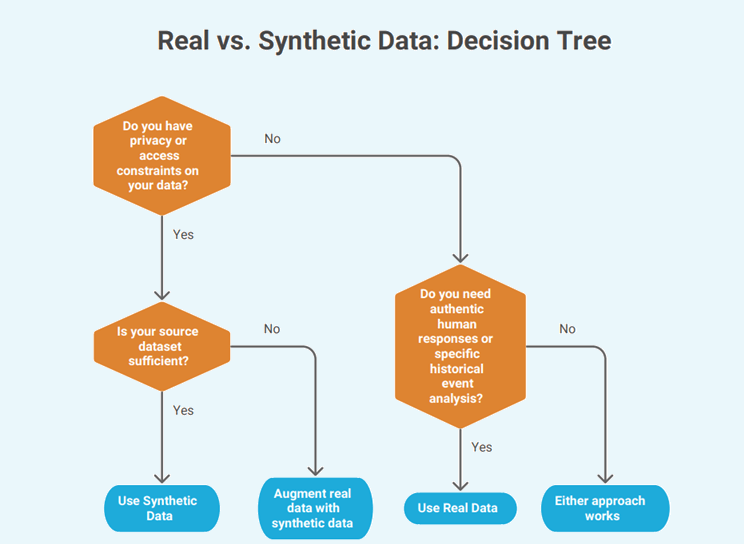
In Which Scenarios Is Synthetic Data Not A Substitute For Real Data?
–Model validation and calibration: The accuracy of simulation models must be verified with real data (e.g., calibrating material constitutive equations, correcting aerodynamic coefficients). Relying solely on a “self-loop” of simulated data can lead to error accumulation. For example, weather forecasting models need to be calibrated with historical real observation data.
–Exploration of unknown laws: Real data may contain physical mechanisms not captured by models (e.g., nonlinear effects of complex systems, new material properties). For instance: discovering new phase transition behavior in materials science.
–Final performance validation: In critical fields (e.g., aerospace), final acceptance typically requires real data validation. For example, aircraft airworthiness certification requires real flight test data.
Insight from AI Robots Eidos about Synthetic Data vs Real Data
–Synthetic data vs real data – a dynamic feedback loop
Synthetic data and real data are not a static mixture but form a dynamic feedback loop similar to the structure of a DNA double helix. Real data serves as an “anchor point”: it regularly detects distribution shifts in synthetic data generators using real data (for instance, through Wasserstein distance or adversarial discriminators). Once deviations are identified, the generator is forced to recalibrate.
Synthetic data acts as an “extender”: it proactively generates long-tail samples that real data has not yet covered within a safe zone around the anchor point. In each iteration, the generator first creates augmented data based on the real anchor, and after model training, it is deployed into a real environment. The new data fed back from the real environment becomes the anchor for the next round. This cycle continues, tightening the “integration” between the two.
–Synthetic data vs real data – from resemblance to possibility
The traditional goal of synthetic data has been to “resemble real data.” The newer application is to generate scenarios that have never occurred in the real world but could physically or logically happen. This requires the integration of physical engines or causal models rather than simple statistical mimicry. It necessitates embedding the physical laws of the domain into the generative model, ensuring that synthetic data meets physical constraints while breaking the frequency restrictions of real distributions. For example, simulating nuclear power plant failures. This means using AI for stress testing and safety validation, allowing the model to learn how to handle “risks not validated by reality” in advance.
–Synthetic data vs real data – the data gap
Caution is necessary regarding the “wealth gap in synthetic data,” as the quality of synthetic data highly depends on the quality of the real data used for training it. Institutions with vast amounts of high-quality real data can generate highly realistic synthetic data, thereby further enhancing model performance. In contrast, smaller institutions with scarce data may find that even with the use of synthetic data technology, the poor quality of the seed real data leads to greater biases in the generated synthetic data, exacerbating performance disparities further.
Image Credits: Labellerr & Web & Medium & Questionpro & Bluegen