
Table of Contents
Heavy duty AGV manufacturers help the manufacturing and logistics industries automate the handling of heavy materials by developing and producing high-load, high-precision AGV equipment. Moreover, due to the unique characteristics of heavy duty AGVs, their product R&D also drives upgrades and innovations in subsystems such as motors, sensors, and control systems.
What is a Heavy Duty AGV?
A heavy duty AGV (Automated Guided Vehicle) is a heavy-load version of a standard AGV. It is a transport device that can travel automatically along a predefined path without driver operation. Heavy duty AGVs are characterized by multiple degrees of freedom, large dimensions, and high load capacity. They consist of drive units, sensors, and control systems.
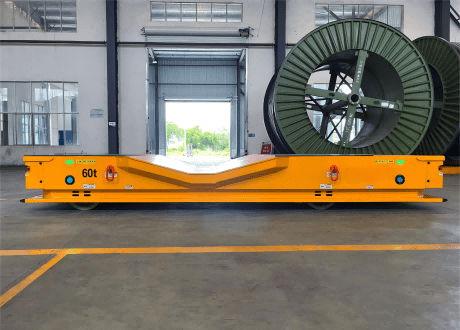
Whereas standard AGVs can only carry loads ranging from a few hundred kilograms to about one ton, heavy duty AGVs generally have a load capacity greater than 5 tons. Due to the increased load, the vehicle structure requires special drive wheels with stronger load-bearing and driving capabilities; motor power and operating current are increased; the AGV frame needs to be reinforced; and the lifting mechanism is often changed from electric to hydraulic.
Because of their high load capacity, heavy duty AGVs are widely used in heavy machinery plants, railway transportation, ports and airports, large transformer factories, heavy-duty truck manufacturing plants, and other such venues.
Recommended In-depth Reading from AI Robots Eidos
If readers want a comprehensive understanding of heavy duty AGVs, please read this detailed article about heavy duty AGVs.
Major Global Heavy Duty AGV Manufacturers
Scott Technology
Scott Technology is a company founded in New Zealand. After acquiring the Belgian automation company Alvey Group, Scott Technology further acquired Transbotics in 2018. With this acquisition, Scott Technology enhanced its end‑of‑line logistics capabilities, completing the entire production process from raw material receiving to final distribution, and building a complete end‑to‑end robotics product system.
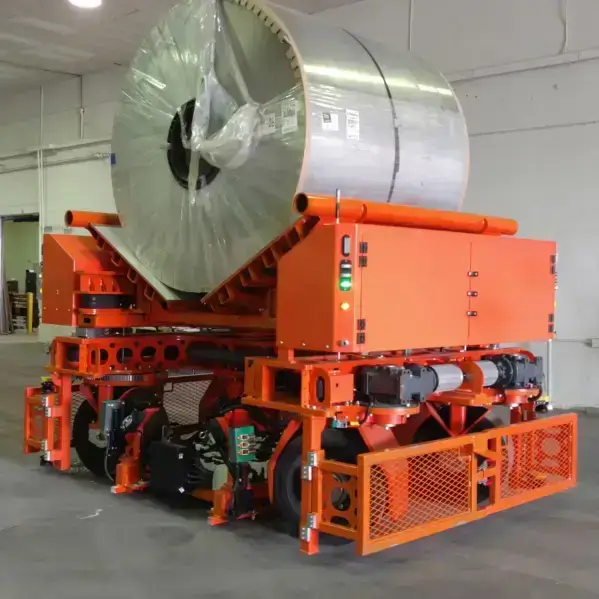
Scott Technology’s flagship product is the NexBot modular AGV launched in 2025. It features a modular design with interchangeable front attachments, allowing flexible configuration as a counterbalanced forklift, tugger, roller truck, elevator, or straddle lift. Designed for narrow aisles, heavy loads, and long reach, it is suitable for industrial and manufacturing environments. It supports natural feature navigation or laser reflector navigation and is equipped with fast‑charging batteries and intelligent control functions.
DTA
DTA is an Italian company founded in 1972. As a specialist in designing and providing custom solutions, it offers material transport vehicles for heavy industry. DTA continues to deepen its R&D, manufacturing, and application of AGVs, primarily in steel, shipbuilding, aerospace, wind power, automotive, and nuclear power plants, with a focus on customization. As one of Europe’s heavy duty AGV manufacturers, DTA has launched a series of AGV products:
–RHINO: Medium heavy duty AGV for steel, shipbuilding, automotive and other industries.
–T-REX: Large heavy duty AGV focused on overweight cargo transport.
–TIGER: Multi‑purpose AGV suitable for various industrial scenarios.
–DOLPHIN: Ultra‑heavy outdoor AGV designed for extreme loads and complex terrain.
Esatroll SA
Esatroll SA is a Swiss company that develops and produces high‑tech machinery and equipment for the industrial sector. Its products include heavy duty AGVs and forklift AGVs (load capacities from 200 kg to 20 tons), and it can also customize larger load products as needed. Esatroll SA offers three navigation types: laser, inertial, and wire‑guided. For laser navigation, it uses Bluebotics’ ANT laser navigation system. As a well‑known heavy duty AGV manufacturer, Esatroll SA’s product series includes:
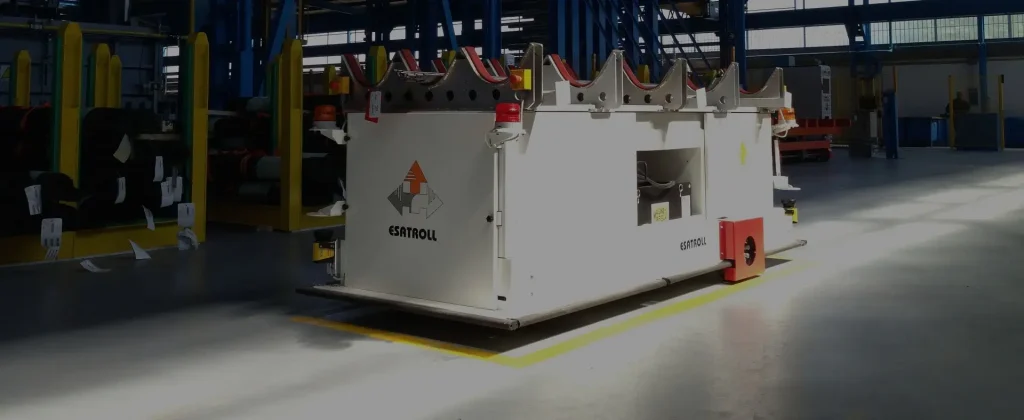
–LGV Contrappesati: Equipped with counterweights and large wheels, suitable for scenarios with low floor precision requirements, capable of stably carrying heavy loads.
–Veicoli da Esterno (Outdoor AGV): Designed specifically for outdoor environments with good water and dust resistance and strong battery life for continuous operation.
–Veicoli Speciali (Custom AGV): Developed to meet specific customer requirements, integrating special functions such as high‑precision positioning, multi‑axis motion control, and explosion‑proof design.
Gottwald
Founded in 1906, Gottwald is a world-renowned port equipment manufacturer. For a long time, Gottwald has been a market leader in the R&D and manufacturing of mobile port lifting equipment. Since the late 1980s, it has also led the trend in terminal automation, providing not only port cranes but also creative automation solutions for container transport and housekeeping. As one of Germany’s heavy duty AGV manufacturers, Gottwald has sold over 1,000 AGVs in 2023, mainly operating in the ports of Rotterdam and Hamburg, with over 70,000 operating hours.
Kion Group
Kion Group is a globally leading supplier of supply chain solutions and material handling equipment, headquartered in Frankfurt, Germany. With decades of technological expertise in the mobile robotics field and a global R&D team of over 300 people, Kion Group focuses on the development and application of intelligent material handling technologies such as AGVs (Automated Guided Vehicles) and AMRs (Autonomous Mobile Robots). Kion Group’s heavy duty AGV series mainly includes the Linde T-Matic series and the Dematic series.
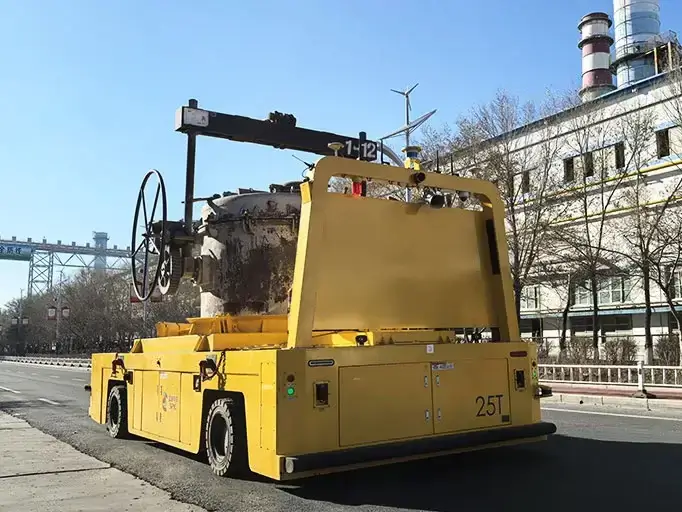
–Linde T-Matic Heavy Duty AGV Series: Capable of carrying loads from 10 tons to 50 tons and above, suitable for heavy material handling scenarios such as steel, chemical, and heavy machinery manufacturing.
–Dematic Heavy Duty AGV Series: With a load range from 20 tons to 100 tons, designed specifically for ultra-heavy material handling, suitable for large-scale warehousing, ports, mining, and other scenarios.
ROFA
ROFA Industrial Automation Group is also one of Germany’s heavy duty AGV manufacturers. It is a representative company in industrial automation, conveying, logistics, and custom equipment. With decades of experience in conveying system solutions, ROFA provides comprehensive industry‑specific solutions, ranging from logistics and production automation conveying systems from a single source to complete solutions encompassing design, simulation, and implementation.
AGV products are an important part of ROFA’s portfolio, offering heavy duty AGVs and other customized solutions. For example, its “Caesar PN‑1.0 MYK” model measures 1,700mm × 900mm × 280mm, can transport up to 63 tons, reaches a speed of 1.5 m/s, is equipped with a 3D camera, safety scanners, etc., and is suitable for chassis line transport in automotive assembly plants.
Langyu
As one of China’s important heavy duty AGV manufacturers, Langyu focuses on the R&D of heavy duty AGVs and intelligent logistics systems. Its heavy duty AGV series achieves high-precision positioning, intelligent obstacle avoidance, and adaptive control through modular design, multi‑sensor fusion navigation, multi‑motor coordinated group control, and other technologies, meeting the intelligent transportation needs of overweight, overlong, and oversized materials in different scenarios.
Langyu’s heavy duty AGV series is characterized by high load capacity, high adaptability, and intelligence, covering different load and scenario requirements. Its ultra-heavy duty AGV series has received widespread attention.
–240‑ton heavy duty AGV: Widely used in the wind power industry. For CRRC Wind Power customers, it has increased annual output value by nearly 1 billion yuan and improved production efficiency by 30%.
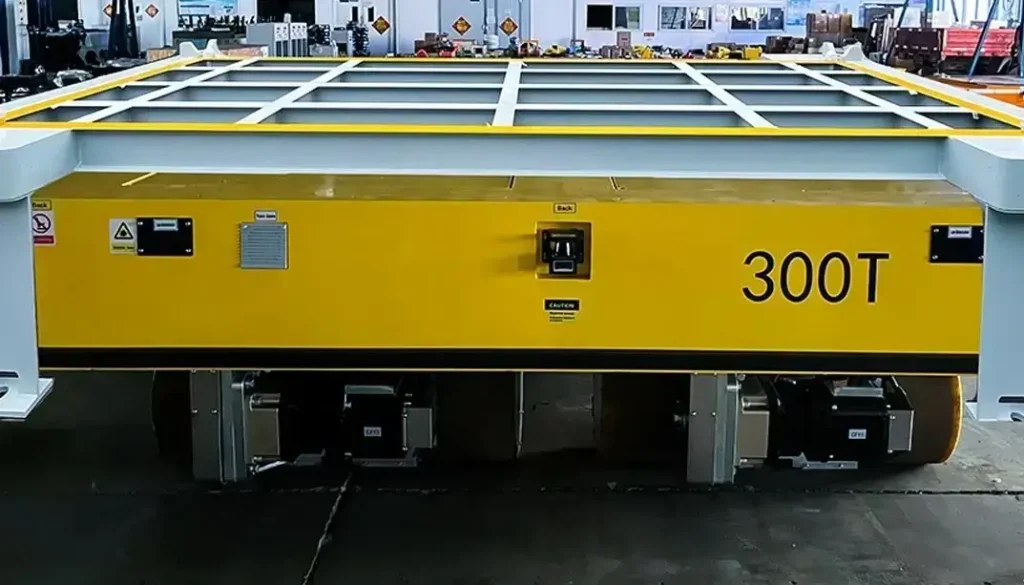
–360‑ton heavy duty AGV: Used in offshore wind farms, replacing fuel‑powered vehicles. It saves 1,000 tons of fuel annually and reduces carbon emissions by 70,000 tons.
–600‑ton heavy duty AGV: Adopts a 4‑drive, 16‑wheel omnidirectional drive design, capable of climbing 5‑degree slopes, suitable for ultra‑large material handling scenarios.
Challenges Faced by Heavy Duty AGV Manufacturers
–Relatively High Technical Difficulty: Heavy duty AGV manufacturers face higher technical requirements and supporting demands. Heavy duty AGVs involve many technical difficulties, and their design structure differs significantly from that of light duty AGVs. The selection standards for components are also different. Therefore, compared with ordinary AGVs, the R&D and production barriers for heavy duty AGV manufacturers are relatively high.
–Non‑standard Design Capability: Different application scenarios have greatly varying requirements for the size, shape, loading method, etc., of heavy duty AGVs. Manufacturers must possess strong non‑standard design capability to customize vehicle bodies, lifting mechanisms, etc., according to customer needs, and to meet special process requirements. This poses a considerable challenge to the design and technical capabilities of heavy duty AGV manufacturers.
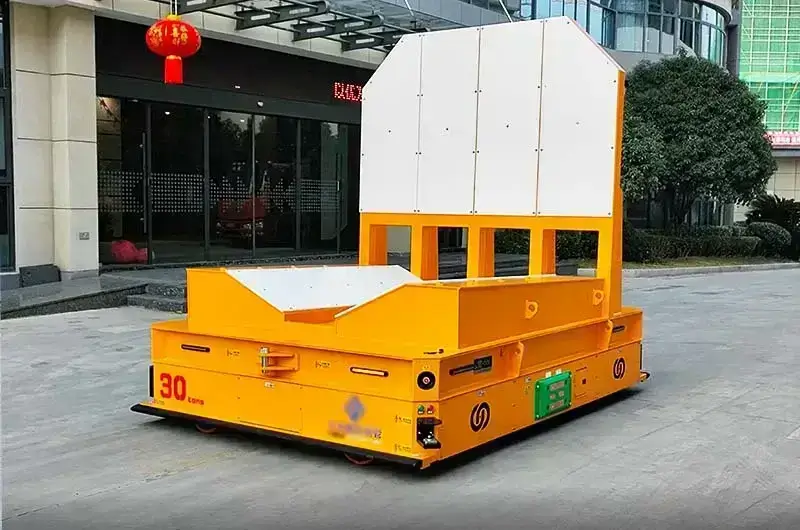
–High Entry Barriers for Application Fields: The main application fields of heavy duty AGVs are concentrated in ports and terminals, railway transportation, and certain special industries. These fields require heavy duty AGVs to have good outdoor environmental adaptability, withstanding harsh conditions such as high temperatures, salt spray, rain, and snow. At the same time, the vehicle body must be waterproof, dustproof, and corrosion‑resistant.
Addressing these challenges will determine which heavy duty AGV manufacturers can lead the next phase of competition.
The Rise of Chinese Heavy Duty AGV Manufacturers
Reasons for the Rise of Chinese Heavy Duty AGV Manufacturers
Developments in market and technology have contributed to the technological progress and product quality improvement of Chinese heavy duty AGV manufacturers.
–Increasing Industry Demand:
New Energy Industry: The lithium battery and photovoltaic sectors demand extremely high precision (±2 mm) and stability for heavy material handling (e.g., electrodes, battery packs, silicon wafers), driving up demand for unmanned heavy duty AGVs.
Steel/Port Industry: Handling heavy materials (steel coils, containers, ore) inside plants or terminals – unmanned heavy duty AGVs can cope with harsh working conditions and improve operational efficiency and safety.
–Improved Technological Maturity:
With China’s multi‑sensor fusion navigation combining BeiDou, inertial navigation, visual perception, and LiDAR, positioning accuracy has reached ±10 mm. Products developed by Chinese heavy duty AGV manufacturers have improved in dynamic path planning, autonomous obstacle avoidance, and multi‑vehicle coordination.
China’s pure electric and battery‑swapping technologies are maturing, so the endurance and charging efficiency of heavy duty AGVs can meet the needs of more and more industries.
–Innovation in Corporate Strategy: Chinese heavy duty AGV manufacturers are beginning to focus on niche scenarios (e.g., new energy), creating different customized solutions for different industries. At the same time, they are actively expanding business models, shifting from “equipment purchase” to leasing, pay‑per‑use, RaaS (Robot as a Service), and system integration plus operation & maintenance services, thereby reducing initial investment for customer companies and accelerating the large‑scale application of heavy duty AGVs.
Major Heavy Duty AGV Manufacturers in China (List)
| Company | Product Features | Applications |
| SIASUN Robot | The heavy duty AGV developed by SIASUN for Singapore Port has a rated load of up to 65 tons, positioning accuracy of ±5 cm, maximum speed of 7 m/s, and braking distance of less than 13 m. | Large tank production line manufacturing, commercial vehicle assembly lines, passenger car stamping workshop logistics handling. |
| Dongfeng Special Equipment | The low-profile lifting and transfer AGV has a load capacity of 10 tons, uses 4-wheel steering drive, and achieves a maximum speed of 20 m/min at full load. | Automotive industry |
| Guozi Robot | Related products adopt navigation methods such as laser navigation, magnetic stripe, QR code, and texture navigation, with load capacities ranging from 10T to 30T. | Construction machinery, automotive, rail transit, etc. |
| Lingong Zhike | Mainly features hybrid and magnetic navigation; the star product DL100 has a load capacity of over 10 tons. | Vehicles, mechanical parts, heavy industry |
| Shanghai Huiju | Uses Mecanum wheels to achieve zero turning radius, lateral movement, and full-directional omnidirectional drifting; customizable platforms with loads from 10 to 50 tons. | Aerospace, rail transit, wind turbine blade transfer, power industry, precision casting, logistics warehouse forklift AGVs, etc. |
| Chizhong Robot | Maximum load capacity of 200 tons, lifting capability with a stroke of 200 mm, 4 drive units for omnidirectional movement, climbing ability ≥5%, max speed up to 25 m/min. | Automotive manufacturing, rail transit, heavy industry |
| Kaiyunlai | Mainly magnetic navigation, the heavy duty AGV series has launched intelligent handling AGVs with a load capacity of 100 tons. | Heavy machinery plants, heavy duty truck plants |
| Tianjin Langyu | Load capacity up to 200 tons, featuring “eight system advantages”: servo control, wireless communication, synchronous hydraulics, power monitoring, self-leveling chassis, safety protection, intelligent dispatching, and fault self-diagnosis. | Aerospace, wind power |
| Kunming Shipbuilding Intelligent Equipment | Uses China’s self-developed BeiDou positioning system for navigation, meeting various large-tonnage customization needs. | Locomotives, ports and terminals |
| Zhenhua Heavy Industries | One of the leading heavy duty AGV manufacturers in China, its products with loads of 20–50 tons can be customized. Earlier products mainly used magnetic navigation, later transitioning to multi-sensor fusion positioning technologies, including satellite navigation, LiDAR SLAM, and visual SLAM. | Ports and terminals |
Insight from AI Robots Eidos about Heavy Duty AGV Manufacturers
Currently, global heavy duty AGV manufacturers are still competing on maximum load capacity, ranging from 65 tons to 200 tons and even 300 tons. However, the core competitiveness of leading companies in the future will not merely be the increase in tonnage but rather the ability to deeply customize solutions for specific scenarios. For example, the new energy industry demands ±2mm precision and clean environments, while ports require outdoor all-weather operations and multi-vehicle collaboration. The aerospace sector has needs for ultra-long items and multi-degree-of-freedom loading and unloading. Manufacturers that can quickly define and meet the triple adaptation of “scenario + working conditions + processes” will achieve higher premiums.
Existing products still insufficiently cover extreme environments like -40°C cold, 50°C high temperatures, high salinity (offshore platforms), and explosion-proof Zones 1/2. With the rising demand for automation in scenarios such as wind power (blade transportation), polar scientific research, nuclear power plants, and open-pit mining, heavy duty AGVs that possess “extreme environment adaptability certification” will form unique technological barriers.
Looking ahead, in a large workshop or port, there will be a future need to coordinate dozens of heterogeneous devices such as AGVs, autonomous forklifts, overhead cranes, and stackers, with load capacities ranging from 10 to 200 tons. This requires scheduling systems to evolve from “AGV-specific scheduling” to “heavy logistics equipment operating systems,” incorporating digital twin technology and edge computing. Manufacturers that provide unified open interfaces (such as VDA 5050 or industry standards) and achieve millisecond-level real-time collaboration will occupy a dominant position at the system level.
Image Credits: Gradinlift & Scottautomation & Kinocranes & Lonyurobot & Esatroll & Hensenagv
Other Articles on The Topic of AGVs
Level A (Foundational )