Rolling Shutter vs Global Shutter: Which Fits?
Table of Contents
Rolling Shutter vs Global Shutter is the central topic of this article. Global Shutter and Rolling Shutter are two mainstream exposure methods in machine vision systems. They differ significantly in definition, principle, characteristics, image effects, and applications. This article will provide a detailed introduction to all aspects of rolling shutter vs global shutter to help you make the right choice in practical projects.
Rolling Shutter vs Global Shutter: Definition
Rolling Shutter
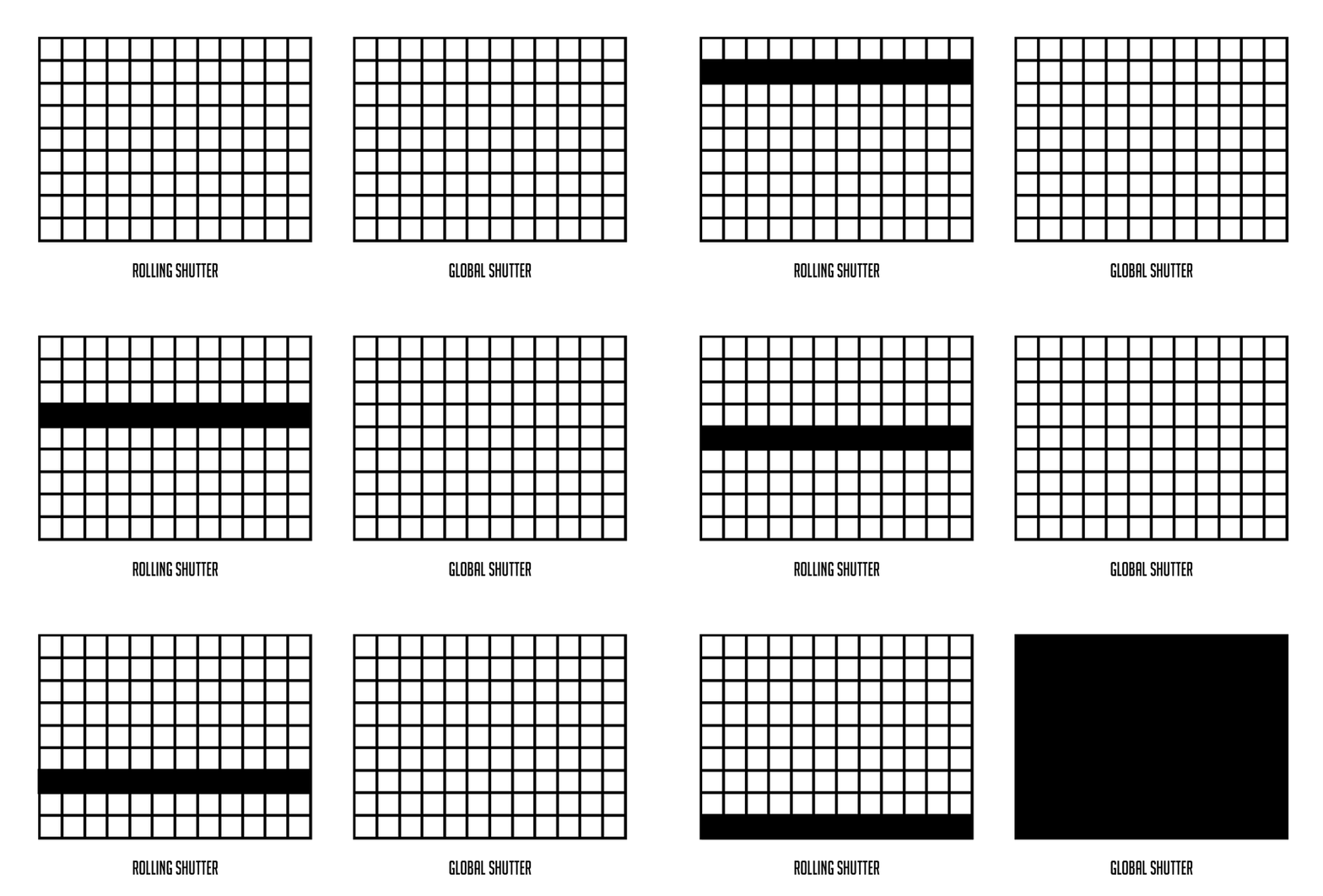
A rolling shutter sensor does not expose all pixels simultaneously. Instead, it exposes the sensor row by row, from top to bottom. The exposure duration for each row is the same, but there is a time offset from one row to the next. The exposure of the first row ends and is read out (Line Readout), followed by the exposure end and readout of the next row. This causes a delay between the end of exposure and the start of readout for consecutive rows. This shutter mode works somewhat like a curtain or a rolling blind, which is why it is called a rolling shutter.
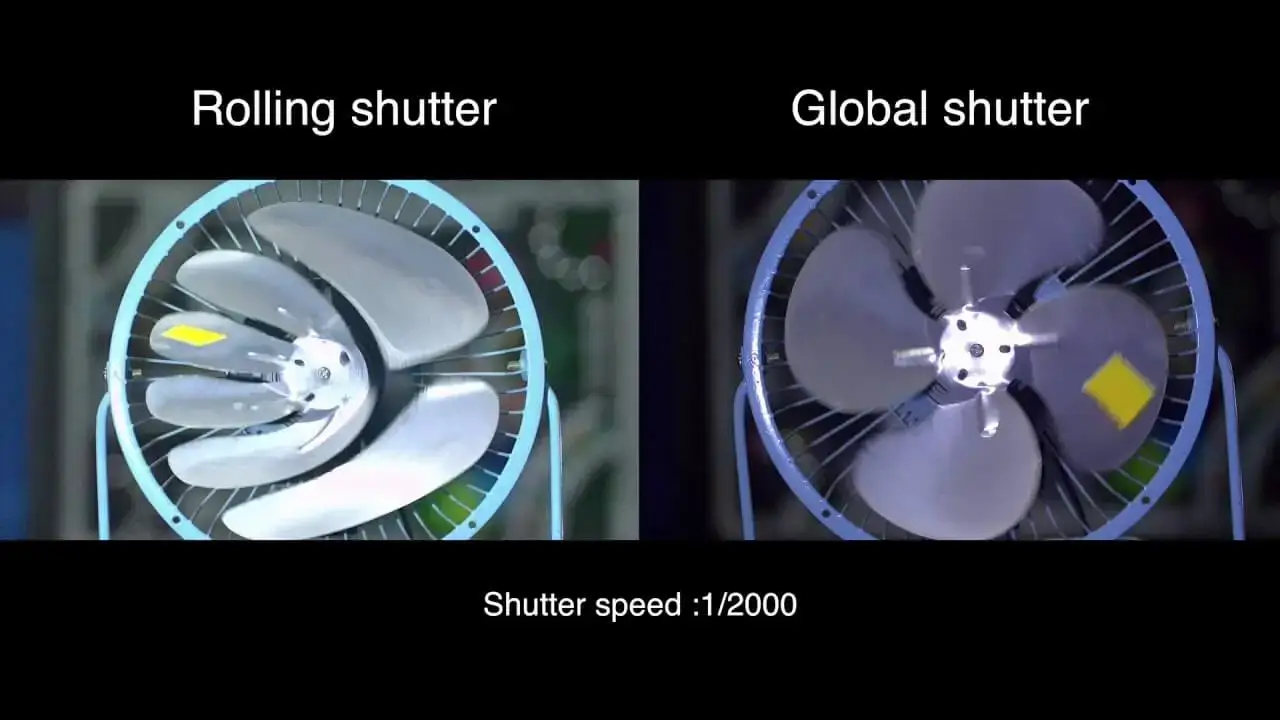
However, if the object is moving rapidly, although the exposure time for all pixel rows is the same, there is a slight time delay in the start of exposure for each row. During this delay, the object continues to move. Consequently, the imaging position of the object changes from one exposed row to the next, ultimately producing a distorted image. The degree of distortion depends on the object’s speed and the rolling shutter speed. The most common distortion is that vertical lines in motion appear tilted or wavy.
However, due to the high resolution of rolling shutters, rolling shutter sensors perform well for static or slowly moving objects.
Global Shutter
A global shutter sensor exposes all pixels in the array simultaneously. All pixels begin capturing light at the same time, and all pixels stop at the same time. This is why this shutter mode is called a global shutter. After exposure, the sensor reads out row by row from top to bottom.
All pixels start and end exposure at the same time, but readout (line readout) still proceeds row by row. This exposure method produces images without distortion. Global shutter sensors have a significant advantage for imaging high-speed moving objects.
Recommended In-depth Reading from AI Robots Eidos
Rolling Shutter and Global Shutter are important components of machine vision, determining the image acquisition quality, detection accuracy, and system stability within machine vision systems. Together, they form the technical foundation that allows industrial vision systems to flexibly respond to ever-changing detection needs.
If readers wish to further explore the entire machine vision system, please refer to this detailed article introducing machine vision.
Rolling Shutter vs Global Shutter: Principles
Principle of Rolling Shutter
The core of rolling shutter is “row-by-row asynchronization.” It requires no complex storage cells, has a simple structure, and its operation is divided into several stages:
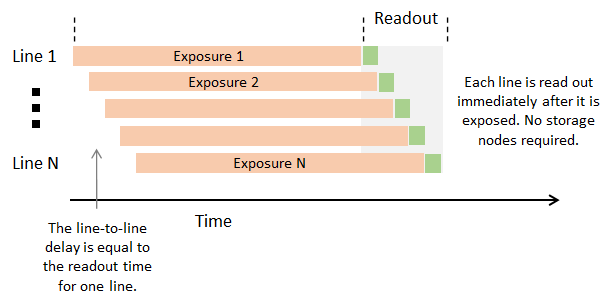
–Row-by-row Reset: Starting from the top row, each row is reset, and exposure begins immediately.
–Row-by-row Exposure: Adjacent rows are reset and exposed sequentially with a microsecond-level “row time” interval, forming a rolling exposure pattern.
–Row-by-row Readout: As soon as the first row completes exposure, it is read out immediately, occurring in parallel with the exposure of subsequent rows, without waiting for the entire frame to finish.
–Image Assembly: Data from all rows is read and assembled in sequence to form a complete image.
Key Parameter:
Row time (the exposure start time difference between two adjacent rows) can be estimated by rowtime = 1 / (maxFps × rows). The larger the row time, the more obvious the dynamic distortion. Example: For a 1920×1080, 30fps camera, the row time is approximately 30.86μs.
Principle of Global Shutter
The core of a global shutter is “full-frame synchronization,” which relies on a special sensor structure (e.g., additional storage cells per pixel). Its operation is also divided into several stages:
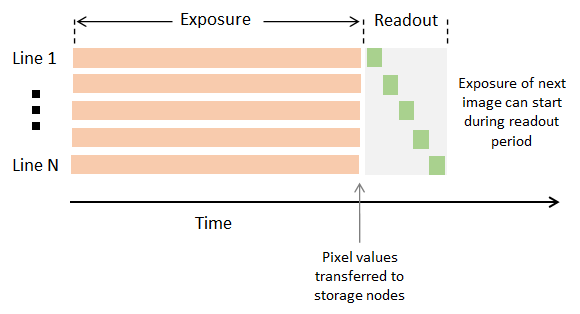
–Global Reset: Before exposure, a global reset signal clears residual charge from all pixels, ensuring the same starting state.
–Synchronous Exposure: Upon receiving a trigger signal, the photosensitive elements of all pixels turn on simultaneously and accumulate charge for a set time, with the process being completely consistent.
–Charge Transfer: After exposure ends, the charge from all pixels is simultaneously transferred to storage cells for temporary holding, preventing light interference.
–Row-by-row Readout: The charge from the storage cells is read row by row, converted into digital signals, and assembled into a complete image.
Supplement: CCD sensors natively support global shutter. CMOS sensors require additional storage nodes (e.g., 4T pixels), which increases design complexity. Mainstream global shutter CMOS sensors use a stacked structure to balance performance and pixel density.
From a principled perspective, rolling shutter vs global shutter can be summarized as follows: the rolling shutter operates with “line-by-line asynchronous capture, exposing and reading simultaneously,” while the global shutter utilizes “full-frame synchronization, storing before reading.” This fundamental difference in principle determines their varying characteristics in terms of image distortion, frame rate, cost, and other aspects.
Rolling Shutter vs Global Shutter: Image Effects
Dynamic Shooting and Distortion
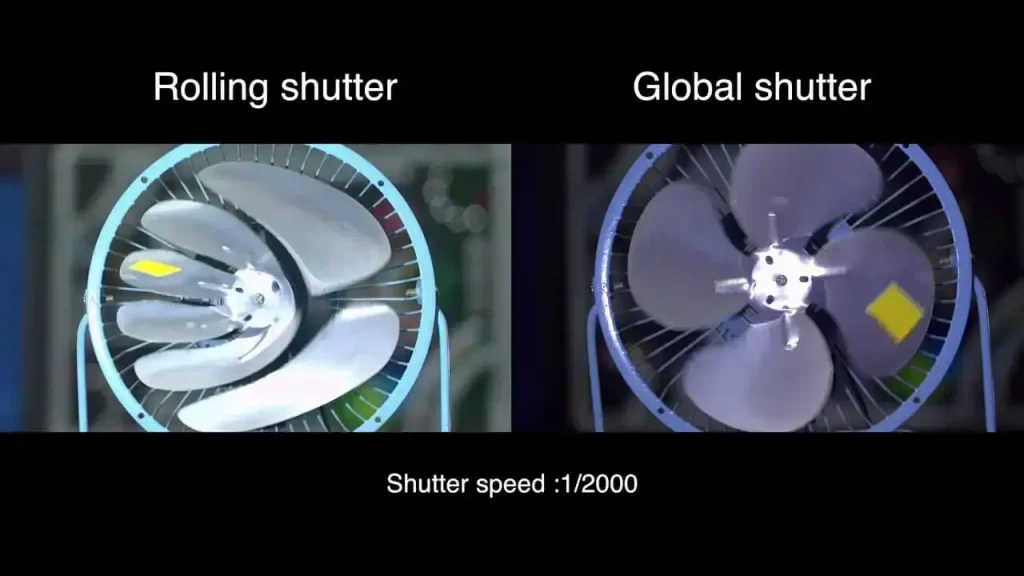
–Global Shutter: Since all pixels capture images synchronously, no matter how fast the object moves, the captured image represents the object’s “true instant” without any deformation.
–Rolling Shutter: When shooting moving objects, because each row of images is taken at a different point in time, by the time the last row of images is taken, the object has already moved some distance. This produces the famous “Jello Effect,” causing round objects to appear as ellipses and rectangles as parallelograms.
Frame Rate and Cost
–Global Shutter: Due to the need for additional storage cells in each pixel (for latching charge), the chip structure is more complex, the fill factor is lower, and the cost is generally higher.
–Rolling Shutter: The structure is simple with high integration. At the same pixel count, rolling shutter cameras typically offer higher frame rates and lower prices.
| Comparison | Global Shutter | Rolling Shutter |
| Exposure Timing | All pixels start and stop exposure simultaneously, with consistent timing | Start and stop row by row, with microsecond-level time differences between rows |
| Image Distortion | No jello effect in rolling shutter, suitable for high-speed motion capture | Prone to the jello effect; fast-moving objects may appear distorted; static scenes show no noticeable distortion |
| Minimum Exposure Time | Relatively long due to storage cell limitations, at the microsecond (μs) level | Extremely short with no storage limitations, at the nanosecond (ns) level, suitable for high-brightness and high-speed imaging |
| Maximum Frame Rate | Lower, due to high data processing demands | Higher, as exposure and readout occur in parallel, it easily achieves 60 fps or more |
| Sensor Structure | Complex; CMOS requires additional storage cells, resulting in a lower fill factor | Simple; no storage cells needed, resulting in a high fill factor and good photosensitivity |
| Cost and Power Consumption | High cost, high power consumption, and difficult for mass production | Low cost, low power consumption, easy for mass production, high cost-performance ratio |
| Low-Light Performance | Poorer, due to a smaller light-sensitive area and lower quantum efficiency | Better, due to a larger light-sensitive area |
| Flash Synchronization | Supports perfect synchronization, enabling high-speed flash photography | Poor synchronization, prone to uneven brightness and banding |
Rolling Shutter vs Global Shutter: Applications
Applications of Rolling Shutter
Due to its low cost, high frame rate, and good low-light performance, rolling shutter is mainly used in machine vision for static or medium-to-low-speed scenarios.
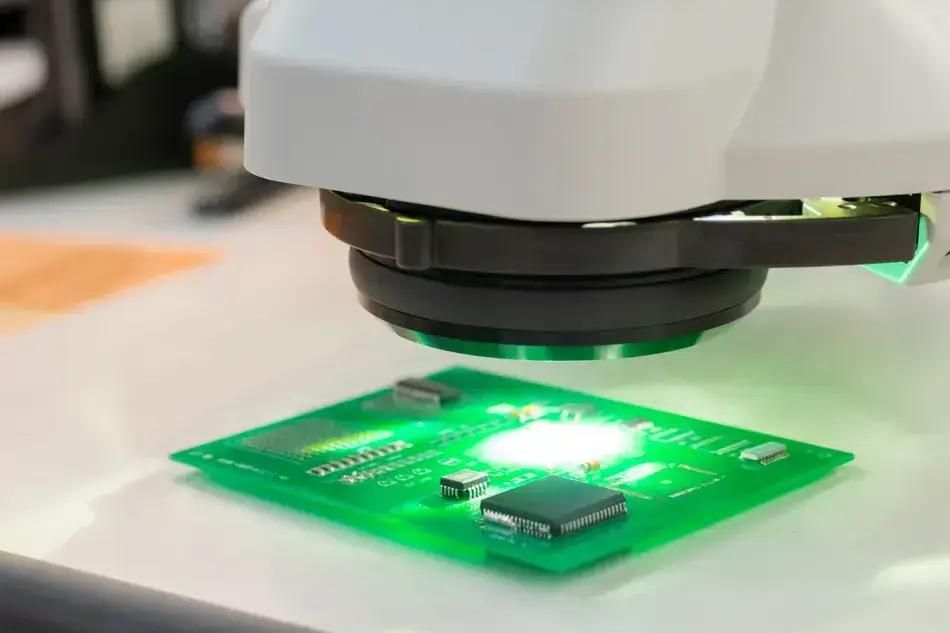
–Static or Extremely Low-Speed Inspection: Because rolling shutter has a simple structure and high resolution (most high-pixel chips are rolling shutter), it provides high-resolution, clear images for stationary or extremely slow-moving objects at a much lower cost than global shutter. A rolling shutter is often used in PCB board inspection, semiconductor metrology, document scanning, and similar fields.
–Security Surveillance and Low-Light Environments: Rolling shutter has a large light-sensitive area and supports high frame rates for smooth monitoring, making it ideal for urban security scenarios that require long operation times and cost sensitivity.
–Handheld Terminals and Embedded Vision: Rolling shutter offers high integration and low power consumption. Combined with software-based image correction algorithms, it meets the daily scanning and recognition needs of handheld devices under slight movement. It is already used in industrial PDAs, barcode scanners, and similar devices.
Applications of Global Shutter
Since the core advantage of a global shutter is “all pixels start and stop simultaneously,” which completely eliminates the “rolling shutter effect” and motion blur in high-speed motion, global shutter in machine vision is mainly used in scenarios that demand extremely high dynamic accuracy and need to capture high-speed moving objects.
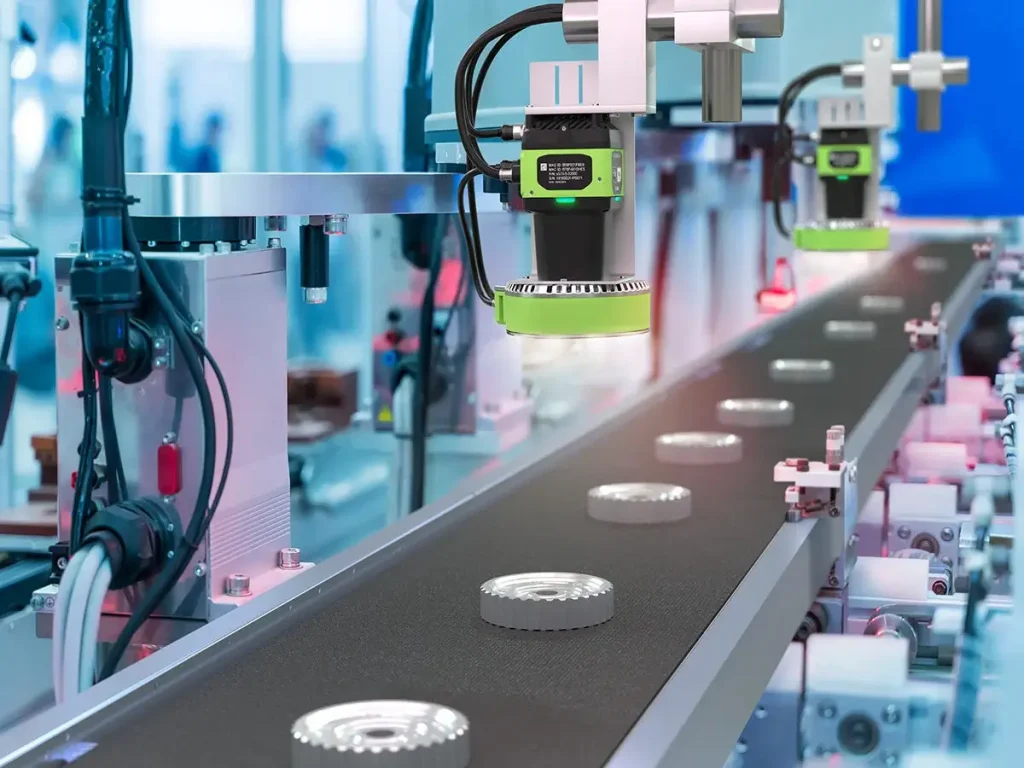
–High-Speed Industrial Production Line Inspection and Sorting (Core Application): Inspection of electronic/semiconductor chip pins, defect detection on mobile phone screens/battery electrodes, leak seal detection in food packaging, precision part dimension measurement, etc. When parts move at high speeds (several meters per second), a global shutter can clearly capture tiny defects (e.g., 0.01mm scratches), avoiding missed detections or false judgments caused by image distortion or motion blur, thereby significantly improving production line yield.
–Robot Hand-Eye Coordination and Motion Trajectory Analysis: Industrial robot grasping, welding trajectory inspection, assembly positioning, 3C product assembly, etc. Global shutter can accurately capture millisecond-level motion trajectories of robotic arm end effectors, correct path deviations in real-time, ensure high-precision assembly, and avoid collisions or positioning failures.
–Traffic and Security Surveillance: Traffic violation capture (license plates/faces), highway ETC recognition, drone obstacle avoidance, parking lot license plate recognition, etc. When vehicles are moving at high speeds or drones are moving rapidly, a global shutter can clearly capture vehicle details, avoiding recognition failure due to motion blur, while also supporting perfect flash synchronization for capture.
Rolling Shutter vs Global Shutter: Device Comparison
| Device | Type |
| Sony IMX264 | Global Shutter |
| Sony IMX250 | Global Shutter |
| Sony IMX183 | Rolling Shutter |
Rolling Shutter vs Global Shutter: Technical Improvement Directions
–Global Shutter: Adopting stacked CMOS to improve fill factor and quantum efficiency, optimizing circuits to increase frame rate. High-end products can achieve 12 megapixels and 1/30000s exposure.
–Rolling Shutter: Using AI algorithms to correct the rolling shutter effect for medium-to-low-speed scenarios; GRR (Global Reset Release) technology enables global reset and row-by-row exposure end, reducing distortion and improving flash synchronization.
With the ongoing evolution of technology, the rolling shutter vs global shutter is blurring—global shutters are reducing costs through stacked processes, while rolling shutters are mitigating the jelly effect with AI algorithms. In the future, both are expected to achieve integration and complementarity in more scenarios.
The rolling shutter vs global shutter is a key step in selecting machine vision systems. We hope this analysis provides valuable references for you in practical projects.
Insight from AI Robots Eidos about Rolling Shutter vs Global Shutter
—Rolling Shutter vs global Shutter is not intended to create a dichotomy between the two, but rather to help readers better understand their respective characteristics. Future sensors may dynamically switch or merge two modes on the same chip. For example, they could use rolling shutter mode in static areas of the image to reduce power consumption and enhance resolution, instantly switching to global shutter when motion is detected. Alternatively, a hybrid technology of “global reset, rolling shutter readout” may be employed.
—By analyzing the temporal differences generated by the rolling shutter, AI can back-calculate the precise motion speed and trajectory of objects, thus transforming the defect of “image distortion” into an advantage for dynamic perception. This means that a low-cost rolling shutter sensor, combined with algorithms, can capture images and measure speed, potentially replacing expensive global shutter + external speed measurement systems in specific scenarios.
—In the future, the temporal consistency of images (where all pixels capture light information at the same moment) may become more important than pixel count. For instance, in scenarios such as obstacle avoidance in drone swarms and hand-eye coordination in industrial robots, systems need to make decisions based on “the present moment” rather than on images from “the past few milliseconds.” Therefore, the primary criteria for selecting future sensors will shift from “how many pixels” to “how many nanoseconds of time error,” leading to a reevaluation and enhancement of the value of global shutters.
Image Credits: Studiobinder & DWE & Wevolver & Zebra & Jai & Regami