
Table of Contents
Autonomous Mobile Robots (AMRs), with their intelligent flexibility, reliability, efficiency, and strong adaptability, help enterprises achieve flexible production and task scalability. This enables companies to quickly optimize production lines, adjust capacity, and respond agilely to market demands.
What Are Autonomous Mobile Robots (AMRs)?
AMRs are the abbreviation for Autonomous Mobile Robots. Unlike rigid magnetic strip or QR code-guided robots, AMRs based on autonomous navigation technology do not require the installation of fixed beacons. By constructing map information in the robot’s “brain,” integrating multiple sensors to perceive the surrounding environment, and combining AI decision-making technologies like machine learning, they achieve dynamic path planning. This allows for flexible and precise autonomous movement, making them comparable to indoor “self-driving vehicles.” Whenever a production line changes, the robot can quickly return to work simply by re-scanning the new work environment, making it highly suitable for increasingly variable market demands.
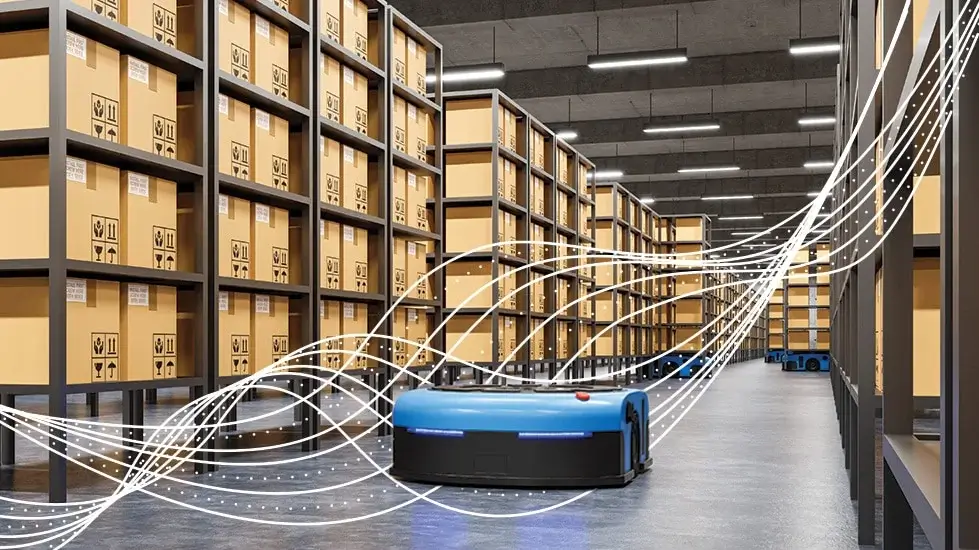
Components of an Autonomous Mobile Robot System
An Autonomous Mobile Robot system mainly consists of a control system, navigation and perception system, drive system, safety monitoring system, communication system, and execution system. The configuration varies for different scenarios and types of AMRs. This section primarily introduces the control system, navigation and perception system, and drive system.
| Control System: The control system is used for autonomous navigation and obstacle avoidance. It is mainly composed of software systems (such as ROS (Robot Operating System), OpenTCS, MiR Fleet) and algorithms. By fusing sensor data, it generates real-time maps and determines the robot’s position and surrounding obstacles. Based on this information, the control system plans the optimal path and actions to avoid collisions with workers, equipment, or other obstacles.
| Navigation and Perception System: Autonomous mobile robots are equipped with a variety of sensors to perceive their surroundings. These sensors can include laser sensors (e.g., LiDAR), vision sensors (e.g., cameras), and ultrasonic sensors. Through different types of sensors, AMRs can obtain information about the surrounding environment, obstacle positions, and distances. The data from these sensors is fed into the software system for processing and analysis, enabling precise navigation and collision avoidance.
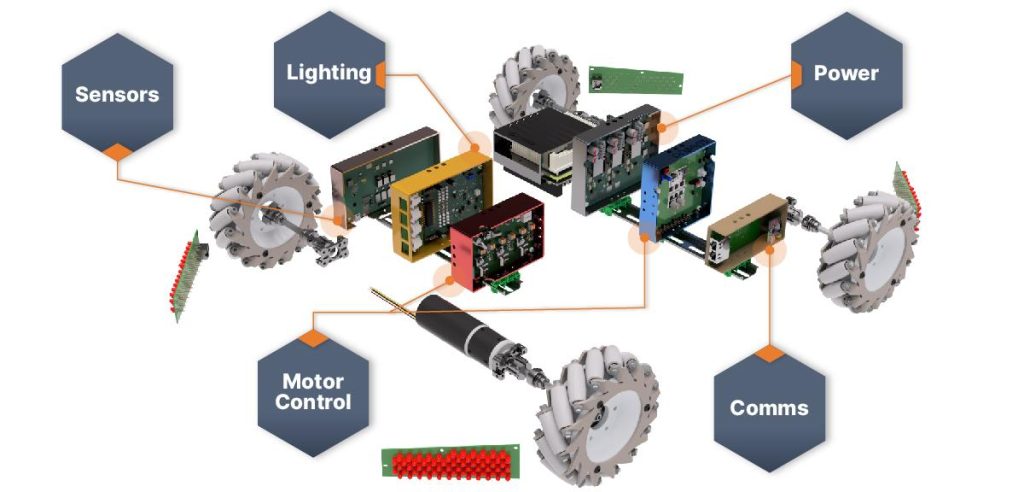
| Drive System: The drive system powers and controls the robot’s movement. Motors are the core of this system; they generate power based on received commands, enabling the robot to move and maneuver within its environment. The drive system typically consists of multiple motors that control different parts of the robot.
The autonomous navigation and collision avoidance capabilities of an AMR are achieved through the combined effect of the drive system providing power and control, the control system performing path planning and motion control, and the navigation and perception system sensing the environment and providing real-time data support.
Advantages of Autonomous Mobile Robots (AMRs)
| Flexibility: Autonomous mobile robots (AMRs) possess high flexibility, allowing them to quickly adjust their routes according to environmental changes. They are suitable for dynamically changing work environments, capable of operating completely autonomously. If obstacles like forklifts, pallets, people, or other obstructions appear ahead, they can use the best alternative route to safely bypass them. Because AMRs can navigate autonomously in complex environments, they can quickly adapt to new layouts when a warehouse or factory changes, without requiring additional setup or adjustments.
| Intelligent Navigation: Compared to earlier AGV (Automated Guided Vehicle) projects, AMRs have built-in navigation and path planning algorithms, eliminating the need for physical guide wires or markers. Through integrated perception systems like ultrasonic sensors, cameras, and LiDAR, they perceive their surroundings in real-time and calculate the optimal path using algorithms. Their intelligent navigation and task execution capabilities reduce reliance on manual operation, lower labor costs, and free up human resources for higher-value work.
| Improved Operational Efficiency: From a deployment perspective, setting up AMRs is simpler. Using SLAM technology, an operator can guide the robot around its operational area to map the environment. Then, drop points can be edited on the intuitive map; if business processes change, modifications can be made directly on the map. This requires almost no modification to existing facilities, resulting in relatively low maintenance costs, although the technical complexity is higher.
| Intelligent Data Support: Autonomous mobile robots (AMRs) are equipped with advanced algorithms and sensors for real-time data processing and decision-making. This allows them to integrate with logistics management systems in the face of unexpected situations or complex tasks, acquiring and transmitting data in real-time to provide accurate information and analytical support for supply chain decisions. Through data collection and analysis, they can also provide real-time operational status and data, which can be used to optimize scheduling, predictive maintenance, and production planning, enabling intelligent management and decision-making.
Challenges Faced by Autonomous Mobile Robots (AMRs) in Development
| Technical Challenges and Stability Issues: In practical applications, autonomous mobile robots may face technical challenges such as stability issues, the need for high-precision navigation, and obstacle avoidance in dynamic environments. These challenges involve complex algorithms and hardware integration, requiring continuous R&D and innovation. For example, in high-precision navigation, AMRs must overcome the influence of complex terrain and building structures to achieve accurate positioning and path planning. For obstacle avoidance in dynamic environments, AMRs need the ability to react quickly and adjust flexibly to sudden obstacles and changing conditions. These technical challenges need to be addressed through algorithm optimization, sensor upgrades, and the application of AI technologies to improve the technical performance and stability of autonomous mobile robots.
| High Initial Cost: Although autonomous mobile robots are cost-effective in the long run, their high initial investment cost can hinder adoption by some companies, especially small and medium-sized enterprises (SMEs). The hardware, software systems, and technology integration for AMRs all require significant capital investment (ranging from 100,000 to 500,000 RMB per unit), which can be a major financial burden for SMEs.
| Lack of Regulations and Safety Standards: The development of autonomous mobile robots requires corresponding regulations and safety standards to ensure operational safety. Currently, these standards may not yet be fully developed.
| Cybersecurity Risks: As AMRs become increasingly intelligent and networked, the cybersecurity threats they face also grow. Hackers could potentially attack an AMR’s control system, communication network, or cloud servers, stealing sensitive data or maliciously controlling the robot’s behavior, creating safety hazards.
Core Technical Specifications of Autonomous Mobile Robots (AMRs)
| Navigation and Positioning Accuracy: Typically requires indoor positioning accuracy of ≤ ±10mm. For some high-precision scenarios (like precision assembly, narrow aisle access), positioning accuracy needs to reach within ±2mm. Repeatability accuracy requires the deviation for multiple positioning attempts to the same target point to be ≤ ±3mm, ensuring stability in repetitive operations. Map accuracy generated by SLAM technology needs to be centimeter-level, accurately reflecting environmental features.
Recommended In-depth Reading from AI Robots Eidos
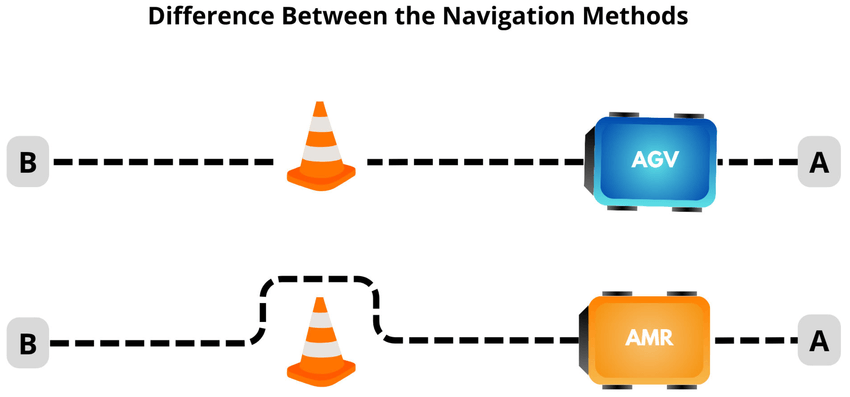
One of the key differences between Autonomous Mobile Robots (AMRs) and Automated Guided Vehicles (AGVs) is their navigation methods.
AGV: AGVs rely on predefined physical markers or guiding infrastructure for navigation, such as magnetic strips, QR codes, or laser reflectors. This requires prior installation of navigation infrastructure, resulting in fixed paths.
AMR: AMRs use autonomous navigation technologies like lidar SLAM and visual SLAM, allowing them to operate without physical markers. They perceive their environment in real-time through sensors and construct maps, enabling them to autonomously plan their paths, which are flexible and variable.
To avoid misleading readers, it’s important to point out that both AMRs and AGVs are very important in industrial automation and logistics, but they are applied in different scenarios. AGVs are suitable for scenarios with fixed routes and structured environments, such as material transfer between large production lines; AMRs are better suited for flexible and dynamic environments, such as flexible manufacturing lines.
If readers wish to learn more about AGVs, they can refer to this article on AGVs.
| Motion Performance: Generally, the maximum speed of an AMR is ≥1.5m/s. Some heavy-load or special-scenario robots can reach speeds of 2-3m/s. AMRs also need rapid start and stop capabilities, with acceleration and deceleration typically ≥0.5m/s², to meet the demands of dynamic obstacle avoidance and precise stopping. To ensure agile turning in narrow spaces, the minimum turning radius should be ≤0.5m.
| Load Capacity: Common industrial AMR load capacities range from a few kilograms (e.g., 1.5kg) to several hundred kilograms (e.g., 1500kg). Some heavy-duty robots can carry loads up to several tons. The robot should maintain smooth operation without significant wobble or deviation when fully loaded.
| Obstacle Avoidance: Since AMRs plan their own paths, they need 360° omnidirectional obstacle avoidance capability, able to detect and avoid low obstacles as low as ≥5cm. To ensure timely collision avoidance, the time from detecting an obstacle to initiating an avoidance action should be ≤0.5 seconds.
Recommended In-depth Reading from AI Robots Eidos
Obstacle avoidance systems are crucial for AMRs (Autonomous Mobile Robots). In mixed human-machine operation environments such as factories and warehouses, AMRs need to detect and avoid personnel and equipment in real-time to prevent collisions and ensure the safety of workers. Additionally, this system protects the AMRs themselves and surrounding equipment from damage due to collisions, reducing maintenance costs and downtime, and ensuring production continuity.
If readers wish to gain a comprehensive understanding of obstacle avoidance systems, they can refer to this article on obstacle avoidance.
| Communication: Industrial AMRs support standard industrial communication protocols (such as CANopen, EtherCAT, Modbus) for real-time data exchange with upper-level management systems (like WMS, ERP). They can seamlessly integrate various sensors (like LiDAR, cameras, IMU) and actuators, supporting multi-robot collaboration and task scheduling.
| Safety: Comply with international safety standards such as ISO 3691-4, R15.08, and be equipped with safety devices like collision detection, emergency stop, and safety LiDAR. Possess fault self-diagnosis and tolerance capabilities to continue operating or shut down safely in case of partial sensor or component failure.
Autonomous Mobile Robots Examples (For Reference Only)
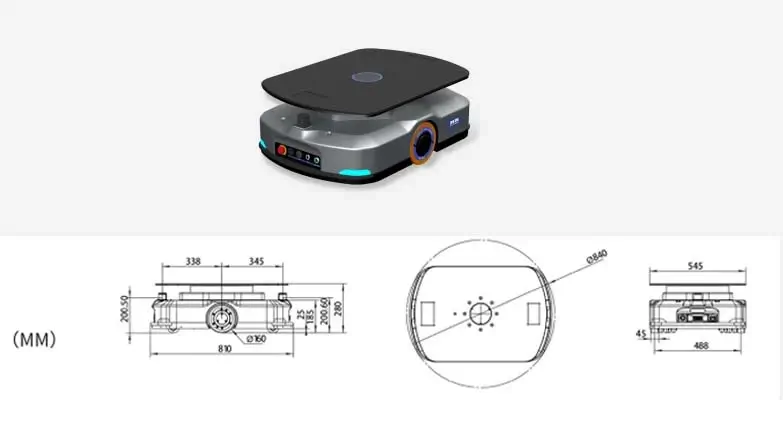
The data in the table is intended to give readers a more intuitive understanding of AMRs and does not imply any recommendation.
| Basic Parameters | |||
| Parameter | Specification | Parameter | Specification |
| Navigation Method | Laser SLAM + Camera | Max Lifting Stroke | 60±2MM |
| Length X Width X Height | 810X545X280MM | Navigation Position Accuracy | ±5MM |
| Rotation Diameter | 840MM | Travel Speed | ≤1.5M/S |
| Payload | 400KG | Battery Life | 8H |
| Lifting Platform Size | 750X545MM | Charging Time (10%~80%) | ≤1H |
Autonomous Mobile Robot Applications
| Warehouse Logistics: In warehouse logistics scenarios, autonomous mobile robots are widely used for automation. The core requirement for autonomous mobile robots for warehouse automation is to pick goods with maximum efficiency for a given ROI. In terms of specific functions, AMRs can navigate autonomously within warehouses to handle tasks like item transportation, storage, and sorting, improving efficiency and accuracy. They can also perform autonomous path planning and dynamic obstacle avoidance based on real-time conditions, enabling functions like automatic shelf moving and inventory management. This allows them to complete various logistics tasks without human intervention, increasing warehouse productivity. As the logistics industry evolves, AMRs, as a new type of logistics automation solution, are gradually becoming a mainstream technology for warehouse automation.
| Manufacturing: In manufacturing scenarios, the core demands for AMRs are primarily reliability, safety, and high flexibility. AMRs can be used in various scenarios such as production line automation, material handling, and assembly. Through autonomous navigation, obstacle avoidance, and item handling capabilities, they enable automated material transport and robot collaboration. In warehouse and logistics scenarios within manufacturing, the autonomous navigation and obstacle avoidance of AMRs allow for adaptive adjustments using technologies like visual perception and AI. AMRs are empowering the digital and intelligent operations of smart factories through stable scheduling, safety, and efficiency.
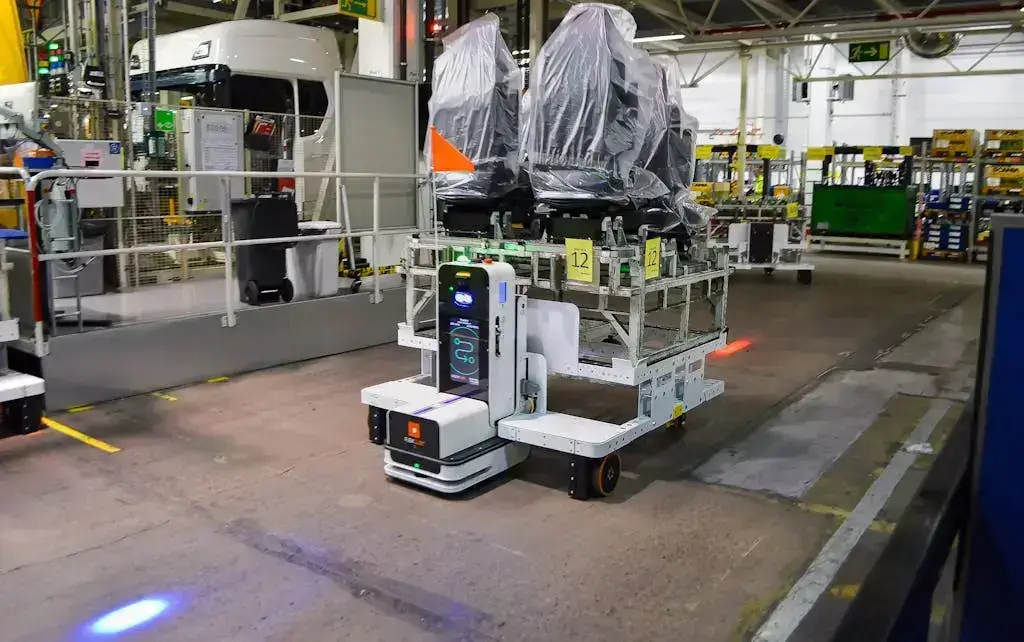
| Automotive Manufacturing
Material Supply and Handling: The automotive manufacturing process requires large-scale material supply and handling. AMRs can undertake the task of automatically transporting materials, delivering components from suppliers to production lines or different workstations, improving the efficiency and accuracy of material conveyance.
Production Line Replenishment: Automotive assembly lines need an on-demand parts supply. AMRs can automatically deliver parts to designated workstations according to the production schedule, ensuring continuous line operation. In Toyota factories, dozens of AMR intelligent logistics robots operate in an orderly manner, handling nearly 1000 types of parts with 100% intelligent transport, enabling automatic parts supply for nearly 200 stations on the final assembly line.
Assembly and Fitting Support: Autonomous mobile robots can assist workers in vehicle assembly and fitting tasks by transporting parts and tools. For example, delivering parts to a worker’s station helps improve efficiency and can reduce material damage during transport and worker injuries.
Inventory Management and Material Tracking: Precise inventory management and tracking of components and finished vehicles are essential in automotive manufacturing. AMRs can automatically record and update material inventory information, track material location and status, and provide real-time inventory data.
Flexible Layout and Production Adjustment: Adjustments to production line layouts and workstations are common needs in automotive manufacturing. AMRs, with their flexible path planning and layout adaptability, can quickly adjust to production demands, enhancing line flexibility and adaptability.
Development Characteristics of Autonomous Mobile Robots (AMRs)
| Continuous Emergence of New Products: In terms of load capacity, AMRs now offer payloads ranging from tens of kilograms to several hundred kilograms or even tons, with loads constantly increasing. This allows them to cover a wide variety of automated handling needs. For example, Mobile Industrial Robots (MiR) has successively launched AMRs with different load capacities such as 100kg, 200kg, 250kg, 500kg, and 600kg. To meet the demand for automated handling of heavy items, MiR developed the MiR1000, capable of carrying 1000kg; subsequently, in 2021, it launched the MiR1350 with a load capacity of 1350kg.
| RaaS Model: Robot as a Service (RaaS) is a business model based on cloud computing and IoT technologies. By leasing or providing robots and related services on demand, it offers users various automation applications and solutions at the right time and place. Through RaaS, enterprises of all sizes can deploy robot automation and related services more flexibly according to their needs at different stages. While accelerating equipment updates and avoiding technological lag, it also reduces capital occupation and costs, decreases expenses on robot maintenance and upgrades, and meets growing demands with smaller investments.
Recommended In-depth Reading from AI Robots Eidos
RaaS lowers the threshold and cost of industrial robot applications through innovative business models, enhancing flexibility and technological advancement. This has significant implications for promoting the popularization and development of the industrial robot industry.
If readers wish to gain a comprehensive understanding of RaaS, they can refer to this article on RaaS.
| Fusion of Navigation Methods: As business scenarios become more complex, the integration of multiple navigation methods is often required. For instance, KUKA’s platform-type AMR, the KMP 1500I, based on the KUKA Navigation Solution, integrates Laser SLAM and Visual SLAM navigation. This enables it to handle complex and changing industrial manufacturing scenarios, achieving real-time positioning, intelligent perception, safety protection, and precise docking, with real-time dynamic map updates, intelligent environmental awareness, and immediate obstacle detection and avoidance, ensuring safe, stable, and reliable operation.
| Integration with New Technologies: With the rise of technologies like Artificial Intelligence (AI), big data, edge computing, and cloud computing, AMRs have achieved performance optimization through close integration with these emerging technologies. AI enables AMRs to better understand their environment, make more precise decisions, autonomously plan paths, and avoid obstacles, thereby completing tasks more efficiently and safely.
| Open Software and Hardware Platforms: Because different industries and application scenarios have varying requirements for AMR functions, and the diverse needs in complex scenarios place higher demands on the scalability of AMR functions, manufacturers are creating open AMR software and hardware platforms. Through standardized, modular, and component-based design, these platforms support more agile secondary development, faster deployment and delivery, and simpler operation and maintenance management. This allows them to more efficiently meet complex, customized scenario needs, promote the large-scale application of AMRs, and penetrate more complex and diverse application scenarios.
Autonomous Mobile Robot Market
Autonomous Mobile Robot Market Size
According to the latest research report from QYResearch, the global market for autonomous mobile robots is projected to reach $3.958 billion by 2030, growing at a compound annual growth rate (CAGR) of 4.07% over the forecast period.
Autonomous Mobile Robots (AMRs) Market Investment and Financing Events
Driven by the demand for logistics automation and intelligence, AMR manufacturers have attracted significant attention from investment institutions. In recent years, investment, financing, and M&A events in the AMR field have remained active.
International Autonomous Mobile Robots (AMRs) Market Investment and Financing Events
| Disclosure Date | Company Name | Financing Round | Amount Raised | Lead/Key Investors | Use of Funds |
| 2022 | Addverb technologies | Equity Financing | $132 Million | Reliance Industries Limited | To build a robotics manufacturing facility in Noida. |
| 2022 | Vecna Robotics | Series C | $65 Million | Led by Tiger Global Management | For R&D of autonomous mobile robots (AMRs) and software, accelerating new order fulfillment, and business expansion. |
| 2022 | Rapyuta Robotics | Series C | $51 Million | Goldman Sachs Asset Management | To expand the development of pick-assist AMRs, train partners, strengthen R&D, and increase awareness of AMRs and their applications in logistics. |
| 2022 | Grey Orange | Growth/Venture Financing | $110 Million | Led by Mithril Capital Management | The majority of funds will be used for hiring; additional funds will support expanding the production and promotion of GreyOrange’s robotic systems. |
| 2022 | Locus Robotics | Series F | $117 Million | Led by Goldman Sachs Asset Management and G2 Venture Partners | Not Disclosed. |
| 2022 | NEURA Robotics | Not Disclosed | $55 Million | Led by Lingotto, Vsquared Ventures, Primepulse, and HV Capital | Not Disclosed. |
| 2023 | Photoneo Brightpick Group | Series B | $19 Million | Led by Taiwania Capital | To fund new deployments of BrightPick’s warehouse automation solutions in the U.S. |
| 2023 | Berkshire Grey | Equity Financing | $218 Million | SoftBank Group Corp. (Japan) | Not Disclosed. |
| 2023 | ANYbotics | Series B | $50 Million | Led by Walden Catalyst and NGP Capital, with participation from Bessemer Venture Partners, Aramco Ventures, Swisscom Ventures, Swisscanto Private Equity, and existing investors. | To expand international deployment, drive new feature development, and solidify ANYbotics’ competitive position in robotic inspection solutions. |
| 2023 | OTTO Motors | Strategic Financing | Not Disclosed | Mitsubishi Electric Corporation | Not Disclosed. |
| 2023 | Balyo | Equity Financing | $11.8 Million | SoftBank Group Corp. (Japan) | Not Disclosed. |
| 2023 | Dexory | Series A | $19 Million | Led by European VC Atomico, with participation from existing investors Lakesar, Kindred, Capnamic, and Maersk Growth (the investment arm of global logistics and container shipping company Maersk). | To accelerate expansion into key markets including the U.S., Central Europe, and Northern Europe. |
M&A Events in The Autonomous Mobile Robots (AMRs) Market
| Acquirer | Acquisition Time | Acquired Company | Description of Acquired Company |
| Shopify (Canada) | 2019 | 6 River Systems | US AMR manufacturer |
| ABB (Switzerland) | 2021 | ASTI Mobile Robotics Group | One of the largest AMR manufacturers in Europe |
| Zebra Technologies (USA) | 2021 | Fetch Robotics | Developer of autonomous mobile robots |
| Locus Robotics (USA) | 2021 | Waypoint Robotics | Manufacturer of omnidirectional mobile robots |
| Jungheinrich Group (Germany) | 2021 | Arculus | German AMR manufacturer |
| Stow Robotics (Belgium) | 2022 | iFollow | AMR manufacturer based in Paris, France |
| Amazon (USA) | 2022 | Cloostermans | Belgian robotics company (origin of Amazon’s first fully autonomous warehouse mobile robot, Proteus) |
Insight from AI Robots Eidos about Autonomous Mobile Robots (AMRs)
| The future warehouses or factories will no longer simply procure autonomous mobile robots (AMRs) but will instead acquire a complete “robotic ecosystem.” At the core of this system is a cloud-based brain capable of centralized scheduling for hundreds or thousands of AMRs from different brands and types. Companies with the most open, stable, and intelligent scheduling systems will become the “invisible champions” defining the standards of next-generation industrial automation.
| Autonomous Mobile Robots (AMRs) will evolve into the “real-time digital twin builders” for enterprises. While transporting goods, they will continuously scan and update the three-dimensional maps of factories and warehouses through onboard visual and LiDAR technology, monitoring inventory locations, environmental temperatures, and even equipment operation statuses in real-time. The value of this real-time data for optimizing production processes, enabling predictive maintenance, and ensuring safe production will far exceed the value of the material handling performed by robots themselves. In the future, selling hardware may merely serve as an entry point, while selling data insights and services will be the core source of profit.
| With the integration of navigation technologies, “boundaryless autonomous mobile robots (AMRs)” that can seamlessly connect between warehouses, factory premises, and even public roads will emerge. For example, an AMR could automatically drive from the production workshop to a warehouse at the other end of the premises or even autonomously board a freight truck for long-distance transport. This will completely streamline logistics within and outside the factory, achieving a truly “end-to-end” unmanned flow of materials, which will have a revolutionary impact on the existing logistics system.
Image Credits: Flex & Embeddedcomputing & Web & Rozitek & Researchgate & Flexqube
Other Articles on The Topic of AMRs
RGV vs AMR: A Quick Guide
AGV vs AMR: What’s The Difference?
AGV or AMR: How to Choose