
Table of Contents
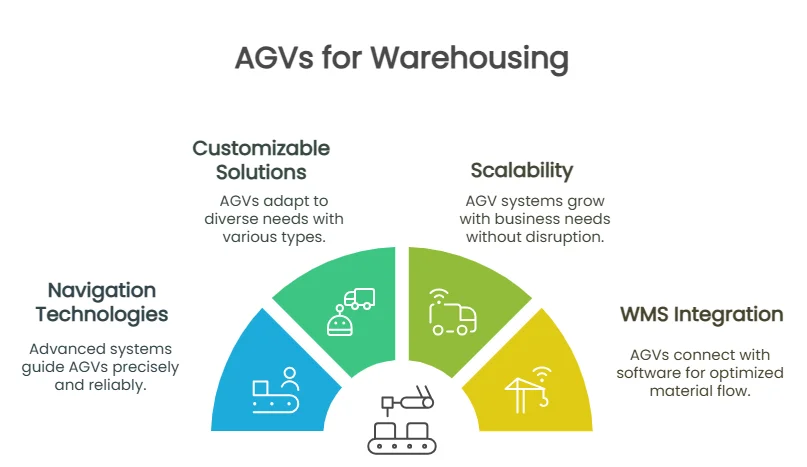
AGVs in warehouses leverage their automation and intelligence capabilities to enhance the efficiency, accuracy, and safety of warehouse logistics, making them an essential component of modern smart warehousing systems.
What is an AGV in a warehouse?
An AGV (Automated Guided Vehicle) in a warehouse refers to a transport vehicle equipped with automatic guidance devices such as electromagnetic or optical sensors, controlled by a computer, characterized by wheeled mobility, self-powered or with a power conversion unit, and capable of automatically traveling along a prescribed guided path. By integrating with WMS (Warehouse Management System) and MES (Manufacturing Execution System), AGVs in warehouses enable automated handling management, flexible dynamic allocation of storage locations, and transform picking from “person-to-goods” to “goods-to-person”, thereby improving work efficiency.
Types of AGVs in Warehouses
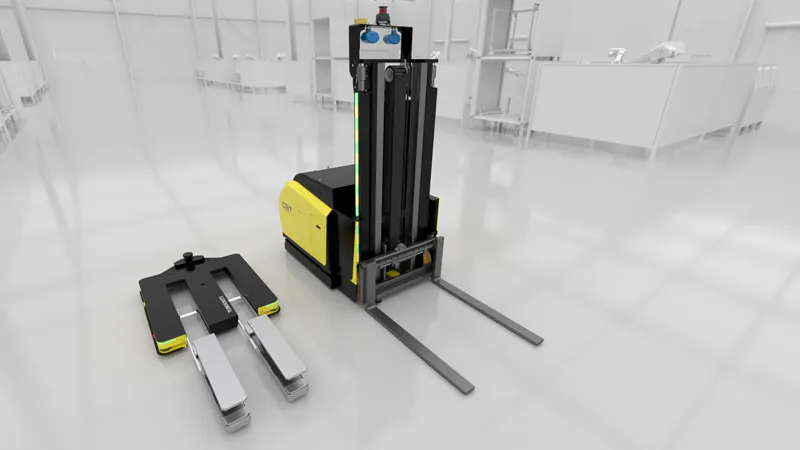
–Forklift AGV: A forklift AGV is an intelligent handling device that combines the functionality of a traditional forklift with automated navigation technology. It is primarily driven by a single steering wheel. The advantages of this type are its simple structure, low cost, strong load-bearing capacity, and support for high stacking. However, its disadvantages include large size, the need for a turning radius (cannot rotate in place), and high requirements for floor flatness. In current industrial scenarios, forklift AGVs are widely used in automated warehouse material handling and flexible production lines.
–Towing AGV: A towing AGV is an automated device specifically designed for towing trailers. It is mainly driven by an electric motor and navigates using magnetic strips or lasers. Its advantage is its large load capacity. Its disadvantages include the need for a fixed path and poor environmental adaptability. Towing AGVs are typically used for long-distance, high-volume material handling in special environments.
–Roller AGV: A roller AGV has a conveyor belt on its top and is used in conjunction with a roller conveyor system for continuous goods transport. It is primarily designed to handle goods with an unstable center of gravity; the rolling transport allows for more stable horizontal movement of the goods.

–Lifting AGV: A lifting AGV is a transport device that integrates automatic guidance and lifting functions. Through its built-in lifting mechanism, it can lift or lower goods from the ground or other carriers, enabling vertical handling of goods. Its advantages include excellent height adaptability, the ability to interface with equipment at different heights, precise navigation in narrow-aisle warehouses, and compatibility with high-bay racking to increase storage density. However, it requires specific rack structures and has certain operational limitations.
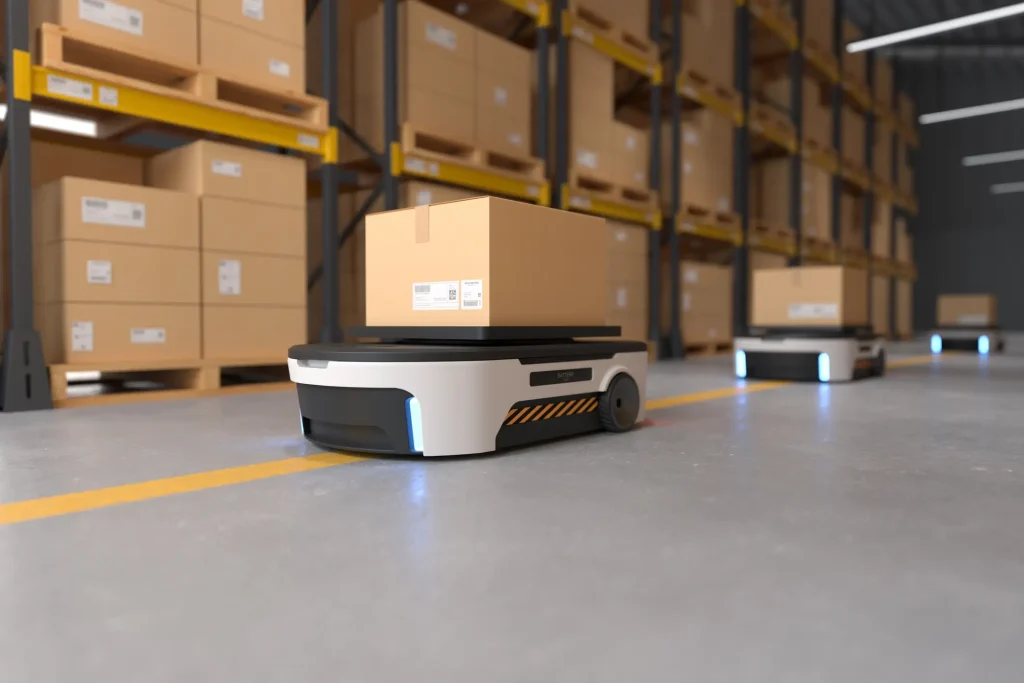
–Unit Load AGV: A unit Load AGV appears relatively low in height and has a more regular shape, resembling a moving rectangular prism. It handles goods by carrying them on its top surface. Its advantages are flexibility, high efficiency, and a high degree of automation. Its disadvantage is limited load capacity – it cannot lift heavy goods. Back-mounted AGVs are suitable for production scenarios with frequent transport, long material supply cycles, and certain load capacity requirements.
Benefits of Implementing AGVs in Warehouses
–Safety: AGVs in warehouses are equipped with multiple protection mechanisms, including laser obstacle detection, mechanical bumpers, and emergency stop devices. They can detect obstacles in real time and automatically decelerate or stop, reducing the risk of collision by over 90%. In addition, a central control system monitors AGV status in real time and issues alerts in case of abnormalities, ensuring the safety of personnel and equipment.
–Space Utilization: AGVs can flexibly navigate aisles as narrow as 0.8–1.7 meters. Compared to traditional manual forklifts or forklift aisles, they significantly reduce aisle space occupation, increasing warehouse space utilization by 30%–50%. When AGVs in warehouses are combined with automated high-bay racking systems, they support precise access to high-bay racks, further utilizing vertical warehouse space and significantly increasing storage capacity per unit area.
–Precision: AGVs in warehouses use technologies such as laser SLAM, QR code positioning, and vision recognition to achieve positioning accuracy of ±2 mm to ±5 mm, ensuring precise handling and placement of goods. In modern warehouses, forks or carriers are driven by servo motors, supporting automatic width adjustment and side-shift compensation for errors, enabling millimeter-level precision docking with AGVs.
–Real-Time Monitoring: AGV robots can connect to the warehouse system to update material status and location in real time. Therefore, AGV robots are widely used in various warehousing and logistics industries to improve work efficiency. Additionally, AGV robots are equipped with obstacle detection sensors to ensure safe operation.
Recommended In-depth Reading from AI Robots Eidos
AGV warehouse automation not only enhances the efficiency, accuracy, and safety of warehouse operations but also provides data support and execution capabilities for intelligent warehousing. It is one of the key technologies for building modern intelligent warehouse systems.
Interested readers can read this article about AGV warehouse automation.
Process of Selecting AGVs in Warehouses
–Identify Requirements: First, collect data on existing warehouse handling tasks, including daily handling frequency, types of goods, travel distances, load weights, etc. Assess suitable application scenarios for AGVs. You can start by deploying AGVs in a local area rather than covering the entire warehouse from the outset.
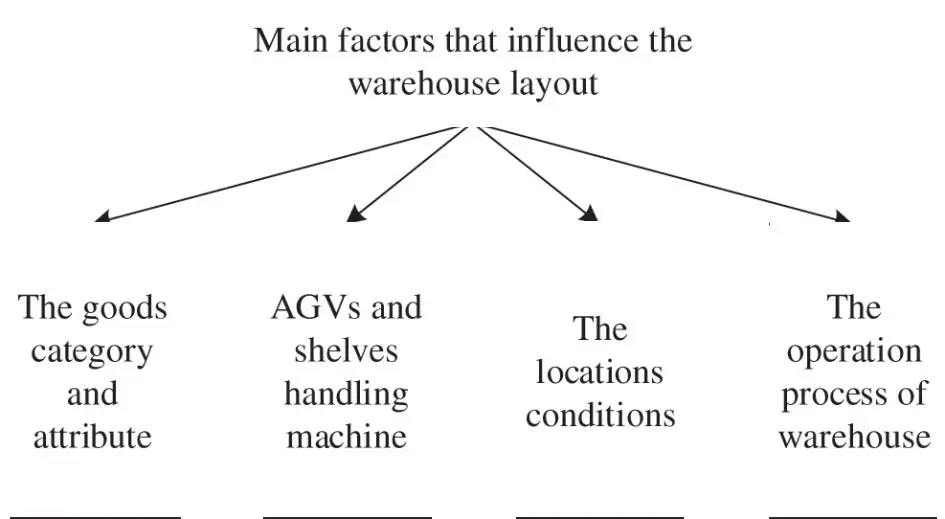
–Site Survey: Measure warehouse aisle widths, slopes, and turning radii. Confirm that there are no protruding columns, cable trays, or other obstacles that could affect AGV operation. Also check floor flatness (tolerance ≤5mm). Shoot on-site videos or draw floor plans for suppliers to conduct on-site surveys, design path solutions, and select equipment.
–Solution Selection: Match AGV models, navigation methods, and load capacities according to requirements. Compare quotes and service contents (e.g., commissioning period, after-sales response time) from 3–5 manufacturers. Schedule on-site surveys with technical solution planners from prospective suppliers to reduce selection risks. Also pay attention to the payback period – entry-level AGVs typically achieve ROI within 2–3 years.
–Deployment & Operation: Require the AGV manufacturer to conduct 1–2 days of trial operation after installation, testing core functions such as task assignment, obstacle avoidance, and automatic charging. Provide professional training for operators, focusing on task release, exception handling (e.g., using the emergency stop button), etc. Later, as business grows, you can gradually increase the number of AGVs and expand application scenarios (e.g., inventory counting, finished goods outbound).
How to Properly Deploy AGVs in Warehouses?
–Don’t Be Obsessed with High-End Features: Unless actually needed, be cautious about choosing AGVs that support complex functions such as “multi-robot collaborative simulation” or “dynamic priority scheduling.” These features increase costs and debugging difficulty. Enterprises should focus on the core needs of handling and transporting.
–Paying Attention to Ground and Environmental Compatibility: AGVs in warehouses have certain requirements for floor flatness and aisle width. Failure to survey and repair these in advance can lead to navigation failures, equipment damage, and increased maintenance costs. Also consider the warehouse environment (e.g., clean zones, low-temperature areas) and select compatible AGV models (e.g., cleanroom-specific AGVs).
–Reserving Room for Expansion: Choose AGVs that support “modular expansion” (e.g., adding battery capacity, upgrading navigation methods) to avoid having to replace entire equipment when business grows, which would waste resources. Also reserve system interfaces to facilitate future integration with WMS (Warehouse Management System) and ERP systems for more comprehensive intelligent coordination.
How Do AGVs in Warehouses Accurately Identify Whether a Storage Location is Occupied or Empty?
–Laser Sensors: Laser sensors are one of the core devices used by AGVs to identify storage location status. They emit laser beams and receive reflected light, using the propagation time and angle of the laser to precisely measure the distance and relative position between the storage location and the AGV. When the AGV approaches a storage location, the laser sensor quickly scans the area to detect any obstacles reflecting the signal.
Empty location identification: If the location is empty, the laser beam passes through or reflects weakly, resulting in a low signal intensity received by the sensor, allowing the AGV to determine that the location is unoccupied.
Occupied location identification: When goods are present, the surface of the goods reflects the laser, and the sensor receives a strong reflection signal. By analyzing the reflection pattern (e.g., intensity, angle changes), the AGV can determine the size, shape, and position of the goods, thereby confirming the status of the location.
The advantage of laser sensors lies in their high precision and fast response, enabling stable operation even under complex lighting conditions. However, they may face challenges in identifying transparent or highly reflective goods, requiring optimization with other technologies.
–Warehouse Management System (WMS): AGV robots can also communicate in real time with the Warehouse Management System (WMS). The WMS stores detailed information about each storage location, including occupancy status, goods storage information, etc. During operation, AGV robots continuously retrieve the latest location status information from the WMS and use it to plan their travel routes and operational tasks.
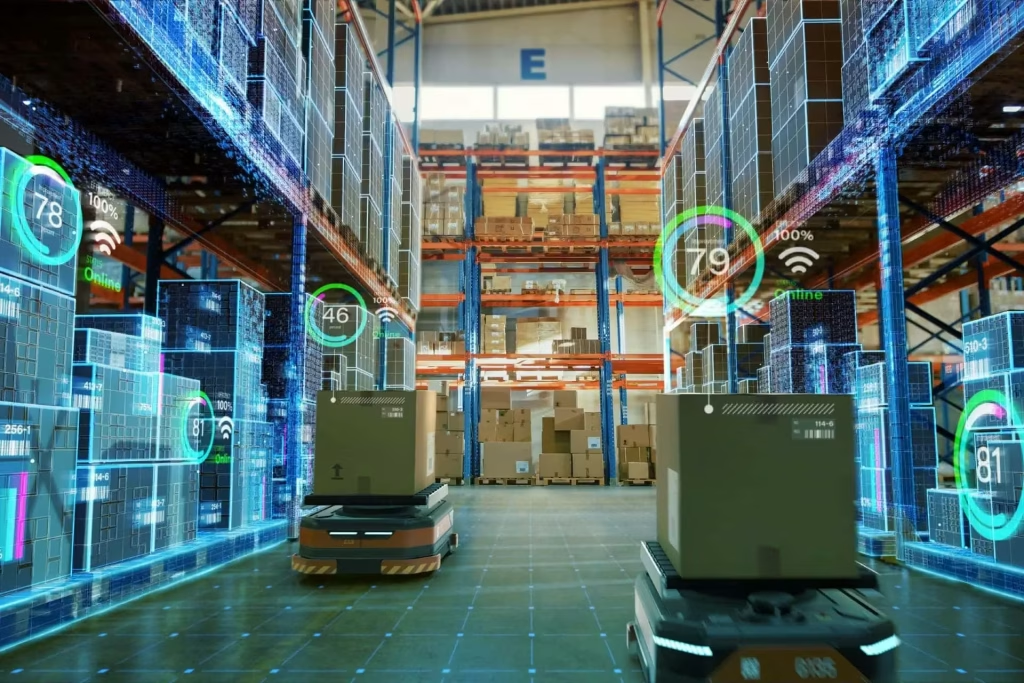
–Vision Recognition Technology: Vision recognition technology provides AGVs with richer environmental perception. AGVs equipped with high-definition cameras capture images of storage locations and use image processing and machine learning algorithms to analyze the characteristics of goods in the images.
Image feature learning: The system pre-learns the image features of occupied and empty locations (e.g., color, texture, shape), and through deep learning model training, enables the AGV to automatically identify location status.
Real-time recognition and adjustment: When presented with a new location image, the AGV quickly compares it against pre-stored features to determine whether goods are present. The vision system can also recognize the placement posture of goods, guiding subsequent handling operations.
The advantage of vision recognition technology lies in its powerful information processing capability and adaptability, allowing it to identify various types of goods. However, it may perform poorly in low-light conditions or when goods are severely obstructed, necessitating complementary use with laser sensors or pressure sensors.
In practice, AGVs in warehouses typically combine laser sensors, vision recognition technology, and real-time communication with the WMS to improve recognition accuracy and reliability.
How Do AGVs in Warehouses Identify Different Goods?
–Vision Recognition: Vision recognition is one of the mainstream methods for AGVs to identify goods. AGVs are equipped with high-definition cameras that capture the appearance of goods. Using built-in image processing algorithms, they analyze features such as shape, color, and size to accurately distinguish different goods.
In e-commerce warehousing picking scenarios, when shelves are filled with products in various packages, the AGV quickly scans with its camera, instantly recognizes the appearance features of the products, and accurately transports the corresponding items to the picking station. Even for similarly packaged goods, it can make precise judgments based on subtle color differences or pattern variations. This recognition method is highly flexible and requires no additional labels on goods, making it suitable for most conventional goods identification needs.
–RFID Technology: If vision recognition relies on “seeing,” RFID technology relies on “reading.” RFID (Radio Frequency Identification) technology attaches a unique “electronic ID” — an RFID tag — to each item, storing detailed information such as product category, specification, and batch. AGVs equipped with RFID readers automatically read the information on the tags when approaching the goods, quickly identifying the type of goods.
In automotive manufacturing workshops, precise delivery of components is critical. By installing RFID tags on each parts tray, the AGV, during handling, simply reads the RFID tag to accurately know the model and purpose of the components inside the tray, delivering them to the corresponding assembly station. RFID technology offers fast recognition speed and high accuracy, working reliably even in stacked or poorly lit environments, making it especially suitable for large-scale, standardized goods identification and management.
–Sensor Fusion: To handle complex and diverse goods recognition scenarios, sensor fusion technology integrates multiple devices such as laser scanners, infrared sensors, and weight sensors to perceive goods information from multiple dimensions.
Laser scanners acquire the three-dimensional outline of goods, helping the AGV determine volume and shape.
Infrared sensors identify reflection characteristics of goods and read information such as barcodes.
Weight sensors assist in distinguishing different types of goods by detecting their weight.
In heavy goods handling scenarios, the AGV uses the laser scanner to obtain the external dimensions of the goods, combines this with weight data from weight sensors, and cross-references RFID tag information to comprehensively confirm the goods information, ensuring accurate handling.
–Intelligent System Integration: The goods recognition capability of AGVs is also supported by backend intelligent systems. AGVs deeply integrate with WMS (Warehouse Management System), MES (Manufacturing Execution System), and others, retrieving real-time data such as order information and storage locations of goods. When assigned a handling task, the AGV validates the goods information provided by the system using on-site recognition technologies like vision or RFID, achieving a dual confirmation of “system data + on-site recognition” to further improve recognition accuracy.
In new energy battery production workshops, AGVs in warehouses need to handle different models of battery modules. By integrating with the MES system, the AGV obtains the module model and delivery information in advance. On-site, it visually recognizes the markings on the module while reading the RFID tag information, compares it with the system data, and proceeds with handling only after ensuring everything matches — effectively avoiding the risk of mis-handling or mixing different types of goods.
Insight from AI Robots Eidos about AGVs in Warehouses
—In the future, AGVs in warehouses will leverage federated learning and real-time occupancy data to proactively predict which storage locations are “most suitable” for the current batch of goods (based on dimensions such as access frequency, size matching, shortest path, etc.), and will write their recommendations back to the WMS. This breaks the traditional “WMS one-way assignment” model, forming bidirectional intelligent collaboration and significantly improving storage location turnover rates.
—In the future, AGVs in warehouses will integrate multimodal perception (vision + laser + millimeter-wave radar) with edge AI reasoning, enabling AGVs to no longer just “follow the line” but truly “understand” the warehouse environment. For example, they will be able to identify oil spills, floor damage, or temporary obstructions in real time, proactively report them, and replan routes. This capability, as a “mobile sensing terminal,” will upgrade AGVs from mere handling tools to dynamic environmental monitoring nodes within the warehouse.
—Currently, most automatic charging for AGVs relies on returning to a charging post for slow charging. In the future, AGVs in warehouses will be served by mobile battery-swapping robots. When an AGV’s battery level falls below a threshold, the swapping robot will proactively approach the AGV along its travel path and perform a rapid battery swap, allowing the AGV to remain on its mission route. This “battery-swapping as a service” model can increase the overall utilization rate of AGVs by more than 30% while reducing dependence on floor flatness (since precise docking with a charging post is no longer required).
Image Credits: Robodk & Asseco-ceit & Ncr & Sciencedirect & Helichina & Framos