
Table of Contents
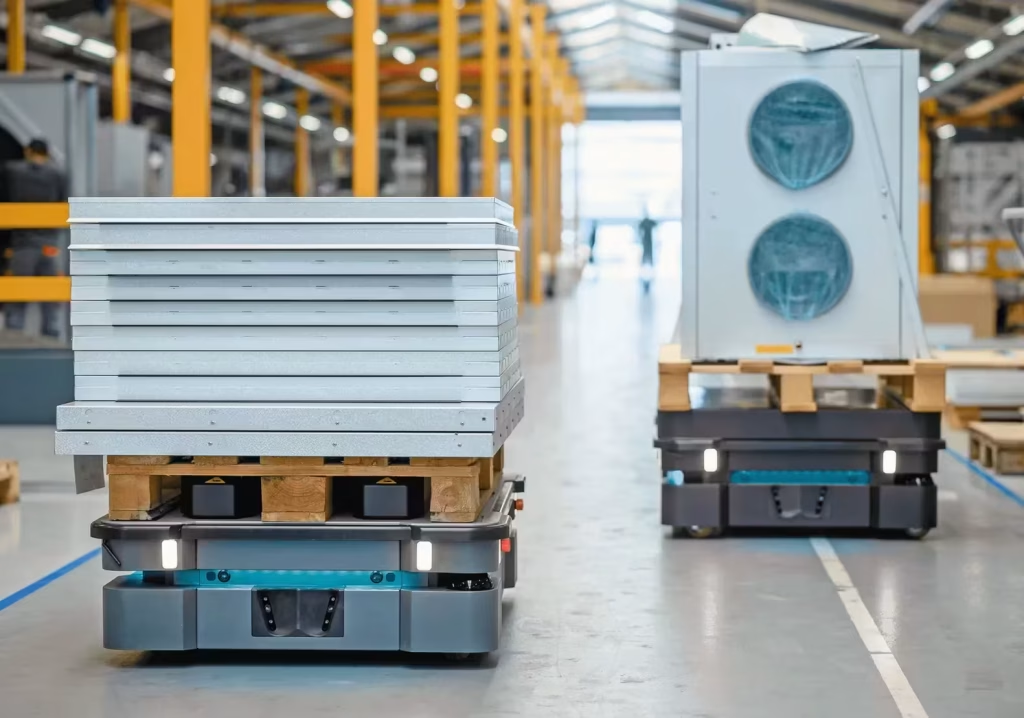
AGV in logistics, leveraging the widespread adoption of intelligence and informatization in the industry, has fully demonstrated its unique advantages and become a critical component of intelligent logistics systems.
What is an AGV?
An AGV (Automated Guided Vehicle) is an unmanned transport robot equipped with navigation (laser/vision/magnetic strip), obstacle avoidance, and dispatching modules. It is computer‑controlled, features wheeled mobility, carries its own power source or power conversion device, and can automatically travel along predetermined guide paths. By integrating with WMS and MES, AGVs enable automated material handling and management in logistics.
Advantages of AGV in Logistics
–Optimized Space Utilisation: AGVs automatically shuttle through warehouses, production lines, and other areas, improving space utilisation, especially in zones that are difficult or dangerous for manual operation.
–Improved Logistics Management: AGVs can automatically identify and properly store goods by category, ensuring orderly logistics operations. At the same time, advanced logistics management systems enable real‑time transmission of cargo information, facilitating data management and analysis for enterprises, thus better supporting production and sales.
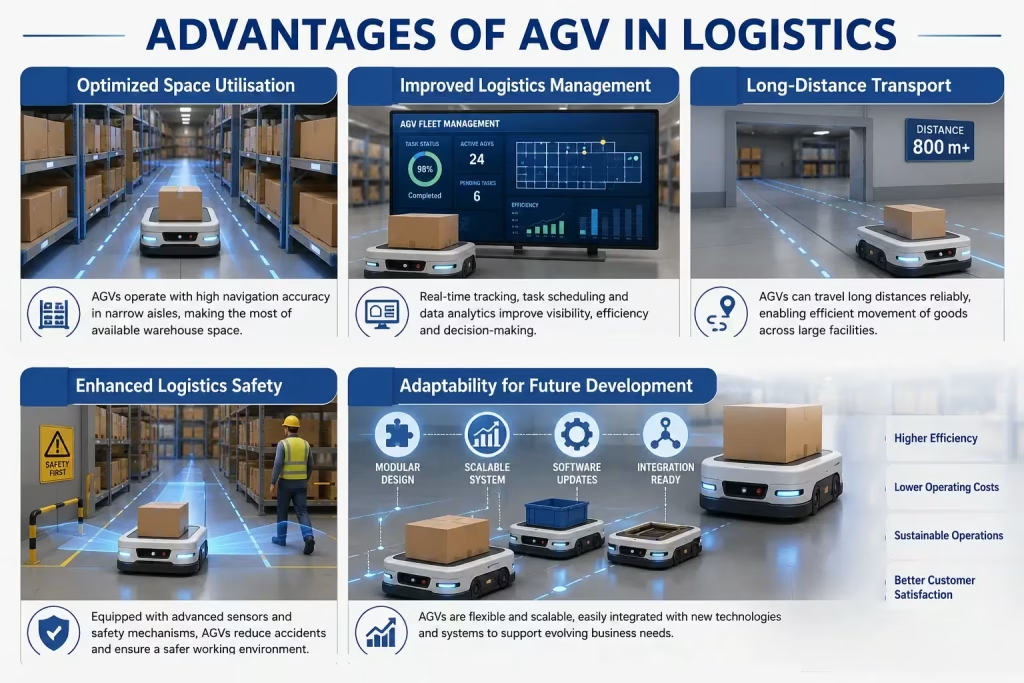
–Long‑Distance Transport: In the logistics industry, manual handling is usually suitable only for short distances. For long‑distance transport (over 60 metres), traditional methods rely on transport tools with low efficiency. AGVs, however, can move goods between any stations, significantly improving handling efficiency.
–Enhanced Logistics Safety: AGV operation is not affected by human factors; they travel automatically along pre‑set paths with obstacle‑avoidance systems, reducing accidents caused by human error.
–Adaptability for Future Development: The flexibility and scalability of AGVs allow smart logistics to respond more readily to future technological and market changes, facilitating future expansion and upgrades for cities and enterprises.
Recommended Related Reading from AI Robots Eidos
To prevent misleading readers, AI Robots Eidos needs to point out that in modern logistics systems, in addition to AGVs, there are various other automation devices, such as AMRs (Autonomous Mobile Robots) and RGVs (Rail Guided Vehicles).
These devices typically work in conjunction with WMS (Warehouse Management Systems) and WCS (Warehouse Control Systems) to achieve efficient and smooth operations in logistics systems.
Equipment Specifications For AGV in Logistics
AGV In Logistics For Factory Production Lines
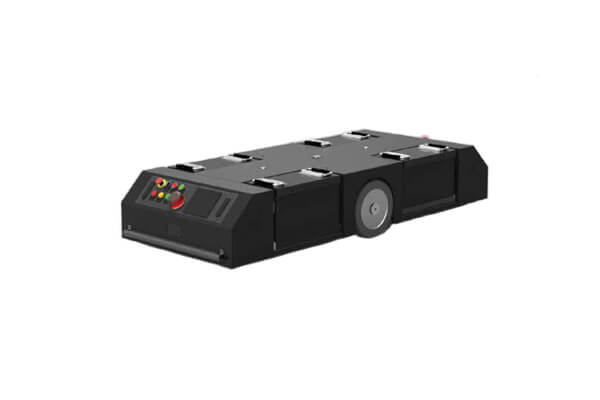
| Parameter | Specification |
| Max. load (towing) | 2000 kg |
| Min. height (ground clearance) | 250 mm |
| Travel direction | Bidirectional |
| Positioning accuracy | ±5 mm |
| Wireless communication | Wi-Fi |
| Speed range | 90 m/min |
| Battery type | Lead-acid / Li-ion (optional) |
| Node recognition | QR code / RFID |
| Safety protection | Non-contact + mechanical contact |
| Charging method | Manual / Auto (optional) |
| Guidance method | Magnetic / Vision |
AGV In Logistics For Warehouses
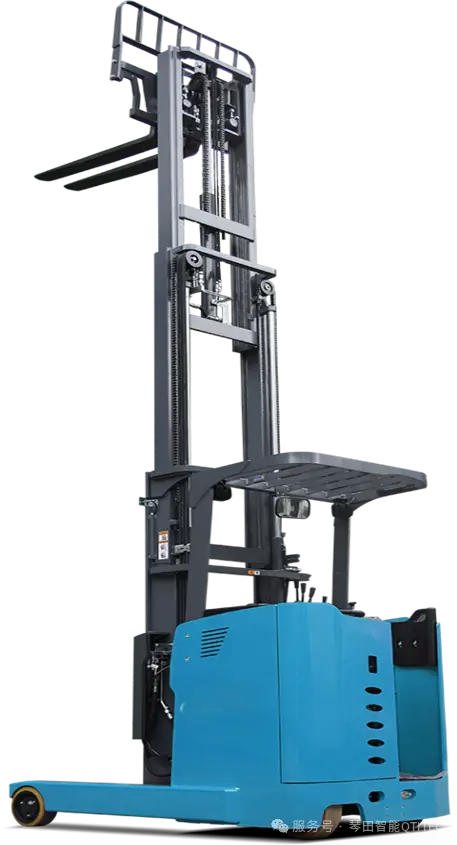
| Parameter | Value |
| Rated load capacity | 1500 kg |
| Lifting height | 8500 mm |
| Traveling speed | 5 km/h |
| Lifting speed | 300 mm/s |
| Lowering speed | 300 mm/s |
| Suitable aisle width | 2600 mm |
AGV In Logistics For Ports
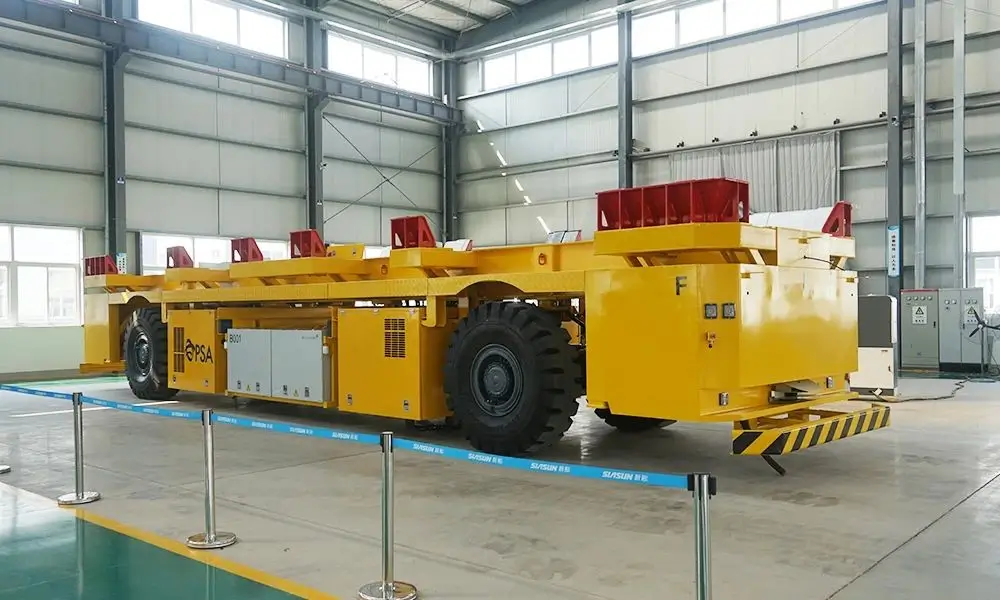
| Vehicle Weight | 32 t |
| Maximum Payload | 65 t |
| Normal Payload | 50 t |
| Maximum Operating Speed | 7 m/s |
| Minimum Stable Speed | 0.1 m/s |
| Positioning Accuracy | ±5 cm |
| Acceleration | 0.33 m/s² |
| Vehicle Length | 15 m |
| Vehicle Width | 2.7 m |
Applications of AGV in Logistics
AGV in Logistics: Factory Production Lines
Material Outbound Transport
Task Trigger: Workshop operators initiate material requests via call terminals.
Inventory Response: The Warehouse Management System (WMS) automatically retrieves the corresponding materials from the automated warehouse, and the outbound conveying system delivers the goods to the AGV pick‑up station.
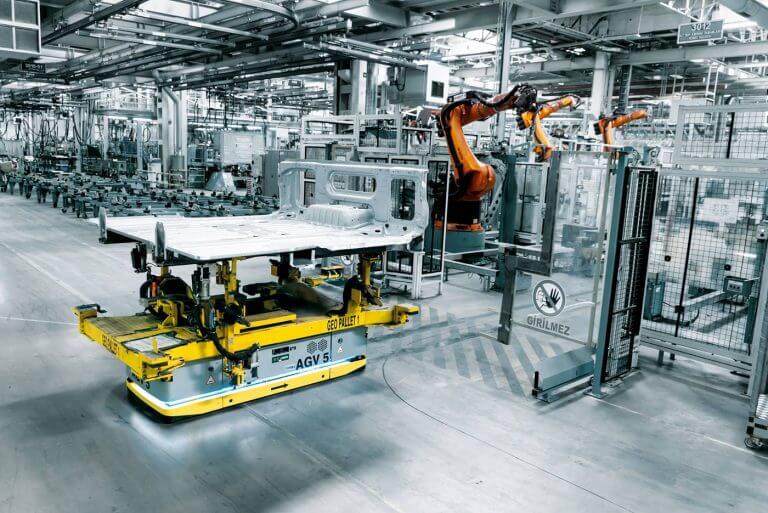
AGV Dispatching: The WMS sends a pick‑up request to the AGV supervisory computer; based on real‑time positions and task loads, the system intelligently dispatches the nearest idle AGV to the pick‑up station.
Delivery Execution: After picking up the goods, the AGV follows the planned path to the target workstation, completing the outbound process.
Residual Material Return Transport
Task Trigger: Operators initiate a residual material return request via the terminal.
Task Assignment: The WMS sends a command to the AGV supervisory system, which prioritises dispatching the AGV that has just finished unloading to perform the return task, reducing empty travel.
Residual Material Collection: The AGV goes to the designated station, picks up the residual materials, and transports them to the residual material collection area.
Dispatching Optimisation: This task is usually dynamically combined with outbound tasks to improve AGV utilisation.
Empty Box Return Transport
Task Trigger: Operators place empty boxes at the return station and send a return request via the terminal.
Intelligent Dispatching: The WMS cooperates with the AGV system to assign the nearest idle AGV to pick up the empty totes and deliver them to the specified return station.
Combined Tasks: Through algorithmic optimisation, the system integrates empty‑box return with outbound tasks, reducing empty‑running rates and improving overall efficiency.
AGV in Logistics: Warehouses
Cargo Input Area Tasks
When goods arrive at the warehouse by truck, the truck aligns its tail with the unloading point, matching the AGV travel path. The control centre then issues a command to dispatch nearby AGVs to the unloading point. The AGVs transport the goods along pre‑set paths to the inbound conveyor line. Since the number of AGVs is limited while the volume of incoming goods is large, each AGV repeatedly performs the “pick‑up → drop‑off” cycle.
Cargo Transfer Area Tasks
All operations in the intelligent transfer‑in area are performed automatically by AGVs. After the goods are palletised, AGVs pick up the pallets from the interface points and transport them along pre‑laid routes to the storage area interfaces. With multiple pallet outlets and storage interfaces, each AGV follows the control system’s instructions to fetch goods from a designated interface of the sorting and palletising area and then automatically travels to any system‑specified warehouse interface, completing automatic sorting and transport of full pallets. The entire process is coordinated by the control and management system, improving transfer‑in efficiency and increasing system flexibility.
Cargo Output Area Tasks
All operations in the intelligent transfer‑out area are also performed by AGVs. According to the instructions from the control system, AGVs travel along predefined routes to the outbound chain conveyor, pick up palletised goods, and transport them to the automatic depalletising and shipping area interfaces. There are also multiple interfaces for transfer‑out and depalletising. AGVs can fetch goods from designated interfaces and automatically travel to system‑specified warehouse interfaces, realising automatic sorting and transport of palletised goods. Under the traffic management system, AGVs strictly follow designated paths and operate independently, enhancing workflow smoothness and flexibility.
Cargo Shipping Area Tasks
Outbound goods are transported by telescopic belt conveyors to the rear of the delivery trucks. Following the “nearest‑first” principle, the control system assigns the nearest AGV to travel along preset routes to the truck tail, where it picks up goods from the telescopic conveyor and stacks them neatly inside the container. This eliminates manual stacking and improves operational efficiency. Empty pallets and partial pallets from split goods are returned to the warehouse by AGVs. The entire process raises the intelligence level of warehouse operations.
AGV in Logistics: Ports
Cargo Handling
AGVs can automatically transport goods from the dock to warehouses or other destinations according to preset paths and tasks. Their high speed and precision greatly shorten cargo handling time and improve logistics efficiency.
Container Stacking
Equipped with various sensors and navigation systems, AGVs can accurately place containers at designated positions. Automated stacking eliminates human errors and increases storage density and safety.
Ship Loading/Unloading
AGVs can coordinate with port cranes and other equipment to move goods between ships and the dock or vice versa. This not only boosts loading/unloading efficiency but also reduces risks associated with manual operations.
Warehouse Management
AGVs can interface with warehouse management systems to automatically transport goods within the warehouse, handling inbound, outbound, and internal movements. This automated management enables precise tracking and control of goods.
Insight from AI Robots Eidos about AGV in Logistics
—The future of AGV in logistics will no longer be just a physical device executing point-to-point transport; instead, it will become a mobile sensor network that gathers real-time data on the environment, goods, and equipment status. Each AGV will possess edge computing capabilities, allowing it to analyze local parameters such as its operational data, path congestion, and the temperature and humidity of the goods. Furthermore, it will collaborate with the cloud, transitioning the logistics system from “passive response” to “proactive anticipation.”
—In the future, AGVs in logistics will utilize distributed decision-making based on collective intelligence. AGV clusters will operate similarly to a swarm, without the need for a central control console to command them. Instead, they will autonomously negotiate paths and task assignments through real-time information exchange among neighboring vehicles, achieving decentralized and flexible scheduling. This will significantly enhance system fault tolerance and adaptability, making it particularly suitable for dynamic and complex warehousing and port scenarios.
—Moreover, future AGVs in logistics will feature standardized mechanical interfaces, communication protocols, and data formats, enabling quick task switching across different scenarios. Companies will no longer purchase AGV hardware; instead, they will call upon “logistics service” resources as needed, creating a “Logistics as a Service (LaaS)” model similar to cloud computing. This approach will greatly reduce entry barriers for users and improve asset utilization.
Image Credits:Siasunagv & Directindustry & Damon-group & AI & Mobile-industrial-robots