Table of Contents
Articulated robots, leveraging their high flexibility, precision, and strong adaptability, have become core equipment for industrial upgrading and flexible manufacturing, and are also the most common form of industrial robots in the manufacturing sector.
Articulated Robot Definition
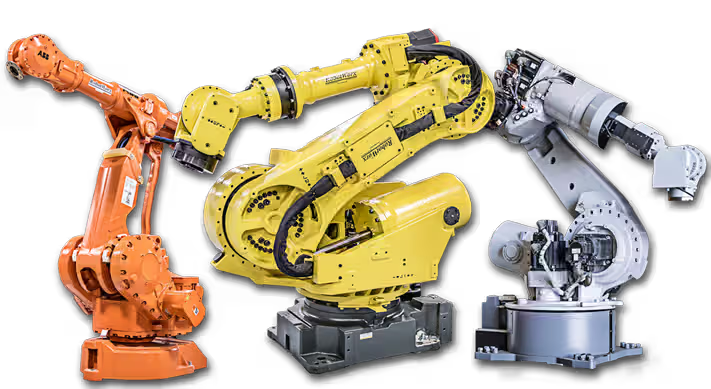
Articulated robots (also known as articulated robotic arms or multi-joint robots) use rotary joints as their primary motion units. They are composed of multiple rotary joints and connecting links, typically offering 4 to 7 degrees of freedom (DOF). A key characteristic of articulated robots is that the motion of each joint affects the position of the subsequent joints. This allows them to mimic the flexible movement of a human arm, enabling precise and complex motion trajectories and actions. Articulated robots have been widely adopted for mechanical automation tasks across numerous industrial fields.
Basic Principles of Articulated Robots
The mechanical structure of an articulated robot is similar to that of a human arm. It mainly consists of a joint system, a linkage system, a drive system, and a sensor system. These components work together to empower the robot with robust functionality.
Sensors acquire the robot’s current position and posture information.
—The motion planning module generates the robot’s motion trajectory based on the task requirements.
—The trajectory control module converts the trajectory into control commands for the drive system.
—The drive system actuates the robot’s joints according to the control commands.
—The above steps are repeated until the robot completes the task.
Types of Articulated Robots
Articulated robots are typically distinguished by the number of axes they have. An “axis” refers to the drive axis built into the robot’s joint. Each “axis” provides independent motion in a specific direction, such as horizontal rotation, vertical swinging, or linear advancement. Therefore, a higher number of “axes” indicates greater flexibility for the robot.
4-Axis Articulated Robot
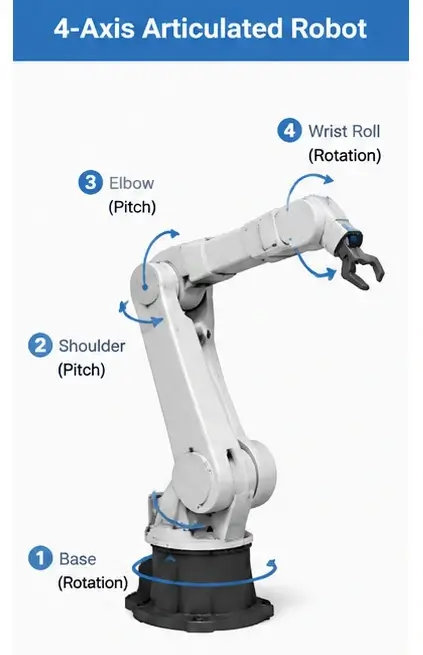
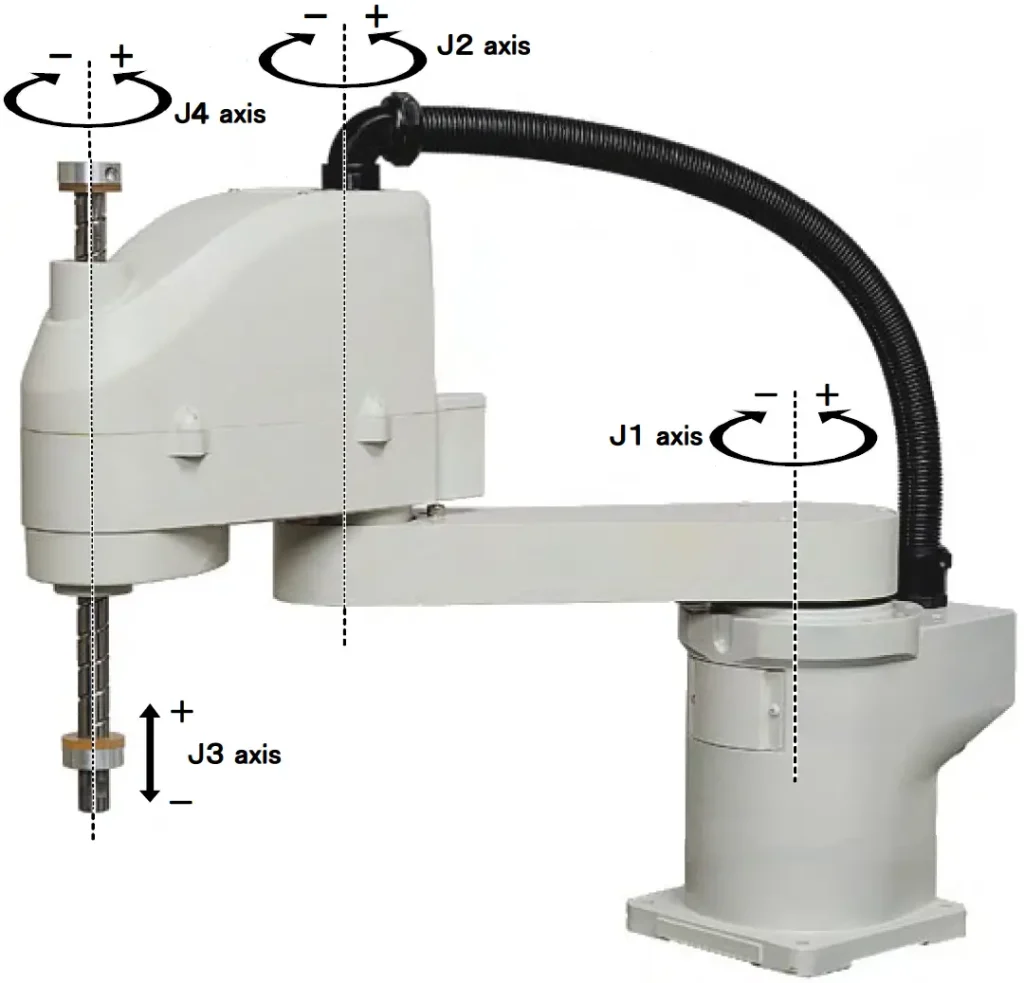
4-axis robots can perform planar positioning within their workspace, vertical (Z-axis) movement, and rotational movement around the Z-axis. Currently, there are two main types of 4-axis robots: the traditional 4-axis robot formed by four rotary joints in series, and the SCARA robot.
Traditional 4-axis robots typically add a parallelogram (or follower) linkage alongside the main motion links. This increases the overall rigidity of the structure and enhances its load-bearing capacity—much like a person having stronger arms to lift heavier objects. Generally, traditional 4-axis robots are used for palletizing, sorting, and transporting boxes on production lines.
SCARA Robot (full name: Selective Compliance Assembly Robot Arm). It is composed of 3 rotary (R) joints, 1 prismatic (P) joint, and 4 links in series, also known as an RRRP robot. Its workspace is cylindrical, similar to that of a cylindrical-coordinate robot. It excels at fast, repetitive, and continuous point-to-point motions and is suitable for small-part loading/unloading, small-part assembly, handling, sorting, and packaging.
5-Axis Articulated Robot
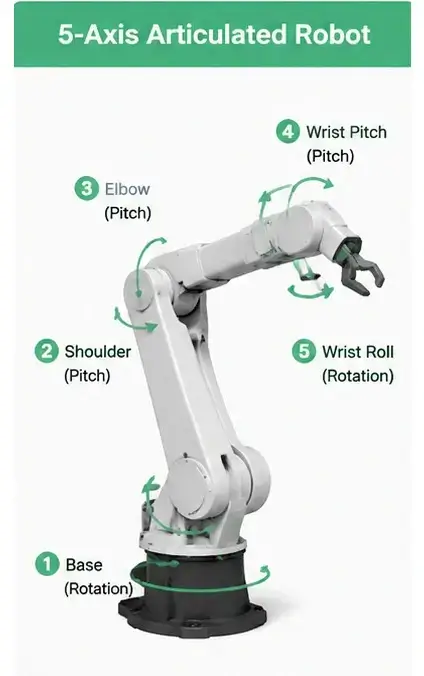
5-axis robots typically have one additional wrist swing axis compared to 4-axis robots, enabling them to adjust the posture of materials during transport. The main value of a 5-axis robot lies in its enhanced motion flexibility. However, this usually comes with a reduction in its maximum payload. They are commonly used in spraying, complex assembly, and welding.
6-Axis Articulated Robot
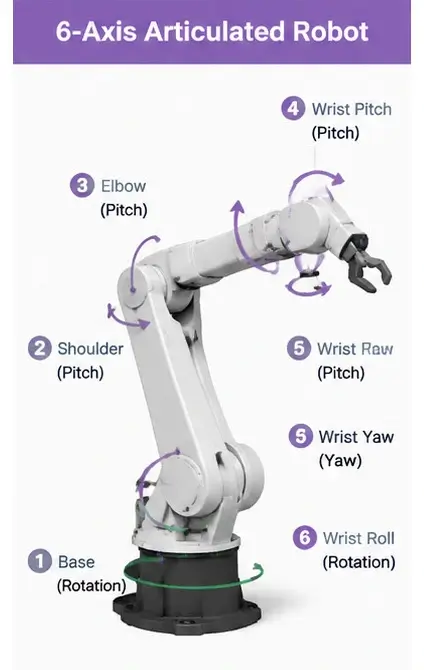
6-axis robots feature six rotary joints, each capable of independent motion. Compared to a 5-axis robot, a 6-axis robot typically has an additional wrist rotation axis, allowing rotational movement around all six joint axes to varying degrees. This enables its end-effector to position and operate at different angles within three-dimensional space, significantly enhancing its obstacle avoidance capabilities and flexibility in complex environments. They are suitable for most industrial scenarios, including spot welding, arc welding, spraying, palletizing, depalletizing, packaging, cleaning, assembly, and inspection.
7-Axis Robot
7-axis robots typically add a base swing axis to the traditional 6-axis configuration. They possess superior obstacle avoidance capabilities compared to 6-axis robots, enabling more complex motion trajectories and a wider range of motion. They are often used in spraying, welding, and other applications.
Most Widely Used Articulated Robots
SCARA robots and 6-axis robots are the two most widely used types of articulated robots in industrial applications. This can be analyzed from both structural and cost perspectives.
–Structural Perspective: For 3-Dimensional spatial applications, 4-axis robots excel at high-speed planar pick-and-place tasks but have weaker vertical motion capabilities and are unsuitable for complex tasks requiring multi-DOF manipulation. While 5-axis robots offer improved flexibility, they still cannot match the full range of motion provided by a 6-axis robot. Consequently, the usage range and flexibility of 4-axis and 5-axis robots in 3-Dimensional space are relatively limited, making it difficult to meet complex and ever-changing industrial needs. Therefore, 6-axis robots are more prominent in handling complex tasks.
–Cost Perspective: For 2-Dimensional planar motion scenarios demanding high cycle rates, high precision, and high stability, SCARA robots are fully capable. The total procurement cost of SCARA robots is also lower than that of traditional 4-axis robots and general-purpose small 6-axis robots. Furthermore, SCARA robots can adapt to different working ranges by adjusting the length of their link arms, meeting customized enterprise needs and further reducing total operating costs. For complex 3D tasks, we have already analyzed the advantages of 6-axis robots from a structural perspective. Leveraging these advantages, 6-axis robots hold a significant share of the industrial robot market, and mass production has helped dilute their manufacturing costs.
At this point, some readers might wonder: 7-axis robots are more flexible, so why aren’t they as widely used as 6-axis robots?
This is because 6-axis robots can already meet the vast majority of industrial application scenarios and most enterprise requirements. After years of development, the production technology and control algorithms for 6-axis robots have matured considerably. Moreover, the corresponding technical support, service networks, and spare parts supply have formed a relatively robust market ecosystem.
While 7-axis robots are indeed superior in flexibility and obstacle avoidance, the additional DOF makes inverse kinematics calculations more complex, imposes higher demands on path planning and motion control algorithms, and increases both manufacturing and maintenance costs. Therefore, 7-axis robots are currently more commonly used in niche fields and high-end markets (such as cutting-edge research).
Recommended Related Reading from AI Robots Eidos
As two important types of industrial robots, AI Robots Eidos also provides detailed introductions to these two robots. Interested readers can refer to these two articles.
SCARA Robots: Speed & Precision for Modern Assembly
Articulated Robot Advantages
–High Degree of Freedom: Articulated robots consist of multiple movable joints, typically 5 to 6 axes, granting them high flexibility. They can mimic human motion patterns and achieve complex movements and posture adjustments. Their working radius can exceed 3 meters, enabling them to perform tasks such as assembly, welding, and painting.
–Accuracy: By controlling the motion of each joint, articulated robots can accurately achieve various positions and postures. Their repeatability (repeat positioning accuracy) typically ranges from ±0.02 mm to ±0.1 mm, with high-end models achieving within ±0.01 mm. This ensures product consistency in mass production (e.g., precision manufacturing), thereby improving yield rates.
–Adaptability: Articulated robots are flexibly programmable and can adapt to environmental and task changes. By adjusting parameters such as joint angles, force, and speed, they can suit different application scenarios. According to statistics from the IFR and CRIA, articulated robots account for over 60% of the global industrial robot market.
Articulated Robot Example (Product Parameters For Reference Only)
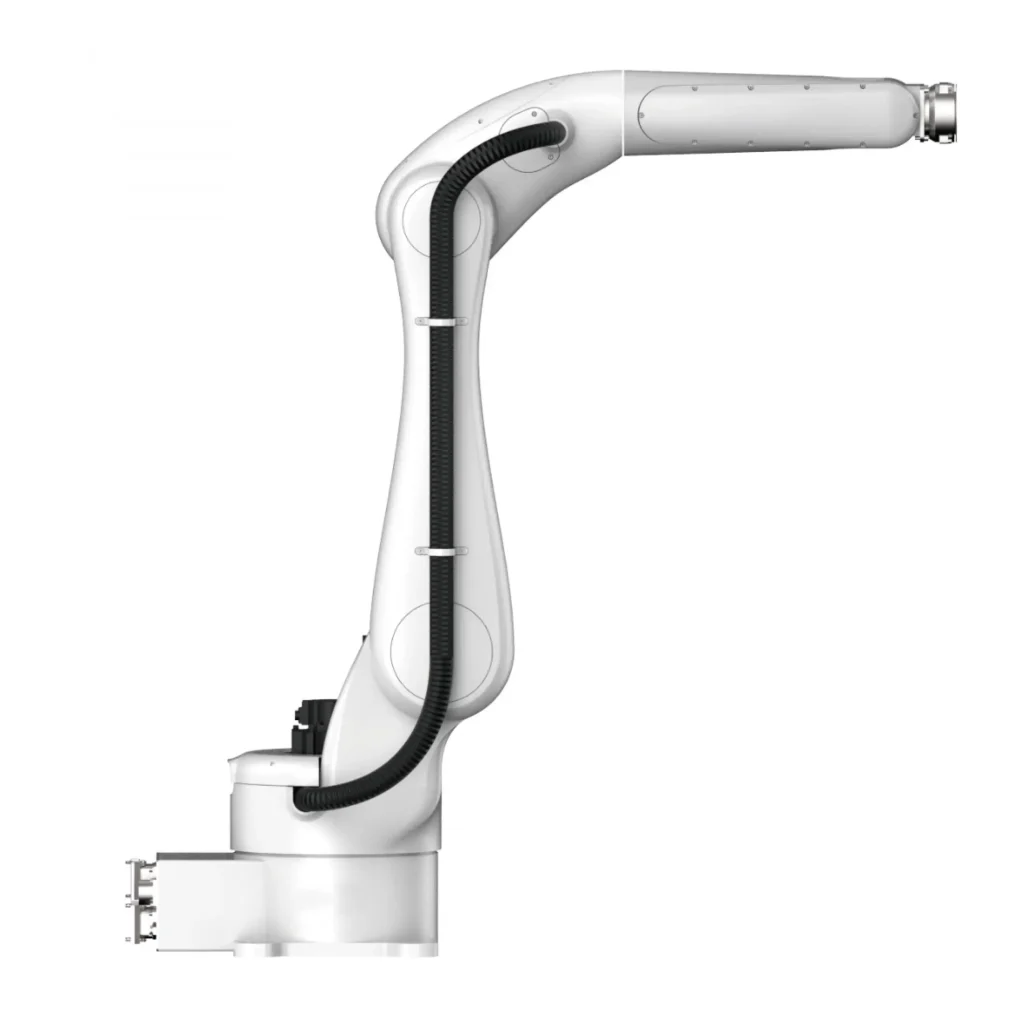
| Maximum Reach | 1,452 mm | |
| Maximum Payload | 12 kg | |
| Position Repeatability | ±0.04 mm | |
| Maximum Motion Range | J1 (Turning) | 170° |
| J2 (Lower Arm) | from -90°to +150° | |
| J3 (Upper Arm) | from -150°to + 80° | |
| J4 (Wrist Roll) | ±190° | |
| J5 (Wrist Bend) | ±135° | |
| J6 (Wrist Twist) | ±360° | |
| Maximum Velocity | J1 | 260°/s |
| J2 | 200°/s | |
| J3 | 260°/s | |
| J4 | 470°/s | |
| J5 | 470°/s | |
| J6 | 700°/s | |
| Maximum Static Load Torque | J4 | 25.0 N·m |
| J5 | 25.0 N·m | |
| J6 | 9.8 N·m | |
| Maximum Moment of Inertia | J4 | 0.7 kgf·m2 |
| J5 | 0.7 kgf·m2 | |
| J6 | 0.2 kgf·m2 | |
| Weight | 150 kg | |
Comparative Analysis: Cartesian Robots vs. Articulated Robots
Load Capacity
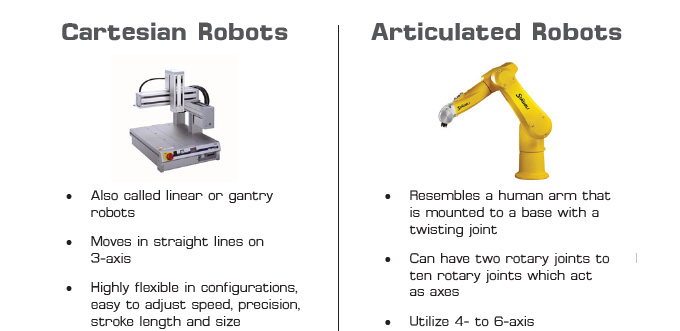
–Cartesian Robots: Standard single slide lengths are 6 meters, but can be assembled to reach up to 100 meters. Configured as gantry robots, single-axis loads range from 10–200 kg, with special structures capable of handling up to 2400 kg. The gantry frame structure offers strong load capacity, stability, and reliability at a relatively lower cost.
–Articulated Robots: Have a working radius of up to 3 meters and can work at any angle within this effective radius. Since safety isolation is required within their operating range, they are unsuitable for long-distance applications. Common payload capacities are typically between 5–20 kg. As the designed load capacity of an articulated robot increases, ensuring a stable mechanical structure becomes significantly more expensive.
Precision
Under normal circumstances, both types can meet precision requirements.
–Cartesian Robots: Due to their simple structure, the repeat positioning accuracy of Cartesian Robots is 0.05 mm, or even higher.
–Articulated Robots: Repeat positioning accuracy is approximately 0.06 mm. For light loads with a small radius, it can be 0.02 mm; for heavy loads, it is around 0.2 mm.
Initial Investment Cost (excluding ongoing maintenance and repair costs, based on a 60 kg payload palletizing robot)
–Cartesian Robot: USD 40,000 – 60,000
–Articulated Robot: USD 90,000 – 110,000
Articulated Robot Applications
Articulated robots of different payloads and precisions (e.g., light, medium, and heavy payloads) are suited to distinct sub-scenarios. For example, light-payload articulated robots (≤20 kg) are often used for precision assembly and light material handling, while heavy-payload articulated robots (100 kg – 300 kg) are used for handling heavy structural components.
–Automotive Industry: Widely used for body welding (spot, arc, and laser welding), body painting (precise control of spray gun trajectories), and precision assembly (grabbing and assembling heavy components such as engines, transmissions, and chassis).
–Electronics Manufacturing: Primarily used for precision assembly (e.g., PCB soldering), material handling (grasping and transferring small components), dispensing, intelligent inspection, and sorting.
–Commercial Applications: The main application scenario is in unmanned retail. Robots navigate autonomously within stores, intelligently identify and grab items based on customer orders, and perform tasks such as sorting, restocking shelves, and barcode scanning, thereby improving the efficiency and inventory management precision of unmanned retail.
Insight from AI Robots Eidos
As production lines demand greater flexibility, a hybrid robot configuration that combines the horizontal rigidity of SCARA with the spatial flexibility of a 6‑axis articulated robot is likely to become the next R&D hotspot. For example, on an assembly line, the front end could adopt a SCARA structure for high‑speed insertion, while the rear end is augmented with a small 6‑axis wrist for fine angle adjustments. This “heterogeneous integration” would redefine the efficiency boundaries of multi‑task production lines.
Under light loads and small working radii, articulated robots can achieve a positioning accuracy of 0.02 mm, but under heavy loads, accuracy drops to 0.2 mm. This implies that the same robot exhibits “accuracy drift” under different operating conditions. The future breakthrough may not lie in pursuing absolute high precision across all conditions, but rather in developing load‑adaptive accuracy compensation algorithms that enable the robot to automatically adjust control parameters based on the weight of the object being handled, thereby achieving intelligent operation with “scenario‑defined precision.”
In the future, the selection of articulated robots will no longer be about “pursuing more axes,” but about dynamic optimization based on task complexity and the cost‑efficiency ratio. Customized, scenario‑adapted designs with “just‑right” numbers of axes will prove more sustainable than a business model that simply stacks hardware.
Image Credits: Robots & Wikipedia & Jhfoster & AI & Web