Industrial Robot Wrists: Why 3 Rotational Joints
Table of Contents
The vast majority of industrial robot wrists fundamentally consist of three rotational joints. You may wonder why most industrial robot wrists have three joints. This article will answer this question step by step.
Why Do Industrial Robot Wrists Have Three Joints?
This is because the core task of the industrial robot wrist is to achieve “full freedom of end-effector posture.”
For a robot to perform complex tasks, it requires three degrees of freedom (DOF) for its posture in three-dimensional space. For example, tasks such as welding along curved paths or tightening screws from different angles necessitate the ability to freely control the orientation of the end-effector (such as a welding gun or screwdriver).
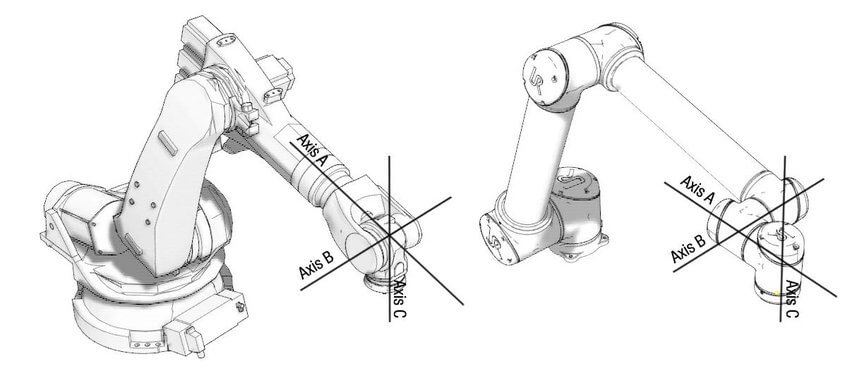
In three-dimensional space, describing an object’s orientation requires three independent rotational dimensions, which typically correspond to rotations about the X-axis (pitch), Y-axis (yaw), and Z-axis (roll). That is to say, the wrist needs at least three joints to allow tools to tilt and rotate freely, covering all possible angles.
Why Are The Joints of Industrial Robot Wrists Mostly “Rotational Joints”?
| High Space Utilization: The wrist, located at the end of the robotic arm, often operates in constrained working spaces. If mobile joints (like telescopic structures) were used, they would require extra space for movement, which could lead to interference or collisions. In contrast, rotational joints rotate around their own axes and occupy almost no extra external space, making them compact and well-suited for operations in confined environments.
| Efficient Force Transmission and Durability: The wrist directly supports the weight of the end-effector and the operational force (such as the torque for screw tightening or resistance when grinding). Rotational joints typically use RV reducers or harmonic reducers driven by servo motors, yielding strong rigidity, high torque, high precision, and minimal wear with a long lifespan. Conversely, mobile joints (like lead screws or linear guides) tend to develop play during frequent extension and retraction, which decreases precision over time, and have weaker capacity for bearing high torques.
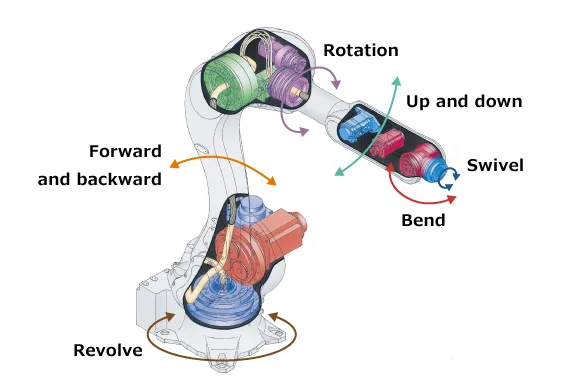
| Mature Technology and High Reliability: The drive solutions for rotational joints (servo motor + precision reducer) have been used in the industry for decades, with controllable costs and good stability, allowing for 24-hour continuous high-intensity operations. In industrial scenarios, reliability and ease of maintenance are paramount, and rotational joints are clearly favored over linear motion joints.
What Types of Three-Degree-of-Freedom Industrial Robot Wrists?
There are various structures for three-degree-of-freedom industrial robot wrists. Through the careful design of joint arrangement and drive methods, these wrists can achieve high precision and high flexibility in movement, suitable for different scenarios and needs.
To help readers better understand different wrist mechanisms, here’s an overview of B joints and R joints. B joints typically correspond to rotations about a specific axis (not the tool axis), which can achieve pitch or yaw, while R joints correspond to the roll about the tool axis.
| BBR Wrist: Composed of two bending joints (B joints) and one rolling joint (R joint). It can achieve pitch, yaw, and roll (RPY) movements with a large range of motion, allowing flexible adjustment of the hand’s posture and making it suitable for tasks requiring complex posture adjustments.
| RRR Wrist: Made of three R joints, where the axes of the three joints typically intersect at a point, forming a spherical wrist structure. It has a simple structure and high transmission efficiency, allowing for omnidirectional rotation with a wide range of motion, enabling quick adjustments of the hand’s posture; however, it may face singularity issues that need to be avoided in control. The RRR wrist is widely used in scenarios requiring rapid positioning and posture adjustment.
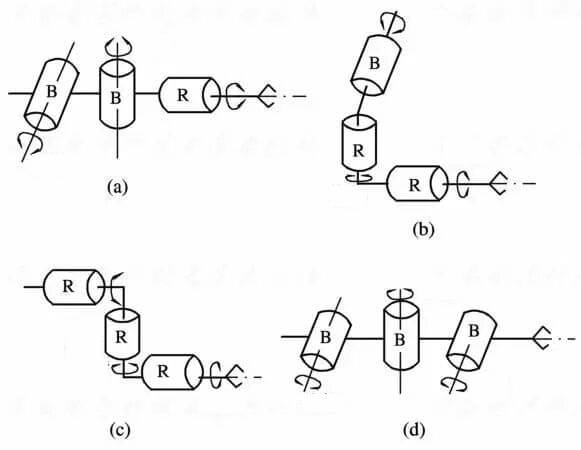
| BRR Wrist: A combination of one bending joint (B) and two rolling joints (R). The first rolling joint requires a biased design to avoid loss of degrees of freedom (the loss of degrees of freedom refers to a reduction in effective control dimensions when multiple joint axes are collinear or parallel). It can achieve RPY movements. Due to the bias design of the R joint, it offers high motion precision and flexibility, making it better suited to complex spatial trajectories.
| RBR Wrist: Composed of three joints, namely the first R joint (Roll), a B joint (Bend), and the second R joint (Roll). The RBR wrist has a compact structure with a clear transmission route, making it easy to maintain and debug. It can achieve RPY movements with high precision, suitable for tasks at different angles and positions while also exhibiting good stability and reliability.
| BBB Wrist: Composed of three bending joints (B); however, in practical applications, it often degenerates to a two-degree-of-freedom structure, thus being rarely used alone and usually requiring a combination with other structures.
Why Don’t Industrial Robot Wrists Use Two Rotational Joints?
The various three-joint configurations are designed to achieve full posture control while avoiding structural issues. So, can we simplify further by only using two joints? The answer is no.
You can imagine trying to twist a bottle cap with just two fingers: sometimes, when the cap reaches a certain angle, the fingers will not be able to turn further. The same applies to industrial robot wrists: with only two rotational joints, singularity points may occur in certain postures, preventing tools from smoothly reaching all necessary angles. This is primarily due to the Jacobian matrix losing rank, reducing operability in a certain direction. Hence, three rotational joints represent the “minimum number of joints” necessary for full coverage of three-dimensional spatial posture, allowing for any orientation without adding unnecessary structures.
Here, robot singularities refer to cases where the robot exhibits abnormal kinematic model behavior at certain specific postures or joint positions. The motion capability of the robot’s end-effector (such as the Tool Center Point, TCP) in space is restricted, and what could be unrestricted movement and rotation might only allow movement in a specific direction or prevent certain posture adjustments at singular points. Common types of robot singularities include shoulder joint singularities, elbow joint singularities, and wrist joint singularities, with different types corresponding to different motion limitations.
Why Don’t Industrial Robot Wrists Use Four or Six Joints?
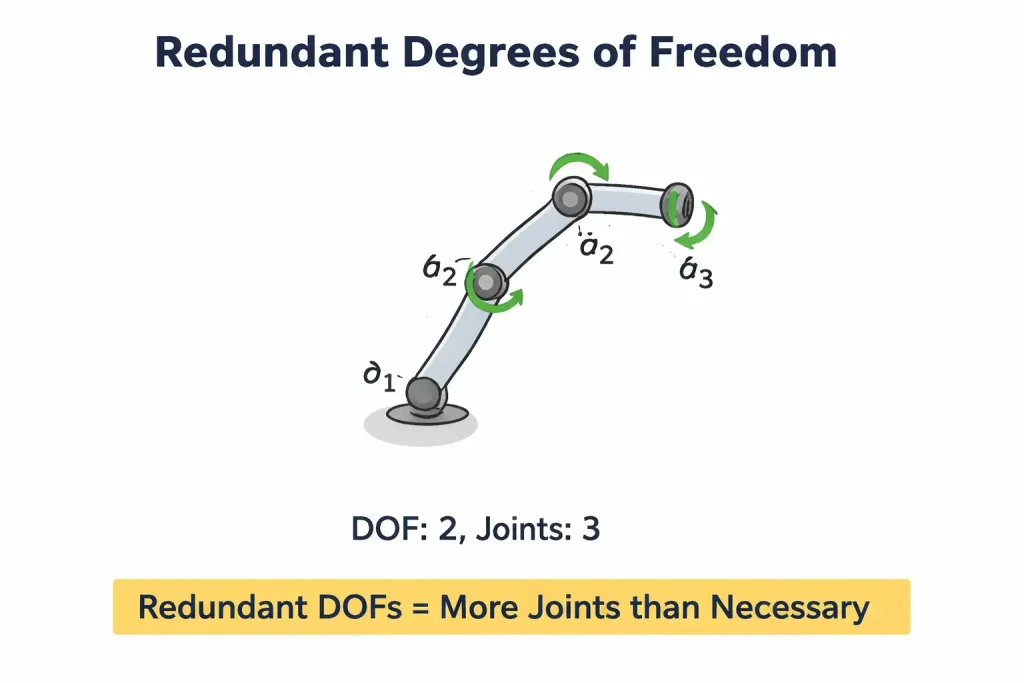
Using four or six rotational joints can lead to “motion redundancy.” Although redundant degrees of freedom have some value in avoiding obstacles, fault tolerance (to continue operation despite a joint failure), and optimizing performance metrics (such as joint torque optimization), they significantly increase the complexity of control algorithms and hardware costs. For most industrial scenarios, three joints suffice to cover the vast majority of posture requirements, and adding more joints would represent excess performance, contrary to the industrial philosophy of “reliable, simple, and economical” design.
Are There Any Exceptions Where Industrial Robot Wrists Might Differ?
The answer is yes.
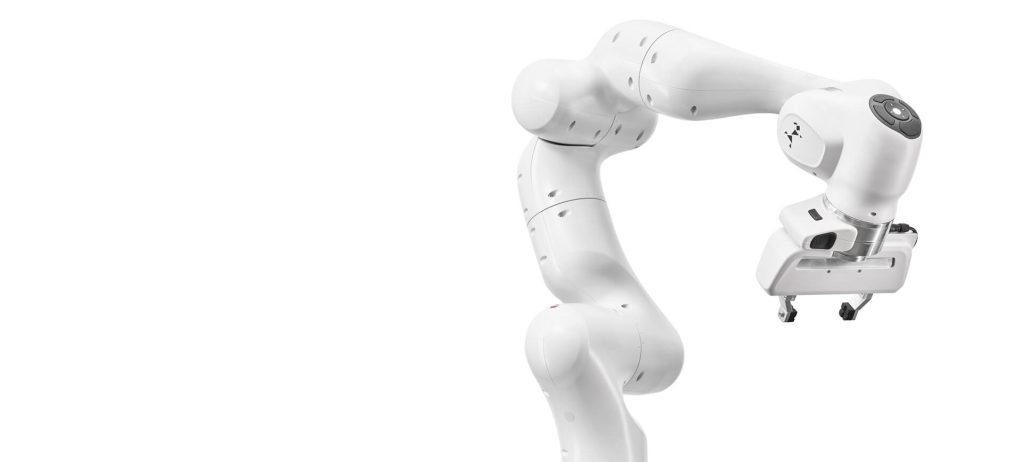
| Some collaborative robots (such as UR, Franka), in pursuit of lightweight designs and human-robot collaboration safety, may adopt “2 rotational joints + 1 flexible joint” or more simplified wrist designs, sacrificing some extreme posture capabilities in exchange for lighter arm-end weights and lower collision risks.
| Certain specialized robots, such as those used for specific processes, may only configure 1 to 2 joints for the wrist since the operational postures are very fixed, belonging to a “good enough” custom design.
Thanks to the three rotational joints, the wrist of an industrial robot can rotate flexibly, allowing the end tools to complete various tasks freely and flexibly.
Recommended In-depth Reading from AI Robots Eidos
After understanding the design of industrial robot wrists, do you have more curiosity about the overall knowledge of industrial robots? If you want to have a comprehensive understanding of industrial robots, please read this in-depth article about industrial robots.
Insight from AI Eidos Robots about Industrial Robot Wrists And 3 Rotational Joints
| Limits of Dexterous Manipulation: The current three-joint wrists achieve “full posture” but do not optimize for “full path.” When assembling highly complex products, the paths for posture transitions may not be optimal, resulting in unnecessary empty strokes. Future wrists may need to integrate micro trajectory planners to achieve intelligent local path optimization at the joint level, rather than solely relying on a central controller.
| Bottleneck of Precise Force Control: Rotational joints transmit forces efficiently, but real adaptive force control in the future requires joints to perceive and adjust their “mechanical impedance.” This has led to the development of joint modules with built-in force sensing and variable stiffness actuators. The wrist may evolve from a “pure motion execution unit” to a “perception-execution fusion unit,” with each joint acting as an intelligent agent.
| Redundancy as Optimization: Enhancing Energy Efficiency and Lifespan Management: Redundant degrees of freedom provide the system with choice. AI can plan movement trajectories in real-time that minimize energy consumption or balance joint wear, thereby extending the overall lifespan of the equipment and reducing operating costs. Redundancy becomes a manageable “performance reserve.”
Image Credits: Kawasakirobotics & Researchgate & Franka & Web & AI & Yaskawa-global