Why Humanoid Robot Joint Modules Need Axial Flux Motors
Table of Contents
Why humanoid robot joint modules need axial flux motors is the central theme of this article.
Definition of Axial Flux Motor
An axial flux motor features a magnetic flux direction parallel to the motor’s rotation axis, fundamentally different from the perpendicular magnetic field orientation in traditional radial flux motors.
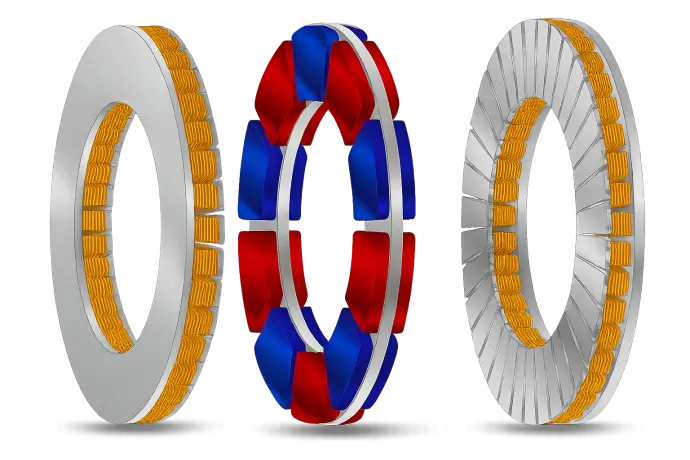
The stator and rotor are arranged as parallel discs, with the magnetic field closing along the axial direction, resulting in a flat and compact structure. When energized, the stator windings generate axial magnetic flux. Due to the short, straight flux path without directional bends, magnetic energy utilization is more efficient. Because the flux path is short and direct, core losses are significantly lower than in traditional radial flux motors, with some axial flux motors achieving efficiencies exceeding 96%.

Recommended In-depth Reading from AI Robots Eidos
Axial flux motors are just one type of motor used in humanoid robots; other motors utilized include coreless motors and frameless torque motors, among various others. These motors work in coordination, collectively forming the drive system for humanoid robots and providing power support for flexible movement, precise operations, and the execution of complex tasks. If you wish to gain further understanding of the motors in robots, please read this in-depth article on robot motors.
What are Humanoid Robot Joint Modules?
A joint module is the core component for robot motion control, typically referring to a standardized mechanical joint unit that highly integrates subsystems such as the motor, reducer, encoder, driver, and structural components. It can output rotary or linear motion to drive various parts of the robot’s body, supports closed-loop control and intelligent communication, and represents the minimal functional unit for achieving robot motion control.

Role of Motors in Humanoid Robot Joint Modules
As a key component of the joint module, the motor performs functions such as speed reduction, transmission, and torque amplification. Humanoid robots are typically designed for human daily living environments, possessing human-like perception, decision-making, behavior, and biomimetic mobility. In this process, the motor drives joints to complete complex actions by precisely regulating speed, torque, and position, enabling movements such as walking, running, and jumping.
Why are Axial Flux Motors More Suitable for Humanoid Robot Joint Modules than Traditional Radial Motors?
| Structural Advantages of Axial Flux Motors Enable Integrated Humanoid Robot Joint Modules: Traditional radial motors employ a “sleeve-type” magnetic circuit structure, with stator and rotor concentrically arranged in a cylindrical form. The motor itself occupies significant radial and axial space and can only connect to the reducer in a serial configuration, forming a “motor + reducer” split layout, leading to excessive overall length and weight.
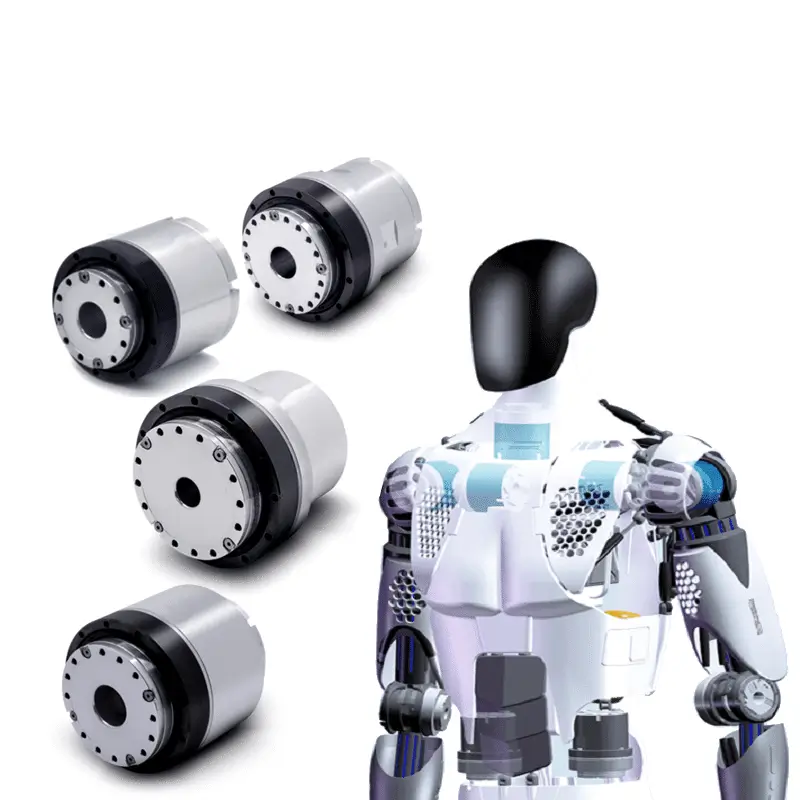
In contrast, axial flux motors utilize an “electromagnetic sandwich” structure (dual-rotor single-stator or single-rotor dual-stator) with permanent magnets arranged in an axial ring array and flux direction parallel to the rotation axis. This flat design inherently possesses the geometric advantage of coaxial nesting with reducers, creating the structural foundation for integrated design.
| Axial Flux Motors Facilitate Performance Enhancement in Humanoid Robot Joint Modules: The design achieves millimeter-level coaxial integration of axial flux motors with harmonic drives. Through an “axial stacking-compartmentalized packaging” approach, the flat stator of the axial flux motor can be highly integrated with core components of the reducer, such as the wave generator and flexspline, within the same axial space, completely breaking the spatial constraints of traditional split configurations.
This integration method compresses the axial length of the joint module to 55% of traditional solutions. The flat axial flux motor, with a thickness of less than 12mm, forms an integrated structure with a PEEK-metal composite housing, reducing total module mass by 40%. Furthermore, through optimized magnetic circuit design and thermal management systems, with axial dimensions reduced by 50% and weight only 2.5kg, power density is increased threefold to 80 Nm/kg, and peak torque is boosted by 20% to 200 Nm.
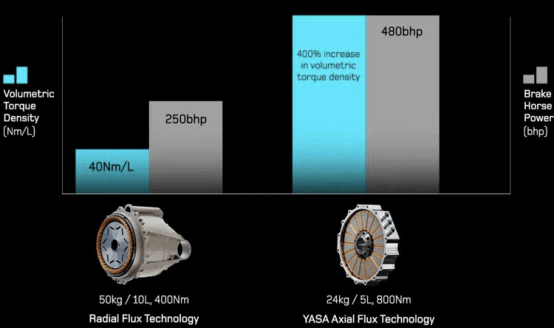
While integrated design brings significant volume and performance optimization, fixed torque output becomes a new bottleneck for more complex application scenarios, thereby giving rise to the variable-radius design for axial flux motors.
| Axial Flux Motors Drive Innovation in Humanoid Robot Joint Modules: Improved axial flux motors fully leverage the axial arrangement characteristics, innovatively addressing the core issue of dynamically changing torque requirements in humanoid robot joints. Although traditional axial flux motors have a flat structure, their torque output is fixed and cannot adapt to varying robot loads.
Current engineering exploration focuses on achieving dynamic torque adjustment through a variable-radius design: when the robot needs to bear larger loads, an electromagnetic coil drives a lower magnetic block to push sliders, causing locking blocks to move closer and release the position limit of the mounting base.
Subsequently, an electromagnetic ring uses magnetic force to push an upper magnetic block outward, driving the mounting base and magnets to move away from the rotor disk axis, thereby increasing the rotor radius. Since the torque of an axial flux motor is proportional to the cube of the rotor radius, this design can significantly enhance torque output, enabling a flat design with a diameter of 120mm and a thickness of only 40mm to continuously deliver 180 Nm of torque.
Application of Axial Flux Motors in Humanoid Robot Joint Modules
The leg joints of the Qinglong (Green Dragon) robot utilize axial flux motors, achieving a maximum torque of 396 N·m for leg swing and knee joints, with a peak torque density as high as 200 N·m/kg, ensuring the robot’s stable walking capability on complex terrains.
| Motor Solution | Joint Location | Degrees of Freedom | Joint Name | Peak Torque (Nm) |
| Axial Flux Motor | Waist | 3 | Pitch Joint | 315 |
| Adduction Joint | 315 | |||
| Yaw (Rotation) Joint | 121 | |||
| Leg | 6*2 | Hip Abduction Joint | 320 | |
| Hip Rotation Joint | 160 | |||
| Hip Flexion Joint | 396 | |||
| Knee Joint | 396 | |||
| Ankle Joint | 208 |
Challenges for Axial Flux Motors in Humanoid Robot Joint Modules
| Complex Manufacturing Processes: The axial alignment structure of the stator and rotor requires extremely high control over the air gap, demanding micron-level precision. Production involves processes like precision machining, laser welding, and automated assembly, requiring substantial equipment investment and numerous manual operation steps, leading to low production efficiency and limited yield rates.
| High Costs: To ensure magnetic performance stability under high-temperature conditions, high-coercivity NdFeB magnets with added heavy rare-earth elements like Dysprosium (Dy) and Terbium (Tb) are often necessary. Furthermore, the widespread use of high-performance carbon fiber composite materials in rotor manufacturing is costly, and auxiliary materials such as specialized insulating materials and high-precision bearings also contribute to higher expenses.
Development Directions for Axial Flux Motors in Humanoid Robot Joint Modules
To address the aforementioned challenges of complex processes and high costs, the industry is seeking breakthroughs through two main pathways: material innovation and design innovation.
| Cost Reduction: The use of SMC (Soft Magnetic Composites) leverages their net-shaping capability to mold complex structures—such as porous heat dissipation structures and radial cooling channels—in a single pressing operation, which are difficult to achieve with traditional processes. In axial flux motors, this enables the integrated design of stator tooth cores and heat dissipation structures, significantly reducing costs, especially in high-volume production. Although its saturation flux density and permeability are slightly lower than those of silicon steel, performance can be compensated through optimized magnetic circuit design and increased effective cross-sectional area.
| Process Simplification: The yokeless segmented stator design adopts completely independent stator tooth structures, fundamentally re-engineering the manufacturing process chain for axial flux motors. Each stator tooth is an independent module, integrating its own iron core and pre-wound windings, with teeth fixed together via special non-magnetic connecting structures. Its core logic lies in decomposing a complex monolithic stator into multiple standardized independent units, greatly simplifying the manufacturing flow. In technical solutions such as those from YASA and Traxis, this design achieves complete separation of winding and assembly processes, effectively streamlining production.
With technological advancements, the advantages of axial flux motors will be further leveraged, promoting enhanced performance of humanoid robot joint modules and providing an ideal power solution for humanoid robots.
Insight from AI Eidos Robots about Humanoid Robot Joint Modules And Axial Flux Motors
| From “actuator” to “structure”: The ultra-thin, disc-like characteristics of axial flux motors transform them from merely being a “driving component” to being part of the robot’s skeleton or structural support. Future joint modules may no longer be “motor-embedded structures,” but rather “motors as structures.” For instance, the structure of the robot’s pelvis or scapula itself could be a large axial flux motor disc, providing support, protection, and driving functions simultaneously. This will utterly blur the boundaries between mechanical structure and drive units, realizing a true mechatronic symbiotic entity.
| The inevitability of distributed intelligence and “joint brains”: The high integration brought by axial flux motors provides physical space and electrical foundation for embedding stronger local computing capabilities (such as miniaturized motor driver chips and status-monitoring AI units) at the joint module level. Future joint modules will not just be power units but “intelligent agents” with autonomous perception, decision-making (millisecond-level reflexes), and collaborative communication capabilities. Each joint acts as an edge computing node, achieving extreme response speed through local closed loops and overall coordination via a body bus, which will be critical for achieving humanoid agility and robustness.
Image Credits: Traxial & Mosrac & Linkedin & Farady & Sintex