
YASA Motor Breaks Record Again: Power Density Reaches 59 kW/kg
Table of Contents
According to the latest data from YASA Motors, its core performance indicators have achieved significant breakthroughs.
The Peak Power of The New YASA Motor
The YASA motor weighs 12.7 kg and has a peak power of 750 kW, setting an unofficial industry record for power density at 59 kW/kg. This marks a 40% increase from the company’s previous record of 42 kW/kg announced in July 2025, while also achieving over a 33% increase in power output with a weight reduction of approximately 14.17 g.
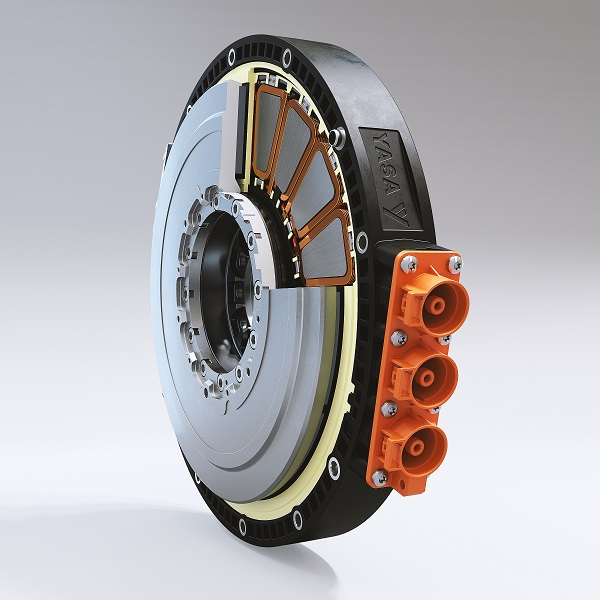
YASA disclosed that this prototype motor has completed dynamometer testing and is not merely a concept product; the materials and production processes used have the potential for large-scale application. Since becoming a wholly-owned subsidiary of the Mercedes-Benz Group in 2021, YASA’s R&D has continued to focus on automotive applications, and this breakthrough further consolidates its technological leadership in the field of axial flux motors.
Advantages of The New YASA Motor
From the high-power-density motor products currently available in overseas markets, the performance advantages of the new YASA motor are evident:
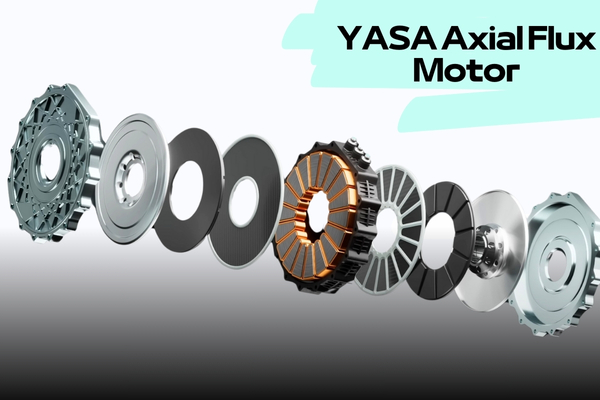
| Comparison with Similar Axial Flux Technologies: The previous industry record holder was the Evolito D250 motor, with a power density of 28 kW/kg; the new YASA motor’s power density is 2.1 times higher. Notably, the technology behind Evolito can be traced back to YASA, and it is positioned for applications in the aerospace sector.
| Comparison with Mainstream Products Across Multiple Sectors: In recent years, newly launched high power density motors include the Donut Labs automotive hub motor (15.8 kW/kg), H3X aviation motor (13.4 kW/kg), and Equipmake hybrid motor (13.3 kW/kg), all of which have power densities that are less than 30% of YASA’s new motor product.
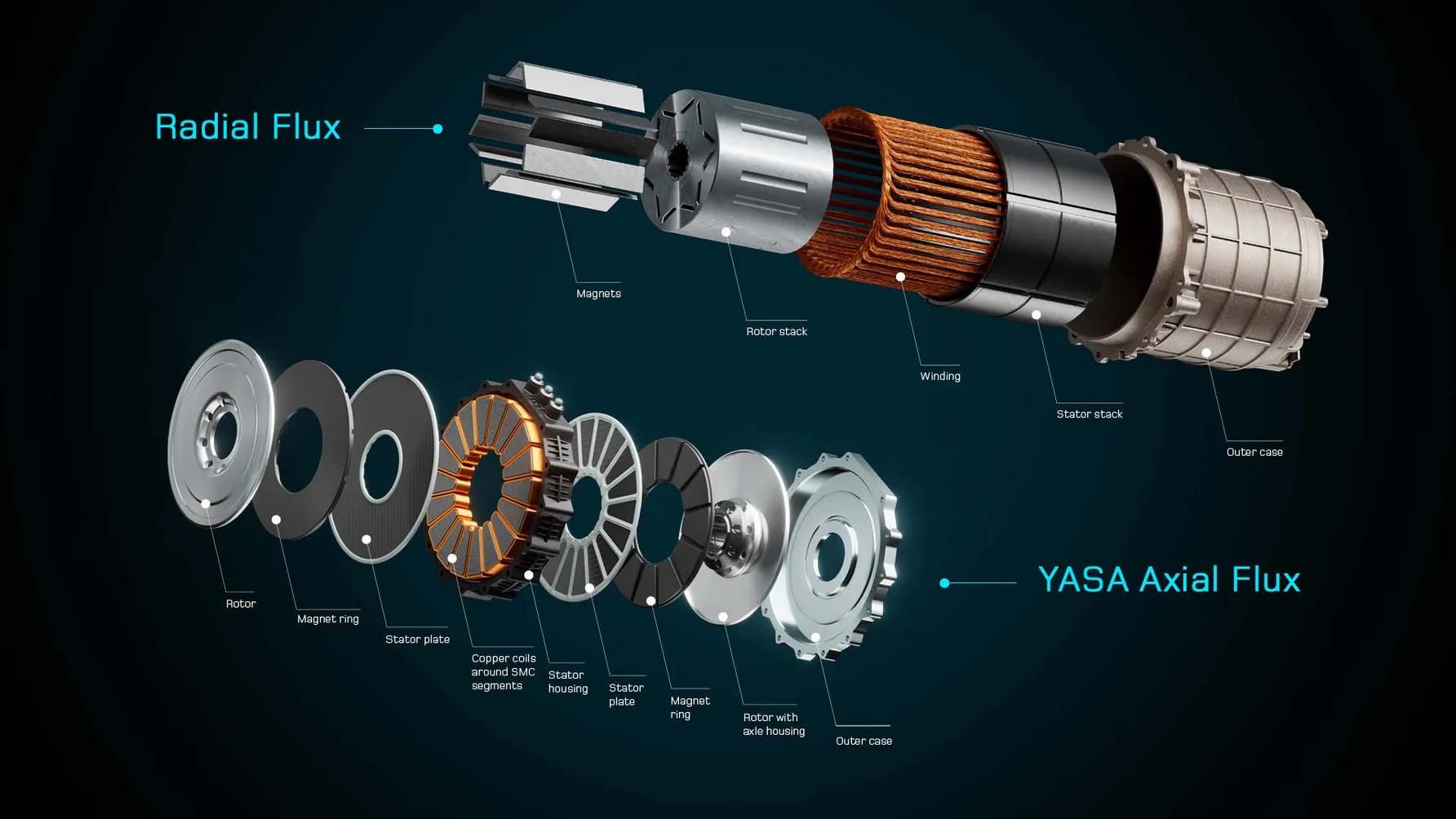
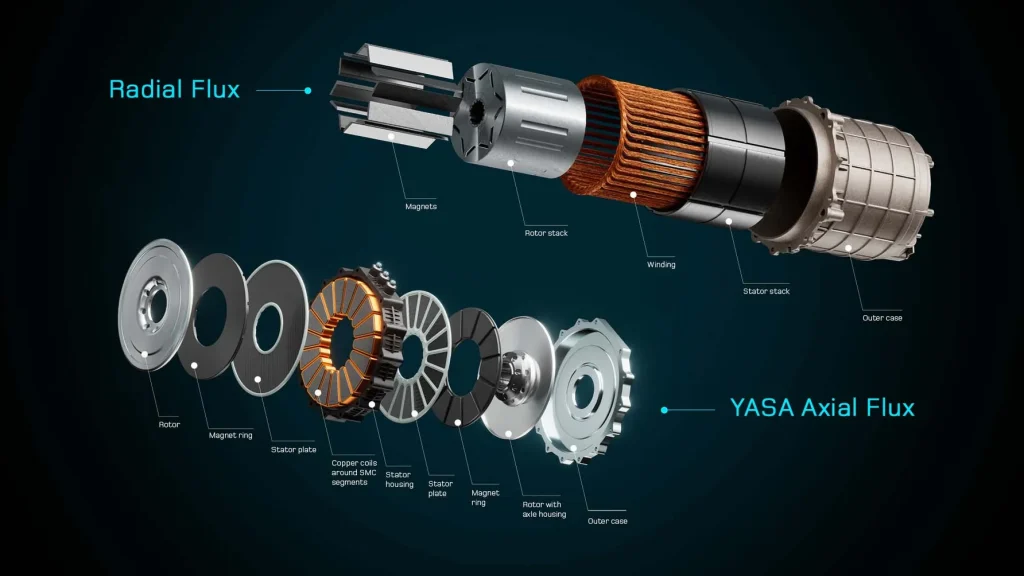
| Comparison with Radial Flux Technologies: The SPX177 radial flux motor developed by the UK company Helix for a supercar project weighs 28 kg, has a peak power of 711 kW, and a power density of approximately 25.4 kW/kg, which is only 43% of the new YASA motor’s power density.
| Additionally, the continuous operating performance of this motor is also outstanding: the YASA team estimates its continuous power to be between 350 and 400 kW, corresponding to a continuous power density of 27.6 kW/kg. This figure already exceeds the peak power densities of most of the aforementioned motors.
Currently, YASA has clearly positioned this prototype motor technology for applications in the high-performance automotive sector. From the perspective of the technological pathway comparison, this YASA motor has been considered feasible for mass production during its development phase, differentiating itself from the Helix SPX177, which aims exclusively for extreme performance while minimizing considerations of cost and mass production.
News Analysis from AI Robots Eidos
The advantages of “intergenerational differences” in absolute performance: The peak power density of 59 kW/kg and continuous power density ranging from 27.6 to 31.5 kW/kg represent a dual breakthrough. Its continuous power density has surpassed the peak power densities of most high-performance motors on the market, indicating that YASA has fundamentally addressed the issues of heat dissipation and thermal degradation in high-power-density motors while pursuing extreme output.
Verification and establishment of the technical pathway: This breakthrough serves as another strong validation of axial flux technology over traditional radial flux technology. Compared to the Helix SPX177 radial flux motor designed for supercars (25.4 kW/kg), YASA achieved higher power output with a 55% weight reduction. This further consolidates the structural advantages of axial flux in pursuing extreme power density and lightweight designs, which may compel radial flux solutions to increasingly focus on cost-sensitive and medium-power application markets.
Image Credits: Magneticsmag & Lammotor & Topgear