
Table of Contents
AGV forklifts (also known as driverless forklifts or AGV forklift robots) — the cornerstone of intelligent logistics equipment — are revolutionizing manufacturing and warehousing operations at a remarkable speed.
AGV Forklift Meaning
AGV forklifts are intelligent material handling devices that combine forklift technology with AGV (Automated Guided Vehicle) technology. Compared with traditional forklifts, AGV forklifts can drive and handle materials autonomously without human operators. Compared with standard AGVs, AGV forklifts can not only perform point-to-point material transport but also execute logistics tasks that connect multiple production stages. They excel not only in high-bay warehouses, receiving areas, and production line transfers but also play an irreplaceable role in heavy-load and special-handling scenarios.
Classification of AGV Forklifts
In this article, AI Robots Eidos classifies AGV forklifts by load capacity:
–Under 1 ton: This segment accounts for 24% of total market deployments and is primarily used in electronics manufacturing. Their compact design and low power consumption make them ideal for narrow-aisle warehouses. Over 31% of small warehouses utilize this category for bin transport and light-duty order picking.
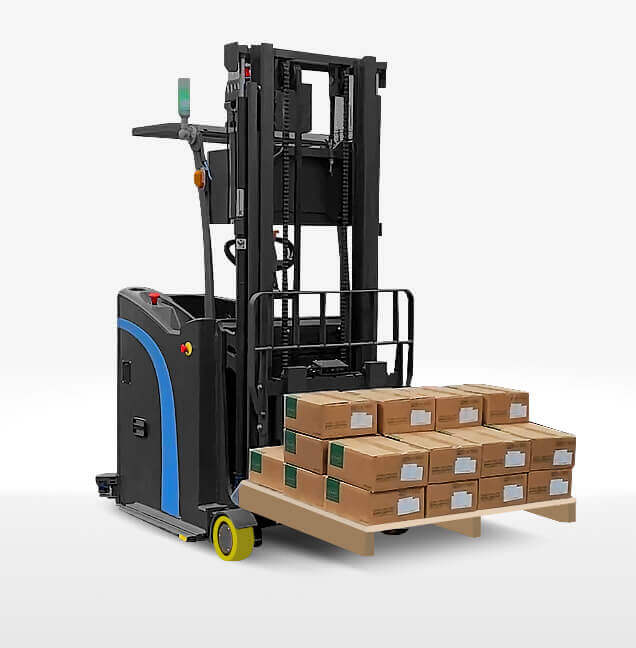
–1 to 2.5 tons: This is the largest market segment, covering 47% of installations, favored by the automotive, fast-moving consumer goods (FMCG), and chemical industries. These forklifts have medium payloads and are used for pallet movement and raw material supply lines. Due to the balance between speed and load capacity, 38% of first-tier city factories prefer this category.
–Over 2.5 tons: Heavy-load AGV forklifts dominate heavy industry and large distribution centers, accounting for 29% of total installations. This segment is particularly prominent in steel, paper, and beverage manufacturing, where heavy pallet movement is common. Nearly 34% of industrial logistics parks deploy these units for bulk goods handling.
Components of AGV Forklifts
AGV forklifts are equipped with positioning, navigation, and certain autonomous decision-making capabilities. They are mainly composed of a control system, drive module, working module, safety module, and functional modules. By integrating forklift technology with AGV technology and incorporating various advanced guidance technologies, mapping algorithms, embedded vehicle software, and safety collision avoidance systems, AGV forklifts achieve automatic guidance, material handling, and stacking functions, thereby enabling unmanned forklift operations.
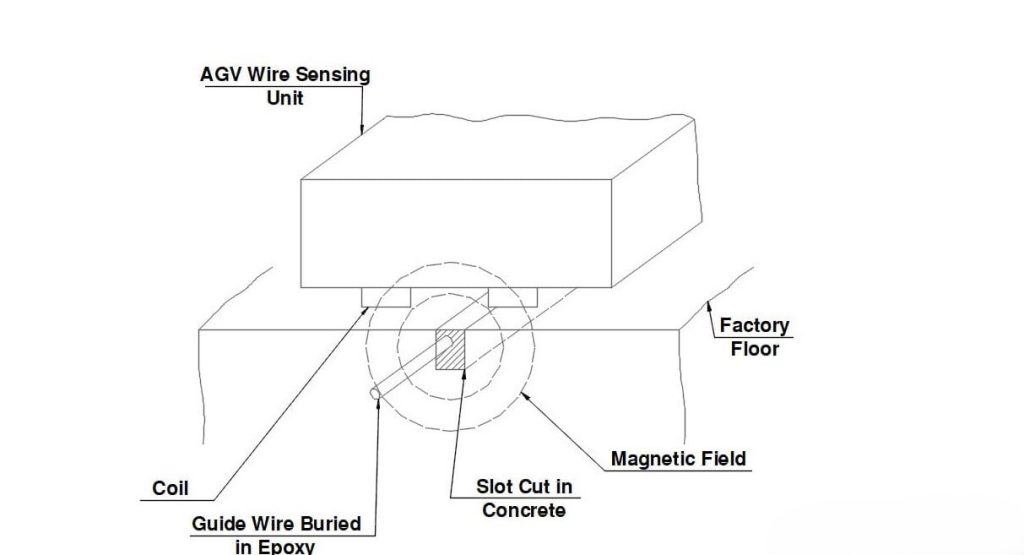
Recommended Related Reading from AI Robots Eidos
In view of the fact that this website has already published multiple articles detailing the composition, positioning navigation, types, and other aspects of AGVs, this article will not go into further detail. If you wish to learn more about the technical architecture of AGV forklifts, please refer to this comprehensive article introducing Automated Guided Vehicles.
AGV Forklift Cost
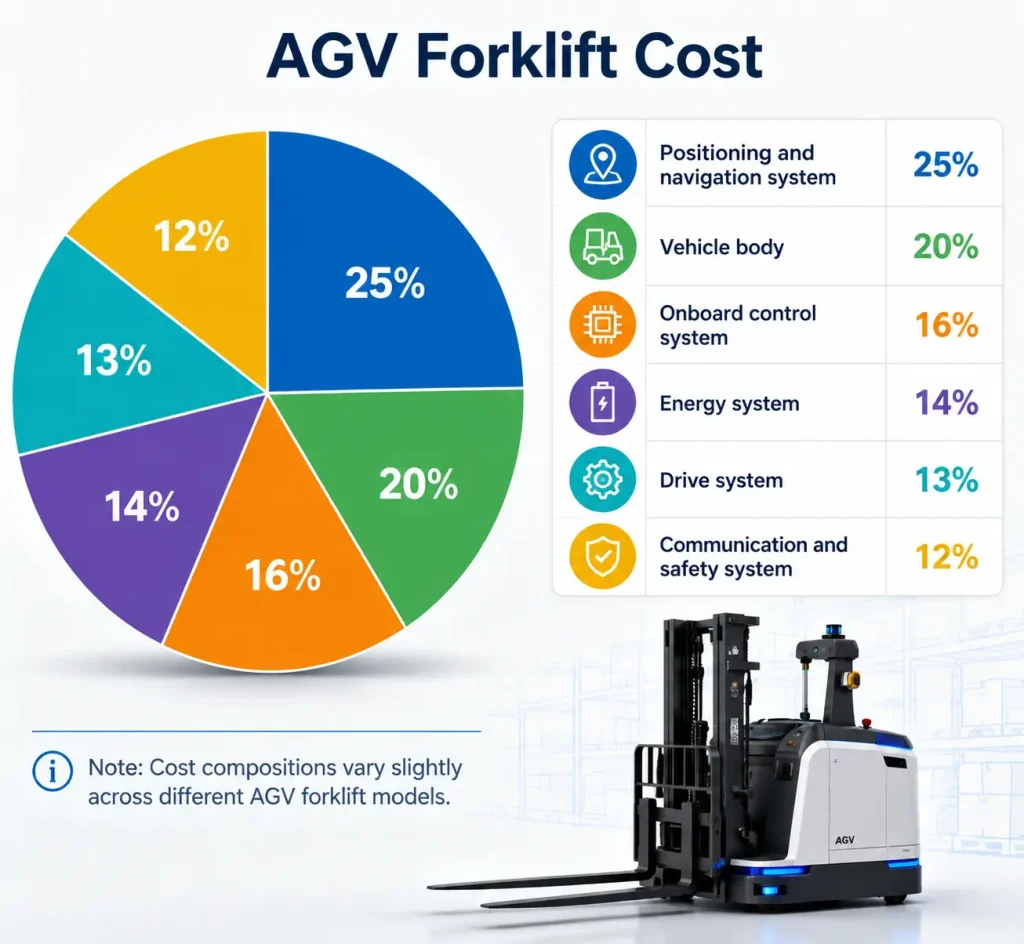
Depending on the technical complexity of different systems, the cost structure of an AGV forklift is generally as follows (Note: Cost compositions vary slightly across different AGV forklift models.):
Positioning and navigation system: 25%; Vehicle body: 20%; Onboard control system: 16%; Energy system: 14%; Drive system: 13%; Communication and safety system: 12%
AGV Forklift Price
The average price fell from approximately $90,000/unit in 2018 to about $30,000/unit in 2024. A series of factors drove the decline in prices.
–Accelerated automation: Global aging populations and negative population growth in many countries have led to a shortage of forklift drivers, driving up labor costs. In Europe and the US, the annual salary for forklift drivers is roughly $50,000–$80,000. Many industries are upgrading automation, which in turn boosts demand for AGV forklifts and enables mass production.
–Economies of scale: The application scope of AGV forklifts continues to expand. With mass production, the average price fell from approximately $90,000/unit in 2018 to about $30,000/unit in 2024, shortening the payback period to 1–3 years.
–Supply chain maturity: As Chinese AGV forklift manufacturers increasingly rise and enter the market, China’s cost advantages have driven down prices for both complete vehicles and components. At the same time, the growing number of manufacturers has intensified competition, further promoting price reductions.
–Policy support: Germany’s “Industry 4.0” initiative, America’s “Advanced Manufacturing” program, and China’s sustained industrial policies all prioritize industrial automation as a key future direction, providing policy subsidies to companies and products in this sector.
AGV Forklift Selection Process
For companies considering introducing AGV forklifts, aligning equipment with business needs is the optimal path:
–Pre-selection preparation: Core requirements include in-depth demand analysis (reviewing operational scenarios and frequency, clarifying material weight/size/carriers, and creating material flow diagrams to identify bottlenecks) and site and environmental assessment (evaluating infrastructure such as aisles, racks, and lighting, as well as special factors like mixed traffic of people and vehicles).
–Selection evaluation: The core is technical solution design and screening. Companies should filter hard requirements following the logic of “function → load capacity → environment,” confirm navigation solutions, docking precision, and AGV charging/swapping strategies; evaluate WMS/MES integration capabilities and safety reliability; and calculate total cost of ownership (TCO) to mitigate risks.
–Deployment and optimization: The core is prototype validation and optimization. Suppliers should conduct on-site demonstrations and trial runs with prototypes to identify and resolve practical issues, assess overall performance, and gradually scale up AGV forklift purchases. Before large-scale procurement, suppliers must ensure long-term technical support and system optimization services.
| Enterprise Type | Core Needs | Key Considerations |
| Large Manufacturing Groups | Heavy-load handling, outdoor operations, cross-facility coordination | Load capacity (≥3T), environmental adaptability (IP protection), system integration depth |
| E-commerce Logistics Centers | High-frequency sorting, dynamic routing, rapid deployment | Order processing capacity (pieces/hour), flexible navigation, fleet scheduling efficiency |
| Precision Electronics Manufacturing | High-precision docking, cleanroom environment, anti-static | Positioning accuracy (±2mm), cleanliness level (Class 1000), vibration control |
| SME (Small and Medium-sized Enterprise) Upgrades | Fast ROI, ease of use and maintenance, cost-effectiveness | Initial investment (≤¥200,000), deployment cycle (≤1 week), operating and maintenance costs |
| Specialized Industry Applications | Complex environments such as dusty areas and cold storage | Safety certifications (ATEX), temperature adaptability (-30°C to 40°C), scenario-specific customization |
Technical Specifications For AGV Forklifts (For Reference Only)
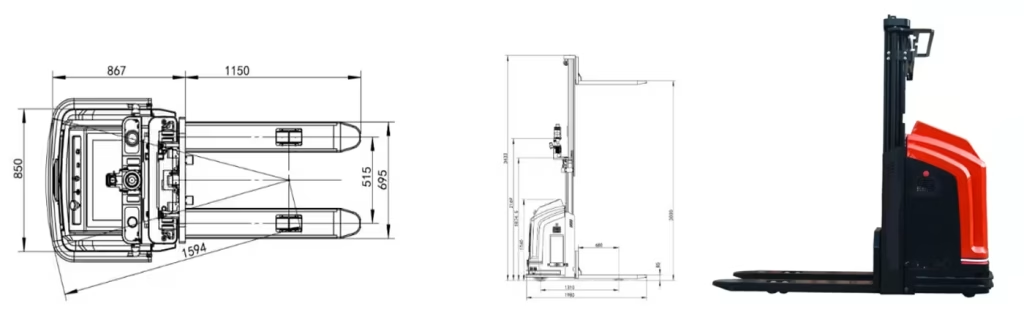
| CharacteZristics | ||
| Power unit | Electric | |
| Operation | AGV | |
| Rated traction weight | Ω (kg) | 1500 |
| Load centre | c (mm) | 600 |
| Axle centre to fork face | x (mm) | 678 |
| Wheel base | y (mm) | 1310 |
| Service weight with battery | kg | 1105 |
| Wheels/Tyres | ||
| Wheels type | PU | |
| Driving wheel size | Ø*w(mm) | Ø250*75 |
| Bearing wheel size | Ø*w(mm) | Ø80*70 |
| Additional wheels (dimensions) | Ø*w(mm) | Ø115*55 |
| Wheels, number front/rear (x = driven) | 1, 4/2 | |
| Track width | b10 (mm) | 580 |
| Track width | b11 (mm) | 515 |
| Dimensions | ||
| Mast/fork carriage tilt, forward/backward | a/b (°) | none |
| Height of mast, lowered | h1 (mm) | 1981 |
| Free lift | h2 (mm) | 80 |
| Lift | h3 (mm) | 3000 |
| Height of mast, extended | h4 (mm) | 3433 |
| Overall height(With handle | h14 (mm) | none |
| Fork Height, Lowered | h13 (mm) | 85 |
| Overall length | I1 (mm) | 1980 |
| Length to fork face | I2 (mm) | 2042 |
| Overall width | b1/ b2 (mm) | 974 (850 ) |
| Fork dimensions | s/e/l (mm) | 60/180/1150 |
| Width of forks | b5 (mm) | 695 |
| Distance Between Suports arms/loading surfaces | b4 (mm) | 0 |
| Reach distance | l4(mm) | 0 |
| Min.Ground clearance | m2 (mm) | 26 |
| Aisle width with pallet 1000 x 1200 across forks | Ast (mm) | 2475 |
| Aisle width with pallet 800 x 1200 along forks | Ast (mm) | 2452 |
| Min.Turning radius | Wa (mm) | 1594 |
| Performance | ||
| Travel speed,laden/unladen | (km/h) | 5.2/5.5 |
| Lifting speed, with/without load | (mm/s) | 90/120 |
| Lowering speed, with/without load | (mm/s) | 120/130 |
| Maximum climbing ability, with/without load | (%) | 5/8 |
| Service brake | Electromagnetic | |
| Drive | ||
| Drive motor, 60 minute rating | (kW) | 1.5 |
| Lift motor rating at S3 15% | (kW) | 3 |
| Battery voltage/rated capacity | (V/Ah) | 240/210Ah |
| Battery weight (±5%) | (kg) | 190 |
| Other | ||
| Type of drive control | AC | |
AGV Forklift Manufacturers
In terms of global market share and rankings, the AGV forklift market is highly competitive yet relatively stable in structure. Major manufacturers include RML Machinery, Toyota Material Handling, Stäubli, Linde Material Handling, Mitsubishi, and others.
Toyota Material Handling: The world’s largest industrial forklift manufacturer, with a rich AGV forklift product line. Leveraging its strong global channels and brand influence, it holds a leading position in North America, Europe, and high-end global markets.
Linde Material Handling: A long-established German forklift giant with a significant share of the high-end market, especially in Europe. Its AGV products are renowned for high reliability and adaptability to complex working conditions.
Dematic (under KION Group): A top-tier international automation systems integrator, holding a substantial share of the high-end logistics integration market in North America and Europe, offering turnkey solutions combining AGVs with warehouse systems.
These manufacturers occupy important positions in the international market due to their deep technical expertise, outstanding product quality, and comprehensive after-sales service systems.
At the same time, market developments have also presented challenges for AGV forklift manufacturers. The pace of technological innovation is accelerating, requiring continuous R&D investment to stay competitive. Market competition is increasingly intense, compelling manufacturers to compete across product quality, pricing, and service to gain market share.
Current Technological Development of AGV Forklifts
–Positioning and navigation: AGV forklift navigation technology is undergoing profound change. Currently, natural navigation represented by laser SLAM and visual SLAM holds over 80% of the market share, while traditional laser reflector-based navigation has shrunk to about 15%.
–Environmental perception: Unmanned forklifts are no longer satisfied with simple obstacle detection. Through combinations of 3-Dimensional vision cameras, safety laser scanners, and AI vision processing units, they are advancing toward higher-level “semantic understanding” and “embodied intelligence.”
–Motion control: Supported by servo motors, drives, integrated electric drive axles, and motion controllers, physical-level motion control has become more precise, more integrated, and more flexible.
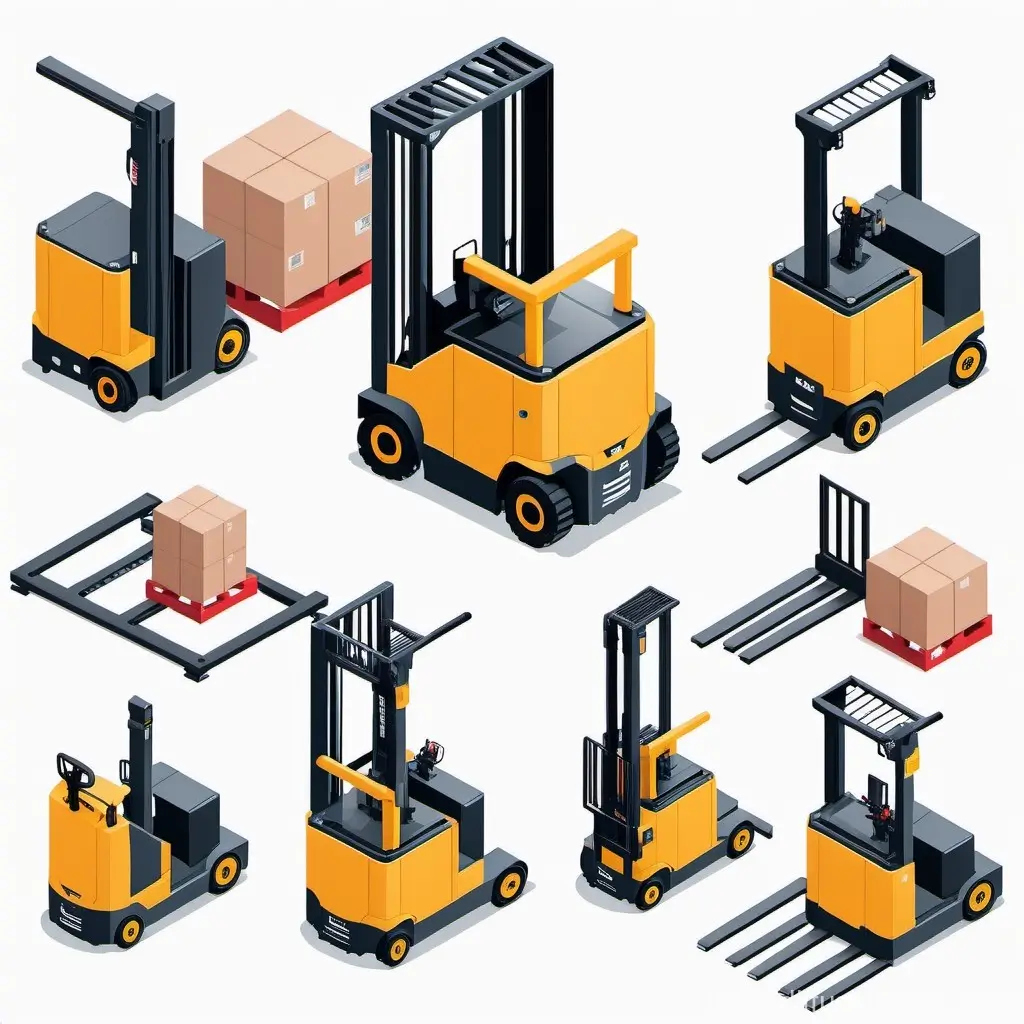
–Scheduling systems: The execution capability of a single AGV forklift is maximized through scheduling systems, which have evolved from simple task assignment tools into platforms integrating fleet management, communication modules, and data interfaces/middleware, enabling multi-brand, multi-device global collaboration.
Development Direction of AGV Forklifts
With the development of new technologies such as AI, AGV forklifts are moving toward greater intelligence and integration.
KION Group, a global material handling giant, announced partnerships with NVIDIA and Accenture to leverage AI technology, integrating smart fixed cameras, unmanned forklifts, and the latest automation and robotics solutions. In the NVIDIA Omniverse platform, highly realistic digital twins are created based on real-time sensor and camera data.
At the 2025 LogiMAT trade show, KION Group demonstrated a new AGV forklift solution. This solution is digitally presented through the NVIDIA Omniverse platform, displaying real-time positioning information of industrial vehicles. Onboard and fixed cameras run on NVIDIA hardware, collecting and processing real-time operational data. The entire solution operates in a continuously evolving simulation environment, preparing for large-scale optimization of vehicle coordination and path planning. Additionally, these vehicles feature application functionalities that support continuous performance enhancement through software upgrades, such as improved personnel recognition and obstacle avoidance capabilities.
This event may mark the beginning of a new phase in the smart logistics industry, moving toward real-time data-driven and AI autonomous decision-making as core elements. In the future, AI is expected to upgrade from a point technology (e.g., visual recognition) to a foundational capability that reconstructs the entire logistics chain, with core value reflected in real-time responsiveness, autonomy, and evolvability.
Applications of AGV Forklifts
–Warehousing and logistics: AGV forklifts are the mainstay of large-scale warehouse logistics handling. Using fork-type handling devices, they can pick up and move palletized goods from one location to another. High-bay unmanned forklifts can be applied to rack storage operations, flexibly moving through warehouses, bypassing obstacles and avoiding collisions, thereby improving safety and reducing the risk of cargo damage. They can also autonomously interface with other equipment in production workshops and storage areas, achieving full automation of production sequencing and warehouse logistics.
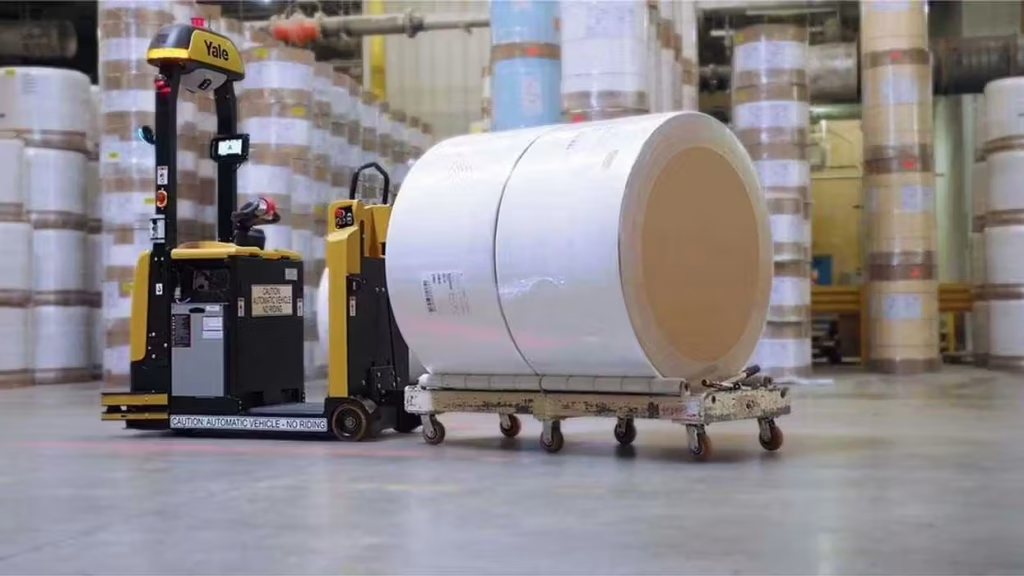
–Manufacturing: AGV forklifts can transport raw materials, components, and finished goods. They can be programmed to follow specific paths, delivering materials to designated locations, improving efficiency and reducing the need for human intervention. In industrial production, they can replace humans in monotonous, frequent, labor-intensive, repetitive tasks or operations in hazardous and harsh environments.
AGV Forklift Market Analysis
According to QYResearch statistics and forecasts, the global AGV forklift market shows a growth trend. In 2024, the market sales reached $4.289 billion, and it is projected to reach $6.535 billion by 2031, with a compound annual growth rate (CAGR) of 6.2% (2025–2031). This data indicates that the AGV forklift market is on an upward trajectory with significant growth potential (data from institutional forecasts, for reference only).
According to data from the CMR Industrial Alliance and the New Strategy Mobile Robotics Industry Research Institute, China’s AGV forklift sales reached 24,500 units in 2024, a year-on-year increase of 25.64%. However, relative to the traditional forklift market, the penetration rate is only 1.91%, exhibiting a typical pattern of “low penetration, high growth.” Over the next 3–5 years, the penetration rate is expected to rise from under 2% to over 10% (penetration rate data from institutional forecasts, for reference only).
Insight from AI Robots Eidos about AGV Forklifts
—The AGV forklift is no longer satisfied with simple obstacle detection, but is advancing towards “semantic understanding” and “embodied intelligence” through 3-Dimensional vision cameras and AI vision processing units. This means that future AGV forklifts will not only be able to “see” the environment but also “understand” the scene—they will know whether there is a loaded pallet ahead or an irregular object temporarily stacked, and will autonomously adjust their action strategies based on this understanding. The forklift will no longer be a cold executor but become an intelligent agent that can actively perceive, reason, and act within the physical world.
—AGV forklifts now have “application functionality, supporting continuous performance enhancement through software upgrades.” This means that the differences between various brands of forklifts in the future will no longer depend on motor power or lifting height, but rather on the speed of software iterations, OTA upgrade capabilities, and the efficiency of AI model evolution. Purchasing an AGV forklift will no longer be about buying a “device,” but rather investing in a “sustainably growing intelligent platform.”
—The upcoming smart factories will no longer require the unified procurement of a single brand of AGV forklifts; instead, they can integrate equipment from different manufacturers, eras, and technological routes through a scheduling platform. Equipment procurement will shift from “closed ecological binding” to “open ecological integration,” which will have profound impacts on the business models of manufacturers.
Image Credits: Ams-fa & Logisticsit & Web & Stablediffusionweb & Dcvelocity & Iqsdirectory & AI