
Table of Contents
Rail Guided Vehicle Tracks are a critical factor affecting the load capacity, running accuracy, and overall stability of a Rail Guided Vehicle (RGV).
Technical Requirements for Rail Guided Vehicle Tracks
–High precision and flatness: This is the most basic and most important requirement. After installation, the straightness and levelness (and parallelism for dual‑rail systems) of Rail Guided Vehicle Tracks must be controlled within millimeter accuracy. Specifically, the horizontal deviation shall be ≤1 mm per meter and ≤2 mm over the full length; the horizontal deviation between corresponding points on two parallel tracks shall be ≤1 mm; and the parallelism deviation between the two tracks shall be < 2 mm. Insufficient precision will cause the RGV to sway during operation, increase wear, and may even lead to positioning failure or derailment.
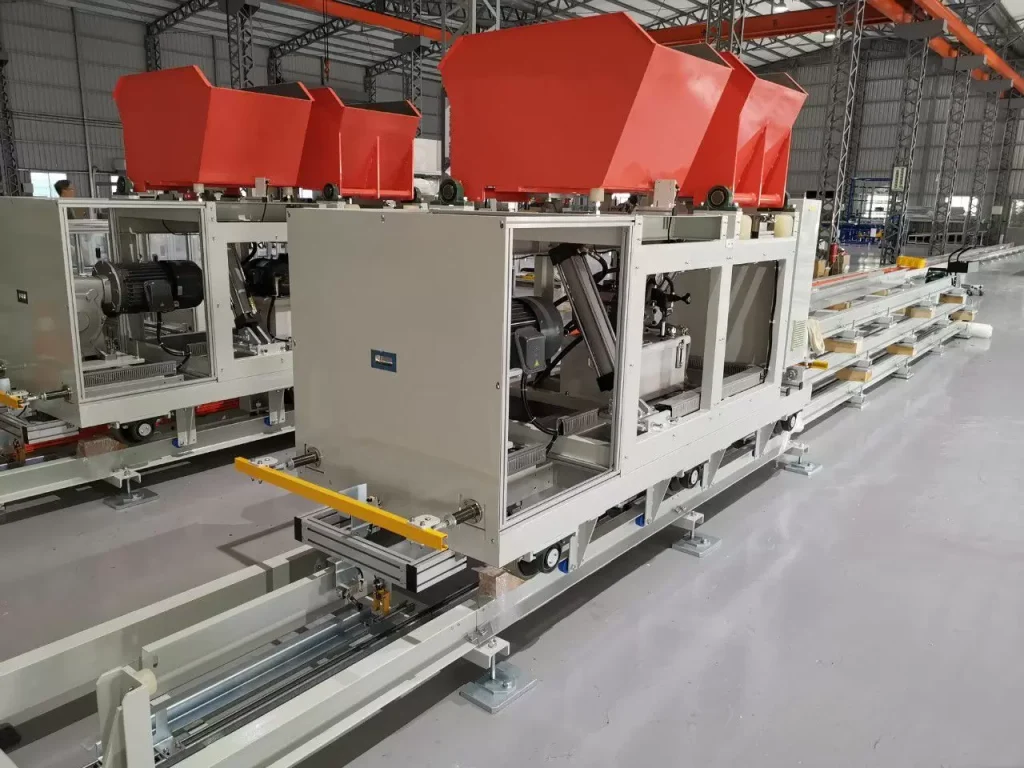
–Reliable guiding mechanism: The track provides an accurate travel path for the RGV. Whether guidance is achieved via wheel flanges (on dual‑rail systems) or side guide rollers (on single‑rail systems), the clearance must be properly maintained. On both inner sides of the track, M8 expansion bolts or powder‑actuated fasteners shall be installed every 500 mm to secure the track firmly to the floor, ensuring that the vehicle does not deviate from the predetermined path during acceleration, deceleration, or high‑speed operation.
–Rigidity and durability: The track must be able to withstand repeated impacts and pressure from the vehicle’s own weight and its payload over the long term, without deformation or settlement. This requires that the track material itself have high strength and wear resistance, and that the foundation be solid and reliable.
Recommended In-depth Reading from AI Robots Eidos
The main topic of this article is Rail Guided Vehicle Tracks. For a systematic understanding of the overall architecture, hardware components, and typical application scenarios of Rail Guided Vehicles, you are welcome to read this article: Rail Guided Vehicle.
Material of Rail Guided Vehicle Tracks
The material of the Rail Guided Vehicle Tracks is the key factor determining the load capacity of the RGV. Different materials are suited to different load scenarios.
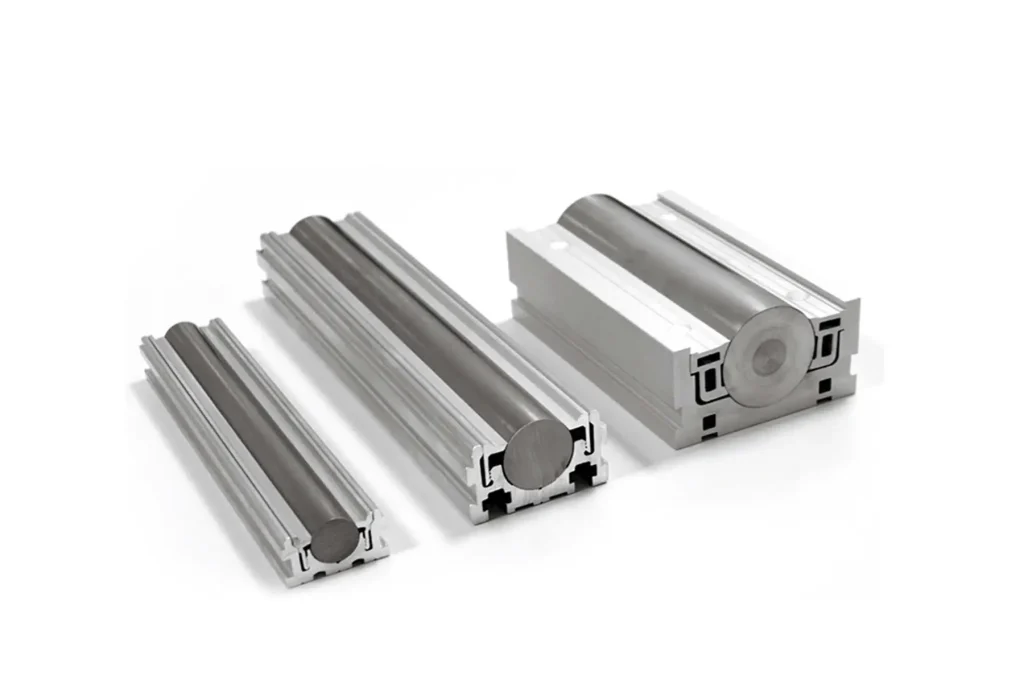
| Material | Characteristics | Load Capacity | Suitable Fields / Scenarios |
| Steel | High strength and hardness | Can withstand several tons | Heavy industry, e.g., stamping workshops in automobile manufacturing (handling large stamping dies) |
| Aluminum alloy | Lightweight | Within several tens of kilograms | Light-load scenarios, e.g., electronic component production workshops (handling small electronic component boards) |
Classification of Rail Guided Vehicle Tracks
Rail Guided Vehicle Tracks can be classified by the number of rails into Single‑rail RGV and Dual‑rail RGV systems.
| Dimension | Single-rail RGV | Dual-rail RGV |
| Track structure | Typically uses a single rail, with a relatively simple structure. | Uses two parallel rails, providing a more stable structure. |
| Movement mode | Commonly found in loop‑type rail systems, enabling one‑way continuous cyclic transport. | Commonly found in linear reciprocating systems, moving back and forth on fixed tracks; also includes transfer shuttles that can autonomously switch tracks. |
| Operational efficiency | High. The loop design allows multiple vehicles to operate simultaneously, with cyclic operations and high throughput. | Depends on the mode. The linear reciprocating type has relatively lower efficiency (usually single‑vehicle operation); the transfer type achieves higher efficiency through flexible path planning. |
| System complexity and cost | The track (e.g., aluminium alloy track) and control system are relatively complex, with higher initial investment typically. | The linear reciprocating type has a simple structure, uses steel rails, and has lower cost; the transfer type incurs higher complexity and cost due to the addition of steering mechanisms. |
| Space utilisation | High. The loop layout can closely connect multiple workstations, suitable for space‑limited floor layouts. | Flexible. The linear type is highly adaptable to aisle layouts; the transfer type can cover a wider warehouse area, improving space utilisation. |
| Load capacity | Around several hundred kilograms, suitable for light or medium‑weight materials. | The dual‑rail load capacity can reach several tons with better stability, suitable for heavy materials. |
| Flexibility/scalability | Fixed path; expansion or modification requires track alterations, resulting in lower flexibility. | Transfer shuttles can flexibly change paths via program control, offering superior flexibility and scalability. |
Rail Guided Vehicle Tracks can also be classified by movement mode into loop‑type (circular) and linear reciprocating systems.
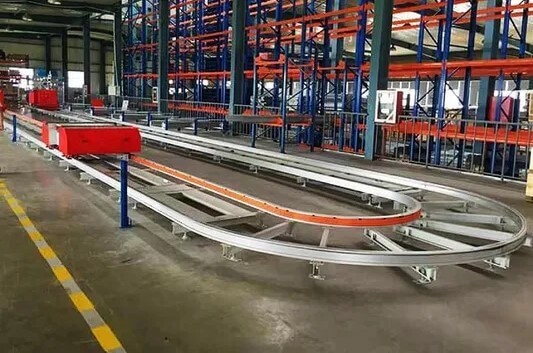
| Type | Features |
| Loop‑type (circular track) | Multiple vehicles operate in parallel; high efficiency; high cost; simple system; small footprint; reliability depends on each vehicle. |
| Linear‑type (straight track) | Single vehicle reciprocates; low cost; relatively low efficiency; steel rail track; can be used independently or as peripheral equipment for automated warehouses / ASRS. |
Design Principles of Rail Guided Vehicle Tracks
—Circumferential monorail designs are suitable for scenarios with high-frequency reciprocation, multi-platform coordination, and compact spaces to achieve multi-vehicle collaboration and continuous cycles. In contrast, linear dual-track designs are appropriate for long-distance, heavy-load scenarios with relatively fixed routes.
—For heavy-load scenarios (such as over 5000kg), dual-track or reinforced track designs are employed to ensure operational stability and positioning accuracy (±5mm). Light or medium-load scenarios (around 1000kg) typically use a monorail design.
—Design considerations should include reserved space for future business expansion or layout adjustments. The design of switch tracks must strategically plan the locations of switches to achieve flexible path switching, enhancing the system’s adaptability to complex storage areas.
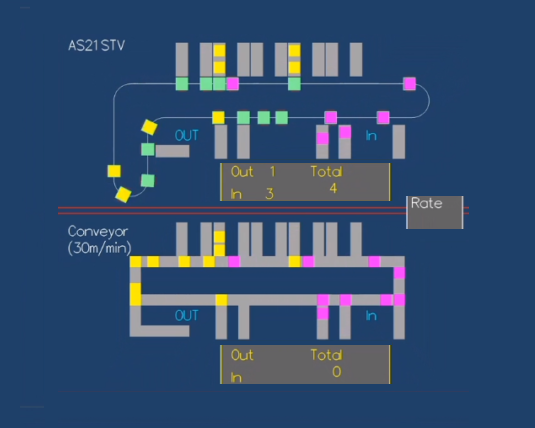
—When designing rail guided vehicle tracks, safety distances must be considered. The switch area should incorporate reasonable locking distances and conflict distances, in conjunction with safety doors, emergency stop buttons, and other safety interlocks to prevent collisions during multi-vehicle operations.
—The track design should also consider the convenience of on-site construction (such as track leveling requirements) as well as the ease of future track maintenance (e.g., reserved maintenance sections and buffering areas).
—Monorail tracks are generally made of aluminum alloy, which has a relatively low initial investment but limited load capacity. Dual tracks are typically made of steel, requiring a higher initial investment while providing greater load-bearing capacity. Therefore, a comprehensive assessment of costs and return on investment should be made during the design process.
Application Scenarios for Rail Guided Vehicle Tracks
In this article, Ai Robots Eidos outlines the common application scenarios for single‑rail and dual‑rail RGV systems.
Application scenarios for Single‑rail RGVs
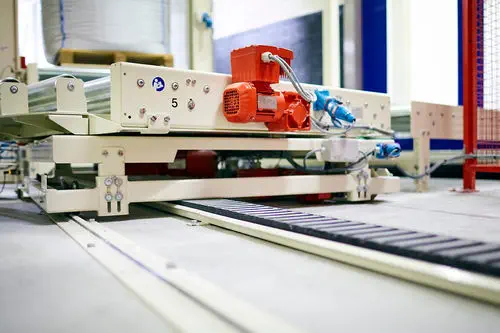
If a warehouse or workshop has a compact layout and needs one transport line to serve multiple pickup and drop‑off stations while handling medium‑weight goods (reference load capacity around 1000 kg); or if you require extremely high inbound/outbound efficiency—for example, in production line material feeding, e‑commerce sorting centers, and other scenarios that demand high‑rhythm cyclic operations—then a single‑rail RGV is the more suitable choice. Its loop layout and multi‑vehicle coordination capability make it ideal for handling material transport tasks requiring sequencing and serving many transfer stations at a processing capacity of 100‑200 cycles per hour.
Application scenarios for Dual‑rail RGVs
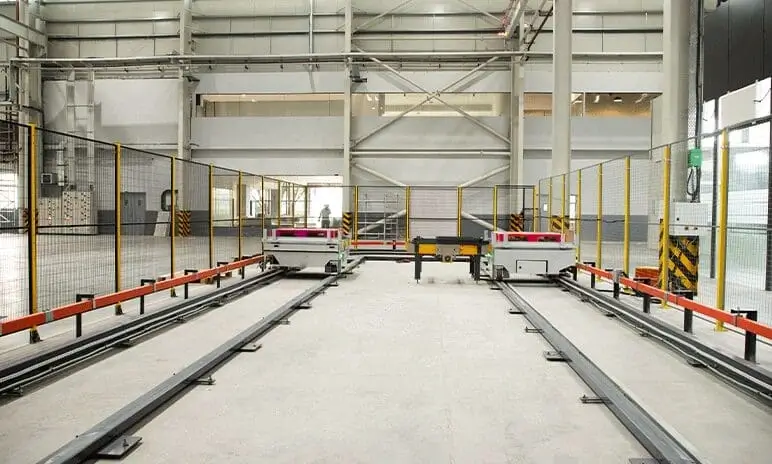
Dual‑rail RGVs are suitable for scenarios involving heavy material handling (e.g., load requirements up to 5000 kg), with high demands on running stability and positioning accuracy (±5 mm), and where the transport route is relatively fixed without frequent lane changes. They are also well‑suited for traditional linear aisle layouts in warehouses where long‑distance transport is needed. A dual‑rail RGV is a more reliable choice. Its high speed (up to 200 m/min) and strong acceleration (0.4 m/s²) can significantly improve logistics efficiency.
Insight from AI Robots Eidos about Rail Guided Vehicle Tracks
—Traditional rail guided vehicle tracks are viewed as passive infrastructure, serving merely to support and guide. In the future, rail guided vehicle tracks will integrate embedded sensors, stress-monitoring units, and wireless communication modules, becoming the “perception nerve” of the entire logistics system. The tracks themselves will be capable of monitoring real-time deviations in linearity, horizontal settlement, localized stress changes, and wear levels, with data uploaded to a cloud-based operation and maintenance platform. This signifies that tracks will no longer be passive components that are “repaired when broken” but rather intelligent assets with self-health-sensing capabilities.
—Currently, rail guided vehicle tracks are primarily composed of two materials: steel (for heavy loads) and aluminum alloy (for light loads). In the future, this pattern will be disrupted by carbon fiber composites, high-performance engineering plastics, and gradient functional materials. Carbon fiber composites feature strength-to-weight ratios that far exceed those of steel, significantly reducing the weight of the tracks while maintaining several tons of load-bearing capacity. This implies that a single‑rail RGV can achieve load capacities close to those of a double-rail, while still retaining the efficiency advantages of its circular layout. Additionally, the track sections will be lighter in weight, drastically shortening installation and modification timelines, thereby truly realizing “flexible tracks.”
—Currently, rail guided vehicle tracks are mostly customized for specific projects, resulting in incompatibility between track systems from different manufacturers and projects. In the future, there will be a push toward the standardization and platformization of RGV tracks—similar to the unified gauge standards of railways—creating industry specifications for dimensions, interface standards, and communication protocols. This means that RGVs from different brands can operate on the same track system, allowing for the reuse of track infrastructure and reducing repetitive investment in projects.
Image Credits: Siempelkamp & Chainwe & Asrs-systems & Rfidhy & Addverb & Cgtrader & Directindustry