
Table of Contents
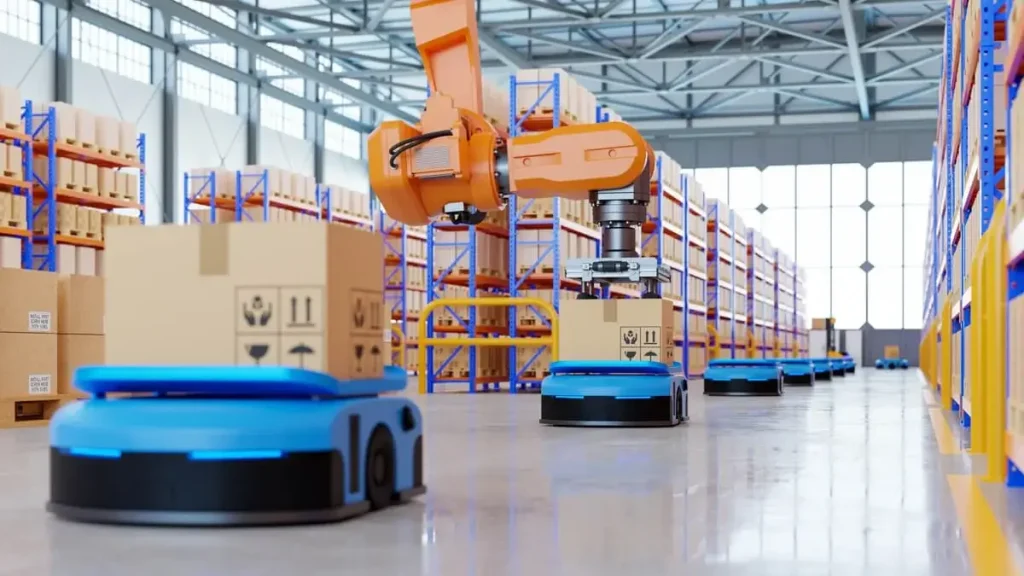
Autonomous mobile robots for warehouse automation are widely used in warehouse automation scenarios. Equipped with high-precision navigation and perception systems, they can operate autonomously in warehouse environments, greatly improving material handling efficiency.
What Are Autonomous Mobile Robots For Warehouse Automation?
Autonomous Mobile Robots are a new generation of mobile robot systems that integrate environmental perception, dynamic decision-making, behavioral control, and autonomous execution. They possess capabilities such as intelligent perception (achieved through LiDAR, cameras, ultrasonic devices, etc.), autonomous path planning (using technologies like SLAM (AI Robots Eidos Note: SLAM refers to Simultaneous Localization and Mapping, a key technology in robotics and autonomous systems that enables robots to simultaneously perform self-localization and map their environment in unknown settings.)), flexible obstacle avoidance, and safe human-robot collaboration. This allows AMRs to be flexibly applied in warehouse environments to complete tasks such as cargo handling and transportation, achieving smarter, safer, more flexible, and more efficient warehouse management.
Recommended In-depth Reading from AI Robots Eidos
The Autonomous Mobile Robot (AMR) achieves autonomous navigation, dynamic obstacle avoidance, and path planning through sensor fusion, SLAM technology, and AI algorithms. Understanding these technological principles allows for a clear insight into how AMRs can perceive, make decisions, and move in real time within complex warehouse environments, helping enterprises optimize warehouse operations and enhance competitiveness.
Interested readers are encouraged to read this detailed article introducing Autonomous Mobile Robots.
Advantages of Autonomous Mobile Robots For Warehouse Automation
–High efficiency: Because autonomous mobile robots for warehouse automation can effectively execute a large number of repetitive tasks in warehouses, in terms of human-robot collaboration and efficiency improvement, AMRs automatically transport goods to the picker. This greatly reduces the walking distance for pickers, allowing them to focus on more value-added tasks such as cargo verification and packaging. Picking efficiency can be increased by 2–3 times, and walking distance can be reduced by more than 50%. This accelerates order processing time and improves business process speed.
–Accuracy: The system of autonomous mobile robots for warehouse automation can be deeply integrated with the WMS to collect real-time data. Managers can clearly understand the performance of each process — for example, identifying which products are “hot sellers” that need to be stored in accessible locations — thereby continuously optimizing warehouse layout and utilization. Moreover, AMRs use advanced sensors connected to AI-driven navigation systems and machine learning capabilities, enabling them to perform tasks with high precision. The high accuracy of AMRs helps managers better handle inventory, thereby reducing return rates and increasing customer satisfaction.
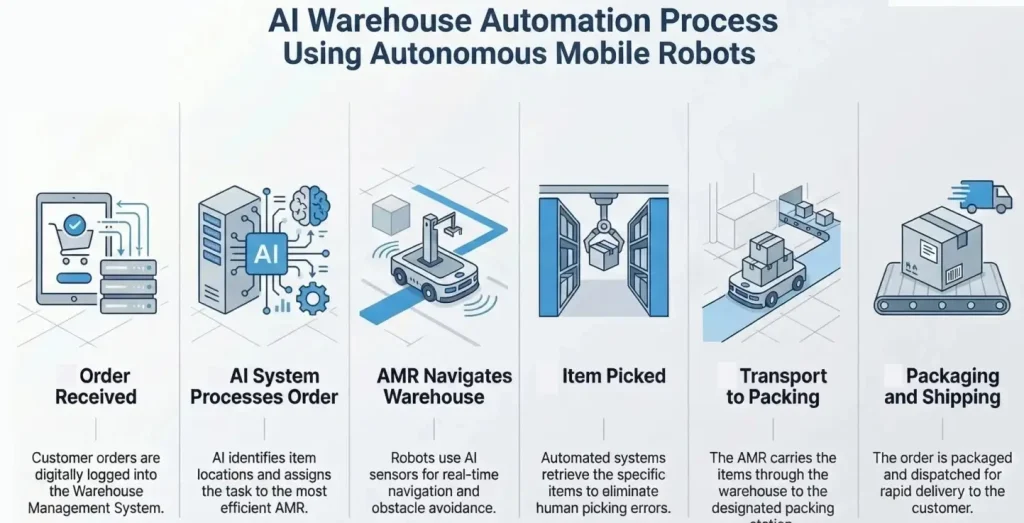
–Scalability and flexibility: AMRs can be deployed flexibly and launched quickly. An AMR solution can typically be deployed within a few weeks and can be modularly expanded as the business grows, without major construction work. Furthermore, autonomous mobile robots for warehouse automation are not constrained by planned paths; they can be quickly put into use in different warehouse environments without the need for path planning. This is particularly meaningful for e-commerce warehouse operations with significant seasonal fluctuations.
At the same time, the Robots-as-a-Service (RaaS) model allows enterprises to use robots by paying a monthly service fee, significantly reducing initial capital pressure and greatly shortening the investment payback period to about one year. This effectively lowers upfront investment and shortens the return cycle.
The scalability and flexibility of autonomous mobile robots for warehouse automation provide a solution for agile manufacturing in enterprises.
Challenges Faced by Autonomous Mobile Robots For Warehouse Automation
Although autonomous mobile robots for warehouse automation bring a range of advantages, at the current stage, due to technical and other reasons, AMRs still face some challenges. When advancing smart warehousing and introducing autonomous mobile robots for warehouse automation — especially when purchasing in large quantities — enterprises need to comprehensively consider the various pros and cons of AMRs.
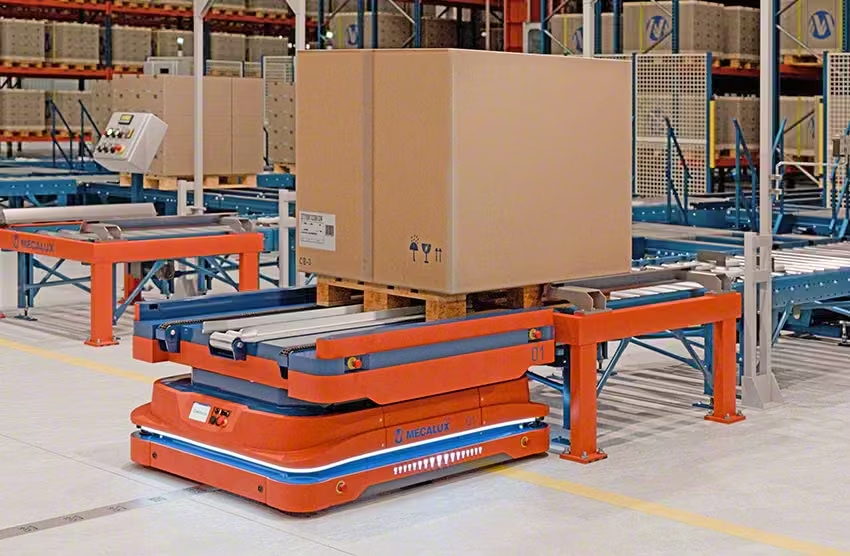
–Load capacity Limitations: Most autonomous mobile robots (AMRs) have limited capacity for handling heavy loads, with a maximum handling weight of 1.2 tons. Therefore, AMRs cannot effectively handle heavy-duty tasks. Traditional forklifts have a higher load capacity than AMRs; they can efficiently transport goods from 1 to 31 tons. Given the significant gap in load capacity between AMRs and traditional forklifts, when dealing with heavy cargo, warehouses need to select tasks suitable for AMRs while retaining a corresponding number of traditional forklifts to effectively complement the AMRs and complete various tasks.
–Speed And Charging Limitations
Speed: To meet safety and accuracy requirements, most autonomous mobile robots for warehouse automation typically travel at speeds around 7 km/h. The current speed level of AMRs can meet standard indoor transport needs but limits peak operation handling.
Charging: Depending on the AMR model and battery specifications, charging time ranges from two to three hours. Without proper planning and scheduling of charging processes and infrastructure, AMR downtime can occur, leading to interrupted task flows, reduced operational efficiency, and potential losses for the enterprise.
–Safety: Even with safety precautions taken during manufacturing, improper use or overloading can still pose risks. For example, when transporting goods exceeding the rated weight, the greater inertia due to overload during emergency stops requires a longer braking distance to bring the vehicle to a halt, thereby exposing the AMR to potential safety risks. To mitigate such risks, regular maintenance inspections of autonomous mobile robots for warehouse automation, training on AMR operation, and strict adherence to safety protocols are necessary.
Preparations before Using Autonomous Mobile Robots For Warehouse Automation
Factories need to make certain preparations before introducing Autonomous Mobile Robots
–Demand Analysis: Review the current issues in warehouse management at the factory, including handling frequency, types of goods, handling distance, and business processes, to identify specific problems that AMRs can address, such as optimizing existing location management and replenishment logic, and maximizing AMR efficiency.
–Site and Environmental Assessment: Measure the widths of main passages and turning points to ensure they meet AMR traffic requirements and avoid collisions. Assess environmental conditions such as temperature, humidity, and lighting to determine whether they fall within the normal operational range for AMRs, and implement protective measures if necessary.
— Equipment integration: Ensure that AMRs can seamlessly integrate with your existing WMS, ERP, and other systems, because unobstructed data flow is the foundation of intelligent scheduling.
–Training: Employees will be new “coworkers” with AMRs; they need to be provided with the necessary training to smoothly transition to the new human-robot collaboration model.
–Pilot Operation and Validation: Before full-scale deployment, select 1-2 production lines or areas for pilot operation to validate the performance, adaptability, and actual effects of AMRs, and adjust the plan based on the pilot results.
Technical Parameters of Autonomous Mobile Robots For Warehouse Automation (For Readers’ Reference Only)
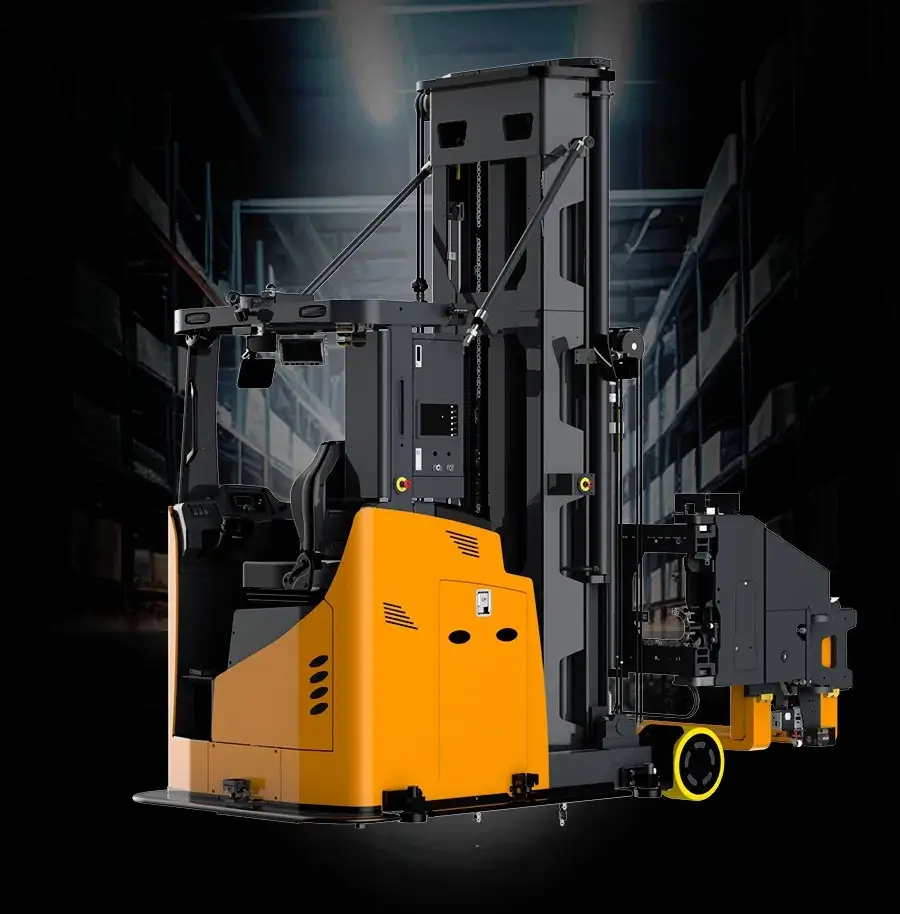
| Type | Unit | Parameter |
| Product Name | / | AMR |
| Rated Load | kg | 1600 |
| Rated Load Center Distance | mm | 600 |
| Overall Dimensions | mm | 3455/1570/3445 |
| Lifting Height | mm | 8500 |
| Navigation Method | / | 3D Laser SLAM Navigation / Laser Reflector Navigation |
| Drive Mode | / | Steer Wheel Drive |
| Travel Speed (Laden/Unladen) | m/s | 1.5/1.5 |
| Navigation Accuracy | mm | 卤10 |
| Max Climbing Ability (Laden/Unladen) | % | 5and5 |
| Aisle Width (Pallet) | mm | 3480 |
| Battery Type | / | Lithium Battery |
| Battery Voltage / Capacity | V/Ah | 48/460 |
| Charging Method | / | Automatic Online / Manual Charging |
| Endurance | h | 6~8 |
| Safety Protection | / | Audible/Visual Alarm / 3 Laser Obstacle Avoidance / Infrared Double Detection for Pallet Positioning / Mechanical Contact Bumper / Emergency Stop Button |
Application Examples of Autonomous Mobile Robots For Warehouse Automation
Because autonomous mobile robots for warehouse automation have succeeded in advancing warehouse and logistics operations, this has effectively promoted the use of AMRs by major companies.
Amazon
Amazon owns more than 750,000 AMRs, mainly including three models: Robin, Sparrow, and Proteus. Robin and Sparrow are responsible for sorting, identifying, and categorizing items, while Proteus can operate autonomously around facility staff. Autonomous mobile robots for warehouse automation have played a positive role in optimizing Amazon’s costs. Morgan Stanley noted in its analysis of Amazon’s newly opened fulfillment center in Shreveport, Louisiana, that the center’s fulfillment costs during peak operations are expected to be reduced by 25%. If Amazon can fulfill 40% of its U.S. orders through such centers by 2030, the total annual cost savings will exceed $10 billion. If the fulfillment rate stands at 30%, the savings will range between $4.5 billion and $9 billion.
John Lewis
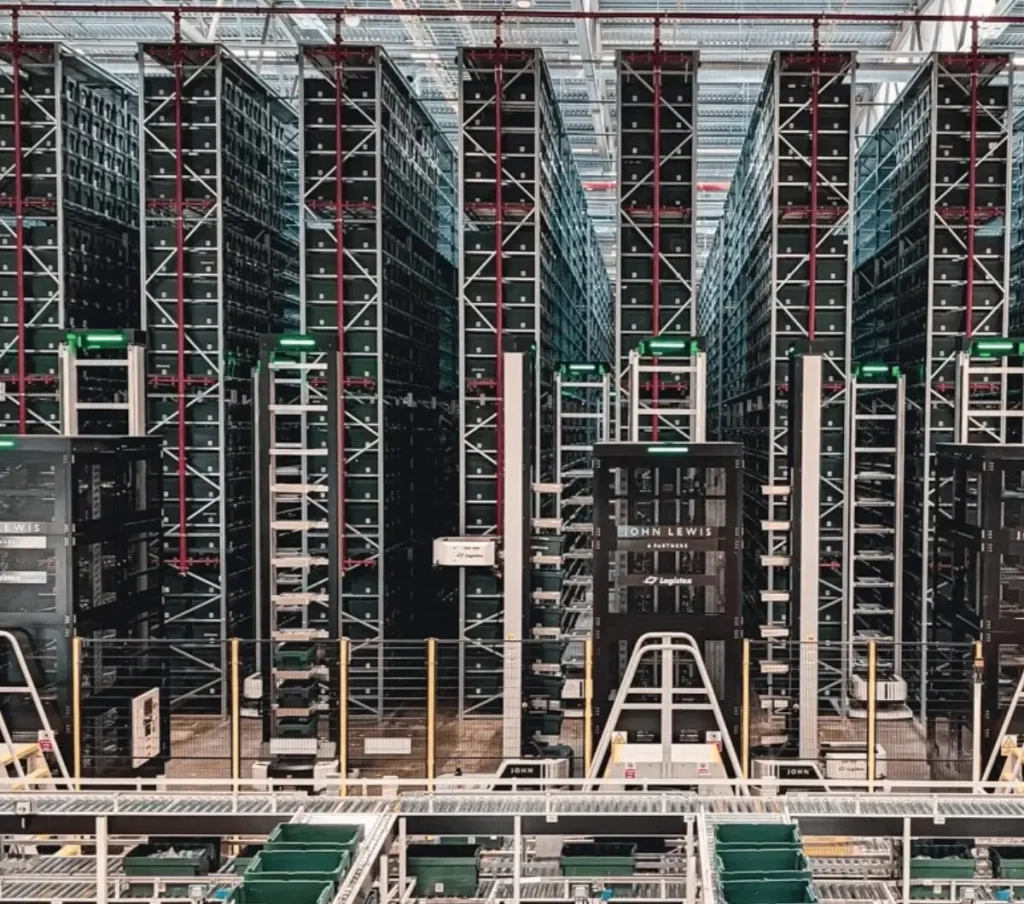
In retail chains, autonomous mobile robots for warehouse automation have also demonstrated their value. The Times reported on November 27, 2024, that John Lewis partnered with Hai Robotics to install 60 autonomous mobile robots reaching a height of 10 meters at its Milton Keynes sorting center (additional information from AI Robots Eidos: the robot model used is HaiPick A42T). This strategy helped John Lewis save £1 million in operating costs and increased usable warehouse space by 75%. During the Christmas season, this system facilitated rapid packaging and fast delivery of approximately 17 million products, improving John Lewis’s order accuracy and speeding up delivery times.
DHL
DHL has partnered with multiple robotics suppliers, such as Locus Robotics, to optimize warehouse processes and implement intelligent upgrades by introducing autonomous mobile robots. For example, in warehouse picking, DHL uses AMRs to implement “goods-to-person” picking, reducing walking distances for workers and improving picking efficiency and accuracy, especially in logistics centers with high SKU volumes.
Future Development Directions of Autonomous Mobile Robots For Warehouse Automation
–Intelligence: Integrating autonomous mobile robots for warehouse automation with AI and big data technologies enables intelligent forecasting and scheduling: analyzing historical order data to predict future peak loads and allocate resources in advance; integration with AI vision navigation, digital twins, and other technologies will give AMRs autonomous perception and decision-making capabilities to effectively handle unexpected situations in complex warehouse environments; using machine learning to optimize path planning, reducing wasted travel and lowering energy costs.
–Systematization: autonomous mobile robots for warehouse automation can be linked with automated warehouses, automatic sorters, and other equipment to build a fully automated intelligent warehousing system; they can also interface with upstream and downstream supply chain systems such as WMS and TMS (Transportation Management System) to achieve end-to-end data connectivity across the supply chain, extending enterprise optimization from “warehouse optimization” to “global supply chain optimization.”
–Lightweighting: Lightweight autonomous mobile robots for warehouse automation can accelerate, turn, and brake more easily, allowing them to maneuver more flexibly in narrow aisles and dense racking, adapt to complex warehouse layouts and dynamic environments, respond quickly to task changes, and improve operational efficiency.
Insight from AI Robots Eidos about Autonomous Mobile Robots For Warehouse Automation
—The future of AMR (Autonomous Mobile Robots) will no longer involve passively executing commands; instead, it will proactively initiate tasks based on real-time data analysis. For example, AMR will utilize machine learning to predict orders for the next 1 to 2 hours and pre-transport high-frequency items to temporary storage locations near the picking area. It may even automatically suggest adjustments to the warehouse layout to the WMS (Warehouse Management System) based on inventory turnover rates. This means that AMR will evolve from being an “executive tool” to a “warehouse intelligent agent,” achieving a truly data-driven warehouse operation.
—In the future, edge computing combined with swarm intelligence algorithms will be introduced. Each AMR will possess lightweight decision-making capabilities, and robots will negotiate in real time through short-distance communication to manage issues such as intersection passage, path avoidance, and charging queues. Even if the central server goes offline, the cluster will continue to operate stably. This decentralized architecture will significantly enhance system robustness, making it particularly suitable for large and dynamically changing warehouse environments.
—The future billing model for warehouse AMR will be based on the actual number of transport tasks completed and the number of order lines processed. Suppliers will bear the risks of inadequate equipment operating efficiency, compelling them to continuously optimize algorithms and provide more proactive maintenance services. For user companies, this model enables “zero fixed costs and fully variable costs,” making it especially suitable for businesses with significant seasonal fluctuations.
Image Credits: Renovotec & Hairobotics & Industrialroboticsmagazine & Mecalux & Web