
Table of Contents
Represented by GaN technology (Gallium Nitride technology), the third-generation semiconductor is replacing traditional silicon-based devices in robotics. Particularly in key areas of humanoid robotics, such as joint actuation, module integration, and overall energy consumption control, GaN technology is demonstrating a critical role in robotic joint drives.
What is GaN Technology?
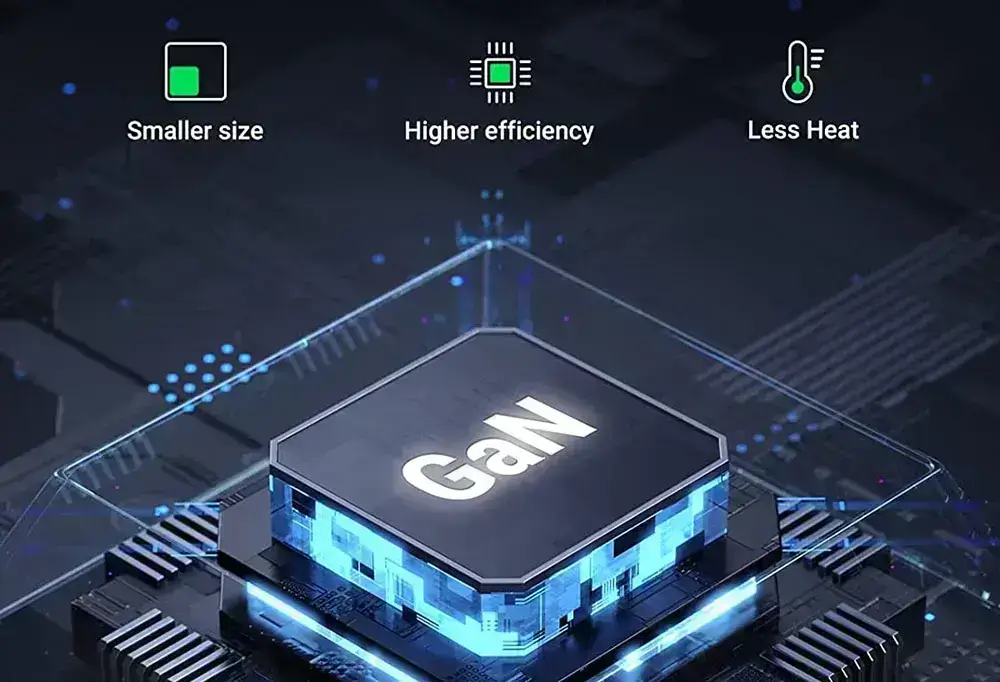
Gallium Nitride can be viewed as a new type of semiconductor material composed of Gallium and Nitrogen. Compared to first-generation silicon and second-generation gallium arsenide semiconductors, GaN has higher electron mobility and a wider bandgap, giving it significant advantages in power consumption, speed, and efficiency.
GaN technology is an advanced electronic technology based on Gallium Nitride (GaN) semiconductor material, which is driving the electronics industry towards higher efficiency, higher frequencies, and miniaturization.
Why is GaN Technology Being Used in Robotics?
GaN is being adopted in robotics because, as robot technology advances, traditional silicon-based MOSFETs face increasing limitations.
| Power Supply: The robot’s power architecture is primarily based on a 48V bus and is rapidly upgrading towards 72V. This covers five core modules: battery charging/storage, management, power conversion, joint actuation, and smart charging. The extreme demands for high power density, lightweight design, low energy consumption, and high safety make traditional silicon-based power semiconductors completely unable to adapt to the new architectural requirements.
| Joints: To achieve human-like flexible movement, the diameter of standard humanoid robot joints needs to be controlled within 100mm, and fine joints within 50mm. While the traditional silicon-based MOSFET solution is low-cost, its biggest bottleneck when facing the increasingly complex internal structure of humanoid robots lies in size and wiring. Humanoid robot joints typically use a hollow design to allow wiring harnesses for power, communication, and sensors to pass through. However, as the number of sensors increases, the “congestion” problem inside the joint becomes increasingly severe.
| Thermal Management: The cramped space inside the joint also results in a compact, sealed joint cavity with no extra room for independent cooling components. However, the dense motor layout required for high degrees of freedom causes a sharp increase in heat flux density during high-load operation. This can easily lead to problems like permanent magnet demagnetization, component aging, and precision drift, directly limiting the robot’s continuous operation capability.
Note: A silicon-based MOSFET (Metal-Oxide-Semiconductor Field-Effect Transistor) is a voltage-controlled semiconductor device based on silicon material, widely used in modern electronic circuits. Its core structure consists of a metal (or polysilicon) gate, an oxide insulating layer (usually silicon dioxide), and a silicon semiconductor substrate. It precisely controls the current between the drain and source by using the electric field effect generated by the gate voltage to control the formation and conduction level of the conductive channel on the semiconductor surface.
To avoid misleading readers, it’s important to point out that GaN technology primarily addresses the physical limitations of traditional silicon in medium/low voltage and high-frequency scenarios. In other areas, silicon continues to evolve and holds a price advantage.
GaN technology is typically suitable for medium-to-low power, medium voltage scenarios, with a common application voltage range of 100V to 650V. It is well-suited for data centers and robotics.
SiC is more suitable for high-power, high-voltage applications, with a voltage range typically above 600V. Its applications include traction inverters for electric vehicles, wind power generation, and railway traction systems.
Types of GaN Used in Robotics
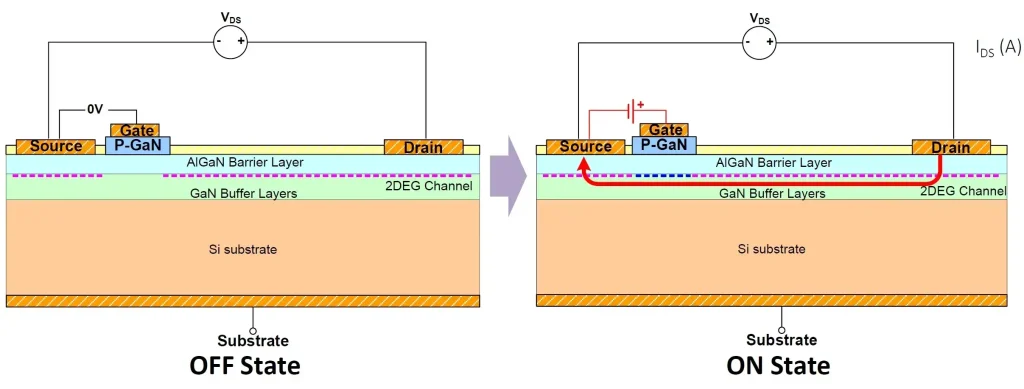
| Enhancement-mode GaN HEMT (eGaN / e-mode GaN): This is the most mainstream type of GaN device in robotics, especially humanoid robots. These normally off devices do not conduct when no voltage is applied to the gate, offering high safety. They feature low EMI, no reverse recovery loss, positive temperature coefficient, easy paralleling, and are suitable for high-frequency, high-precision control scenarios like robotic joint drives and sensor interfaces.
| Integrated GaN Power Stage IC: This integrates GaN power switches, gate drivers, protection circuits, and other functions into a single chip. It offers small size, low parasitic parameters, and supports high-frequency, high-power-density designs.
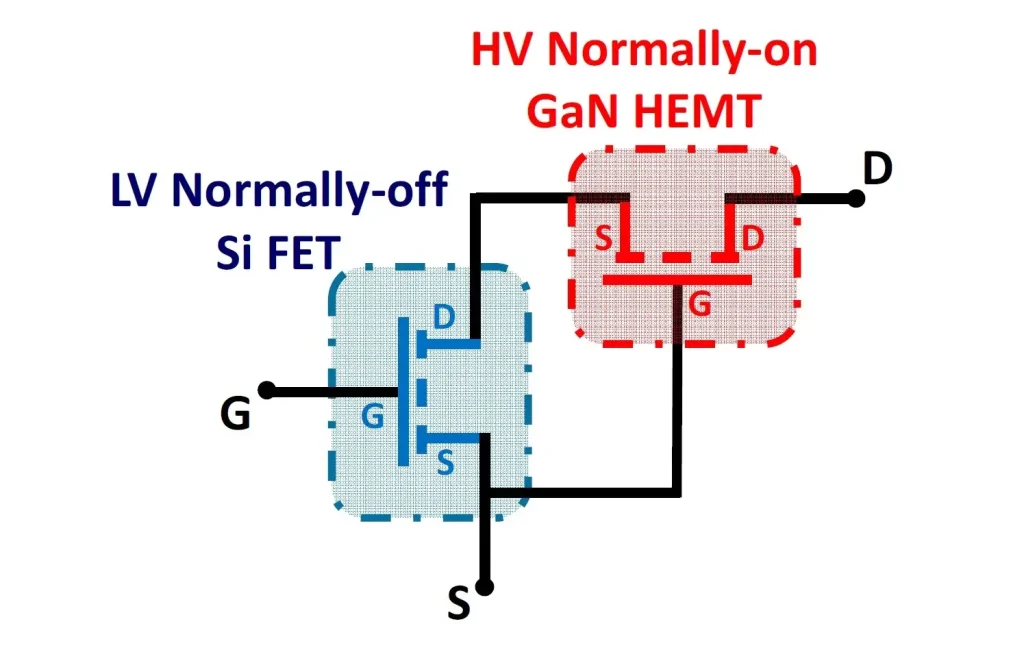
| Cascode GaN: This connects a normally-on (d-mode) GaN HEMT in series with a low-voltage silicon MOSFET. By cascading the low-voltage Si MOSFET, it achieves a normally-off function. It can use traditional Si MOS drive circuits but offers higher switching speed and efficiency than Si MOSFETs.
| High-Speed Pulsed GaN FET: Utilizes GaN’s high-frequency, high-power characteristics to achieve high-speed signal transmission and processing, supporting high-frequency signal handling in robot communication and perception systems (e.g., millimeter-wave radar, LiDAR). The narrower the pulse, the higher the resolution of the robot’s environmental modeling, and the more accurate the obstacle avoidance when moving at high speeds.
Recommended In-depth Reading from AI Robots Eidos
Obstacle avoidance technology is key for robots to achieve autonomous navigation, efficient operation, and safe performance, directly impacting their capability, reliability, and range of applications.
If you are interested in robot obstacle avoidance technology, please read this article on obstacle avoidance.
| Depletion-mode GaN (D-Mode GaN): These are normally-on devices that require external circuits (like cascode or direct drive) to achieve normally-off functionality. The drive circuit is relatively simple, but stability at high frequencies needs attention.
Advantages of GaN Technology in Robotics
| High Frequency Driving Miniaturization: GaN switching frequencies reach 1-10MHz, a 10-50 times improvement over silicon solutions, enabling a reduction in passive component volume by over 70%. For example, GaN devices can reduce the size of a 48V power supply by 30% and compress joint module area by 40%, providing technical support for the miniaturization of fine joints and perfectly adapting to the compact installation requirements of humanoid robot joints.
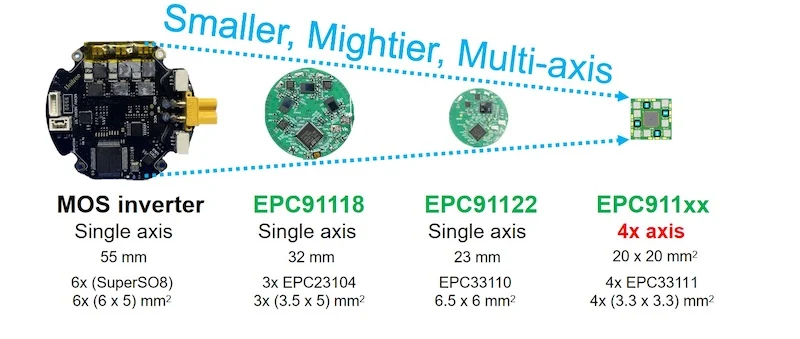
Consider a joint cavity with a diameter of less than 10 cm. With silicon devices, it’s difficult to fully integrate components like the motor driver, sensors, reducer, and power capacitors. Thanks to high integration, GaN solutions can reduce the driver board volume by 20%-40% under the same specifications. A GaN solution can free up about 5mm of physical space compared to traditional solutions. This 5mm is crucial for joint design, allowing for a larger hollow bore diameter for complex wiring harnesses to pass through smoothly, directly solving the wiring challenges of multi-component integration.
| Precision: Beyond spatial advantages, GaN’s high-frequency, low-loss characteristics mitigate jitter in robot motion control. This improves control precision by 60%: traditional MOSFETs typically operate at 20-40kHz, while GaN easily exceeds 100kHz. This results in smoother current control, achieving torque control accuracy of ±0.05N·m. For the end-user, this translates to smoother robot movements, eliminating current ripple at low speeds.
For example, in the action of a finger grasping a glass, the motor needs to accelerate from standstill to 500rpm in 0.1 seconds. The control loop must support PWM frequencies of at least several tens of kHz.
With MOSFETs, such high-frequency operation often requires larger cooling structures. GaN devices, however, can operate stably at 100kHz and even higher frequencies, reducing system losses by over 85% compared to silicon without introducing additional temperature rise.
| Efficiency: As a wide-bandgap semiconductor, GaN has an electron mobility more than double that of silicon and a critical breakdown electric field strength 6-10 times greater. This allows GaN devices to achieve ultra-high operating frequencies and extremely low on-resistance, unattainable with silicon. In robotic applications, this enables a doubling of power density in motor drives and a significant increase in energy conversion efficiency.
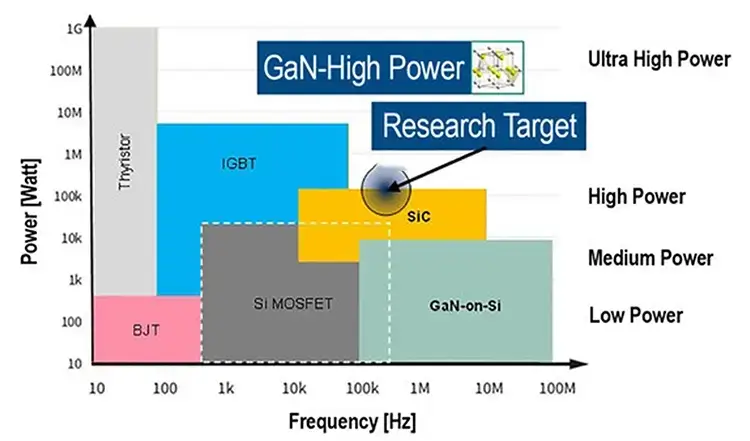
For instance, in medium-to-high power, medium-to-high frequency motor drive scenarios, the switching losses of GaN devices are far lower than silicon devices, allowing the entire motor drive system to achieve efficiencies above 98.5%, significantly higher than the 95%-96% of traditional solutions. These few percentage points of improvement translate to extended robot runtime and significant simplification of the cooling system.
| Thermal Performance: For safety reasons, robot exterior surface temperatures generally need to be kept below 55°C. GaN’s high thermal conductivity enhances heat dissipation capability several times over, allowing it to meet the stringent standard of keeping the entire exterior below 55°C without complex active cooling, balancing performance and reliability. This characteristic provides immense stability for joint modules that need to dissipate heat in enclosed spaces. Furthermore, GaN can adapt to extreme low temperatures down to -50°C, broadening the application boundaries for specialized robots.
Development Trends in GaN Technology
| 8-Inch GaN Wafers: The successful engineering and mass production of 8-inch (200mm) GaN-on-Si wafers significantly increases the number of chips produced per wafer, driving down GaN chip costs. The industry consensus is shifting towards 200mm (8-inch) wafer manufacturing processes. The economies of scale from this shift will lower chip manufacturing costs, promoting wider adoption of GaN-on-Si devices. (Currently, the overall cost of GaN technology solutions—device + design + manufacturing—remains relatively high. However, in humanoid robots, although the per-device cost of GaN is higher, system-level optimizations like reducing heat sinks and optimizing motor design can lower the overall BOM cost, achieving a balance between performance and cost.)
| Integration: High levels of integration, packaging GaN FETs, drivers, and protection circuits into a single module, reduce system design complexity and procurement costs for users. Integrating capabilities across the entire industry chain is becoming a trend. Leading semiconductor companies are no longer focused solely on manufacturing individual GaN FETs; they are committed to integrating GaN FETs with silicon-based drivers, controllers, and advanced packaging technologies.
Applications of GaN Technology in Robotics
| Joints: Joint servo drives are currently the most mature application area for GaN. Robot joints require drivers to output precise current within extremely short timeframes (microseconds) to control motor torque, enabling fast response and smooth motion.

GaN’s high-frequency characteristics significantly increase the bandwidth of the driver’s current control loop, thereby substantially reducing torque ripple and making robot movements smoother and more precise. This benefits everything from high-speed picking in industrial robots to balance and walking in humanoid robots.
| Power Supplies: The core power system is another major area of application. The central processing units, sensors, and communication modules inside a robot require stable power at different voltage levels. GaN devices can be used to build more efficient, smaller multi-channel digital power supplies, providing clean, efficient energy to the robot’s “brain” and “nerves,” thereby enhancing the overall operational reliability of the machine.
Factors Restricting GaN Application in Robotics
| Long-Term Reliability: This is a primary concern for industrial and consumer markets. Progress is being made:
Innoscience’s GaN devices, in an ultra-small 5.8mm × 7.2mm package, can continuously output an average current of 33.13A even with a chip surface temperature of 226.13°C. They withstand 48-hour burn-in tests without damage, demonstrating outstanding resilience to current change rates (di/dt).
Texas Instruments conducts over 80 million hours of reliability testing to ensure the long-term stability of its GaN devices in complex environments.
It must be noted that the operating conditions for robotic joint motors are complex, with frequent starts/stops and overloads being common. The long-term lifespan data and failure rate statistics for GaN technology under such harsh conditions still require more time and application cases to accumulate and validate.
| High System Design Complexity: GaN’s high-frequency characteristic is a double-edged sword. While enhancing performance, it imposes stringent requirements on parasitic parameter control in circuit boards, electromagnetic compatibility (EMC) design, and thermal management. This demands that system engineers possess new design capabilities.
| Supply Chain Resilience: Although global production capacity is expanding, critical links such as GaN substrate materials and epitaxial growth remain relatively concentrated. Building a diversified, secure, and stable supply chain is a strategic issue that must be addressed before large-scale industry adoption.
GaN Technology Observation:Actions by GaN Manufacturers
Global semiconductor leader Onsemi announced a development agreement with GlobalFoundries. The two companies will collaborate on developing next-generation 650V power devices based on GlobalFoundries’ 8-inch E-mode GaN-on-Si process.
This partnership is more than just a technological alliance; it’s a significant signal for industrial application. The key point of the agreement lies in its target application areas: AI data center power supplies, electric vehicle energy systems, and renewable energy infrastructure. These are currently the markets with the most stringent energy efficiency requirements and the fastest growth. GaN, with its high-speed switching characteristics and low on-resistance, is expected to bring significant system performance improvements to these demanding applications. According to the plan, samples from the collaboration are expected to be available in the first half of 2026.
The Robotics Industry’s Push for GaN Market Growth
According to data from international authorities like IDC and Goldman Sachs, the global shipment of humanoid robots is projected to reach 18,000 units in 2025, a year-on-year increase of 508%. By 2026, this figure is expected to further rise to 51,000 units, representing a year-on-year growth rate of 183.33%.
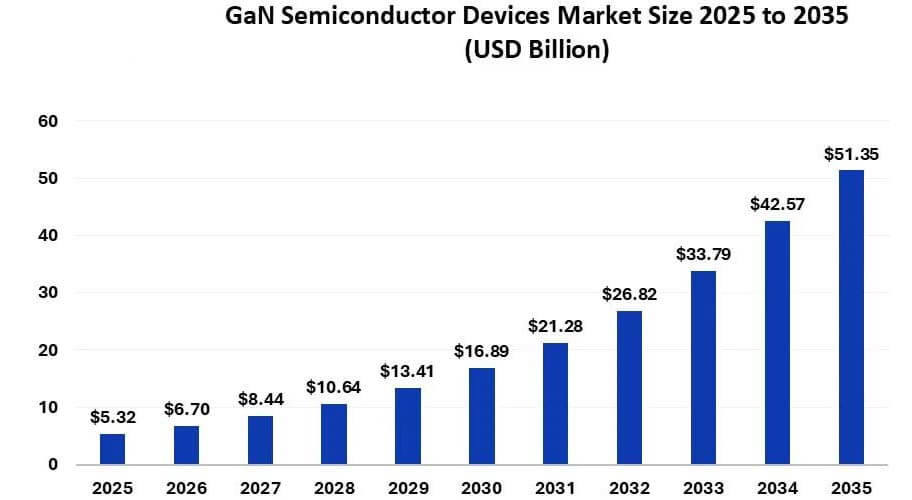
The industrialization of humanoid robots creates a new growth pole for GaN. A single humanoid robot contains approximately 30-40 joints. Small joints may use 3-6 GaN devices, while large joints may require up to 24. The total number of GaN devices per robot is estimated at 300-400 units.
As robot degrees of freedom and power density increase, the number of GaN devices used in a single robot could potentially exceed 1,000. The value of GaN drives in a single humanoid robot has already reached around one thousand US dollars and is expected to continue rising as the number of joints increases.
Insight from AI Robots Eidos about GaN Technology
| GaN is evolving into the ‘motor neurons’ of robots with its high-frequency and high-precision characteristics. It is not only a channel for energy transmission but also a precise executor of motion commands. In the future, GaN technology may directly integrate motion control algorithms, becoming a power device with computational capabilities, allowing joint response speeds to shift from the microsecond level to the nanosecond level.
| In traditional electronics, enclosed spaces imply heat dissipation bottlenecks, which in turn lead to performance compromises. The efficient characteristics and high-temperature resistance of GaN are breaking this iron law. Looking forward, GaN technology will enable robots to operate at full power in vacuum environments (space) and high-pressure environments (deep sea) without the need for complex external cooling systems. This will significantly expand the application boundaries of robots.
| The extreme demands for size, efficiency, and accuracy in humanoid robots are driving GaN technology towards higher integration, greater reliability, and lower costs. The technologies validated today in robotic joints will be applied tomorrow in broader markets such as consumer electronics, industrial drives, and automotive electronics.
Image Credits:Eepower & Epc-co & Powerelectronictips & Precedenceresearch & 9to5mac