
Table of Contents
Outdoor AGVs are transportation devices that can operate autonomously in outdoor environments. They are an important component of automated logistics and a key technology driving industrial upgrading and transformation.
Definition of Outdoor AGV
An Outdoor AGV (Automated Guided Vehicle) refers to an unmanned vehicle capable of autonomous operation in outdoor environments to perform transportation or task execution. By integrating multiple sensors (such as LiDAR, GPS, vision sensors, etc.) and navigation algorithms, it achieves perception and adaptation to complex outdoor environments. It can complete tasks such as material handling, cargo transportation, and inspections under open-air, unstructured, or semi-structured road conditions, following either preset paths or real-time planned routes. Compared with indoor AGVs, outdoor AGVs must contend with harsher natural environments (e.g., temperature, humidity, light, wind, rain), demanding higher equipment reliability, protection ratings, and navigation accuracy. Typical application scenarios include campus material delivery, port and dock cargo handling, power facility inspection, and agricultural operations.
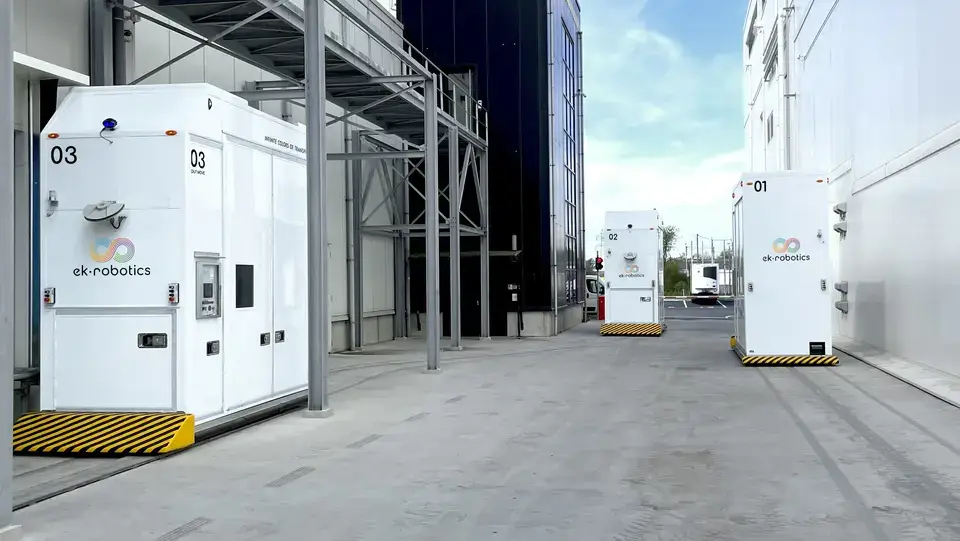
Comparison of Outdoor AGV Navigation Systems
Outdoor AGV navigation systems are the core technology enabling precise positioning, path planning, and dynamic obstacle avoidance. Their accuracy, adaptability, and safety directly determine the application value of AGVs in outdoor scenarios. Therefore, a comparative introduction to outdoor AGV navigation systems is provided here.
| Navigation Method Category | Specific Technology | Advantages | Disadvantages |
| Outdoor Fixed Path Navigation | Magnetic Navigation | AGV positioning is accurate, unaffected by lighting, weather, etc. | Requires road modification, not easy for large-scale promotion. |
| Outdoor Autonomous Navigation | Laser Navigation | Flexible path planning, accurate positioning. | Susceptible to interference from adverse weather (rain, snow, fog) on light, and requires high map-building and computing capability for long-distance, large-scale scenes. |
| Outdoor Autonomous Navigation | Vision Navigation | Flexible path planning, low cost, can extract semantic information. | High difficulty in algorithm development, greatly affected by lighting and stains/dirt. |
| Satellite Positioning System | GNSS | Provides all-weather 3D coordinates, velocity, and time information via space-based radio navigation positioning. | GNSS positioning relies on space satellites, slow initial positioning response. |
| Satellite Positioning System | RTK (Real-Time Kinematic) | Positioning accuracy can reach 1-2 cm. | Relies on the satellite positioning system as a receiving configuration to achieve positioning. |
| Outdoor Auxiliary Navigation | Inertial Navigation | Independent of external information, high data update rate, good continuity, low noise, high short-term accuracy, and stability. | Positioning error increases over time, low long-term accuracy, and cannot obtain time information. |
| Outdoor Auxiliary Navigation | Ultrasonic Navigation, etc. | High resolution, strong anti-interference, can directly measure distance and speed information, suitable for obstacle avoidance. | Difficult to achieve true all-weather detection, expensive components. |
Table Note:
RTK is a differential positioning technology based on GNSS carrier phase observations and requires the use of a GNSS system.
GNSS is a collective term for satellite navigation and positioning systems such as the BeiDou System (BDS), GPS, GLONASS, and Galileo. It refers to a high-precision radio navigation positioning system based on space satellites, utilizing observations like pseudorange, ephemeris, and satellite transmission time from a group of satellites.
Challenges Faced by Outdoor AGV Applications
| Speed and Braking: In outdoor applications, vehicles must cover considerable distances—significantly larger than in indoor applications. This necessitates higher travel speeds; otherwise, satisfactory transportation performance cannot be achieved, which in turn calls into question the economic viability of the solution. Higher speeds mean longer braking distances and require corresponding sensor technology to safely detect obstacles (especially people!) on the AGV’s path, or obstacles close to the path. Simultaneously, different road surface materials, humidity, snow, and ice lead to varying friction coefficients (µr), resulting in changes in braking capability and distance.
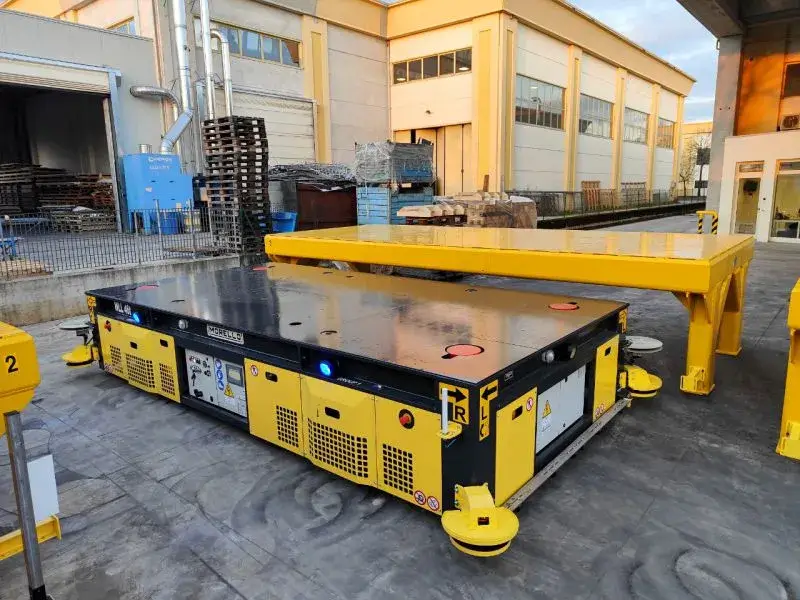
| Navigation System: Compared to indoors, outdoor traffic conditions are more complex, involving pedestrians and other vehicles on the road. The impact of weather on outdoor AGVs cannot be ignored either. Variations in temperature and lighting conditions (cloudy, extreme sunlight, high and low sun angles) all cause changes in the external environment. These changes impose new requirements on the navigation system.
| Chassis Design: Outdoor road conditions are worse than indoor floors. Outdoor roads are more rugged and contain more obstacles (e.g., stones of various sizes). This necessitates differences in the chassis and wheels of outdoor AGVs compared to their indoor counterparts.
Technical Solutions Addressing Outdoor AGV Application Challenges
| Speed: This is addressed by developing a new chassis. The outdoor AGV is equipped with Mecanum wheels, allowing for precise maneuvering in the tightest spaces. An air suspension system ensures safe ground contact and good driving characteristics, regardless of load. With a ground clearance and suspension travel of up to 140 mm, cobblestones, thresholds, and even potholes are not obstacles. Four motors with a total system output power of approximately 60 kW provide a propulsion speed of up to 36 km/h.
| Braking: To enable a vehicle to safely travel and brake outdoors at the maximum possible speed, knowledge of the current friction coefficient between the drive or brake wheels and the ground is essential. This value plays a decisive role in determining braking distance.
The friction coefficient depends not only on the road surface but also on weather conditions. If the road is dirty, wet, or icy, causing a significant reduction in friction, braking distances can become very long. To select the correct/appropriate speed via the vehicle control system, it is necessary to know the currently effective friction coefficient. Otherwise, for safety reasons, a significantly reduced speed must be chosen.
For the economical use of outdoor AGVs, it is ultimately necessary to determine the friction coefficient automatically and in real-time, allowing the system to calculate and travel at the maximum safe speed at any time. The solution involves installing two spring-loaded measuring wheels on each side of the vehicle, near the drive wheels. Both wheels have their own drive motors, enabling a permanent alternation between two states:
The motor drives the measuring wheel pressed against the ground with increasing torque until the wheel can no longer transmit force to the ground and suddenly begins to slip (rotate).
The motor brakes the measuring wheel with increasing torque until the wheel can no longer transmit force to the ground and locks.
Both edge cases can be easily measured by monitoring the current speed. In both cases, the limiting torque is a measure of the currently and locally applicable friction coefficient. This means the vehicle control system can adjust the current speed to suit the prevailing conditions (increase or decrease it).
| Navigation System: Traditional satellite positioning involves signals traveling from distant space to the ground, inevitably encountering disturbances, especially passing through the ionosphere, resulting in errors of several meters. Using RTK differential satellite positioning methods achieves centimeter-level accuracy and is suitable for global positioning.
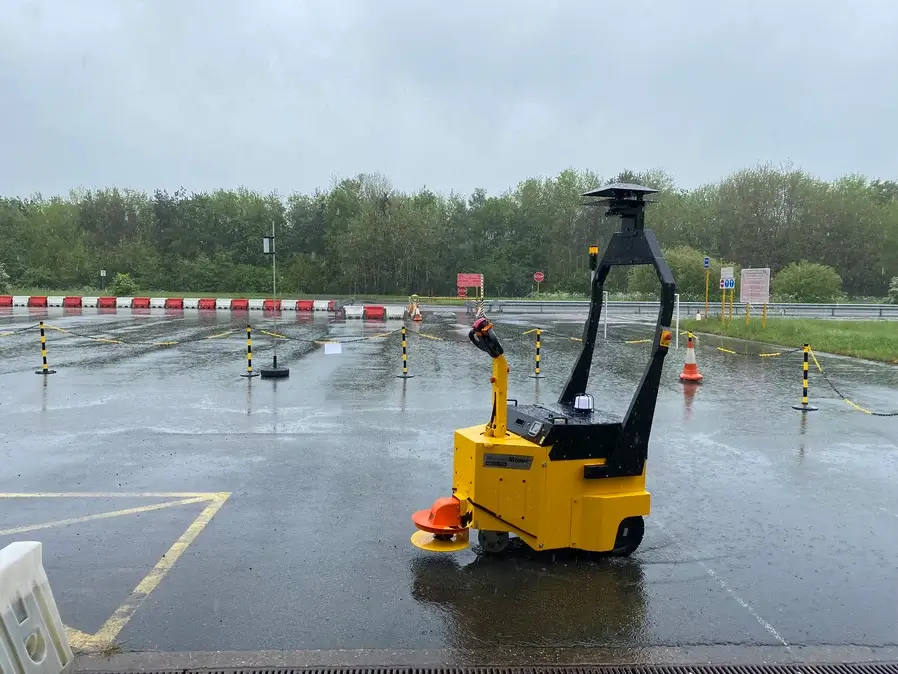
RTK is a carrier-phase differential technique, a real-time method that processes carrier-phase observations from two measurement stations. User equipment for network RTK systems primarily consists of GNSS receivers and antennas. The advantage of Global Navigation Satellite Systems is their ability to provide all-weather, continuous, space-based radio navigation positioning, offering 3D coordinates, velocity, and time information anywhere on or near the Earth’s surface. The disadvantage is that GNSS positioning relies on space satellites and is significantly affected by the environment; signals can be blocked by tall buildings, trees, or tunnels, and the initial positioning response is relatively slow.
| Chassis Design: The Fraunhofer IML in Germany first presented a solution that overcomes this problem without active (driven or spring) elements: the Stuart Chassis. Its joints and levers solve the static overdetermination problem of a four-wheeled chassis. They form two articulated contact triangles around the central differential-drive axle, eliminating the tipping tendency of traditional four-wheel-drive vehicles on uneven ground and ensuring all wheels maintain ground contact even on very uneven surfaces. Furthermore, through the lever length design of the suspension system, the contact force on the central differential drive axle is proportional to the total vehicle weight.
Outdoor AGV Application Example
| Customer Requirement
As the machinery manufacturing industry accelerates its upgrade towards intelligence and green practices, enterprise customers in this sector face challenges in transporting large equipment, with traditional handling methods being inefficient. Enterprises need a high-load, fully automatic AGV suitable for outdoor environments to achieve fully automated transfer of large equipment throughout the entire process using automated logistics equipment.
| Outdoor AGV Solution
An outdoor AGV with a load capacity of 20 tons, based on the OmniRhino vehicle design, was developed. It uses indoor laser SLAM navigation combined with outdoor differential GPS technology for positioning. The front of the vehicle is equipped with a raised bracket for the GPS antenna. It can accurately measure the angle and distance of objects using a laser, enabling seamless switching between operating scenarios. Simultaneously, the AGV’s configured dispatching system monitors the AGV’s position, current working status, battery level, speed, direction, and other information in real-time, improving the convenience and efficiency of dispatching operations.
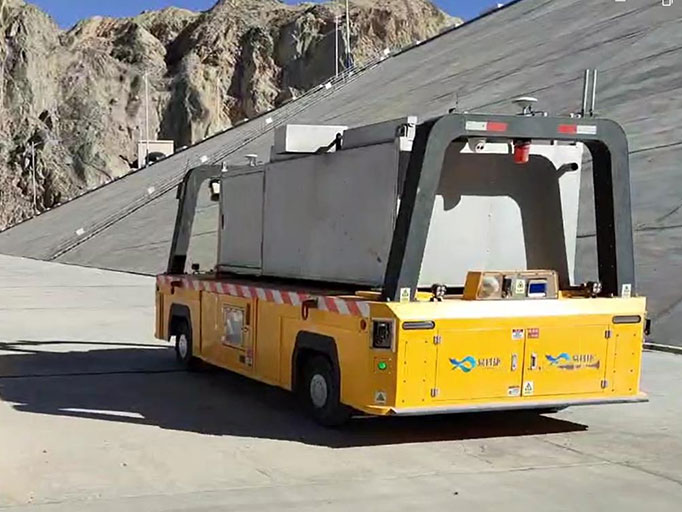
This outdoor AGV adopts a platform carrier model and uses wear-resistant solid tires. It achieves omnidirectional movement (forward/backward, lateral shifting, curved turns, spot turns, etc.) while meeting high load capacity requirements. It possesses strong climbing and obstacle-crossing capabilities, adapting to undulating roads in factory areas.
Operating outdoors, this AGV also has a relatively high protection level. It is equipped with obstacle detection LiDAR and bumpers to prevent collisions between the AGV and pedestrians, walls, or other obstacles. The electrical cabinet and its doors are treated with a waterproof structure, and the top cover structure incorporates waterproof diversion treatment, allowing normal operation even on rainy days.
| Implementation Effect
Since its deployment, this load capacity (20 tons) outdoor AGV has effectively reduced safety risks in handling, achieving zero major handling accidents. It has also improved equipment transfer efficiency and volume, successfully helping the enterprise achieve fully automated transfer of large equipment from the component workshop to the final assembly workshop, accelerating the company’s progress in building a smart factory.
Recommended In-depth Reading from AI Robots Eidos
To expand readers’ knowledge, a concept is introduced here: generally speaking, AGVs weighing over 5 tons are referred to as heavy-duty AGVs.
There are certain technical commonalities between outdoor AGVs and heavy-duty AGVs; for instance, both require high-precision navigation and positioning technology, reliable obstacle avoidance capabilities, and powerful power systems. However, in terms of specific technical implementation, outdoor AGVs pay more attention to environmental adaptability technologies (such as waterproofing, dustproofing, and resistance to light interference), while heavy-duty AGVs focus more on load capacity and structural stability technologies.
If you are interested in heavy-duty AGVs, please read this in-depth article about heavy duty AGVs.
Trends Among Outdoor AGV Companies
| Esatroll has begun offering customized outdoor AGV solutions to its customers. Managing Director Giuliano Bavaj notes, “We see a strong trend emerging. More and more companies want to use AGVs outdoors. In the past, only about 10% of our inquiries involved outdoor applications, but now this proportion has risen sharply, with outdoor applications already accounting for around 30%. Despite the numerous complex challenges of using AGVs outdoors, automating heavy material handling offers significant advantages and considerable cost savings.”
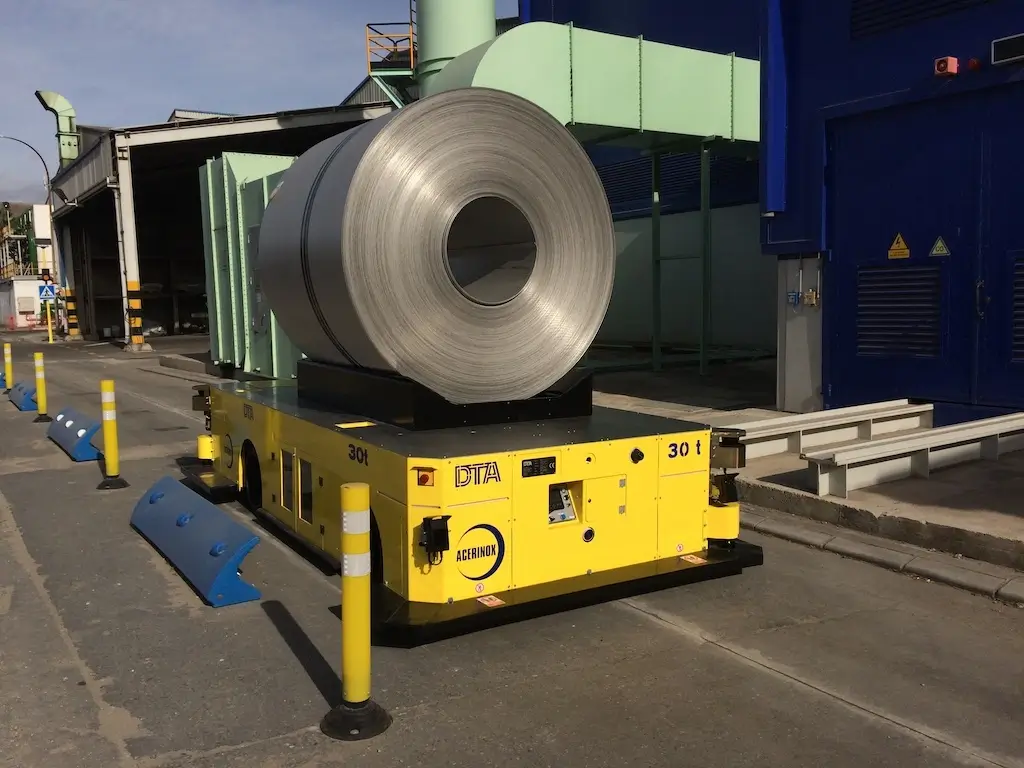
| DTA is also vigorously developing industrial applications for outdoor AGVs. Typical uses for the company’s heavy-duty outdoor AGVs include transporting goods from production facilities to warehouses located in different buildings, possibly hundreds of meters away. Due to the need to move large numbers of car chassis between buildings, their main enterprise clients currently come from the automotive manufacturing industry.
Development Directions for Outdoor AGVs
| Navigation Technology Upgrade – Multi-Sensor Fusion Navigation: Combining multiple sensors such as LiDAR, vision sensors, GPS, and Inertial Measurement Units (IMUs) using data fusion algorithms achieves more accurate and stable positioning and navigation, adapting to complex and changing outdoor environments like variations in lighting and weather effects.
| Intelligence – Artificial Intelligence and Machine Learning: Introducing technologies like deep learning and reinforcement learning enables AGVs to possess autonomous learning and decision-making capabilities. They can automatically adjust paths and optimize operational processes based on environmental changes and task requirements, improving operational efficiency and safety. This also enables collaborative work among multiple AGVs, sharing information via communication networks, coordinating task allocation and path planning, avoiding conflicts and collisions, and enhancing overall operational efficiency and resource utilization.
| Adaptation to Complex Environments: Developing weather-resistant sensors, electronic devices, and mechanical structures allows AGVs to operate normally under adverse weather conditions such as rain, snow, fog, high temperatures, and low temperatures, ensuring equipment reliability and stability. Designing chassis and suspension systems adapted to complex terrains like rugged roads, slopes, and potholes improves the AGV’s traversability and stability, expanding its application scope.
Insight from AI Robots Eidos about Outdoor AGVs
| The current scheduling systems are mostly centrally controlled. In the future, outdoor AGVs will develop stronger “collective intelligence” — vehicles will share real-time road conditions, friction coefficients, and braking intentions through V2X (Vehicle-to-Everything) technology without relying on the cloud. For example, if a forward AGV detects an icy road surface, the rear AGV can automatically adjust its speed and following distance without needing to measure the conditions again.
| The outdoor environment involves a significant amount of public space, and visual data could raise privacy concerns (such as capturing pedestrians’ faces or license plates). Future outdoor AGV technologies must integrate privacy computing. Cameras on outdoor AGVs may be directly equipped with AI chips, only outputting metadata like “someone present” or “vehicle detected” without storing or transmitting the original images, or they may utilize federated learning technology to allow AGVs to share model parameters without sharing raw data, addressing regulatory and privacy issues.
Image Credits: Ek-robotics & Mastermover & Morello & Plantengineering & Kinocranes
Other Articles on The Topic of AGVs
Level A (Foundational )