
Table of Contents
Magnetic tape AGVs and SLAM AMRs represent, in essence, the contrast between “fixed‑path automation” and “flexible autonomous navigation.” Enterprises need to weigh the strengths and weaknesses of both technologies against production line stability, budget, site conditions, and intelligence requirements, so as to select the solution that best fits their needs.
Magnetic Tape AGV vs. SLAM AMR: Definitions
Magnetic Tape AGV
Magnetic tape AGV navigation is widely regarded as a highly mature technology. It primarily measures the magnetic field signal along the path to obtain the vehicle’s positional deviation from the target tracking route, thereby enabling vehicle control and navigation. Magnetic tape navigation offers high measurement accuracy and excellent repeatability. It is largely unaffected by changes in lighting and provides high reliability and robustness during operation. Once the magnetic tape is laid, maintenance costs are very low, and its service life is long.
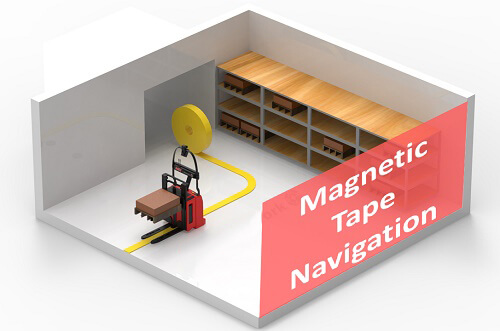
However, after the magnetic tape guidance route is installed, any subsequent route modifications require a secondary construction effort, which increases both construction costs and downtime.
SLAM AMR
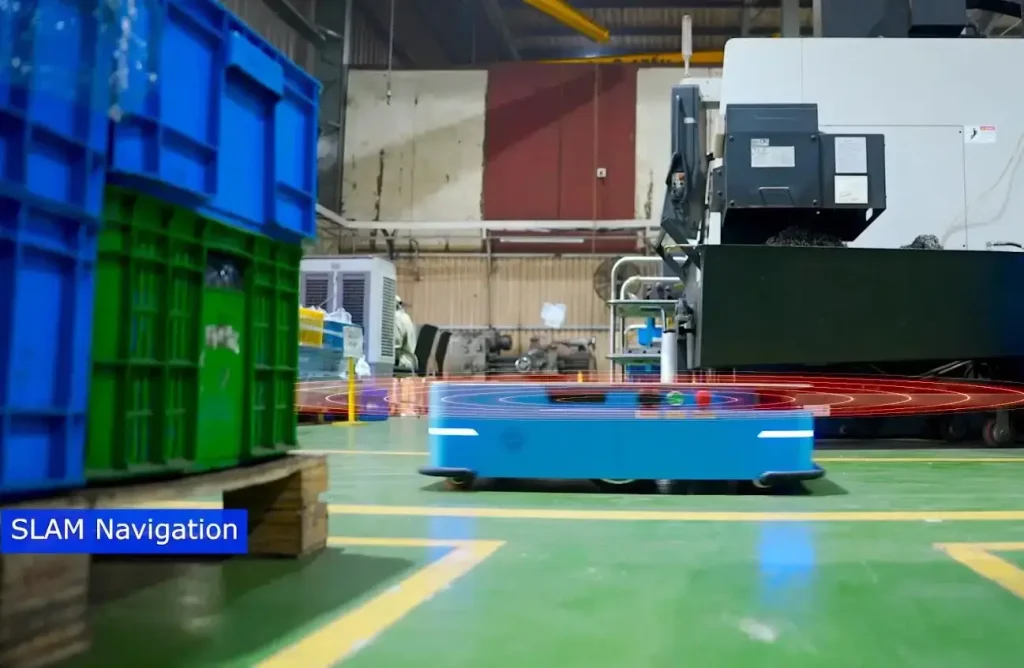
The core functionality of a SLAM AMR lies in Simultaneous Localization and Mapping (SLAM). During operation, the AMR scans environmental feature points in real time and matches them against a pre-stored map to achieve centimeter-level precise localization. Upon receiving a target point command, the onboard algorithm autonomously plans the optimal path based on real-time environmental information and dynamically adjusts the route when encountering obstacles or congested sections. Unlike magnetic tape AGVs, SLAM AMRs demonstrate strong environmental adaptability and autonomous decision-making capabilities.
Recommended In-depth Reading from AI Robots Eidos
AGVs (Automated Guided Vehicles) and AMRs (Autonomous Mobile Robots) are the two core mobile robotics technologies in industrial automation and smart logistics. They play an irreplaceable and vital role in reducing costs, improving efficiency, enhancing safety, and adapting to diverse operational scenarios. The hybrid dispatching approach that combines both—for example, AGVs handling high‑volume transport on main routes while AMRs perform flexible end‑point handling—is emerging as a key trend for enterprises seeking to achieve comprehensive smart logistics upgrades.
Readers who wish to learn more about AGVs and AMRs are encouraged to explore additional articles on the subject.
Automated Guided Vehicles(AGVs): The Complete Guide
Introduction to Autonomous Mobile Robots (AMRs)
Magnetic Tape AGV vs. SLAM AMR: Technical Parameters
Magnetic tape AGVs and SLAM AMRs differ significantly across multiple key performance indicators, and these differences directly affect their practical application effectiveness and suitable scenarios in real-world engineering.
| Comparison Dimension | Magnetic Tape AGV | Laser SLAM AMR | Practical Engineering Notes |
|---|---|---|---|
| Static Repeat Positioning Accuracy | Embedded type: ±2–3mm; surface‑mounted tape: ±3–5mm | Pure 2D laser SLAM: ±10–30mm; with reflector / magnetic‑tape‑assisted fusion SLAM: up to ±5mm | Magnetic tape navigation relies on physical constraints for higher accuracy, but fusion SLAM can improve accuracy with auxiliary markers, though overall procurement and deployment costs increase by ~30%. |
| Dynamic Positioning Stability | High‑power motors and frequency converters within 1.2m of the tape can cause magnetic field distortion; iron filings covering >0.8mm thickness may cause track loss. | Light oil contamination on the floor has no effect; only oil on the lens interferes with ranging. Feature loss may occur in long straight corridors >15m without distinct features, or in large mirrored / pure white wall areas. | In steel workshops, magnetic tape AGV deployment requires pre‑scanning for magnetic field interference; in glass cleanrooms, pure laser SLAM should be used with caution. |
| Deployment & Construction Requirements | Requires floor slotting for embedded tape or surface taping; on‑site civil construction modification is mandatory. | Zero floor modification; only map calibration needed; site‑wide go‑live in 1–3 days. | In old plants and cleanrooms where floor slotting is prohibited, SLAM AMR is the preferred choice. |
| Standard Deployment Cycle | Small to medium plants: 2–4 weeks; large plants: 1–2 months. | Standard workshops: 1–7 days; large warehouses: 3–10 days. | For projects with short retrofitting timelines, SLAM AMR deployment efficiency is significantly higher than that of magnetic tape AGVs. |
| Maximum Normal Travel Speed | 1.2–1.5 m/s (speed limit in mixed human‑machine areas). | Dedicated transport aisles: 1.8–2.5 m/s; automatically slows to 0.8 m/s when encountering personnel. | In indoor mixed areas, maximum no‑load speed limit is 1.5 m/s; dedicated unmanned aisles may have higher limits. |
| Path Modification Cost | Rerouting requires re‑laying the tape; a 100m modification takes 1–2 days, with high consumable costs. | Rerouting by dragging map waypoints in the backend – effective immediately, zero consumable cost. | In high‑frequency line‑change production lines (e.g., new energy, 3C), the long‑term rerouting cost of magnetic tape AGVs is very high. |
| Human‑Machine Mixed Operation Suitability | Very poor; fixed routes easily conflict with pedestrian flow; only basic collision avoidance. | Excellent; real‑time dynamic obstacle avoidance; adaptable to densely populated work areas. | In assembly workshops and production line stations with interspersed operations, SLAM AMR is the top choice. |
| Initial Hardware Cost per Unit | Low; light‑load chassis: RMB 10,000–40,000 (approx. US$1,400–5,600). | Relatively high; same load capacity chassis: RMB 30,000–100,000 (approx. US$4,200–14,000). | Magnetic tape AGVs have a significant upfront investment advantage, but a total lifecycle cost assessment is required. |
| 5‑Year Total Lifecycle Cost | For fixed production lines with no changes within 3 years, roughly on par with AMR; for production lines with ≥6 changes per year, 40%–80% higher than AMR. | High upfront investment, but almost no consumables in O&M; more cost‑effective in the long run. | Choose magnetic tape AGV for fixed production lines; choose SLAM AMR for long‑term flexible production lines. |
| Load Capacity Range | 1–50 tons, mature heavy‑load adaptation. | SLAM AMR mainly covers 0.5–30 tons; above 30 tons, ultra‑heavy‑load SLAM is not yet standardized for mass production. | For ports and heavy machinery heavy‑load transport, magnetic tape AGV is preferred. |
| Maximum Fleet Size | Typically 20–50 units; fixed intersections have no dynamic right‑of‑way allocation; exceeding this may cause congestion and deadlock. | An In‑house distributed scheduling system can support 300–1,000 unit fleet coordination. | For large smart warehouses and mega‑factories with large‑scale deployment, the SLAM AMR solution is preferred. |
Magnetic Tape AGV vs. SLAM AMR: Cost
Magnetic Tape AGV
Magnetic tape AGVs offer significant advantages in upfront investment due to their lower hardware costs. The primary hardware components of a magnetic tape navigation system include the Hall magnetic sensor at the vehicle’s base and the permanent magnetic tape laid on the floor. These components are technologically mature and have relatively low procurement costs. The control logic is simple and does not require high-performance edge computing units. The total hardware cost for a light-load unit is typically under US$6,000.
SLAM AMR
SLAM AMRs involve higher upfront hardware investment. Core components such as LiDAR, IMU, and edge computing modules account for an average of 28.5% of the total BOM cost (ranging from 25% to 30%). The hardware cost for a light-load unit is typically under US$15,000. Path adjustments require only backend map editing, with no consumables and no need for large-scale production stoppages. Light oil contamination on the floor does not affect navigation; only regular cleaning of the LiDAR lens is needed, resulting in extremely low annual maintenance labor costs.
Comprehensive assessment: For fixed assembly lines with no production line changes within 3 years, the total lifecycle cost of magnetic tape AGVs is roughly on par with that of AMRs. For flexible factories that adjust production lines more than 6 times per year, the magnetic tape solution incurs 40%–80% higher total costs over 5 years compared to SLAM AMRs.
Magnetic Tape AGV vs. SLAM AMR: Competitive Landscape
Magnetic Tape AGV
Mainstream European and American magnetic tape AGV manufacturers have deeply cultivated the buried‑tape AGV field for decades, with deep expertise in heavy-duty chassis and motion control algorithms. They primarily serve fixed assembly lines in automotive manufacturing and heavy equipment industries, while also developing heavy-duty specialized SLAM solutions alongside.
Japanese magnetic tape AGV manufacturers primarily target high-end application scenarios, such as semiconductor and precision electronics industries.
It is worth noting that in recent years, as Chinese magnetic tape AGV manufacturers have advanced technologically, the overall performance of their vehicles has matched that of competitors, while offering greater cost-effectiveness due to lower prices.
SLAM AMR
North American SLAM AMR manufacturers have completely abandoned traditional track-based navigation, focusing instead on SLAM AMRs for flexible warehousing and sorting applications. Their equipment is highly lightweight and standardized. Leveraging North America’s computing ecosystem, they have advantages in scheduling algorithms for SLAM AMRs. However, their shortcoming is a lack of heavy-duty industrial models.
Japanese SLAM AMR manufacturers mainly promote laser + vision fusion solutions, which perform excellently in low-light environments. However, their systems are highly closed, resulting in poor compatibility with third-party MES and WMS industrial software.
Chinese SLAM AMR manufacturers are highly competitive in the mid-range market, though they still lag slightly behind in high-end industrial ranging LiDAR.
Magnetic Tape AGV vs. SLAM AMR: Application Scenarios
Magnetic Tape AGV
–Lithium battery PACK production lines: PACK assembly lines demand extremely high anti-derailment and real-time correction capabilities from AGVs. With fixed production line paths, magnetic tape AGVs are required to frequently tow material carts for loading and unloading at docking.
–Fixed-route material transport: In traditional manufacturing warehouses and standardized assembly lines where path flexibility is not a high priority, AGVs are required to stably and continuously transport materials over long distances along fixed routes.
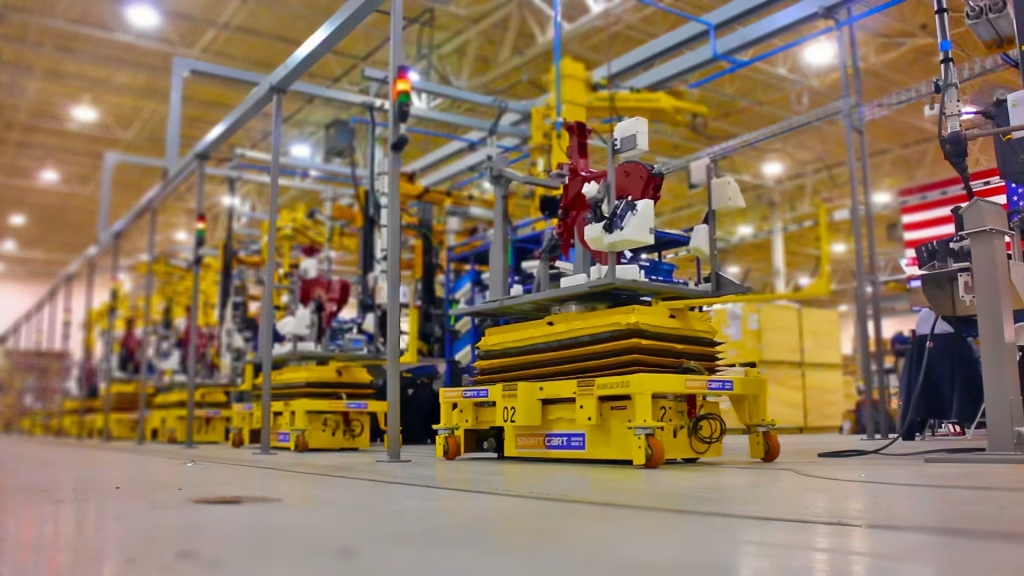
–Heavy-load scenarios: Involving the transport of heavy materials such as steel coils, paper rolls, or cable reels weighing 10 to 50 tons, these scenarios demand high load capacity (heavy-duty AGVs) and operational stability, making magnetic tape AGVs a suitable choice.
SLAM AMR
–Flexible production lines: Suitable for production lines that iterate monthly, such as multi-variety, small-batch manufacturing in the 3C electronics industry. They handle automatic transfer of cells, components, and other materials between processes, enabling “on-demand delivery.”
–Cross-floor transport: Using automatic elevator calling, they enable material transport across different floors. They achieve centimeter-level precision navigation in complex warehousing environments with multi-tier racks and narrow aisles.
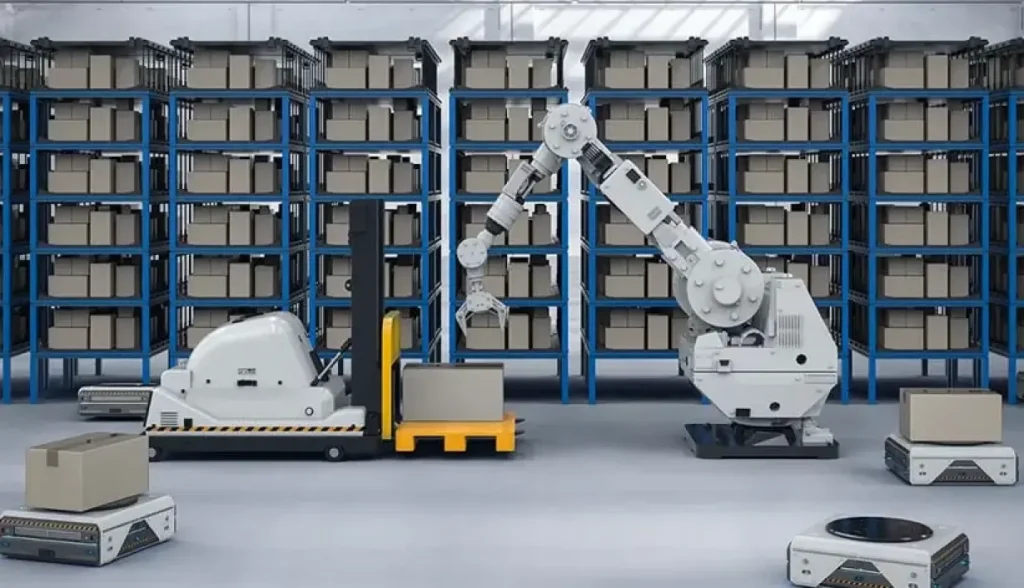
–Smart warehousing: SLAM AMRs work with three-dimensional racking systems to automate inbound, outbound, inventory counting, automated rack organization, and intelligent relocation, thereby improving warehouse space utilization.
Magnetic Tape AGV vs. SLAM AMR: Development Trends
Technological Level
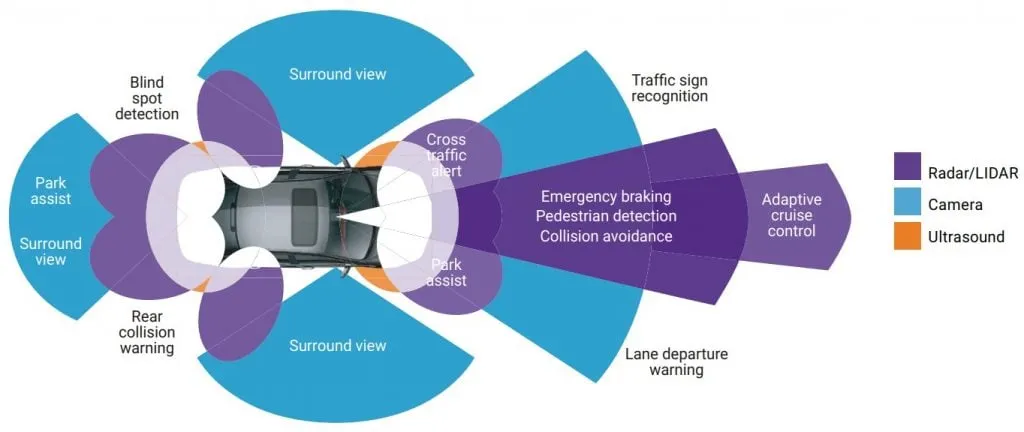
Multi-sensor fusion technology combines complementary data from LiDAR, IMU, vision, and reflective markers to overcome the “environmental weaknesses” of single-navigation solutions. Pure LiDAR SLAM enhanced with vision can reduce drift in texture-poor environments; magnetic tape AGVs equipped with LiDAR can add dynamic obstacle avoidance capabilities, reducing the risk of human-machine collisions. The current industry mainstream is basic LiDAR + IMU fusion, while high-end models incorporate 3-Dimensional LiDAR for three-dimensional obstacle recognition. As edge chip costs decline, multimodal fusion will become a standard general feature.
AI algorithm optimization improves upon traditional A* and Dijkstra path planning, which are only suitable for static environments. Lightweight algorithms based on reinforcement learning and graph neural networks have been scaled for use in SLAM AMRs, enabling real-time prediction of personnel and forklift movements and automatic rerouting around congested passages. Deep learning-based visual recognition can distinguish between personnel, fixtures, and fixed racks, significantly enhancing safety in human-machine mixed environments. For magnetic tape AGVs, with their fixed paths, AI algorithms have limited application—mainly used for auxiliary functions like fault recognition and magnetic field anomaly detection.
Penetration Rate
Short-term (3–5 years): Magnetic tape AGVs will not be replaced; they remain highly competitive in fixed, heavy-load production-line scenarios. However, newly built smart factories have already adopted SLAM AMRs as the standard.
Long-term (~10 years): With ongoing technological iteration, SLAM AMRs will cover the vast majority of general-purpose material-handling scenarios, while magnetic-tape AGVs will shrink to niche applications such as ultra-heavy-load transport.
Insight from AI Robots Eidos about Magnetic Tape AGV vs. SLAM AMR
As AMR scheduling platforms mature, third-party logistics providers can bring their own AMR equipment into factories and charge by the number of moves or by distance traveled. For manufacturers, the upfront cost advantage of magnetic tape AGVs becomes irrelevant—because they no longer bear asset acquisition risk; they simply purchase capacity on demand. This will force magnetic tape AGV manufacturers to shift from “selling equipment” to “selling capacity,” or risk being marginalized by the service model dominated by AMRs.
The continuous collection of personnel movement trajectory data by AMRs in mixed human‑machine environments will become a “golden data source” for optimizing factory labor layouts and workstation designs. By analyzing interaction heatmaps between people and AMRs, plant managers can identify logistics bottlenecks, workstation redundancies, and other patterns. Magnetic tape AGVs, with their fixed paths and inability to perceive surrounding personnel, completely lack this data value. This means AMRs are not just material handling tools—they are factories’ “data sensor networks.”
The low barrier to entry for magnetic tape AGVs (simple control logic and low hardware costs) means high substitutability, intense commoditization, and accelerating margin erosion. In contrast, SLAM AMRs involve a composite technology stack—SLAM algorithms, AI scheduling, edge computing, and more—which inherently creates technological barriers and room for continuous iteration. In the future, AMR manufacturers will be able to sustain high‑gross‑margin revenue through software subscriptions, algorithm upgrades, and other recurring models. The gap in technical sophistication will ultimately translate into a chasm in commercial value.
Image Credits: Agvnetwork & Techvico & Mwes & Rfidlabel & Medium