
Table of Contents
Delta robots have become the core equipment for high-speed sorting and light-load assembly in light industry, thanks to their high speed, high precision, and high cleanliness. If six-axis robots are the all-rounders of industrial automation, then Delta robots are the specialists in high-speed, light-load applications.
Definition of Delta Robots
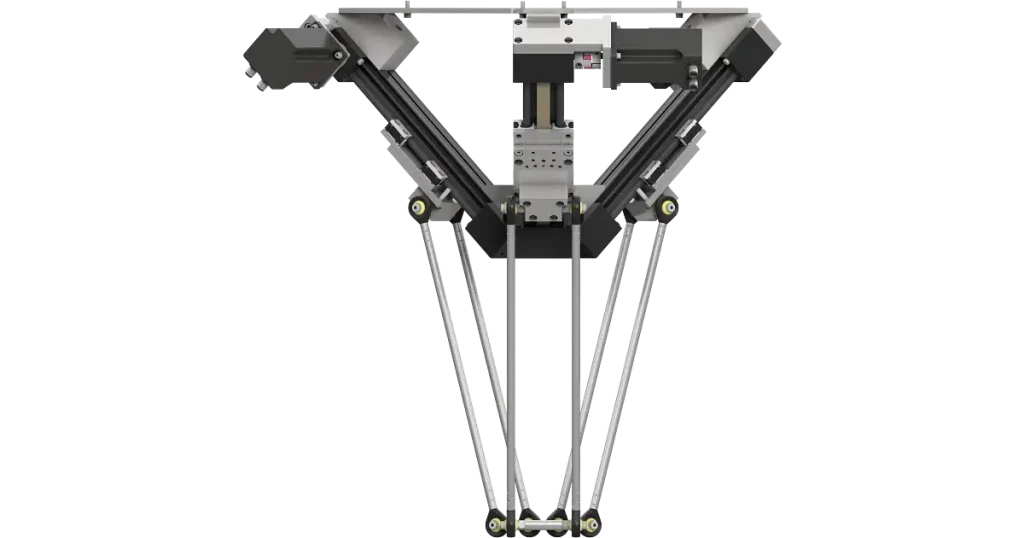
Delta robots, also known as parallel robots, adopt a triangular architecture driven by multiple sets of parallel linkages. The parallel design results in extremely low motion inertia, enabling ultra-high acceleration and extremely fast cycle times, with excellent motion speed and dynamic response. Some Delta robot models can achieve peak picking speeds of several meters per second. In addition, the lightweight linkage design occupies minimal installation space and supports multiple mounting orientations such as inverted and upright configurations. When paired with vision systems, they enable dynamic workpiece tracking and grasping, effectively meeting the high-frequency, repetitive, and standardized demands of high-speed picking applications.
Principle of Delta Robots
Delta robots operate based on the principle of parallel mechanisms. A fixed base houses multiple drive motors, which connect to the end-effector platform via telescopic linkages. When the control system issues commands, multiple servo motors work synchronously to drive the linkages to extend, retract, and angularly deflect, thereby driving the end platform to achieve high-speed translation and attitude adjustment in three-dimensional space.
Thanks to the parallel structure where multiple motors share the driving load, power is distributed, greatly reducing the load on each individual motor and supporting the equipment in achieving high-frequency, ultra-high-speed repetitive operations. Models equipped with vision tracking modules can receive real-time workpiece coordinate information from conveyor belts, dynamically adjust motion trajectories, and enable follow-up picking on dynamic production lines.
Components of Delta Robots
–Fixed Platform: Used to house and secure the servo motors and central shaft, ensuring stable operation under high-frequency, high-intensity working conditions. The fixed platform is the top mechanism for mounting and securing the Delta robot, where all servo motors are located.
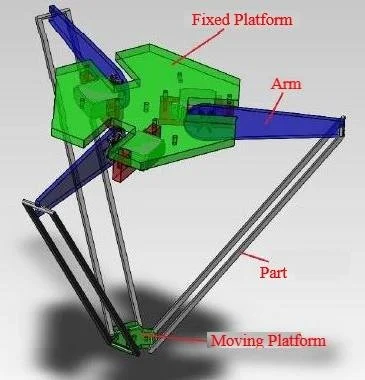
–Moving Platform: Connected to the lower ends of the driven arms, it carries the load and operates within the arm’s reach. It is the platform for mounting grippers or suction cups. Through the coordinated motion of each branch chain, it achieves precise changes in spatial position and orientation (pose).
–Drive Arms: The drive arms consist of active arms and driven arms. The active arms are driven by servo motors and are responsible for transmitting motion; the driven arms transmit motion to the moving platform and ensure the rigidity and accuracy of the mechanism. Because Delta robots operate at very high speeds, the drive arms are generally made of carbon fiber, which meets the requirements of light weight, high strength, and no deformation.
Classification of Delta Robots
2-Axis Delta Robot
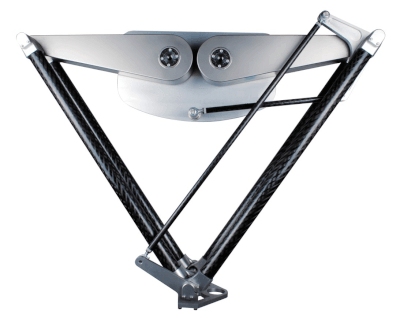
The 2-axis Delta robot is similar to the XZ Cartesian robot but has its unique features, such as lighter self-weight, faster operating speeds, and lower cost.
| Feature | 2‑DOF Delta Robot | XZ Cartesian Robot |
| Self‑weight | Light | Heavy |
| Speed | Fast | Moderate |
| Precision | Medium | High |
| Cost | Low | High |
When the 2-axis Delta robot moves to a target position, its path differs from that of the XZ Cartesian robot. At the same speed, the 2-axis Delta robot reaches the target position in a shorter time.
Recommended Related Reading from AI Robots Eidos
When facing heavy‑load handling tasks or extremely high rigidity requirements, Cartesian robots demonstrate significant advantages. Their XYZ three‑axis linear motion architecture is logically intuitive and easy to control, enabling them to easily carry workpieces weighing tens or even hundreds of kilograms. If you would like to learn more about them, you are welcome to read this detailed article that introduces Cartesian robots.
Cartesian Robots: What You Need to Know
3-Axis Delta Robot
3-axis Delta robots come in many types and are more complex in form. Common types include: planar 3-DOF parallel mechanisms, such as the 3-RRR mechanism; spherical 3-DOF parallel mechanisms, such as the 3-UPS-1-S spherical mechanism, which have simple forward and inverse kinematics and are widely used as 3-Dimensional translational spatial mechanisms; and spatial 3-DOF parallel mechanisms, which are under-rank mechanisms and feature varying motion forms at different points within the workspace.
4-Axis Delta Robot
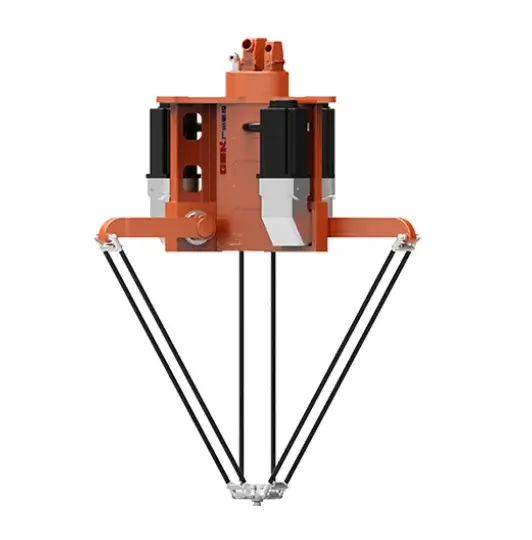
Most 4-axis Delta robots are not fully parallel mechanisms, but they expand application range by adding one rotational degree of freedom to the 3-DOF parallel mechanism, forming a 4-DOF parallel robot.
6-Axis Delta Robot
6-axis Delta robots are the most researched parallel robots by scholars and are widely used in flight simulators, 6D force/torque sensors, parallel machine tools, and other fields. However, many key technologies for this type of robot remain unsolved or not fully resolved, such as forward kinematics solutions, dynamic model establishment, and precision calibration of parallel machine tools.
Structural Characteristics of Delta Robots
The core structural design features two hallmark characteristics that fundamentally distinguish Delta robots from serial robots:
—All drive units fixed, motion components lightweight – All servo motors and reducers are integrated into the top fixed platform and do not move with the end effector. The three lower branches adopt a rigid parallel structure of “active arms + parallelogram driven linkages,” with mainstream models using lightweight materials such as carbon fiber and aviation aluminum to minimize motion inertia. This design completely eliminates the inherent drawback of serial robots—where “joint motors move with the arms and inertia accumulates stage by stage”—and is the fundamental basis for achieving ultra-high acceleration and ultra-fast response.
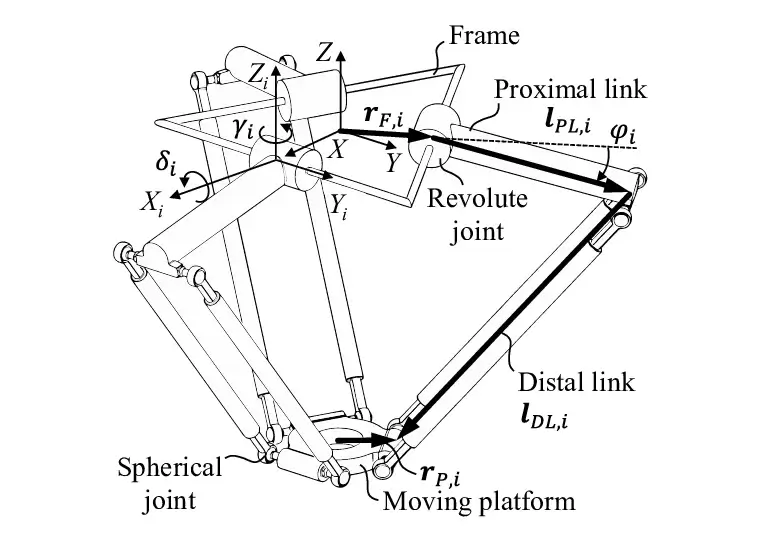
—Parallelogram constraints limit motion to planar characteristics – The parallelogram linkage constraints of the three branches ensure that the moving platform remains parallel to the fixed platform at all times. The end effector can only achieve linear translation along the X/Y/Z axes and single-direction rotation about the Z axis; it cannot perform spatial pitch, roll, or other multi-angle attitude adjustments.
Due to structural constraints, the Z-axis effective stroke of Delta robots is generally small, with standard models having a maximum stroke of no more than 500 mm. The overall workspace is a shallow dome-shaped flat space, with severely limited vertical operational depth. This makes them suitable only for sorting regular, lightweight, and small items on horizontal conveyor belts, and incapable of deep-space, large-drop, or multi-attitude three-dimensional tasks.
Advantages of Delta Robots
–Excellent dynamic performance and production cycle time: The fixed drive architecture combined with ultra-low motion inertia gives Delta robots instantaneous acceleration and dynamic response far superior to serial robots of the same payload class. Under standard continuous sorting of light, small items, their overall operational efficiency is 2–3 times that of SCARA robots and 4–6 times that of six-axis robots. They are currently the only industrial robot type capable of stably achieving continuous industrial sorting cycle rates of over 200 picks per minute.
–High rigidity, high precision, and low cumulative error: The multi-branch parallel constraint structure provides redundant rigid support, resulting in minimal end-effector vibration during high-speed motion. There is no cumulative joint positioning error as seen in serial robots. Under normal conditions, repeat positioning accuracy is stably maintained at ±0.02 mm, with negligible precision degradation over long-term high-speed continuous operation, making them suitable for pharmaceutical precision sorting and high-precision sorting of micro-electronic accessories.
–Strong adaptability to clean environments and low compliance costs: The machine has no exposed complex transmission structures, and its body is well-sealed. It can be quickly adapted for food-grade, dust-free, and sterile applications, supporting high-temperature, high-humidity, and high-pressure water-wash sterilization without requiring large-scale production line modifications. This makes it far more compatible with stringent production compliance requirements in the food industry compared to general-purpose robots.
Disadvantages of Delta Robots
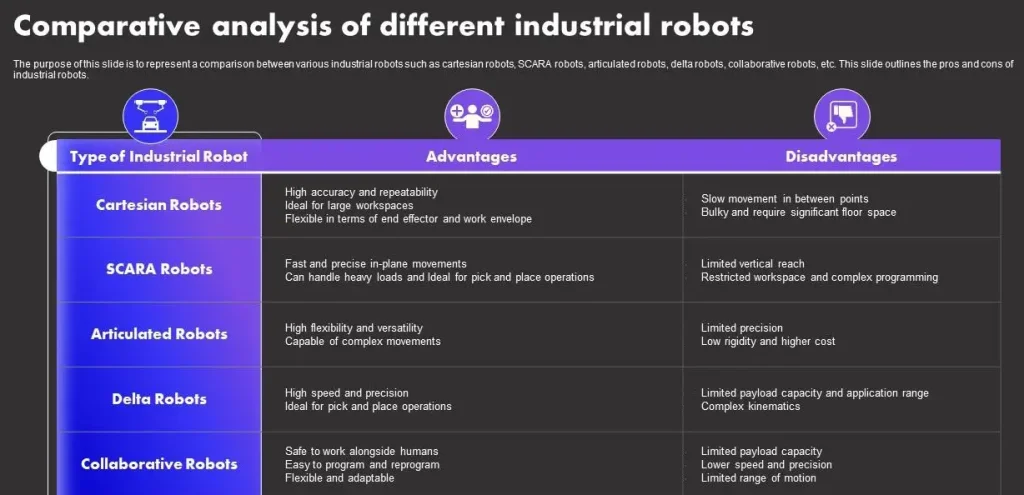
–Poor versatility: The standard 4-DOF configuration lacks pitch and roll attitude DoF, and the Z-axis effective stroke is at most 500 mm. The flat dome-shaped workspace is limited to planar operations, incapable of deep-reach grasping, three-dimensional palletizing, or multi-angle attitude adjustment of workpieces. Application scenarios are highly specialized, and they cannot serve as general-purpose industrial robots.
–Low payload capacity, ineffective for heavy-load scenarios: Standard industrial models have rated payloads of 0.5–10 kg, while custom heavy-load models can reach a maximum of only 25 kg. Moreover, under heavy-load conditions, high-speed cycle performance and positioning accuracy degrade significantly, making them suitable only for light, small-item sorting and completely unable to cover medium- to heavy-material handling.
–Complex kinematics, high debugging and maintenance barriers: Compared to the simple forward and inverse kinematics algorithms of serial robots, the multi-branch coupled motion characteristics of Delta robots result in complex inverse kinematics solutions, numerous trajectory constraints, and significantly higher difficulty in dynamic correction, trajectory planning, and cycle optimization debugging. This demands greater algorithmic knowledge and practical experience from on-site engineers, leading to longer adaptation costs and cycles for non-standard customization.
–Limited effective working area and low space utilization: Due to mechanical constraints of the parallel branches, the robot’s speed, precision, rigidity, and stability are optimal only in the central core working zone. Approaching the edges of the workspace, structural rigidity and positioning accuracy continuously degrade. The proportion of effectively usable working area is relatively low, requiring production line layouts to strictly align with the central operating zone, thus limiting overall equipment space utilization.
Features of High‑End Delta Robots
—The motion control algorithms are highly mature. High‑end Delta robot models can achieve peak sorting cycle rates of up to 300 picks per minute. After 20,000 hours of continuous high‑speed operation, repeat positioning accuracy remains stable at ±0.01 mm, with positioning accuracy degradation of less than 0.01 mm, demonstrating excellent long‑term stability.
—High‑end hygienic‑grade robots come standard with FDA‑certified food‑ and pharmaceutical‑grade materials, vacuum‑sterile‑compatible structures, and fully sealed designs, meeting the most stringent clean‑environment requirements.
—They are equipped with an integrated “robot + digital twin + 3-Dimensional AI vision” solution, featuring functions such as virtual simulation pre‑debugging, equipment fault prediction, and dynamic trajectory intelligent optimisation. This can improve production line debugging efficiency by over 60%, while achieving sorting accuracy of ≥99.98% for irregular, non‑standard workpieces.
Delta Robot Example (Parameter Table for Reader Reference)

Parameter Configuration Table
| Item |
Detailed Parameters |
| Rated load | 1 kg |
| Maximum load | 3 kg |
| Repeat positioning accuracy | ±0.1 mm |
| Rotary axis accuracy | ±1° / ±0.1° (*1) |
| Standard cycle time (25/305/25, no load) | 0.33 s |
| Workspace | Working diameter: 1130 mm |
| Rotation angle: ±180° | |
| Rated voltage | 220 VAC 50/60 Hz |
| Robot weight | 65 kg |
| Operating environment | Temperature: 0°C – 40°C; relative humidity up to 95% (non‑condensing) |
| IP65 protection rating |
Relationship Between Delta Robots and Six-Axis/SCARA Robots
Delta robots and six-axis/SCARA robots are not substitutes for each other; they are complementary and collaborative.
Leveraging their unique parallel structure, Delta robots can achieve maximum motion speeds of 1.5–10 m/s, with stable sorting cycle rates of 120–300 picks per minute for regular light, small items, and extreme high-speed rates of up to 400 picks per minute for micro lightweight workpieces. They are highly suitable for sorting scenarios where task trajectories are planar, loads are light, speeds are high and continuous, and cleanliness requirements are strict.
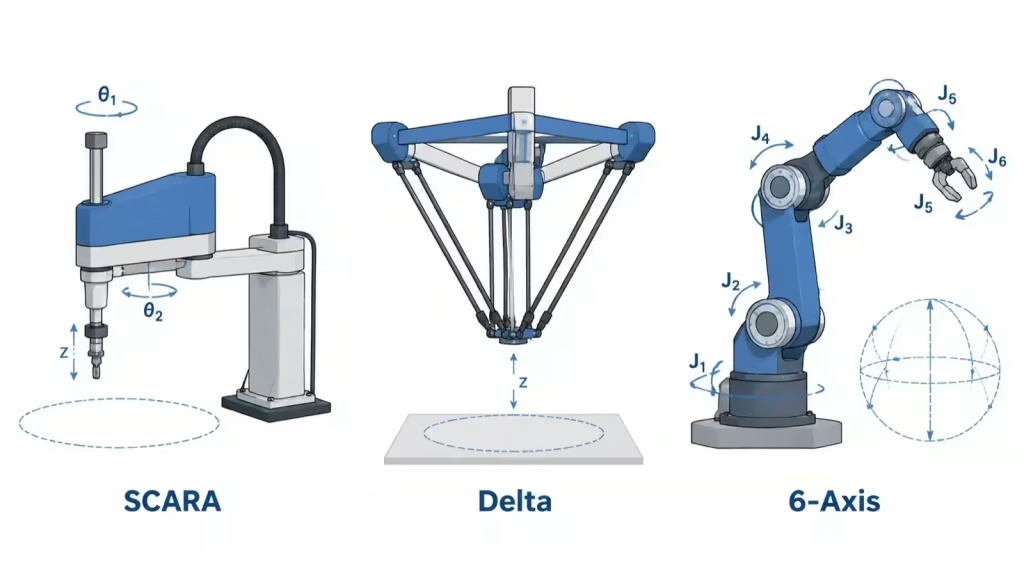
Due to their low payload ceiling, limited flat workspace, and lack of attitude degrees of freedom, Delta robots cannot be applied in scenarios requiring heavy loads, large depths, multiple attitudes, or complex obstacle avoidance. Such applications require multi-DOF articulated robots, such as six-axis or SCARA robots.
Recommended Related Reading from AI Robots Eidos
Six‑axis robots, with their multi‑degree‑of‑freedom flexibility and large working envelopes, are true “all‑rounders” – well suited for complex three‑dimensional tasks such as arc welding, assembly, and grinding.
SCARA robots, on the other hand, offer high speed, high precision, and excellent rigidity within their planar workspace, making them highly cost‑effective in electronics manufacturing and precision assembly.
If you would like to learn more about these two robot types, you are welcome to read the related articles.
Industrial 6 Axis Robots
SCARA Robots: Speed & Precision for Modern Assembly
Applications of Delta Robots
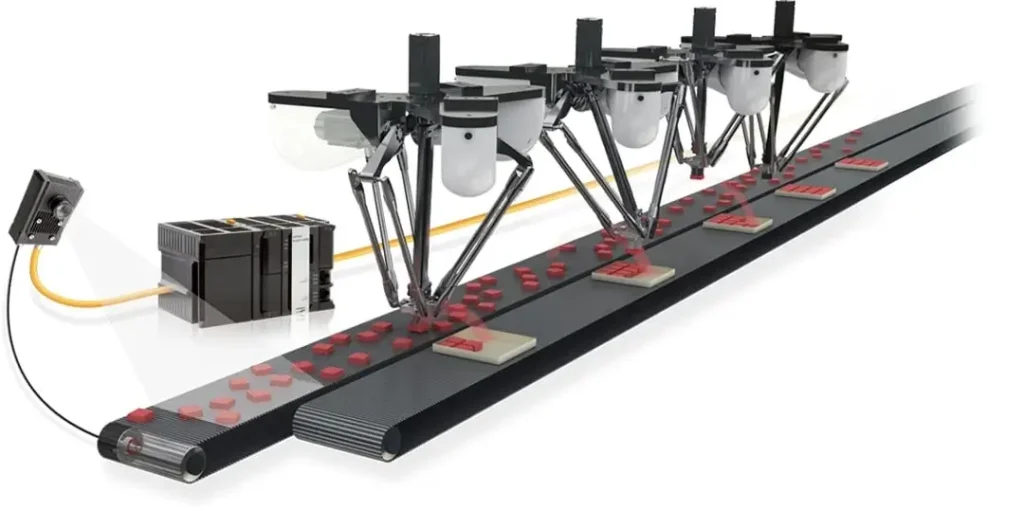
–Continuous dynamic sorting scenarios: Sorting of biscuits, candies, pre-packaged meals, bottled beverages, and similar items is a typical planar continuous dynamic sorting task. Workpieces move at constant speed on horizontal conveyors, requiring no significant height differences or complex attitude adjustments—only high-speed picking, horizontal translation, and precise placement. They fully unleash their core advantages of flat workspace, ultra-fast dynamic response, and micron-level repeatability, while their lightweight flexible motion structure effectively avoids crushing or damaging fragile or deformable workpieces.
–High-cleanliness scenarios: Hygienic-grade Delta models generally feature fully enclosed stainless steel bodies, streamlined structures, and IP67 or higher protection ratings as standard. Some high-end models support IP69K high-pressure water-wash protection, making them suitable for cleanroom and sterile workshop environments and fully compliant with GMP clean production standards. This combination of high-speed performance and high hygienic protection has made Delta robots the dominant choice in high-end clean scenarios.
Future Development Directions for Delta Robots
–High precision: New micro-Delta robots use two-photon polymerization and 3-dimensional precision manufacturing processes to achieve sub-micron motion positioning accuracy and an ultra-high operational bandwidth of 1000 Hz. They are suitable for ultra-micro sorting of precision electronic components and micro precision parts, completely breaking the precision limits of traditional Delta robots and opening new niche segments in micro-manufacturing and micro-sorting.
–Human-robot collaboration safety upgrades and greatly improved flexible production line adaptability: New-generation collaborative Delta robots feature proprietary Reflex Safety real-time collision detection technology, achieving millisecond-level human-robot contact sensing and emergency stopping. Combined with full-area radar safety perception systems, they build multiple layers of safety protection mechanisms, truly enabling safe human-robot mixed-line collaborative operations. This breaks the traditional limitation of Delta robots requiring enclosed, isolated operation, and is highly suitable for retrofitting small-batch, multi-variety, high-flexibility sorting production lines.
Insight from AI Robots Eidos
—Delta robots are no longer confined to light-industry sorting tasks such as food handling; they are expanding into ultra‑precision manufacturing fields including precision electronics, optical communication components, biochips, and micro‑mechanical assembly. In the future, Delta robots are likely to become the standard motion platform for microscale “desktop factories.” By integrating with technologies such as laser processing and micro‑droplet jetting, they will enable a convergence of “sorting + manufacturing,” completely breaking away from the traditional positioning of Delta robots as mere high‑speed material handlers.
—In the future, the control systems of Delta robots will embed self‑learning trajectory optimisation algorithms. Digital twin environments will automatically generate inverse kinematics solutions, and the systems will continuously refine cycle times and accuracy based on real‑world operational data. This means that on‑site engineers will no longer need to be kinematics experts; they will only need to input task parameters, and the robot will automatically “evolve” the optimal motion strategy. This capability will substantially reduce the adaptation cost of Delta robots in non‑standard scenarios, transforming them from “specialists” into “versatile flexible experts.”
—To overcome the inherent limitations of Delta robots—namely, their flattened workspace and small effective operating area—the future solution lies not in improving single units, but in deploying multi‑robot collaborative clusters. Through high‑speed communication buses and global vision systems, multiple Delta robots can share the same conveyor‑belt zone, dynamically partitioning their working areas in real time to create a “virtual large workspace.”
—Furthermore, by synchronising motion planning among robots via edge computing, a group of Delta robots can act like “collaborative arms” to perform tasks that require large spans or complex obstacle avoidance, all while maintaining high cycle rates. This approach will fundamentally change production‑line layout logic: instead of pursuing larger single‑robot reach, manufacturers will achieve high throughput and redundant reliability through low‑cost, multi‑robot clusters.
Image Credits: Proax & Researchgate & Evsint & Omron & Leobotics & Slideteam & Igus