
Table of Contents
Cobot palletizers, also known as palletizing cobot, can automatically handle the transportation and stacking of goods and have become an indispensable part of modern industrial production, gaining widespread application.
What is a cobot palletizer?
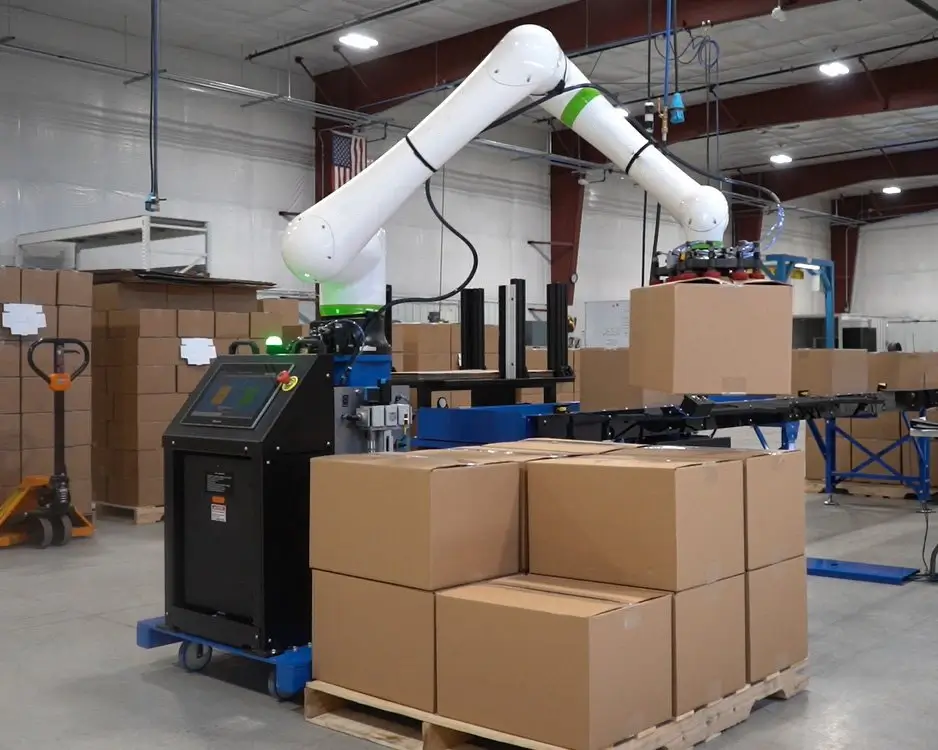
A cobot palletizer is a typical application of industrial robots. It integrates advanced technologies such as artificial intelligence, machine vision, and deep learning, enabling precise identification, grasping, handling, and stacking of goods, thereby accomplishing efficient, accurate, and flexible palletizing tasks.
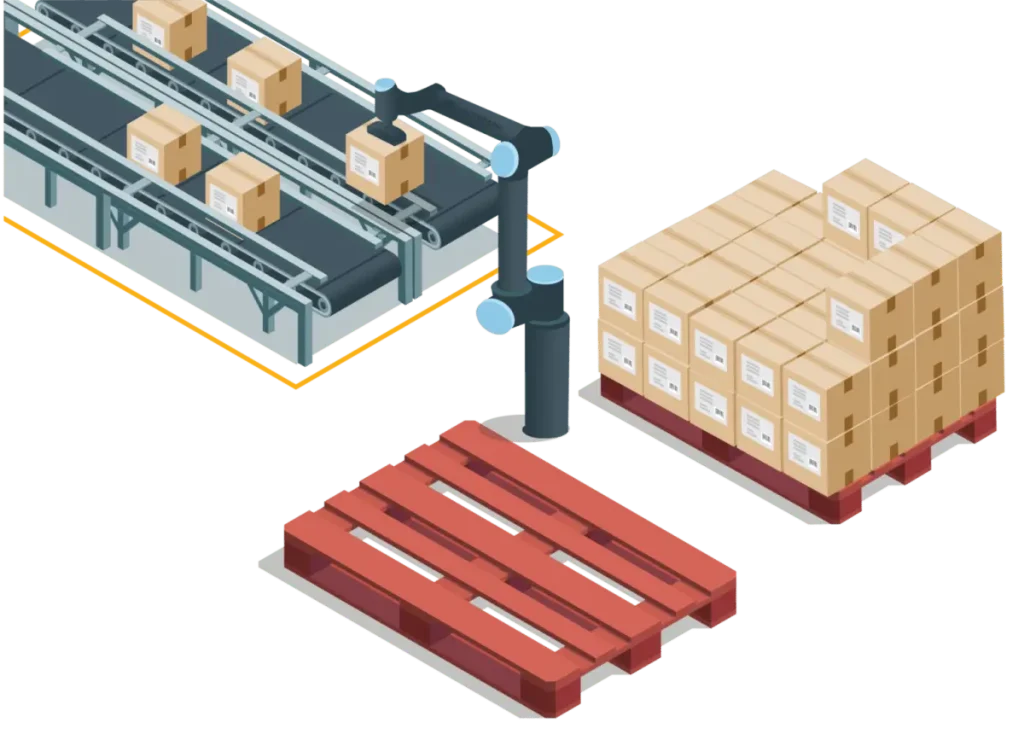
Different programs can be set according to different products and production requirements, and various end-effectors such as grippers, suction cups, and clamps can be used to complete palletizing tasks. They can also be combined with conveyor lines, automatic packaging equipment, etc., to form automated production cells.
Recommended Related Reading from AI Robots Eidos
Understanding collaborative robots (cobots) is fundamental to understanding cobot palletizers, as the latter are essentially a specialized application and extension of cobot technology within palletizing scenarios. Grasping the core characteristics of cobots helps in accurately identifying the technical advantages, suitable applications, and selection criteria for cobot palletizers.
The Principle of a Cobot Palletizer
The working principle of a cobot palletizer can be summarized as a “Perception-Decision-Action” loop:
–Perception: Sensors (e.g., vision sensors, force sensors) perceive the surrounding environment and information about the materials to be handled.
–Decision: Data is processed and analyzed based on preset programs or AI algorithms to formulate the optimal action strategy.
–Action: The robotic arm is driven to perform a series of actions, including grasping, moving, rotating, and placing, to complete the palletizing task.
Advantages of Cobot Palletizers
–Safety: Cobot palletizers incorporate multiple built-in safety mechanisms, such as force feedback control and collision detection, ensuring they do not pose a risk of injury when working alongside humans. According to an Interact Analysis report, the safety incident rate for collaborative robots dropped to 0.02% in 2023.
For low-speed palletizing scenarios, cobot palletizers will immediately stop if they encounter resistance in the direction of movement during the palletizing action, preventing personnel from being struck.
For high-speed palletizing scenarios, cobot palletizer workstations are equipped with safety radar, allowing users to define two-level safety zones based on their requirements. When a person enters the first-level safety zone, a buzzer sounds a warning, but the palletizing operation continues. When a person enters the second-level safety zone, to ensure personnel safety, the cobot palletizer will pause and maintain its current state; manual intervention is required to resume operation. It is worth noting that the safety radar’s protection logic is only active during the palletizing action itself, preventing unnecessary production interruptions.
–Easy Operation: The palletizing process of cobot palletizers requires calibrating the positions of the roller conveyor and the pallet. Unlike traditional industrial robots that use teach pendants for calibration, users simply need to activate the drag-and-teach function and manually move the end-effector to the designated position to complete the calibration, eliminating the need for teach pendant operation.
Cobot palletizers feature a compact multi-joint articulated design with built-in torque sensors in each joint. Combined with force control algorithms, this enables flexible and intuitive operation.
–Flexibility:
Supports multiple production lines: Cobot palletizers can be used with AGVs or mobile bases, enabling flexible deployment across different production lines and workstations, further increasing equipment utilization.
Supports various packaging types and product sizes: They can handle different types of goods, such as standard cardboard boxes or metal-surfaced items. They can also quickly adapt to different box sizes without complex programming.
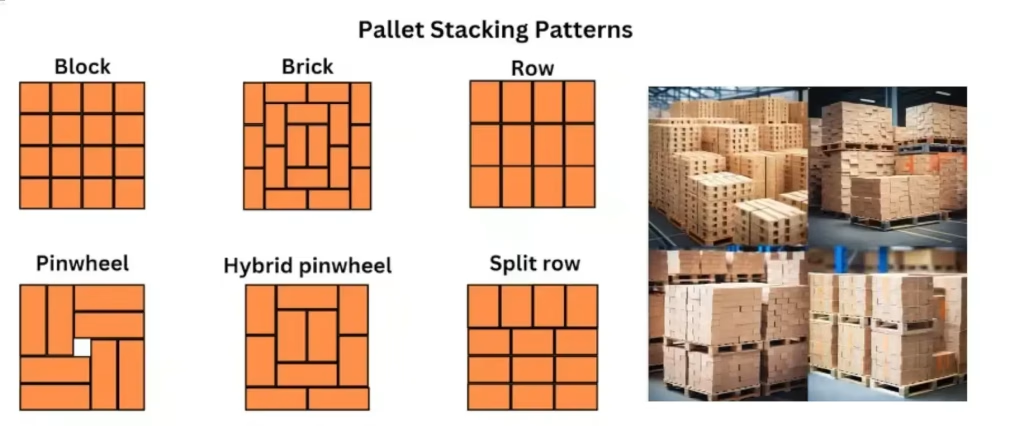
Supports various stacking patterns and adapts to different stacking heights and spatial requirements, such as column stacking, interlocking patterns, etc. Layer-to-layer errors can be controlled within ±0.2mm, ensuring stable and neat pallets.
–Cost-Effectiveness: Since cobot palletizers can be shared across multiple production lines, equipment utilization is high, effectively saving time, labor, and maintenance costs, thereby shortening the return on investment (ROI) period. Typically, ROI can be achieved within 6 to 12 months (this data is for reference only; the payback period varies depending on the cobot palletizer model).
Cobot Palletizer Workstation Introduction
It is an intelligent palletizing unit designed based on a collaborative robot control system, integrating flexible palletizing and real-time data communication technologies. Cobot palletizer workstations have a wide range of applications, including end-of-line packaging lines, large warehouse loading/unloading, and logistics nodes in industries like daily chemicals or food.
Components of a Cobot Palletizer Workstation
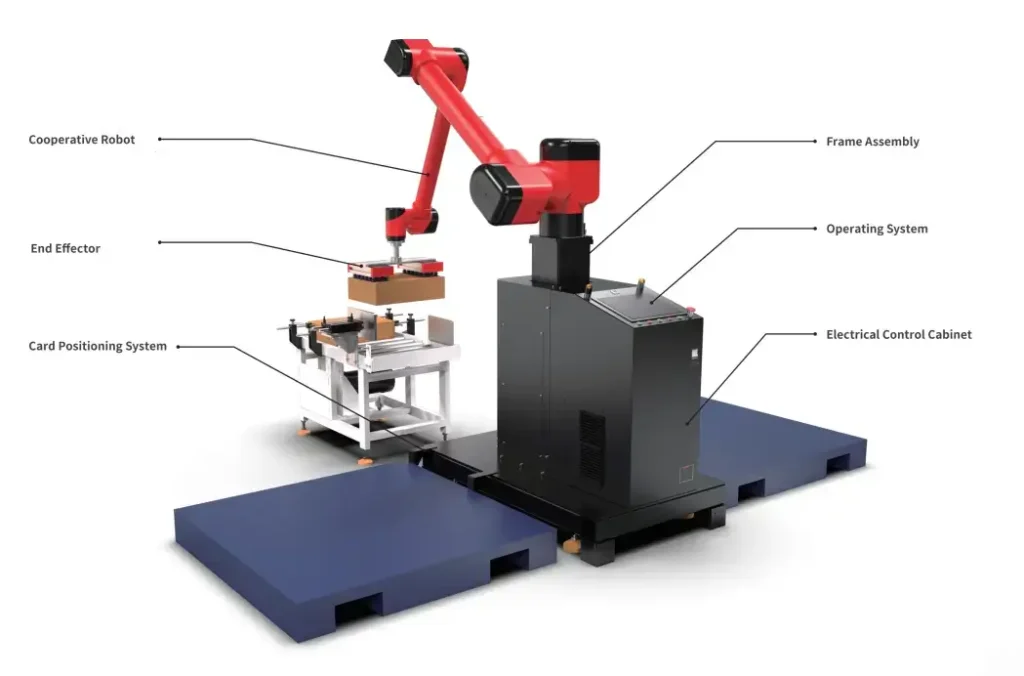
–Collaborative Robot: The core equipment responsible for grasping, handling, and palletizing materials.
–Operating System: Handles motion control, logic programming, and parameter settings for the robot.
–Electrical Control Cabinet: The power distribution and management system, designed for low energy consumption and easy maintenance.
–End-Effector: The device that directly grips or picks up materials via suction, which directly affects the adaptability and efficiency of the palletizing operation.
–Frame Assembly: Supports the collaborative robot arm and assists in completing palletizing actions such as lifting, lowering, and positioning.
–Card Positioning System: A mechanical positioning system designed for quick and convenient positioning, facilitating easy handling and transport.
Technical Specifications of Cobot Palletizers
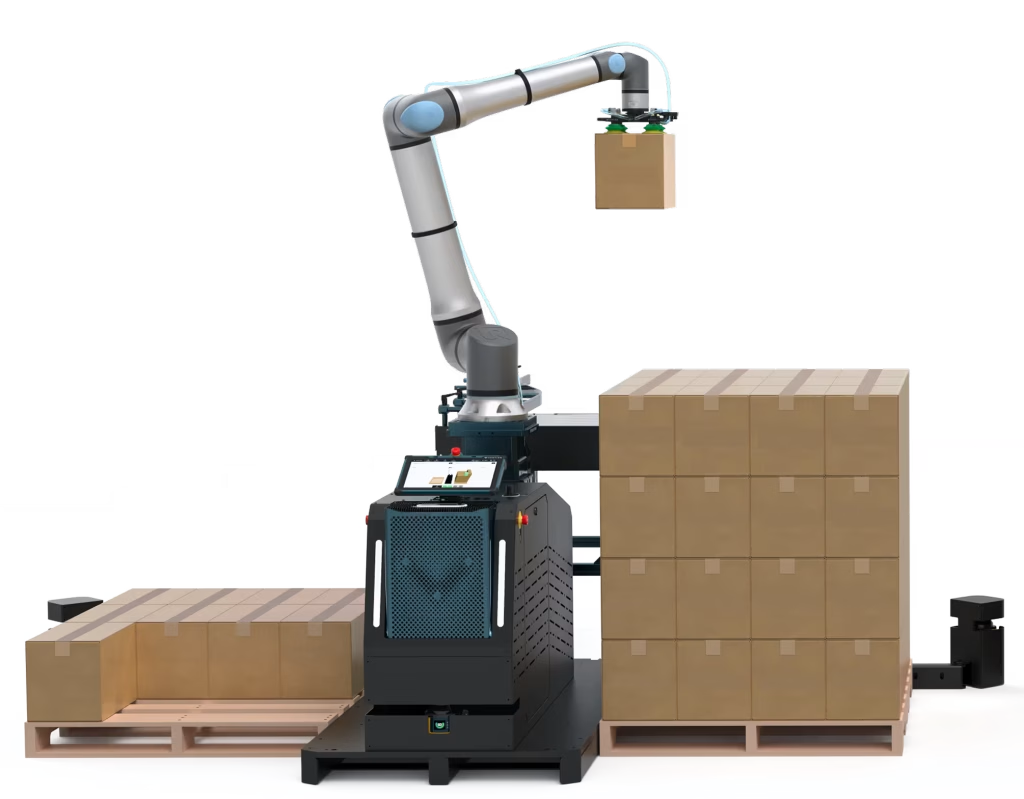
| Specification | Value |
| Payload | 20 kg |
| Working Radius | 1650 mm |
| Pallet Size (Max) | 1200 × 1000 × 100 mm |
| Vertical Reach | 1800 mm |
| Palletizing Speed | 12 cycles/min |
| Repeat Positioning Accuracy | ±0.02 mm |
| Communication | EtherCAT interface, expandable I/O |
| IP Rating | IP65 |
| Temperature Range | 0–50°C |
| Max Power Consumption | 2500 W |
| Rated Voltage | 220 V |
| Total Weight | 350 kg |
| Footprint (Floor Space) | 1260 × 780 mm |
Main Cobot Palletizer Manufacturers
–FANUC (Japan) – Offers a wide range of cobot palletizer models, widely used in food, beverage, chemical, and other industries, renowned for high precision and stability.
–ABB (Switzerland) – Provides efficient and flexible palletizing solutions suitable for various complex environments, with extensive industry application cases and a global service network.
–KUKA (Germany) – Offers high-performance cobot palletizers and system integration services, particularly suitable for palletizing large and heavy items, with deep expertise in automotive manufacturing and heavy industries.
–Yaskawa (Japan) – Focuses on industrial automation; its products are known for high precision and reliability, with globally leading technological accumulation in servo motors and motion control.
Applications of Cobot Palletizers
–Food Industry: The fast-moving consumer goods (FMCG) food industry has a significant demand for collaborative palletizing robots. This is because box specifications in this industry are relatively uniform, and the weight per box is mostly below 25kg, providing favorable conditions for efficient cobot palletizer operation. Simultaneously, the massive production volume in FMCG food manufacturing necessitates large-scale, high-efficiency palletizing tasks.
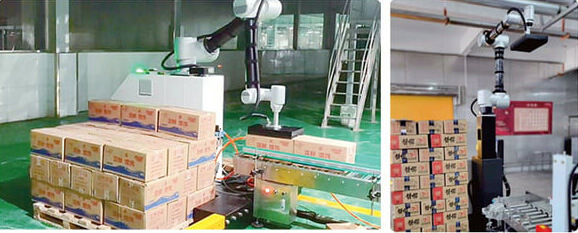
–Daily Chemical Industry: Personal care products encompass a diverse range of categories. Different consumer preferences for product efficacy, fragrance, packaging specifications, etc., require manufacturers to frequently switch production batches to meet varied market demands. Cobot palletizers, with their flexible programming capabilities and rapid task-switching features, can easily handle frequent batch changes, completing palletizing tasks efficiently and accurately.
–Warehousing Industry: In warehouse management, cobot palletizers can handle various items such as bags, barrels, and boxes, stacking them neatly for fast and accurate palletizing and storage, thereby improving warehouse management efficiency. They can also be integrated with automated high-bay warehouses for rapid inbound and outbound logistics.
Future Development Directions for Cobot Palletizers
–Intelligent Upgrades: Traditional robots rely on predefined paths. The new generation of cobot palletizers will deeply integrate AI and vision technologies. They will be able to quickly “understand” chaotic, unordered stacks of goods and calculate the optimal grasping points and stacking patterns. This will significantly enhance the flexibility and stability of cobot palletizers in complex logistics environments.
–Human-Robot Collaboration: In the next five years, robots will be equipped with more sophisticated multi-dimensional sensing systems (force, tactile, proximity), enabling millimeter-level safety responses, ensuring absolute reliability when sharing space with human coworkers. Operation methods will also become more intuitive; for example, natural language commands will significantly lower the operational barrier, allowing production line workers to easily manage robots.
–Expansion of Performance Boundaries: To meet broader industrial demands, the payload capacity of collaborative palletizing robots will continue to increase (exceeding 20kg or higher), working radii will expand further, and speed and precision will be optimized simultaneously. Modular design will become mainstream, with end-effectors (grippers) enabling “plug-and-play” functionality for quick adaptation to goods of different shapes and materials, dramatically improving production line changeover efficiency.
Insight from AI Robots Eidos
Cobot palletizers continuously generate vast amounts of data during operation—including cycle time data, fault logs, energy consumption information, and material characteristics. In the future, this data will enable closed-loop feedback through industrial internet platforms, not only optimizing the palletizing strategies themselves but also providing decision-making support for upstream packaging design and downstream warehouse scheduling. Palletizing will no longer be merely “manual labor” but a critical node in the data value chain.
Current safety mechanisms (such as collision detection and two-level safety zones) still primarily rely on “response upon risk occurrence.” The future direction will be AI-driven behavioral prediction—systems will deeply learn human operational habits and motion trajectories through deep learning, enabling them to anticipate potential collision risks in advance and proactively adjust motion paths, achieving true “preventive safety.” This will completely eliminate the common pain point in collaborative scenarios where “machines frequently stop to ensure safety.”
The capability of a single device is ultimately limited. The future direction lies in forming collaborative clusters of multiple devices, coordinated through a unified scheduling system that enables task allocation, path coordination, and mutual avoidance. In large-scale logistics centers, multi-machine collaboration will significantly improve overall throughput while maintaining coordination capabilities even in the event of single-point failures.
Image Credits: Universal-robots & Web & Zetagroupengineering & Linkedin & Sirosilo & Rocketfarm