
Table of Contents
A multi-AGV scheduling system is the “neural center” of AGV fleets, enabling collaborative operations, task allocation, and resource optimization across multiple AGVs, thereby improving the overall operational efficiency and intelligence of the AGV cluster.
Definition of the Multi-AGV Scheduling System
The multi-AGV Scheduling System is the “brain” or “neural center” of an AGV (Automated Guided Vehicle) fleet and a core component of the upper-level AGV control software. It is primarily designed to address collaborative operations among multiple AGVs in a shared road network, achieving efficient, safe, and orderly multi-AGV operation through global coordination and local fine-tuning.

It is mainly applicable to industrial automation and smart logistics scenarios with a large number of AGVs, complex transport routes, and frequent material handling—such as automotive manufacturing, smart warehousing, and large factories—with the goal of improving the efficiency of multiple AGVs.
Recommended Related Reading from AI Robots Eidos
AGVs need to be liberated from the limitations of single‑vehicle operation by the scheduling system. Through global coordination, path optimization, status monitoring, and system integration, the scheduling system consolidates multiple AGVs into an efficient, collaborative fleet, thereby achieving a leap in overall logistics efficiency.
Understanding the automated material‑handling nature of AGVs is the logical starting point for comprehending the role of a multi‑AGV scheduling system. Readers are encouraged to read this article, which provides a detailed introduction to AGVs.
Automated Guided Vehicles(AGVs): The Complete Guide
Architecture of the Multi-AGV Scheduling System
The three-tier hybrid architecture is the mainstream architecture for multi-AGV Scheduling Systems. This architecture achieves global route planning, regional order control, and local fine-tuning by individual vehicles, preventing large-scale congestion in AGV clusters at the architectural level.
–Cloud Scheduling Layer (Global Coordination): Interfaces with upper-level business systems such as WMS, MES, and ERP. Responsible for long-term task decomposition, global road-network load statistics, cross-workshop large-scale task assignment, and digital-twin simulation preview. Performs macroscopic global route planning at second-level intervals without intervening in millisecond-level real-time obstacle avoidance.
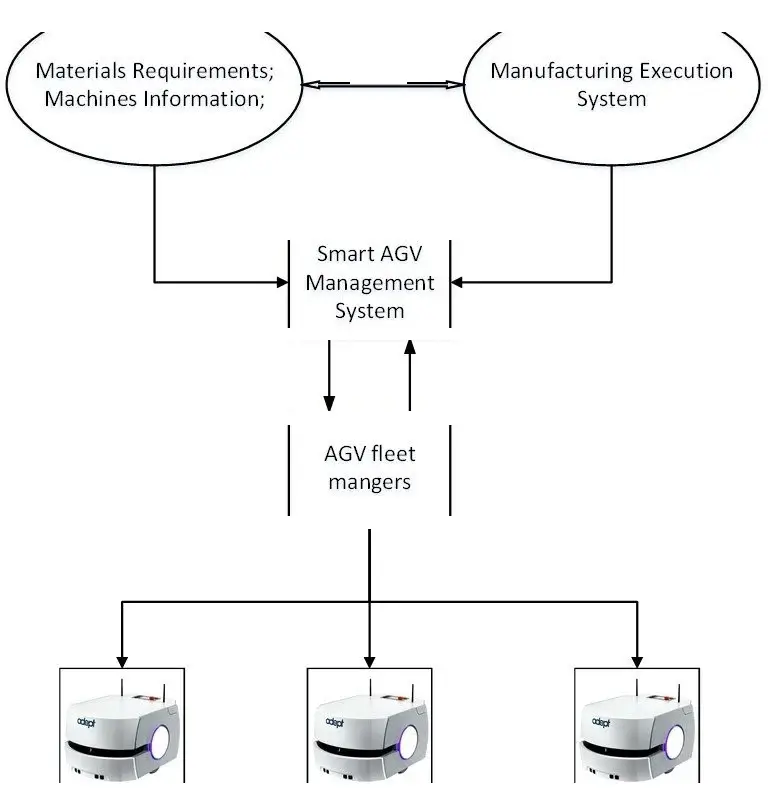
–Edge Scheduling Layer (Regional Control): The factory site and workshops are divided into independent edge control units. A single edge node manages 50–200 AGVs, handling conflict detection, time-slot allocation, congestion relief, and deadlock identification within its region. Detection latency is reduced to 5–15 ms, making this the core execution layer for anti-congestion in the plant.
–Terminal Device Layer (Individual Execution): AGVs are equipped with onboard controllers that rely on laser SLAM and vision-based fusion positioning to perform local dynamic obstacle avoidance and minor path adjustments. They receive instructions from edge nodes to execute acceleration/deceleration, yielding, and on-the-spot waiting. Autonomous local avoidance serves as the final safety backup.
–Communication Assurance Layer: Uses Wi‑Fi 6 or industrial Ethernet to ensure real-time interaction between scheduling commands and AGV status data (latency < 100 ms). Supports common protocols such as OPC UA and MQTT, and is compatible with command sets from different AGV brands.
Functions of the Multi-AGV Scheduling System
–Task Assignment: Task assignment is not simply “dispatch the nearest AGV to execute the task.” It is a classic combinatorial optimization problem that requires comprehensive consideration of vehicle position, battery level, load status, and task priority. The objective is to minimize overall operation time and empty travel. Industry field data shows that a good scheduling system can raise the overall fleet efficiency to above 85% of single-vehicle efficiency—15–25 percentage points higher than manual dispatch.
–Path Planning
AGV path planning is divided into global planning and dynamic replanning.
Global planning finds the optimal path on a known map, with the A* algorithm and its weighted variants being the mainstream choice. Note that “shortest” does not necessarily mean “fastest”—the shortest path may pass through congested areas. In engineering practice, a congestion coefficient is added to the cost function, allowing vehicles to take slightly longer routes with lighter traffic.
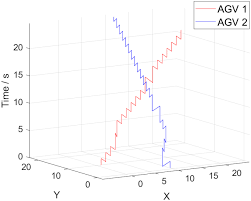
Local dynamic replanning primarily handles environmental changes—for example, when a lane is temporarily occupied by a material cart. The D* (Dynamic A*) algorithm recalculates only the affected segments rather than replanning from scratch, greatly improving response speed. The current mainstream architecture is “edge-hybrid”: workshop-level edge servers handle millisecond-level traffic control and obstacle avoidance, while the cloud handles long-cycle task planning. Tests show that edge nodes can complete path replanning for hundreds of vehicles within 50 ms. For purchasing companies, a good question to ask is: “How long does it take for the fleet to return to normal?”—whether the answer is seconds or half a day directly reflects the system’s dynamic capability.
–Traffic Control:
Preventing collisions among multiple AGVs in a plant relies not on onboard radar (which is the last line of defense) but on scheduling-level “traffic rules”:
Intersection locking (mutual-exclusion zone management): Intersections are treated as mutually exclusive resources—only one AGV is allowed to occupy an intersection at any given time, while others queue outside the lock, effectively installing a traffic light at the crossing.
One-way lane rules: Key narrow passages are set to one-way flow, eliminating head‑on situations from the outset. A well-designed one-way layout can reduce empty-load detour rates from 35% to 10%.
Time-slot resource reservation: Before passing through a segment, each AGV “reserves” a time window with the scheduler, similar to high-speed rail dispatching, separating conflicts in the time dimension.
–Status Monitoring:
Real-time monitoring of AGV position, battery level, and operating status enables automatic dispatch of low‑battery AGVs for charging and exception handling for faulty AGVs, ensuring continuous system operation.
Tips from AI Robots Eidos: For purchasing companies, rather than watching demo videos or PPTs from AGV manufacturers, the most accurate way to assess the effectiveness of a Multi-AGV Scheduling System is to demand an on‑site demonstration: after one AGV breaks down in the middle of the route, observe how quickly the remaining vehicles restore order. This gives a much clearer picture of the system’s real capabilities.
Workflow of the Multi-AGV Scheduling System
–Task Ingestion: The WMS/MES system sends transport tasks via API, which enter a task pool queue.
–Task Assignment: Based on a genetic-algorithm-driven MTSP (Multiple Traveling Salesman Problem) model, tasks are assigned to the optimal AGV by comprehensively considering distance, load, and priority.
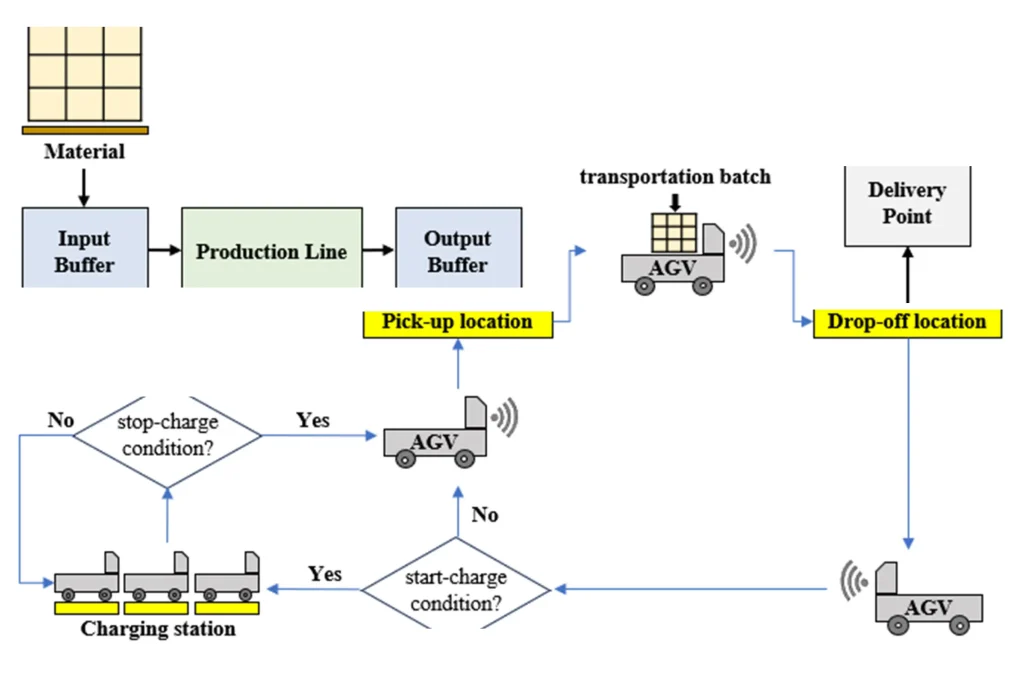
–Global Path Planning: A spatiotemporal A* algorithm generates conflict‑free paths with timestamps for each AGV.
Background: Traditional A* searches in the (x, y) 2D space, while spatiotemporal A* extends states to (x, y, t) in 3D, directly avoiding nodes that are already occupied at a future time—eliminating collision risks at the planning stage.
State definition: Each search node contains spatial coordinates (x, y) and time step t. The evaluation function f = g + h:
g(n): actual cost from start to current node (steps + turning penalty)
h(n): Manhattan distance heuristic, ensuring optimality
Constraint: (x, y, t) must not appear in the global reservation table.
–Congestion Detection and Resolution: Real‑time validation against the global reservation table, with tiered handling of node congestion, etc.
Background: When congestion occurs, the priority in the Multi-AGV Scheduling System is not fixed but dynamically computed from multiple dimensions:
Task priority: emergency orders > regular transport > charging tasks
Battery factor: AGVs with battery below a threshold receive priority passage to prevent mid-route breakdowns
Yield count: continuously yielding AGVs accumulate higher priority to avoid “always yielding” for the same vehicle
Remaining path: AGVs with longer remaining paths receive priority to minimize global waiting cost.
–Command Issuance: Path point sequences are sent to AGV controllers in segments, with dynamic fine‑tuning during execution.
–Status Feedback Loop: AGVs send back real‑time position, battery, and fault information, allowing the scheduler to dynamically adjust subsequent tasks.
Algorithms Involved in the Multi-AGV Scheduling System
Global Static Path Planning Algorithms
Route pre‑planning based on the plant’s static map, mostly used in stable production scenarios.
–Improved A + JPS (Jump Point Search): Currently the most common industrial solution. JPS skips non‑critical grid nodes, improving computational efficiency by more than 10 times over traditional A, balancing path optimality and compute consumption, suitable for conventional clusters of several hundred AGVs.
–Dijkstra’s algorithm: Absolutely optimal in cost but computationally heavy, often used in high‑precision, small‑scale heavy‑load AGV scenarios such as semiconductor wafer fabs.
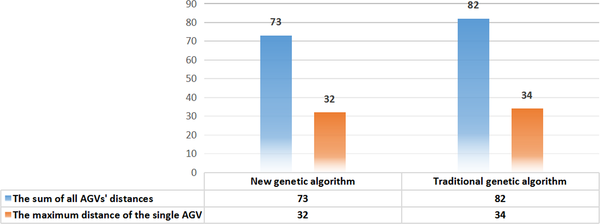
–Genetic algorithms: Used for very large clusters of over 1,000 AGVs, iteratively optimizing overall multi‑vehicle routes—sacrificing per‑vehicle optimality for global network throughput.
Local Dynamic Replanning
Relies on real‑time on‑board algorithms for immediate path changes, mainly addressing temporary material stacking, pedestrian crossing, and equipment failures.
–-DWA (Dynamic Window Approach): Computes velocity and trajectory at high frequency, enabling millisecond‑level fine‑tuning of driving paths, ideal for close‑range emergency obstacle avoidance.
–MPC (Model Predictive Control): Predicts the short‑term movement trajectories of surrounding AGVs and decelerates/reroutes in advance—a standard algorithm for plants with mixed human‑vehicle traffic.
Overview of Multi-AGV Scheduling System Technologies from Leading AGV Manufacturers
Based on the PW Consulting report, the following outlines the capabilities in terms of fleet scheduling, anti‑congestion, and heterogeneous compatibility.
Siemens Simove
—Strengths: Excellent compatibility with the industrial OT ecosystem, deep integration with Siemens PLC production lines, top‑tier centralized scheduling stability, and excels in fixed‑route large‑scale AGV scheduling in automotive assembly plants.
—Weaknesses: Relatively weak in distributed dynamic obstacle avoidance and limited mixed‑fleet scheduling across heterogeneous brands.
Swisslog SynQ Veo
—Strengths: Mature time‑window scheduling algorithms, industry benchmark for congestion control in warehousing, certified to ISO3691‑4 safety standards.
—Weaknesses: High computational cost; significant performance pressure for clusters above 1,000 AGVs, which imposes cost burdens on SMEs.
Dematic
—Strengths: Focused on large‑scale overseas logistics warehousing and distribution scenarios, with outstanding predictive scheduling capabilities—leverages big data to forecast order‑peak traffic.
—Weaknesses: General adaptability to manufacturing plant scenarios is moderate.
Future Directions of Multi-AGV Scheduling Systems
—The traditional closed‑ecosystem of a single brand is breaking down. Many plants now mix traditional magnetic‑strip AGVs, laser‑SLAM AMRs, and vision‑guided robots. Cross‑brand communication and cross‑model coordination have become urgent needs, which will accelerate the adoption of open protocols such as Open‑RMF and VDA5050.
Recommended Related Reading from AI Robots Eidos
VDA5050 provides a standardized data interaction framework for the scheduling system, driving its evolution toward cloud‑native and microservices architectures, and laying the foundation for integrating a wider range of equipment and implementing more intelligent scheduling algorithms.
Readers who wish to gain a deeper understanding of VDA5050 are encouraged to read this article.
VDA5050 Protocol
—Scheduling systems will incorporate large‑model semantic understanding, enabling recognition of pedestrian and temporary‑material movement intentions. Instead of relying purely on physical sensors for collision avoidance, they will preemptively relieve congestion and move away from the inefficient “emergency stop upon obstacle detection” mode.

—Before introducing new equipment, 3–7 days of production traffic will be simulated in a digital‑twin system to optimize road‑network partitioning and scheduling parameters in advance. This resolves congestion and other issues at the simulation stage, greatly shortening on‑site commissioning cycles.
Insight from AI Robots Eidos about Multi-AGV Scheduling Systems
—The future digital twin will no longer be an “offline sandbox” but a “shadow system” synchronized with the physical world at the millisecond level. Using real‑time telemetry data—such as speed deviations caused by tire slippage or road surface wear—it will automatically generate new congestion prediction models on the virtual side and push them back to the scheduling system, achieving “one algorithm optimization per trip.” When purchasing companies perform acceptance testing, they should look not at a demo but at the deviation rate between the twin system’s predictions and actual operational data.
—The future multi-AGVscheduling system will no longer care whether a vehicle uses magnetic strips, QR codes, or SLAM (Simultaneous Localization and Mapping). The system will only define “right‑of‑way rules” (e.g., speed limits on certain sections, load priority, yielding at turns). Each AGV simply translates its own physical capabilities—braking distance, turning radius, etc.—into a “semantic” language that the system understands. The scheduler can then dynamically generate “traffic rules” for devices of different ages and brands, fundamentally eliminating the cumbersome era of interface adaptation.
—Future multi-AGV scheduling systems will no longer plan solely based on current static maps; instead, they will dynamically generate a 15‑minute‑ahead “road‑network heatmap” using time‑window reservation tables. The top priority of the algorithm will shift to “time certainty” rather than “shortest distance.” This leads to a novel strategy: deliberately slowing down some vehicles or sending them on longer routes to achieve “zero emergency stops” across the entire fleet, thereby protecting mechanical lifespans and significantly reducing energy consumption.
Image Credits: Researchgate & Linkedin & Plos & Mdpi & Damon-group