Table of Contents
A Cartesian robot, also known as a Cartesian coordinate robot, is a common type of automation equipment used in industrial applications. Its main characteristics include a simple structure, relatively low cost, and clear system architecture, which is why it is widely used in automated production lines, assembly lines, inspection lines, and similar settings.
What Is A Cartesian Robot?
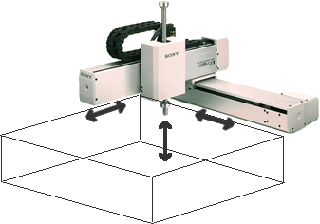
A Cartesian robot is a simple three-axis robot that consists only of linear actuators for its three primary axes. It is an industrial robot that performs linear motion in space. These robots move along mutually orthogonal/perpendicular X, Y, and Z axes. These linear motions can be performed individually or in combination, enabling arbitrary movement in space and forming a cubic workspace/envelope.
Components of A Cartesian Robot System
–Linear Motion Axes: Also called linear motion units, each is an independent motion axis primarily composed of aluminum or steel profiles that support the structure, linear guides installed inside the profiles, moving carriages/sliders, and timing belts that drive the carriages at high speed.
–Drive System of the Motion Axes: The transmission of Cartesian robots is mainly achieved through drive motors that rotate timing belts, which in turn move the carriages on the linear guides. Stepper motors are typically chosen when the maximum speed of the drive axis is below 600 RPM; otherwise, AC servo motors are used.
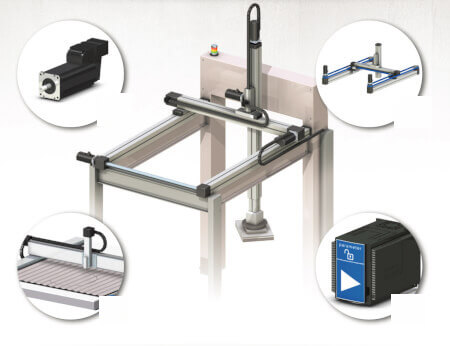
–Control System: The robot must complete specific tasks within a defined time frame and coordinate and synchronize with related equipment via communication or I/O ports. Therefore, the CNC (Computer Numerical Control) system must be selected based on specific application requirements, including the number of control axes, the number of I/O ports, and software functionalities. The control system is typically composed of a CNC system, PLC (Programmable Logic Controller), industrial PC, and I/O port-driven motors.
–End Effector: Depending on the specific application, the end effector can be a pneumatic suction cup, gripper, welding torch, glue gun, specialized tool, or inspection instrument.
Operational Workflow of A Cartesian Robot
–Sensor Data Acquisition: The robot uses sensors mounted on the base or beams to acquire real-time position and orientation information about the workpiece, providing necessary data for subsequent motion control.
–Motion Planning: Based on the position and orientation information of the workpiece, the control system performs motion planning. It determines the motion trajectory and speed along the three axes to ensure the robot can reach the target position accurately.
–Motion Execution: The actuators execute the commands from the control system, implementing motion along the three axes and controlling the tool end to complete operations such as picking, moving, placing, and machining.
–Feedback Control: The robot continuously collects real-time position and orientation data through sensors, compares it with preset target values, and performs feedback control to ensure motion accuracy and machining quality.
–Operation Completion: After completing the task, the robot returns to its home position or standby position, ready for the next cycle.
Advantages of Cartesian Robots
–High Configuration Flexibility: They can be flexibly combined into various structural forms, such as gantry-type, cantilever-type, wall-mounted, or inverted configurations, to suit actual spatial requirements. In practice, there are nearly a hundred structural variations of Cartesian robots, and these structures can be freely combined to create new ones.
–Simple Operation: Cartesian robots are favored for their structural simplicity. Since their motion paths are linear, path planning is straightforward, making them easy to build, teach, and program, thus lowering the barrier to operation.
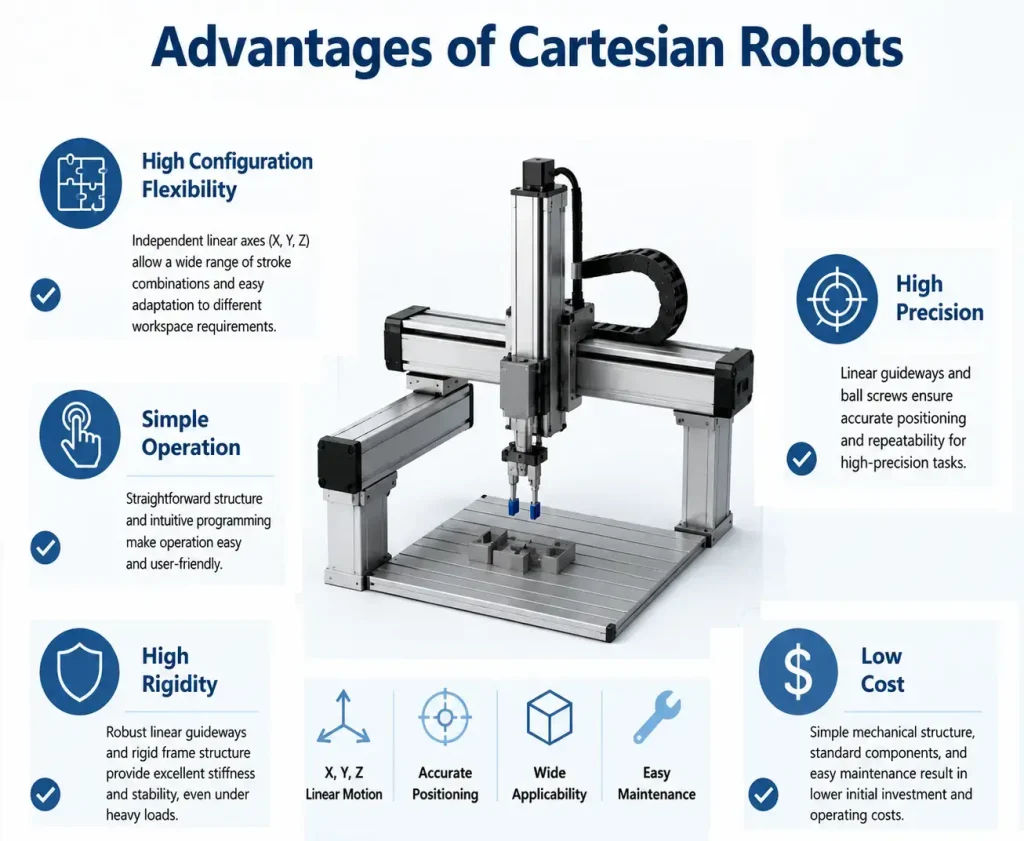
–High Precision: Because they only perform simple linear motions along the orthogonal X, Y, and Z axes, their kinematic models are simple and easy for computers to control precisely. Their repeatability accuracy can reach between 0.05 mm and 0.01 mm across the entire travel range, making them ideal for high-precision applications.
–High Rigidity: Through a fundamental design combining decoupled structure, robust framework, and heavy-load support, Cartesian robots achieve very high mechanical rigidity. The load capacity of a single linear motion unit is typically under 200 kg, but when using multiple rails and carriages, the load capacity can increase to several tons.
(Note from AI Robots Eidos: Decoupling refers to the Cartesian robot’s use of X, Y, and Z orthogonal linear motion structures, where the motion of each axis is independent and does not interfere with the others.)
–Low Cost: The simple construction of Cartesian robots allows them to be manufactured with fewer parts. Therefore, compared to articulated robots, they have lower construction costs. Additionally, due to simple programming, easy staff training, and convenient maintenance, operational costs are also low. From a total cost perspective, Cartesian robots offer excellent economic viability.
Disadvantages of Cartesian Robots
–Large Footprint: Cartesian robots need to move along three orthogonal linear axes (X, Y, Z) and typically require significant clearance and retreat space outside the working area. Among all types of industrial robots, Cartesian robots demand the largest operational space.
–Limited Speed and Acceleration: Because of their linear structure and long guide rails, they have high motion inertia, resulting in relatively slow overall movement speeds. This makes them unsuitable for high-production-rate applications.
–Limited Flexibility: Cartesian robots cannot perform complex curvilinear motions; they only execute simple repetitive tasks along predetermined paths. They struggle to adapt to operations requiring complex spatial trajectories or intricate orientations.
Cartesian and SCARA Robots
–Payload Capacity: Maximum payload varies from robot to robot. The robot’s load capacity must exceed the total weight of the payload. Because all the joints of a SCARA robot are located at the end of the arm, its payload capacity is limited, making it more suitable for small‑part assembly. Cartesian robots, on the other hand, can handle larger payloads due to the inherent rigidity of their structure.
–Reach/Distance: Cartesian robots are better suited for moving parts over long distances, whereas SCARA robots (or six‑axis robots) are more restricted to the base’s working range.
–Motion Capability: Cartesian robots can only perform linear motion and cannot execute rotational movements. SCARA robots have two rotary joints, which allow them to perform more complex motions than Cartesian robots.
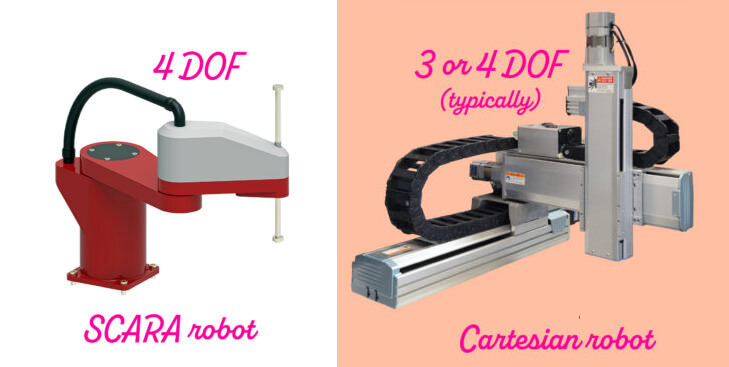
| Feature | SCARA Robot | Cartesian Robot |
| Structure | Selective Compliance Articulated Robot Arm (horizontal joints) | Linear X-Y-Z axes arranged orthogonally |
| Degrees of Freedom (DOF) | Typically 4 DOF | Typically 3 DOF |
| Motion Type | Horizontal compliance, vertical rigidity | Linear motion along each axis |
| Workspace Shape | Cylindrical | Rectangular/Cuboidal |
| Precision | High | Very high |
| Speed | Fast in horizontal motion | Moderate |
| Payload Capacity | Low to medium | Medium to high |
| Programming Complexity | Medium | Simple |
| Installation & Footprint | Compact; fixed on base | Large footprint; needs frame or gantry |
| Best Suited For | Pick-and-place, assembly, packaging | CNC, precise linear operations |
| Cost Range | Moderate | Cost-effective |
| Flexibility | Moderate (mostly planar motion) | Low (linear only) |
Recommended Related Reading from AI Robots Eidos
If readers are not familiar with SCARA robots, please read this article about SCARA robots first to better understand the differences between the two types of robots.
SCARA Robots: Speed & Precision for Modern Assembly
Product Parameters of Cartesian Robots (For Reference Only)
| Parameter | Value/Description |
| Product Name | Lightweight Cartesian Robot |
| Load Capacity | 40 kg |
| X-axis Maximum Speed | 130 m/min |
| Z-axis Maximum Speed | 100 m/min |
| A-axis Maximum Speed | 180 °/s |
| Repeat Positioning Accuracy | ±0.05 mm |
| Guide Rail Type | Λ-track |
| Transmission Mode | Gear and rack drive |
| Drive Mode | Servo motor |
| Control Mode | Dedicated robot controller |
| Programming Method | Teach pendant |
Selection, Installation, and Maintenance of Cartesian Robots
Selection
First, choose the robot’s external structure based on load capacity, travel distance, production cycle time, and workspace constraints.
After selecting the structure, determine the type and model of each axis according to travel distance, deflection, and other factors.
For heavy loads or high impact forces, consider combining 2 or 4 motion axes into a composite motion axis.
The assembly of individual motion axes is critical. Not only must perpendicularity be ensured, but sufficient resistance to impact forces and deflection must also be considered in all directions.
Since the robot must complete one motion cycle within seconds, the drive motor selected must provide sufficient driving force—typically double the theoretically calculated value.
For applications requiring ultra-high dynamic performance and extremely high positioning accuracy, linear motors can be used. However, linear motors present challenges in installation, protection, heat dissipation, collision risk, and control complexity, so their selection requires careful consideration.
Installation
Cartesian robots generate significant impact forces during acceleration and deceleration, so they must be firmly mounted on support structures.
The support structure must have sufficient impact resistance to ensure no vibration occurs under long-term high-speed, high-dynamic motion.
Additionally, parallelism, flatness, and perpendicularity between motion axes must be ensured during installation.
Maintenance
Typically, the linear guide rails on each motion axis of a Cartesian robot require periodic lubrication through the oil nipples on the carriages after a certain amount of travel.
The lubrication interval varies depending on usage conditions. In industries such as food processing, motion axes with dust-proof belts should be chosen, and the lubrication interval should be shortened.
Applications of Cartesian Robots
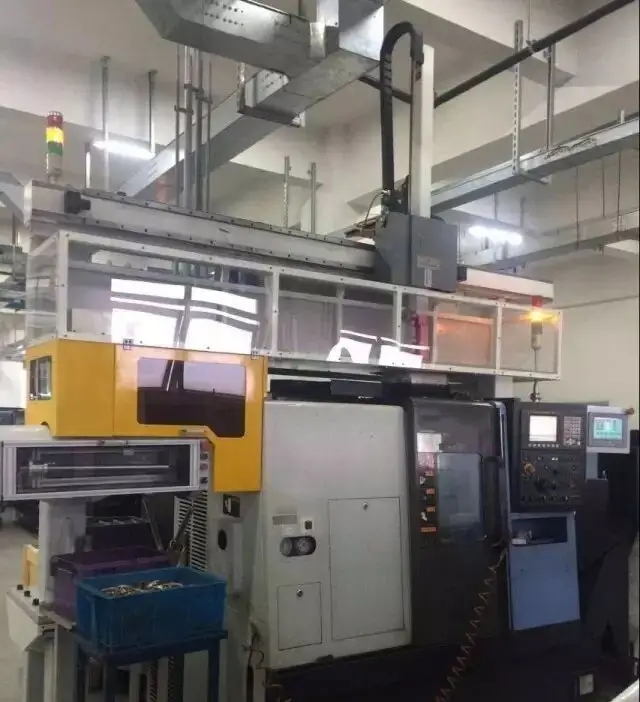
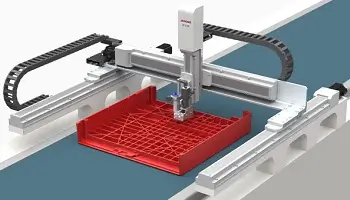
Cartesian robots represent a low-cost, systematically simple automation solution. By utilizing different end effectors, they can be employed in a wide variety of automated equipment for tasks such as dispensing, potting, spraying, palletizing, sorting, packaging, welding, metalworking, material handling, machine loading/unloading, and assembly—common industrial production fields. They offer significant value in improving production efficiency and stabilizing product quality.
Insight from AI Robots Eidos about Cartesian Robots
Future Cartesian robots will serve as a standardized skeleton for flexible manufacturing systems, much like “Industrial LEGOs.” Enterprises can quickly reconfigure the robot structure based on production line needs, just like building blocks, without the need to custom-design complex bodies as required by articulated robots. This “plug-and-play + on-demand combination” model will significantly shorten production line transformation cycles, enabling small and medium-sized enterprises to achieve flexible production at low costs.
In the era of AI and big data, while the complex algorithms of articulated robots are still grappling with issues such as “singularities” and “inverse kinematics with multiple solutions,” Cartesian robots—leveraging their linear, decoupled, and predictable motion characteristics—can more efficiently integrate with digital twins, cloud-based monitoring, and AI scheduling systems. In the future, the combination of “simple structure + intelligent algorithms” may hold greater advantages in practical deployment than “complex structure + ordinary algorithms.”
With the explosive growth of industries such as new energy (e.g., lithium batteries, photovoltaics), aerospace, and large-scale casting, the demand for ultra-long stroke and ultra-high payload capacity is becoming increasingly urgent. Leveraging their high rigidity and heavy-load capabilities, Cartesian robots have the potential to become an underestimated “heavy-lift champion” in scenarios such as heavy-duty material handling and large workpiece machining.
Image Credits: Linearmotiontips & Omron & Janomeie & Web & Motioncontroltips