
Table of Contents
Frameless torque motors consist of only two parts – a stator and a rotor. By being embedded directly into equipment, they enable compact design and efficient power transmission. Characterized by low-speed, high-torque output, they eliminate intermediate mechanical transmission components, thereby reducing energy loss and system inertia while improving response speed and precision.
Definition of a Frameless Torque Motor
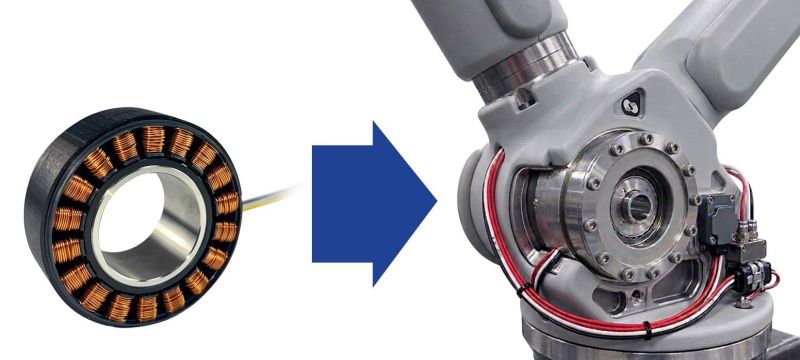
A frameless torque motor completely abandons the external metal housing, independent drive shaft, precision bearings at both ends, flange end caps, coupling, and separate housing for the position feedback device that are essential for conventional motors. The motor consists solely of two core components: the stator and the rotor.
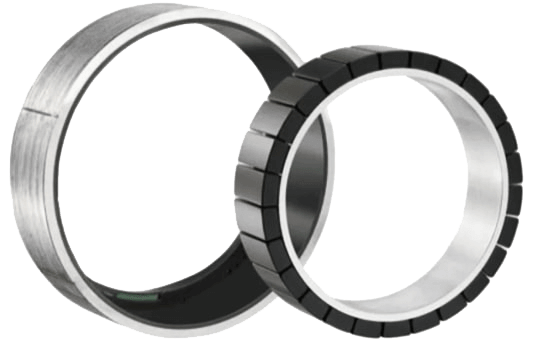
The central idea of this architecture is to achieve “structural integration” of motor components with the robot’s mechanical body. The robot joint’s own metal housing (typically made of lightweight, high-strength aluminum or magnesium alloy) simultaneously serves as the motor’s stator housing; the joint’s rotating central shaft directly becomes the motor’s rotor output shaft; and the cross-roller bearing system supporting the mechanical structure within the joint directly assumes the responsibility of supporting the motor rotor and maintaining the air gap. This deep structural integration reduces system size and mechanical complexity.
Structure and Principle of Frameless Torque Motors
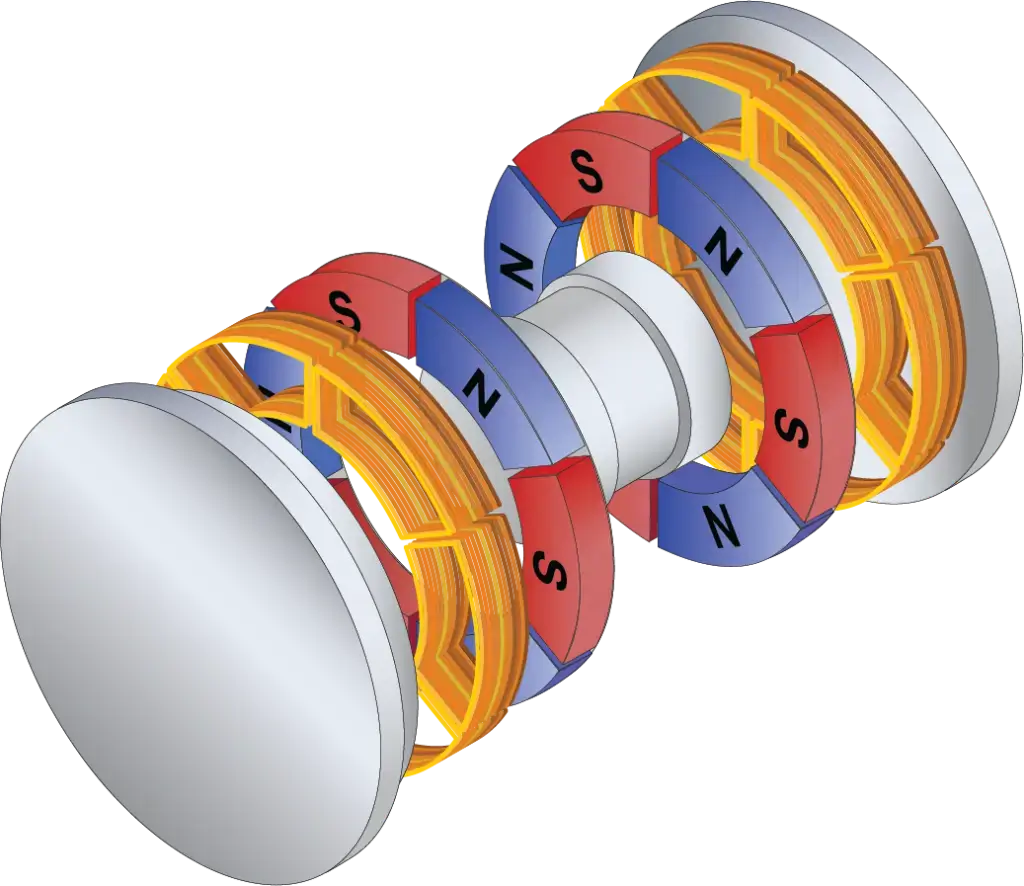
A frameless torque motor retains only the core rotor and stator. The rotor generally consists of multiple pairs of high-performance rare-earth permanent magnets fixed on the rotor in a specific magnetic pole arrangement, generating a fixed magnetic field. The stator is a toroidal ring with copper windings – multiple copper coils wound on laminated steel teeth and fixed within the mechanical structure. This simple structure gives frameless torque motors a significant advantage in volume and weight over conventional motors, better meeting the demand for lightweight and integrated motors.
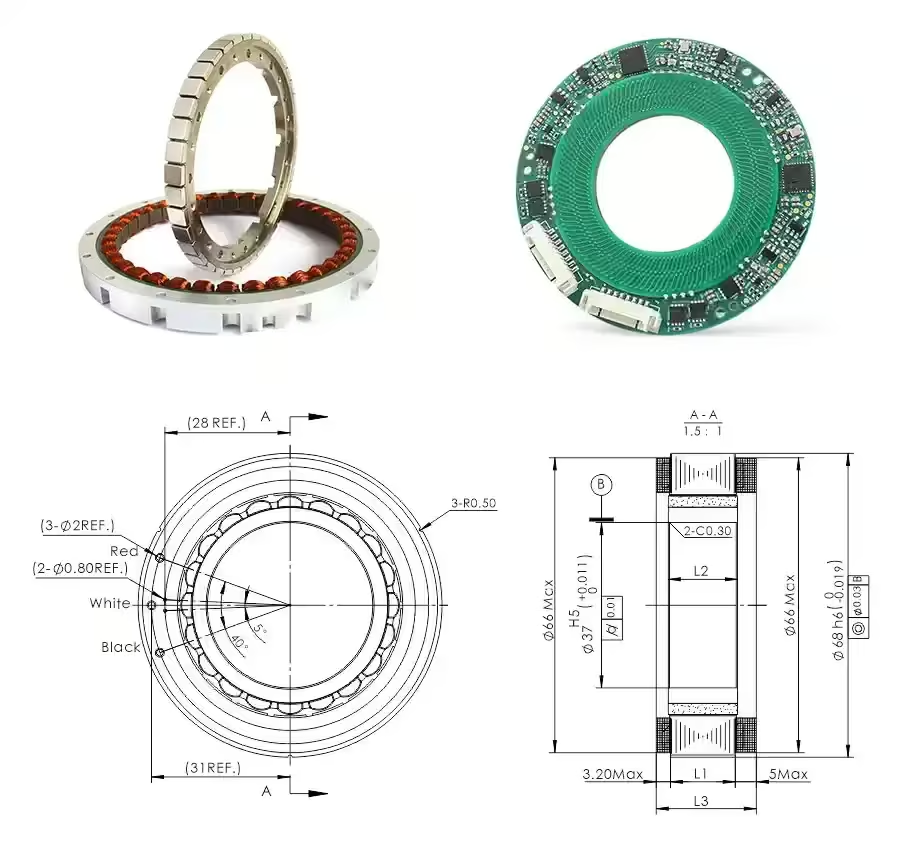
When the driver supplies power, three-phase current excites a rotating electromagnetic field in the stator coils. This rotating field interacts with the permanent magnets in the rotor, producing electromagnetic torque that drives the rotor to rotate, providing precise power output for humanoid robot joints.
Recommended In-depth Reading from AI Robots Eidos
Humanoid robots are typical carriers of frameless torque motor technology applications. By understanding humanoid robots, one can gain a more comprehensive and in-depth understanding of the operating principles and technical value of frameless torque motors.
If readers would like to learn more about humanoid robots, please read this article about humanoid robots.
Advantages of Frameless Torque Motors
–Compact Structure (Fast Response): Because the conventional motor housing, bearings, and end caps are removed, the motor consists only of a stator and rotor. It is compact, lightweight, and has low inertia. Frameless motors achieve fast dynamic response, with command-to-state transition times in milliseconds, making them suitable for humanoid robots that require frequent starting, stopping, and sensitive response.
–High Torque Density: Frameless torque motors eliminate the iron core of conventional motors. Their compact, lightweight structure allows for higher torque output in a limited space, achieving greater power density. They meet high power-output requirements under joint-space constraints, making them ideal for humanoid robot joint components.
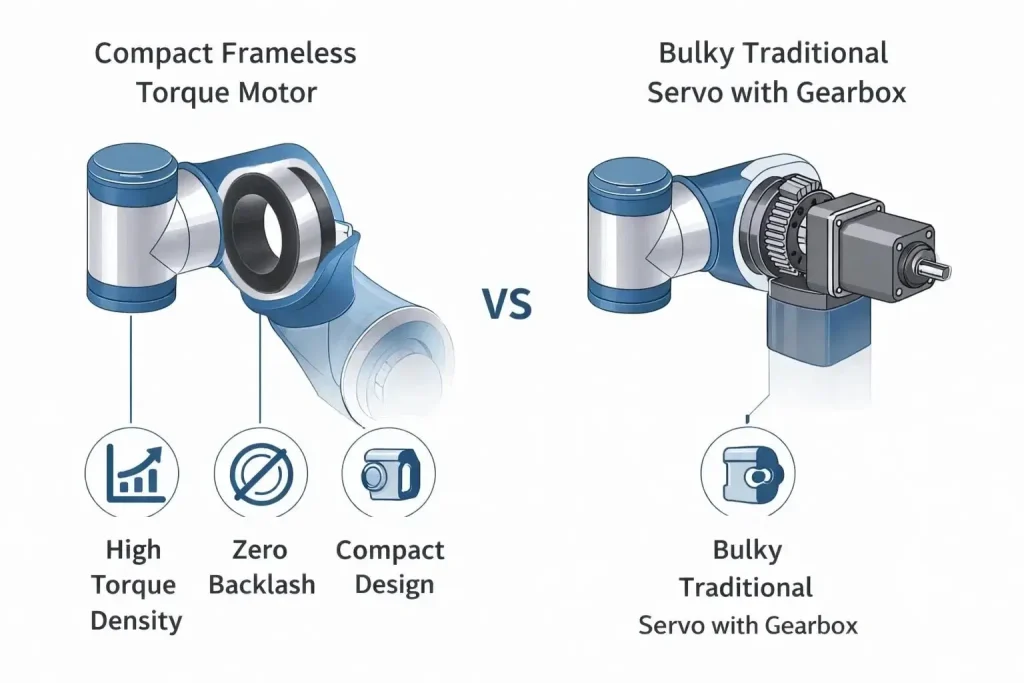
–Excellent Spatial Adaptability: Frameless torque motors support deep embedded integration, allowing high integration with components like reducers inside the joint. Thus, they offer high design flexibility and can be customized (e.g., pancake-shaped, hollow) to perfectly adapt to the mechanical structure and space constraints of different joint locations such as hips, shoulders, and elbows. For example, in Tesla’s Optimus humanoid robot, all 28 joint actuator systems use high-power-density frameless torque motors as the core drive unit.
Challenges of Frameless Torque Motors
–High Manufacturing Precision: Frameless torque motors demand extremely high precision in manufacturing and assembly. Machining tolerances for key components must be controlled within a very small range, such as the magnetization accuracy of permanent magnets and the winding accuracy of stators. Any slight deviation can lead to degraded motor performance.
–Production Difficulty: Customized production is often required, increasing difficulty and cost. Different robots have varying joint structures and motion requirements, requiring frameless torque motors to be flexibly adaptable, which places high demands on the R&D capabilities and production processes of manufacturers.
–Heat Dissipation: Due to their compact structure and limited internal space, heat dissipation becomes a problem. Heat generated during operation, if not dissipated in time, raises internal temperatures and affects performance and reliability. Traditional cooling methods have limited effectiveness on frameless torque motors, especially under high load and long operation.
Performance Specifications of Frameless Torque Motors (For Reference Only)
| Step Electric (China) | Kollmorgen (USA) | TQ Robodrive (Germany) | |
| Product Model | FMC | TBM 2G | ILM |
| Rated Power (W) | 100 – 1,050 | 205 – 1,430 | 70 – 570 |
| Rated Torque (Nm) | 0.45 – 3.5 | 0.27 – 6.03 | 0.032 – 3.9 |
| Rated Speed (rpm) | 2,500 – 3,000 | 2,600 – 8,000 | 1,400 – 22,650 |
| Stator Outer Diameter (mm) | 57.8 – 104 | 50 – 115 | 25 – 115 |
| Rotor Inner Diameter (mm) | 25 – 55 | 24.75 – 57.5 | 11.6 – 74 |
Key Design Considerations for Frameless Torque Motors
–Pursuit of High Torque Density: High torque density is one of the key design goals. During humanoid robot movement, joints frequently bear forces in various directions and magnitudes for walking, grasping, climbing, etc., requiring the motor to output sufficient torque in a compact structure.
Several methods achieve high torque density. Distributed fractional-slot design is a common and effective method. Rationally distributing stator slots and windings, it reduces cogging torque and improves efficiency and torque output. For example, German TQ Robodrive’s frameless torque motors use a 20-pole, 18-slot magnetic circuit layout, achieving higher torque output and energy conversion efficiency in a limited space. Carbon fiber, with its high strength and low density, can be used to band the rotor, effectively increasing mechanical strength, allowing higher rotational speeds, and thus increasing torque density. Optimizing permanent magnet shape and adjusting air gap length also helps improve magnetic flux utilization, achieving high torque density.
–Fast Response Design: Humanoid robots must react quickly to environmental changes and task requirements, imposing high demands on the motor’s fast response.
Due to the removal of conventional motor housings and bearings, the moment of inertia of a frameless torque motor is greatly reduced, enabling faster starting, stopping, and speed changes. In rotor design, using lightweight materials and optimized structural shapes further reduces rotor inertia. Meanwhile, improving the control system with faster signal processing and more precise control algorithms minimizes the time from command signal to operational state.
–High-Precision Control Design: Humanoid robots require extremely high motion accuracy for micro-level positioning and smooth, stable movement. Frameless torque motors feature low speed, high torque, high overload capacity, fast response, and good linearity, maintaining high stability and precision during operation.
To achieve high-precision control, frameless torque motors are typically combined with high-resolution encoders and controllers. In some high-end humanoid robots, this synergy enables joint position control accuracy within ±0.01° and repeatability within ±0.005°, ensuring extremely high motion accuracy and stability.
Technological Breakthroughs in Frameless Torque Motors
–Cooling Technology Breakthroughs: Some companies have developed novel cooling structures and materials, such as liquid cooling technology with internal coolant channels to quickly remove heat, effectively reducing temperature rise. Others use high-thermal-conductivity ceramic materials to improve heat dissipation efficiency.
–Manufacturing Process Upgrades: Some manufacturers have adopted next-generation magnetic circuit optimization and encapsulation technologies, achieving ultra-low temperature rise, ultra-high density, and ultra-long endurance, accelerating commercial application in humanoid robotics.
–Customization and Integration: Companies are establishing flexible production systems to quickly design and produce motors meeting specific customer requirements. Meanwhile, integrating frameless torque motors with sensors and drivers reduces system volume and weight while improving reliability and response speed.
Applications of Frameless Torque Motors
–Robotics: In industrial robotics, frameless torque motors are used in joints and arms for high torque and precision control. Typical applications include collaborative robot joints, each requiring 6–7 motors. In humanoid robotics (e.g., Tesla Optimus), both linear and rotary actuators contain frameless torque motors. Humanoid robots are expected to become the most important downstream application.
–CNC Machine Tools and Precision Manufacturing: Frameless torque motors directly drive machine tool feed axes, achieving nanometer-level positioning accuracy and high dynamic response. They are used in semiconductor manufacturing, optical component machining, precision mold making, etc., improving efficiency and quality. They are also used in CNC rotary tables for high-precision rotary positioning, meeting multi-axis linkage machining needs.
–Electric Vehicles: Frameless torque motors can drive auxiliary systems such as electric power steering (EPS), electronic parking brakes (EPB), and electronic shifters. Their high-precision control ensures fast response, smooth operation, and improved driving comfort and safety.
Main Frameless Torque Motor Manufacturers
These Manufacturers have deep technical expertise, e.g., Kollmorgen’s distributed fractional-slot and carbon-fiber banding technology and TQ-Robodrive’s modular stator and epoxy encapsulation technology.
–Kollmorgen (USA): A pioneer and leader in frameless torque motors, having invented them. Its TBM series is designed for robotics, using advanced windings and materials to solve the low-speed performance issues of traditional frameless motors, maintaining high power, torque, and efficiency across the full speed range. It dominates the global high-end robotics market.
–-TQ RoboDrive (Germany): A subsidiary of the TQ Group, leveraging technology from the German Aerospace Center (DLR), specializing in high torque density, high dynamic performance frameless torque motors. Its products use original stator-rotor kit technology with high copper fill factor and low losses, suitable for high-end scenarios like humanoid robots. It is a key supplier of robotic core components in Europe.
–Aerotech (USA): Its S-series frameless torque motors feature a slotless stator design and high magnetic pole count rotor, achieving zero cogging and excellent speed stability. The S-series covers a wide range of torque and package sizes. Continuous torque ranges from 0.20 N·m to 29.09 N·m; peak torque from 0.82 N·m to 116.37 N·m.
–Maxon Motor (Switzerland): Its frameless torque motors are compact and easy to integrate into OEM machines. They feature an external rotor design with internal space for wiring, facilitating control. The multi-pole external rotor provides high torque, low cogging torque, and high overload capacity.
Market for Frameless Torque Motors
According to Technavio, the global torque motor market grew by 6.95% in 2023, reaching $657 million. Driven by the commercialization of humanoid robots, the market for frameless torque motors in this sector is expected to reach $2.397 billion by 2030. With steady growth in traditional industrial applications, the total market is projected to hit $3.3 billion by 2030.
| Number of Frameless Torque Motors in Tesla Optimus Humanoid Robot | ||
| Actuator Type | Body Part | Number of Frameless Torque Motors |
| Rotary Actuator | Shoulder | 6 (3×2) |
| Elbow | 2 (1×2) | |
| Lumbosacral region | 6 (2×3) | |
| Linear Actuator | Upper arm | 2 (1×2) |
| Forearm | 4 (2×2) | |
| Thigh | 4 (2×2) | |
| Calf | 4 (2×2) | |
| Total | 28 | |
Development Trends of Frameless Torque Motors
–Performance Improvement: Further increasing torque density, reducing inertia, and improving response speed and control accuracy. This will be achieved through optimized magnetic circuit design, new materials, and advanced manufacturing processes to enhance competitiveness.
–Cost Reduction: Companies will optimize production processes, improve efficiency, and strengthen supply chain management to lower raw material and manufacturing costs. As technology matures and production scales up, the cost of frameless torque motors will gradually decrease.
–Application Expansion: Frameless torque motors will extend beyond humanoid robots and industrial automation into emerging fields such as smart home appliances, where they can be used for drive and control to achieve intelligent and user-friendly operation.
Insight from AI Robots Eidos about Frameless Torque Motors
—The future competition will shift towards “joint integration density”—the efficiency of integrating motors, reducers, encoders, drivers, and cooling structures within a unit volume or weight. Frameless torque motors, with their “bare” characteristics of being housing-free, shaft-free, and bearing-free, naturally support structural integration. In the future, the boundaries between motor manufacturers and robot body manufacturers will blur, leading to a joint development model of “motor-structure integrated design.”
—As liquid cooling technology matures and becomes cost-effective, frameless torque motors can transition from competing on “peak torque” to competing on “continuous torque power density.” This means that humanoid robots can operate under high loads for extended periods (such as continuous transportation). This will directly promote robots from being “demonstrative” to “productive,” generating real productivity in fields such as factories and logistics.
—In the future, encapsulation technology will not only serve insulation and fixing but also act as a thermal management strategy. New thermally conductive encapsulation materials (such as aluminum nitride fillers and ceramic microspheres) can quickly conduct heat from the stator to the robot’s shell, using the metal framework of the robot as a radiator. In the future, robots themselves will become large heat dissipation structures, eliminating the need for separate fans or liquid cooling loops for frameless motors, thereby achieving a higher overall energy efficiency ratio.
Image Credits: Mosrac & Hobberdrive & Motioncontroltips & Sierramotion & Linkedin