
Bomb Disposal Robots: Silent Heroes
Bomb disposal robots, also known as explosive ordnance disposal robots, are a kind of specialized robots, serving as a crucial means for handling hazardous materials and explosives, and are playing an increasingly important role in the field of explosive ordnance disposal. In explosive-related sites, bomb disposal robots conduct reconnaissance, assessment, and transfer tasks, providing unparalleled advantages.
Definition of Bomb Disposal Robots
A bomb disposal Robot is primarily used to replace humans in environments that are too hazardous or not suitable due to the risk of explosion, conducting reconnaissance, neutralization, and handling of explosives and other dangerous materials at the incident scene. They reduce personnel risk and improve efficiency, providing significant social and economic benefits.
Advantages of Bomb Disposal Robots
| Bomb disposal robots can operate under various environmental conditions with minimal operational requirements. Depending on different conditions at explosive sites, disposal teams can choose robots of varying sizes and functionalities. They range from robots less than one meter tall to dual-arm robots capable of carrying around 20 kilograms, meeting the needs of most security and explosive disposal tasks.
| Equipped with high-definition cameras, bomb disposal robots can conduct in-depth, multi-angle, and comprehensive real-time assessments of explosive areas. They can observe every detail of explosive devices up close, offering bomb disposal teams more effective and valuable information support.
| The application of bomb disposal robots increases the reliability of handling explosive scenes, making transfer operations more precise and efficient. Through remote control, these robots can transfer explosives to safe areas without direct contact.
Structural Components of Bomb Disposal Robots
| Protection System: The “outer layer” of bomb disposal robots is not simple. To survive extreme environments such as explosive shocks and electromagnetic interference, their bodies are made of high-strength aluminum alloy and ballistic steel plates, with critical areas covered in blast-resistant coatings to withstand shockwaves from nearby explosions, minimizing secondary injuries even in the case of disposal errors.
| Mobility System: The mobility capability is the “basic skill” of bomb disposal robots. The tracked chassis can easily roll over piles of rubble and climb over 30 cm high steps, while a hybrid wheeled/tracked design accommodates both flat, rapid movement and complex terrain climbing. In narrow hallways, some robots can move laterally like “crabs” and can fold their bodies to lower their height in low spaces, showing flexibility not typically expected from heavy machinery.
| Perception System: When facing tightly wrapped suspicious objects, high-definition wide-angle cameras provide a 360-degree unobstructed view. Infrared lenses can capture temperature anomalies in the dark, while X-ray scanners act like “X-ray eyes,” clearly showing the pathways of wires and the structures of components within the package. More advanced models are equipped with gas sensors capable of detecting chemical detonators through trace volatiles.
Mobility Methods of Bomb Disposal Robots
Bomb disposal robots primarily use tracked and hybrid wheeled designs. Tracks offer better terrain adaptability than wheels, making tracked designs mainstream; the hybrid design is an innovation intended to provide faster speeds for larger robots. There are also biomimetic multi-legged, flying, and diving models to meet various operational needs. The effectiveness of a robot is not just determined by its appearance; different occasions require the selection of different robots.
Intelligent Features of Bomb Disposal Robots
| Object Detection: Based on convolutional neural networks (CNN), this model can analyze video streams in real time, automatically highlighting suspicious items in the frame (such as backpacks, wires, mobile phones, cans, etc.) and classifying them. It can even recognize common components of specific types of explosive devices (such as IEDs).
| Path Planning: Thanks to advancements in simultaneous localization and mapping (SLAM), semantic segmentation, and path planning algorithms, operator instructions are greatly simplified. An operator may only need to click on a target point on a tablet map, and the bomb disposal robot can autonomously plan a safe and efficient route based on the real-time constructed environmental map while avoiding dynamic obstacles, ultimately reaching the target stably.
| Action Planning: This is primarily reflected in intelligent grasp planning technology. When faced with an unknown object, the robot no longer requires the operator to manually adjust each joint angle. Its internal AI model can automatically calculate the optimal grasp point, the precise force needed for the gripper, and the approaching angle based on the point cloud model generated by the visual sensors, controlling the robotic arm to complete a smooth and efficient grasp.
Auxiliary Equipment for Bomb Disposal Robots
Robotic dogs are a new type of auxiliary equipment for explosive disposal, possessing unique technical advantages. They play an important role in enhancing the operational efficiency of bomb disposal robots, compensating for the shortcomings of drones and bomb disposal robots in certain complex environments, thereby improving the safety and efficiency of disposal tasks and meeting the requirements of explosive operations in such environments.
The flexible design of robotic dogs allows for different equipment to be attached as needed for tasks. By collaborating with bomb disposal robots, robotic dogs can better tackle various complex explosive disposal tasks, providing strong support for ensuring safe disposals and maintaining social stability. However, the development of robotic dogs still faces numerous challenges, including stability, endurance, and load capacity, necessitating ongoing technological innovation to improve their effectiveness in explosive disposal applications.
Classic Bomb Disposal Robots
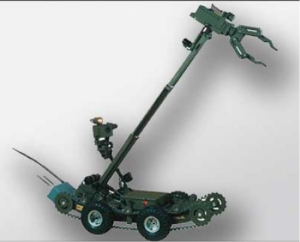
Mini-Andros II
Mobility Mode: Hybrid wheeled
Speed: 0-10.8 km/h, continuously adjustable
Climbing Ability: Stairs, 45 degrees, 41 cm high steps, 53 cm wide gaps
Maximum Grasping Capacity: 7 kg when fully extended
Optional Configuration: Camera extension pole, night vision components, head-mounted display.
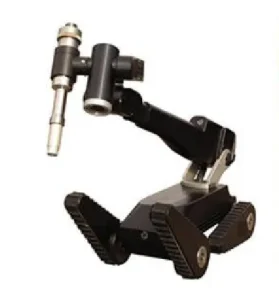
Guardian ROV
Mobility Mode: Hybrid wheeled
Speed: Tracks at 2.7 km/h, wheels at 45 km/h
Arm Horizontal Extension Length: 2.1 m, Arm Vertical Extension Length: 2.6 m
Grasping Weight: 10 kg when extended, 30 kg when retracted
Optional Configuration: X-ray detector, chemical detector, laser rangefinder.
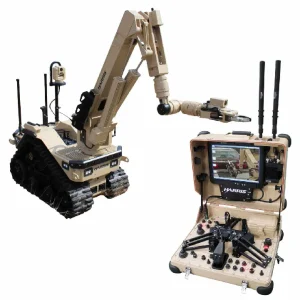
Harris T7
Mobility Mode: Tracked
Features precise control and dexterous movement capabilities, mimicking human-like dexterity and tactile feedback.
The tracked chassis is very robust, providing high maneuverability in rugged terrain.
Optional Configuration: Standard sensors, jammers, and various attachments.
Roboteam
Mobility Mode: Tracked
Speed: 10.5 km/h
Operational Range: 1.3 km
Portable modular design for convenient maintenance and upgrades
Grasping Power: Maximum 20 kg, 6.8 kg when extended, can work continuously for 15 hours and detect suspicious objects underground.
Guardian GT
Dual-arm robot, powered by fuel hydraulics
Single-arm load capacity of 200 kg, dual-arm capacity of 400 kg
Equipped with tactile sensors, dual cameras, and a VR system for intelligent operation.