Table of Contents
The Industrial VLA (Vision-Language-Action) system represents the application of embodied AI in the industrial sector. Industrial VLA is not just a technological breakthrough but also a key force driving industrial automation toward intelligence, flexibility, and efficiency.
What is VLA (Vision-Language-Action)?
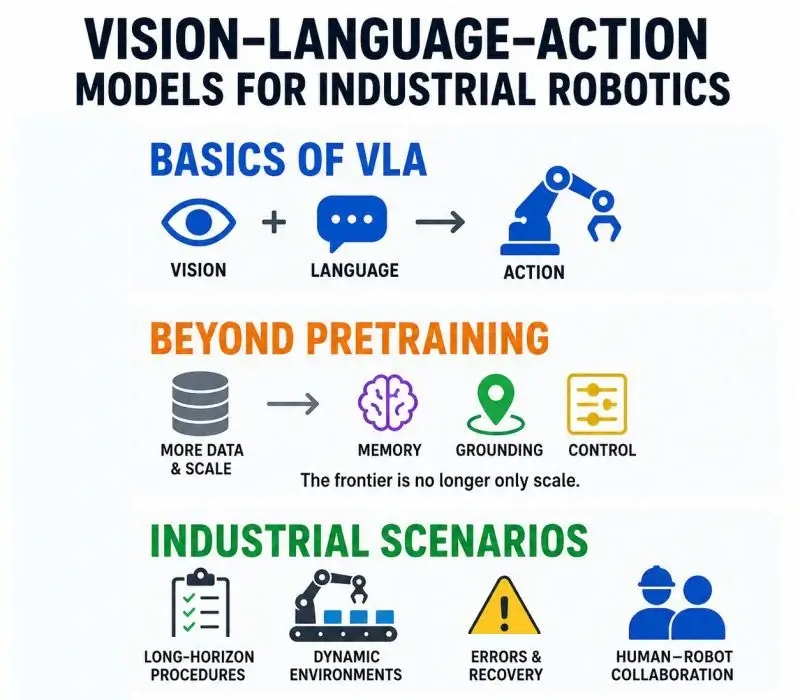
The Vision-Language-Action model represents a transformative breakthrough in AI — it builds a single computational framework that unifies perception, language understanding, and embodied action. In simple terms:
See → Recognize objects and scenes in images
Say → Understand natural language commands from humans
Do → Execute precise physical actions
As a new paradigm unifying perception, language, and action, the VLA model represents a fundamental shift in AI and robotics. It is the cornerstone for building next-generation general-purpose agents that can coexist harmoniously and collaborate safely with human society.
The Specificity of Industrial VLA Systems
Industrial VLA systems apply VLA technology to the industrial domain, enabling industrial robots or intelligent systems to understand natural language commands, parse complex industrial scenes, and generate corresponding action sequences, thereby achieving intelligent interaction with the physical environment. Because industrial environments impose much stricter requirements on VLA systems, industrial VLA systems have certain distinctive characteristics.
–Precision and Reliability: In industrial scenarios, industrial VLA systems often need to achieve millimeter or even micrometer-level operational precision, with extremely high reliability requirements. This is because even a 95% success rate in an industrial setting means one error every 20 operations, which can cause economic losses for enterprises.
–Real-time Performance: The high-speed operation of industrial production lines requires industrial VLA systems to complete the entire perception-decision-action cycle in a very short time. To meet production line cycle times, the total latency from visual capture to action generation must be controlled at the millisecond level.
–Environmental Complexity: Industrial sites are complex and variable, with factors such as lighting changes, occlusion, and dust interference. At the same time, industrial scenarios involve diverse objects, including reflective surfaces, transparent objects, and deformable objects — all of which place higher demands on industrial VLA.
Comparison Between Industrial VLA Systems and General VLA Systems
| Industrial VLA | General VLA | Industrial Adaptation Requirements | |
| Reliability | Above 99.99% | 90–95% | Requires redundancy design and fail-safe mechanisms |
| Precision | Millimeter/micrometer level | Centimeter level | High-precision sensors and calibration algorithms |
| Response Time | Millisecond-level real-time response | Second-level response | Algorithm optimization and hardware acceleration |
| Environmental Adaptability | Harsh industrial environments (vibration, dust, etc.) | Controlled environments | Protective design and anti-interference algorithms |
| Interpretability | Fully interpretable and auditable | Partially black-box characteristics | Visualized decision paths and fault traceability |
Architecture of Industrial VLA Systems
–Industrial Vision Perception Module: This module is responsible for extracting meaningful visual information from complex industrial environments. Unlike traditional vision systems, the vision perception of industrial VLA needs to simultaneously process multiple types of visual input (e.g., RGB images, depth information, thermal imaging) and overcome challenges such as lighting changes, metal reflections, and occlusion in industrial environments. For example, open-source tools like MMPose support 2D/3D pose estimation and maintain high recognition accuracy in complex environments.
–Industrial Language Understanding Module: This module is responsible for parsing and understanding natural language commands, processing documents, and operating specifications. Industrial language understanding needs to handle a large number of domain-specific terms and abbreviations, comprehend structured process instructions, and infer exact intent from ambiguous descriptions.
–Industrial Action Generation Module: This module is responsible for converting perception and language understanding into precise, reliable action sequences. Industrial action generation must consider robot dynamics constraints, obstacle avoidance requirements, and process parameter precision to generate smooth, efficient, and safe motion trajectories.
Recommended In-depth Reading from AI Robots Eidos
Industrial VLA systems provide intelligent decision-making capabilities for automatic obstacle avoidance in industrial equipment. Traditional obstacle avoidance methods rely on preset rules or specific environmental modeling, making it challenging to handle unknown or complex scenarios. The VLA model, through large-scale data training, possesses semantic understanding and generalization abilities, allowing it to adapt to various environments, types of obstacles, and dynamic changes, thereby enhancing the generalization capability of automatic obstacle avoidance.
Readers can read this article on obstacle avoidance to gain a deeper understanding of the subject.
Types of Industrial VLA Systems
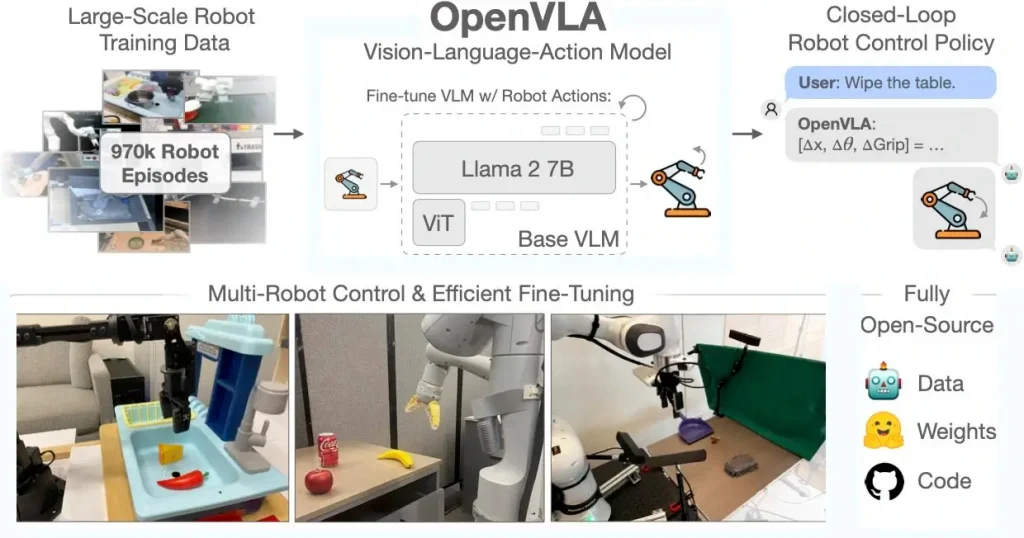
–Autoregressive VLA: Autoregressive VLA discretizes action sequences into tokens and generates actions through a “next token prediction” mechanism similar to language models, relying on the Transformer architecture for cross-modal alignment—representative models: RT-2, OpenVLA.
–Whole-Body Control VLA: Whole-body control VLA breaks through the limitation of traditional VLA controlling only a robotic arm, enabling simultaneous output of mobile base trajectory and arm actions to achieve whole-body coordinated control. Representative model: GOVLA.
–Flow Matching VLA: Flow matching VLA directly learns the “flow field” mapping of actions, generating smooth, continuous actions, with higher training and sampling efficiency. Representative models: π0, π0.5, SmolVLA, X-VLA.
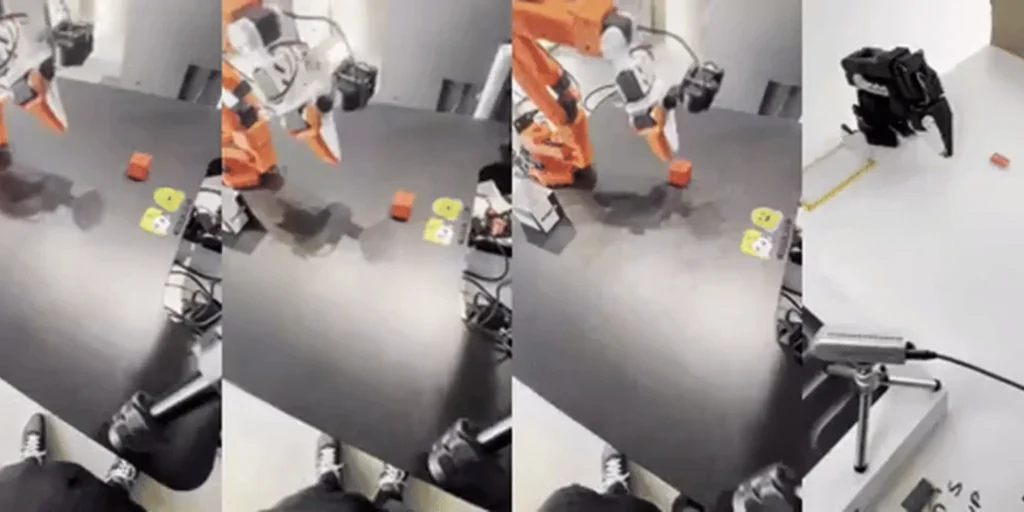
–Fusion VLA: Fusion VLA deeply integrates a world model with VLA, using spatiotemporal state prediction and causal reasoning to improve zero-shot generalization, capable of handling unseen scenes and long-horizon tasks. Representative model: WALL-A.
–Lightweight VLA: Through techniques such as parameter compression, model pruning, and quantization, it reduces model computation and memory footprint, suitable for running on resource-constrained edge devices. Representative models: SmolVLA, HoloBrain-0.
Positive Significance of Industrial VLA Systems
–Automation begins to cover unstructured scenarios. Traditional industrial robots rely on highly structured environments, whereas the improved perception and decision-making capabilities of industrial VLA technology enable robots to perform tasks in scenes with position variations, occlusion, material mixing, and random stacking.
–Operated objects expand from rigid parts to flexible and amorphous objects. Industrial VLA technology addresses the handling of cables, fabrics, flexible packaging, food items, and irregularly shaped objects. Such objects are difficult to handle stably using fixed trajectories and parameter modeling. Multimodal perception and policy learning significantly expand the range of automatable objects.
–Automation configuration costs decrease. With the deep coupling of perception, understanding, and action generation, robots become less dependent on tooling, fixtures, and high-precision calibration. In scenarios with frequent SKU changes and fast adjustment of working conditions, some automation solutions that previously had prohibitive engineering costs become feasible.
However, it should be noted that current industrial VLA systems are still significantly weaker than traditional industrial robots in precision, cycle time, and long-term stability, and cannot replace high-speed, high-precision core manufacturing processes.
Technical Challenges of Industrial VLA
The development of industrial VLA systems faces several technical bottlenecks that constrain their large-scale application in industrial scenarios:
–Data: High-quality multimodal data in industrial scenarios is expensive to acquire and limited in scale. The data required for industrial scenarios is not just massive unimodal data, but heterogeneous data incorporating physical interaction and environmental feedback — its demand is millions of times greater than that of large language models. Moreover, annotating industrial data requires domain-expert involvement, further increasing the difficulty and cost of data preparation.
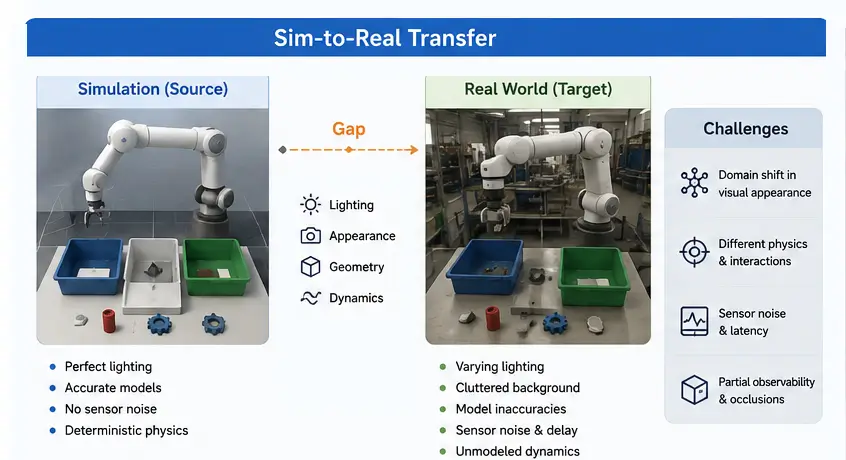
–Sim-to-Real Transfer: Although simulation environments can generate large amounts of training data, the physical complexity of industrial scenarios makes sim-to-real transfer highly challenging. Inaccurate modeling of physical parameters and improper simulation of contact mechanics can cause policies trained in simulation to perform poorly in the real world. Future development requires more accurate physics simulation engines and better online adaptation techniques. Meta-learning methods can enable models to learn sim-to-real adaptation strategies from small amounts of real-world data, improving transfer success rates.
–Long-Horizon Tasks: Industrial operations often involve multi-step, long-horizon tasks, where small errors in preceding steps are amplified in subsequent steps. Unlike independent setups, where each subtask starts from a state within the training distribution, in continuous setups, subtasks are executed sequentially, leading to state distribution shift, error accumulation, and performance degradation. Solutions include developing better state representations and error compensation mechanisms, as well as introducing explicit state estimation and calibration modules.
Applications of Industrial VLA Systems
Industrial VLA technology has already shown great value in multiple fields, from traditional manufacturing to emerging smart factories — VLA systems are gradually changing the implementation of industrial automation.
–Intelligent Material Handling: Intelligent material handling is one of the most mature application areas of industrial VLA, involving equipment such as automated guided vehicles (AGVs), autonomous mobile robots (AMRs), and intelligent forklifts. These application scenarios are relatively structured but still require tasks such as environmental perception, path planning, and motion control. These systems perceive their environment using multimodal sensors (LiDAR, cameras, IMUs), understand natural language commands, and generate safe motion trajectories.
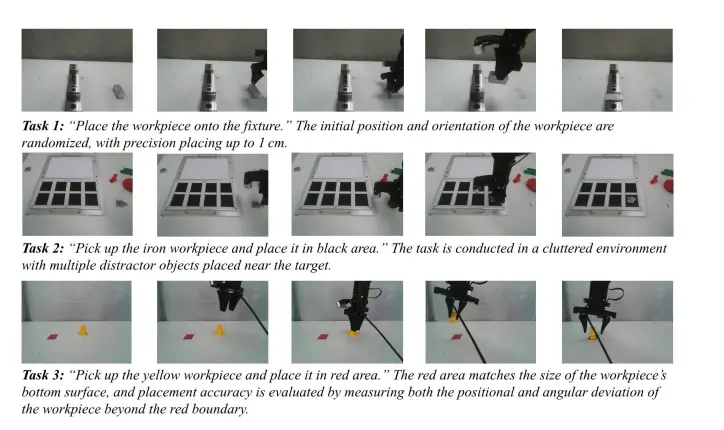
–Precision Assembly: Precision assembly is a core part of industrial manufacturing, demanding extremely high precision, consistency, and reliability. The application of industrial VLA systems in this field must overcome challenges such as small part recognition, fine motion control, and quality consistency inspection. Through digital twin-assisted human-robot collaborative assembly, a closed-loop architecture of “embodied cerebellum – embodied cerebrum – embodied neurons” is constructed, enabling dynamic perception, task reasoning, and autonomous execution with vision-language models. This system solves problems of traditional HRC, such as repeated model training and poor environmental adaptability, and combines the strong generalization of VLMs with the simulation and reasoning advantages of digital twins, offering a new paradigm for complex product assembly.
–High-Precision Quality Inspection: Industrial VLA systems use deep learning models to detect quality issues in real time during production, such as part defects, assembly errors, and process deviations. Once an issue is identified, the system can report it via a language interface and provide detailed problem feedback. This intuitive quality feedback mechanism greatly lowers the technical threshold for quality inspectors and improves issue resolution efficiency.
–Flexible Circuit Board Assembly: The π0.5 industrial VLA model can perform complex, multi-stage operational behaviors lasting 10 to 15 minutes. In circuit board assembly scenarios, the system can understand instructions and decompose them into a sequence of fine actions. By transferring knowledge from diverse heterogeneous data sources — including other robot data, language instructions, and internet data — π0.5 achieves broad generalization across different environments and objects, and can handle circuit boards and components of various specifications.
Future Directions for Industrial VLA Systems
Industrial VLA systems are in a phase of rapid development and are expected to make breakthroughs in several directions.
–World Models and Mental Simulation: Current industrial VLA models make decisions primarily based on current observations and commands, lacking internal simulation of world dynamics. Future VLA systems may incorporate world models, enabling deeper reasoning and planning by internally simulating the long-term consequences of different actions.
–Cross-Modal Concept Learning: Future industrial VLA systems may develop cross-modal concept learning capabilities, allowing them to learn new concepts from a few examples and flexibly apply them in different contexts. For instance, by watching a single video of “how to assemble a part”, a robot could understand the essence of each step and generalize to different parts and environments. This capability would enable industrial robots to quickly adapt to new environments and tasks, truly realizing general intelligence.
–Distributed Collaborative Learning: Future industrial environments may see multiple industrial VLA systems working together, requiring distributed collaborative learning mechanisms. Systems can share knowledge and experience to jointly improve performance. Federated learning techniques can allow multiple systems to learn from each other’s experiences while preserving data privacy. Swarm intelligence principles can be applied to industrial VLA systems, enabling multiple robots to collaboratively accomplish complex tasks with capabilities far exceeding those of a single system.
Insight from AI Robots Eidos about Industrial VLA
—The future industrial VLA systems will become “process brains” capable of absorbing human experience descriptions, unstructured operational notes, and even verbal instructions on-site, transforming them into reusable action strategies. This means that industrial knowledge will no longer rely on explicit programming or fixed parameters but will be embedded in a “vision-language-action” collaborative format. In future factories, changing production setups may only require natural language descriptions of new processes, and the VLA systems will automatically reason and generate suitable assembly sequences and parameters, significantly reducing reliance on low-code programming or manual teaching.
—Future industrial VLA systems will not only perform a single simulation training before deployment but will also continuously maintain a high-fidelity digital twin synchronized with the physical environment during operation. Whenever real actions produce slight errors (such as fluctuations in part positioning), the system will instantly reverse simulate in the twin space, adjusting subsequent strategies and feeding corrective experiences back into the shared model. This “physical execution → digital extrapolation → strategy update” loop, operating in seconds, will endow industrial VLA with online adaptability and proactive interference resistance, moving away from reliance on offline transfer learning or the retraining of large amounts of real data.
—In terms of collaboration among multiple VLA systems, future industrial VLA systems (such as mobile chassis + robotic arms + quality inspection drones) will no longer simply assign tasks through central dispatch; they will engage in real-time physical collaboration based on a shared world model and language instructions. For example, if one robot says, “I need to insert this flexible cable, but it is swaying too much,” another robot will automatically adjust its actions to help stabilize the cable without being explicitly programmed.