
Table of Contents
The VDA5050 protocol, as a globally recognized communication interface standard for AGVs/AMRs, has its core value in unifying the machine language, enabling AGVs/AMRs from different brands to connect to the same dispatching system.
What Is The VDA5050 Protocol?
The VDA5050 protocol is a standardized communication protocol for mobile robots. Its core positioning is to enable AGVs/AMRs to achieve “plug-and-play” functionality. Any AGV/AMR robot, regardless of brand, that adheres to this protocol can communicate with a dispatch system that also complies with the same standard, completely breaking down the barriers between AGV/AMR devices. Specifically:
–Underlying technology: Based on the MQTT protocol + JSON data format – lightweight, efficient, and adaptable to cloud-native and microservice architectures.
–Applicable devices: Covers all categories of AGVs (Automated Guided Vehicles) and AMRs (Autonomous Mobile Robots).
–Core value: Unifies the “language” of robots, allowing devices from different brands to seamlessly communicate with a single dispatch system.

According to statistics from the German Mechanical Engineering Industry Association (VDMA), after adopting the VDA5050 standard, the integration time for factory AGV/AMR systems is reduced by an average of 40%, and operation and maintenance costs are reduced by 35%. This fully demonstrates the positive significance of the VDA5050 protocol.
Recommended In-depth Reading from AI Robots Eidos
VDA5050 is not only a communication standard at the technical level but also a key force driving the AGV/AMR industry from “closed customization” to “open interconnection.”
In this article, AGVs and AMRs are frequently referred to collectively as AGV/AMR. To prevent misleading readers, it is important to clarify that these two are different automated devices. Interested readers can refer to the article on AGVs or AMRs to understand the differences between the two in detail.
Development History of the VDA5050 Protocol
Before the birth of VDA5050, the global AGV/AMR market faced problems such as incompatible communication protocols among device brands, incompatibility between dispatch systems and device control logic, and incompatibility of data formats among upstream and downstream information systems (WMS/TMS/MES). According to VDMA statistics, in 2018, integration costs caused by protocol incompatibility accounted for 35%-50% of total project investment in global automated logistics projects, and project delivery cycles were extended by an average of 6-12 months.
–VDA5050 Version 1.0: In 2019, the German Association of the Automotive Industry (VDA), together with VDMA and the KIT Institute of Logistics, released VDA5050 version 1.0. The core goal was to address the need for coordinated scheduling of multi-brand AGVs in flexible production in the automotive manufacturing industry. The emergence of VDA5050 filled a gap in the industry.

–VDA5050 Version 2.1.0: The protocol was updated to version 2.1.0 in 2024. It added functions such as autonomous obstacle avoidance in robot corridors, dynamic adjustment of multi-task priorities, and cross-dispatch-domain collaboration. The applicable scenarios have expanded from industrial warehousing to e-commerce sorting, cold chain logistics, and other fields. More than 200 companies worldwide participated in the iteration.
–VDA5050 Version 3.0: In 2025, the German Machinery and Equipment Manufacturing Federation (VDMA) recently released version 3.0 of its VDA 5050 communication interface. New features include intelligent zone control, path sharing and cooperative planning, automatic map distribution, corridor passage mechanisms, energy-saving mode switching, and localized error message display. The new version further enhances VDA5050’s capabilities in mixed fleet management, multi-vehicle coordination, and flexible deployment, providing strong support for mobile robots in complex scenarios.
Technical Architecture of the VDA5050 Protocol
–Robot Controller System (RCS): Receives task instructions from upper-level systems (such as WMS, MES, ERP), decomposes, optimizes, and assigns tasks to appropriate AGV/AMR devices. At the same time, it calculates optimal driving paths based on task requirements and real-time traffic conditions, enabling multi-vehicle collaborative operation.

–MQTT Broker: This is the message transfer hub. It implements the publish/subscribe pattern based on the MQTT protocol (version 3.1.1), ensuring high-concurrency, low-latency data transmission. The transport layer typically uses the TCP/IP protocol to ensure reliable data transmission.
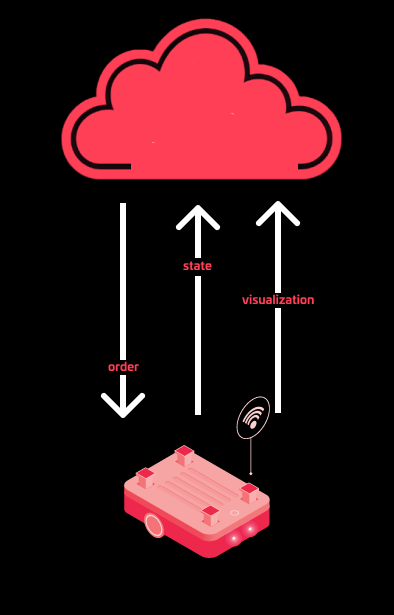
–AGV/AMR End: The dispatch system sends tasks to AGVs/AMRs through the Order Interface. It executes tasks through the Instant Actions Interface. The AGV returns status information (including position, battery level, load situation, safety status, etc.) to the dispatch system through the State Interface.
Core Mechanisms of the VDA5050 Protocol
| Core Mechanism | Core Design | Value Proposition |
| Factsheet Device Capability Declaration | Automatically reports core parameters (dimensions, load capacity, navigation type, safety level, supported functions) upon device connection | Enables the dispatching system to quickly identify device compatibility, achieving “plug-and-play” without manual configuration |
| Standardized Message Exchange | Defines 18 core message types (order issuance, path planning, status feedback, fault alarms, etc.) with unified data fields and formats | Eliminates “language barriers” between brands, ensuring unambiguous information exchange during mixed fleet dispatching |
| Embedded Safety Compliance | Compatible with EN ISO 3691-4 (AGV safety standard) and IEC 61508 (functional safety standard); includes built-in safety status feedback fields | Ensures personnel and equipment safety in multi-vehicle collaboration scenarios, reducing compliance risks |
| Flexible Extension Interface | Supports custom extension fields (e.g., temperature/humidity data for cold chain logistics, safety monitoring data) | Adapts to personalized requirements across different industry scenarios, avoiding rigid standardization |
Core Interfaces of the VDA5050 Protocol
Order Interface
As the most core interface, the Order Interface defines the complete specification for the dispatch system to issue tasks to AGVs. A typical task message contains the following key fields:
{
  "header": {
    "version": "2.0",
    "timestamp": "2025-04-15T09:30:00Z",
    "msgId": "order_123456"
  },
"orders": [
    {
      "orderId": "T20230515001",
      "orderUpdateId": 1,
      "nodes": [
        {
          "nodeId": "N1001",
          "sequenceId": 1,
          "nodePosition": {"x": 10.5, "y": 5.2, "theta": 0.0},
          "actions": [
            {
              "actionType": "LOAD",
              "actionId": "A001",
              "actionParameters": {"height": 1200}
            }
          ]
        }
      ],
      "edges": [
        {
          "edgeId": "E1001",
          "sequenceId": 1,
          "startNodeId": "N1001",
          "endNodeId": "N1002",
          "maxSpeed": 1.5,
          "orientation": "FORWARD"
        }
      ]
    }
  ]
}
This interface supports the definition of complex task chains, including detailed information on path nodes and edges, as well as various operation commands. Version 2.0 added support for advanced functions such as dynamic speed adjustment and path weights.
Instant Actions Interface
In addition to pre-planned tasks, the dispatch system may need to intervene in AGV operation in real time. The Instant Actions Interface provides this emergency control channel. Typical actions include: emergency stop: immediately stops all motion; speed adjustment: dynamically adjusts travel speed; priority setting: handles right-of-way at intersections; status query: obtains real-time information on load, battery level, etc.
These commands are published through independent topics to ensure timely response. The standard requires AGVs to respond to instant actions within 300ms, which imposes strict real-time requirements on the system.
State Interface
The AGV periodically reports its own status to the dispatch system through this interface, typically at a frequency of 1 Hz. The state message contains rich information:
{
  "agvId": "AGV001",
"position": {"x": 10.3, "y": 5.1, "theta": 0.1},
"velocity": {"linear": 0.8, "angular": 0.05},
"battery": {"charge": 78.5, "voltage": 48.2},
"load": {"status": "LOADED", "weight": 450},
"currentOrder": "T20230515001",
"operationalState": "EXECUTING",
"errors": [],
"safetyState": "NORMAL"
}
This comprehensive status feedback enables the dispatch system to accurately grasp the real-time situation of each AGV, providing a data foundation for intelligent decision-making.
Significance of the VDA5050 Protocol
–Breaking down barriers: Previously, AGV or AMR manufacturers built closed ecosystems through “proprietary protocols + exclusive dispatch systems”, gaining unfair competitive advantages. The emergence of the VDA5050 protocol broke this pattern, giving enterprises absolute choice over equipment. Companies can select the best equipment based on their needs (e.g., AGVs for high-load scenarios, AMRs for flexible path scenarios) without being locked into a single brand.

–Improving efficiency: Standardized interfaces compress new equipment integration cycles from “months” to “days”. Unified fault codes and status feedback mechanisms reduce the time to discover and locate equipment issues from “hours” to “minutes”.
–Reducing enterprise costs: With the rise of mixed fleet leasing, third-party dispatch services, and other models, enterprises no longer need to purchase large quantities of equipment upfront. They can flexibly lease multi-brand AGVs/AMRs based on production capacity fluctuations. According to a VDMA 2023 report, projects adopting the VDA5050 protocol achieve an average integration cost reduction of 40-60%, equipment utilization increases of 25-40%, and a shortened ROI payback period of 1-2 years.
–Accelerating AGV/AMR R&D: AGV/AMR manufacturers do not need to repeatedly develop basic communication modules. They can focus on core technological breakthroughs (such as laser SLAM navigation accuracy, AGV load capacity, AI scheduling algorithms). The technology iteration cycle for equipment is shortened from “2-3 years” to “less than 1 year”.
Challenges Facing the VDA5050 Protocol
Although the VDA5050 protocol solves communication problems between AGVs/AMRs and dispatch systems, smart logistics is a complex ecosystem covering “equipment-systems-scenarios”. VDA5050 still faces some challenges.
–Diversity of equipment types: In addition to AGVs/AMRs, smart logistics also involves various other equipment such as automatic sorters, stackers, shuttles, and RFID readers/writers. This leads to fragmentation of equipment interfaces. Communication protocols of different devices (e.g., Modbus, OPC UA, TCP/IP) are incompatible with each other, creating “device silos”.
–Complexity at the system level: From edge devices (sensors, AGVs) to middle-level systems (WMS/TMS/EMS) to upper-level cloud platforms (supply chain collaboration platforms), data formats at different levels are inconsistent, leading to data fragmentation and making it difficult to achieve end-to-end data integration and intelligent decision-making.
–Convergence across scenarios: The need for collaboration across warehousing, transportation, distribution, production, and other links is growing (e.g., “warehouse-distribution integration”, “production-supply-sales collaboration”). However, there is currently a lack of general interface standards covering all scenarios, resulting in missing standards and inefficient cross-link coordination.
Applications of the VDA5050 Protocol
–Automotive industry: Allows AGVs and AMRs of different brands and models to connect to the same dispatch system, enabling unified task assignment, path planning, and traffic management. Achieves automatic material handling between stamping workshops, improving production efficiency.
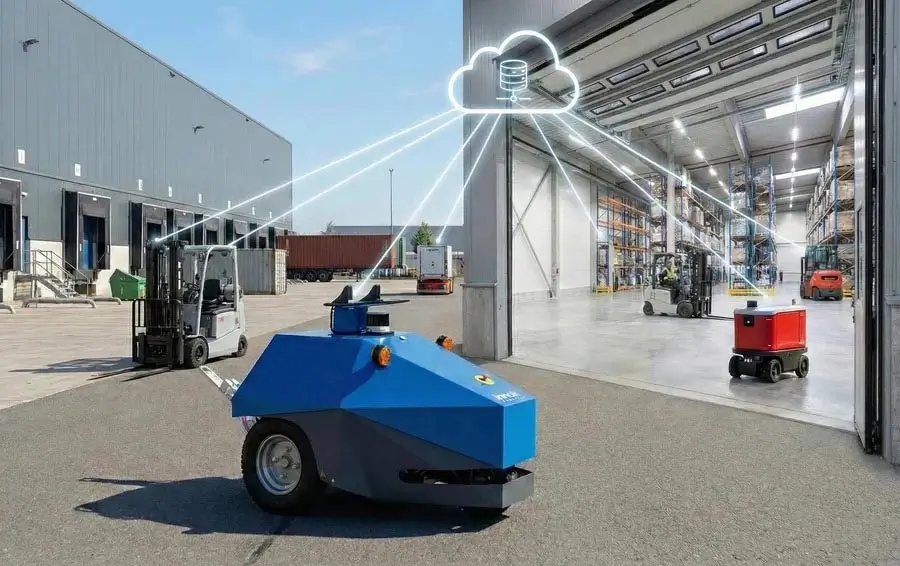
–E-commerce logistics: In e-commerce warehouses, the VDA5050 protocol is used to coordinate AMRs for goods sorting, handling, and shelving, seamlessly interfacing with WMS (Warehouse Management System) to improve sorting efficiency and order fulfillment speed.
–Cold chain logistics: Low-temperature AGVs adapted for VDA5050 use extended fields to monitor and upload real-time temperature and humidity data, ensuring that environmental conditions for cold chain goods meet requirements during transportation and reducing cold chain product loss rates.
Development Direction of the VDA5050 Protocol
–Functionality: Add control interfaces for vehicle mechanical parameters and external devices (such as forks, robotic arms) to support more complex operation scenarios, such as precise loading/unloading and multi-station operations. Introduce functions such as dynamic multi-task priority adjustment and cross-dispatch-domain collaboration to improve system flexibility and efficiency in complex task environments.
–Efficiency and reliability: Optimize the use of the MQTT protocol to reduce message latency and bandwidth usage, support higher-frequency status reporting and command issuance, and meet the needs of application scenarios with stricter real-time requirements. Strengthen safety compliance, be compatible with more international safety standards (e.g., EN ISO 3826-3), and add fault detection and recovery mechanisms to improve overall system reliability.
–Adaptability: Expand application scenarios from automotive manufacturing to e-commerce logistics, cold chain logistics, and other fields, adding support for specialized equipment. Strengthen integration with enterprise information systems such as WMS, TMS, and MES to achieve seamless data exchange and business process collaboration, promoting full-link digitalization of smart logistics. Attract more enterprises and research institutions to participate in standard iteration to further improve protocol adaptability.
Insight from AI Robots Eidos about VDA5050 Protocol
—The future evolution of the protocol will become a native description language for digital twin models of mobile robots—not only transmitting location, status, and tasks but also synchronously carrying real-time digital twin attributes (such as energy consumption models, dynamics parameters, and predictive maintenance features), enabling scheduling systems to complete “realistic simulations” in virtual space before issuing commands, thereby achieving a one-time successful scheduling driven by the digital twin.
—In the future, VDA5050 will abstract a collaborative protocol layer across enterprise boundaries, allowing robot clusters from different factories, logistics centers, or even different companies to share tasks and paths through federated scheduling. For example, an AMR in Warehouse A can directly respond to temporary transportation requests from Factory B when idle, with the protocol serving as the operating system for a flexible logistics capacity network within the supply chain.
—There will also be specialized hardware and software middleware that encapsulates non-VDA5050 devices as virtual AGVs/AMRs, presenting standard interfaces externally. This effectively expands the “coverage” of the protocol from mobile robots to the entire logistics equipment layer, ultimately achieving unified access for all equipment in various scenarios, rather than waiting for all devices to support it natively.
Image Credits: Antdriven & Ros & Innok-robotics & Linkedin & Synaos