
Table of Contents
RGV vs AMR is the central theme of this paper. The significance of comparing the two lies in helping enterprises select the most suitable equipment based on their operational needs (stable scenarios vs. dynamic scenarios), thereby achieving improved efficiency and cost reduction.
RGV vs AMR: Definitions
RGV(Rail Guided Vehicle)
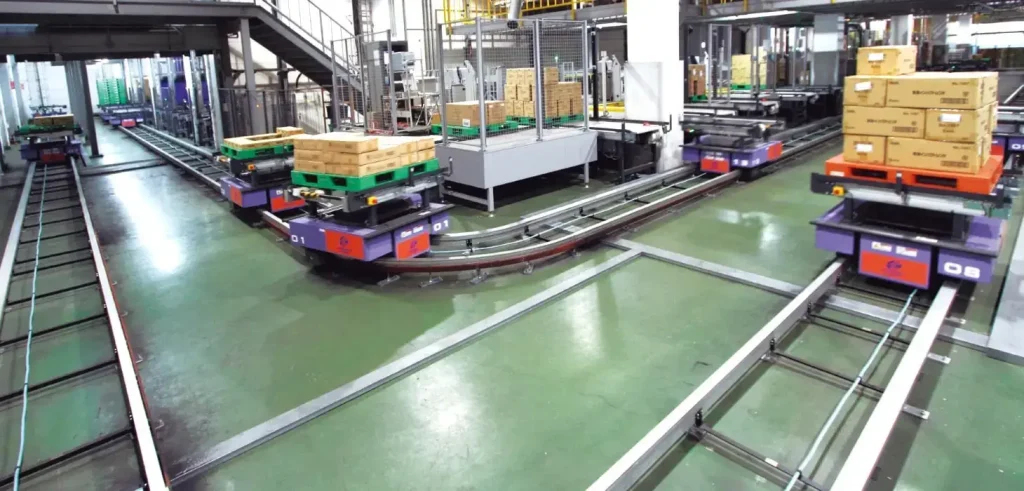
RGV stands for Rail Guided Vehicle, also known as a “rail-guided shuttle.” RGVs are commonly used in various types of high-density storage warehouses. The shuttle’s travel path can be designed to any length as needed. When handling and moving goods, no other equipment needs to enter the aisle, offering high speed and safety, which effectively improves the operational efficiency of the warehouse system. RGVs can also be used for connecting and transferring between parallel multi-segment conveyor lines, enabling logistics connectivity between them.
AMR (Autonomous Mobile Robot)
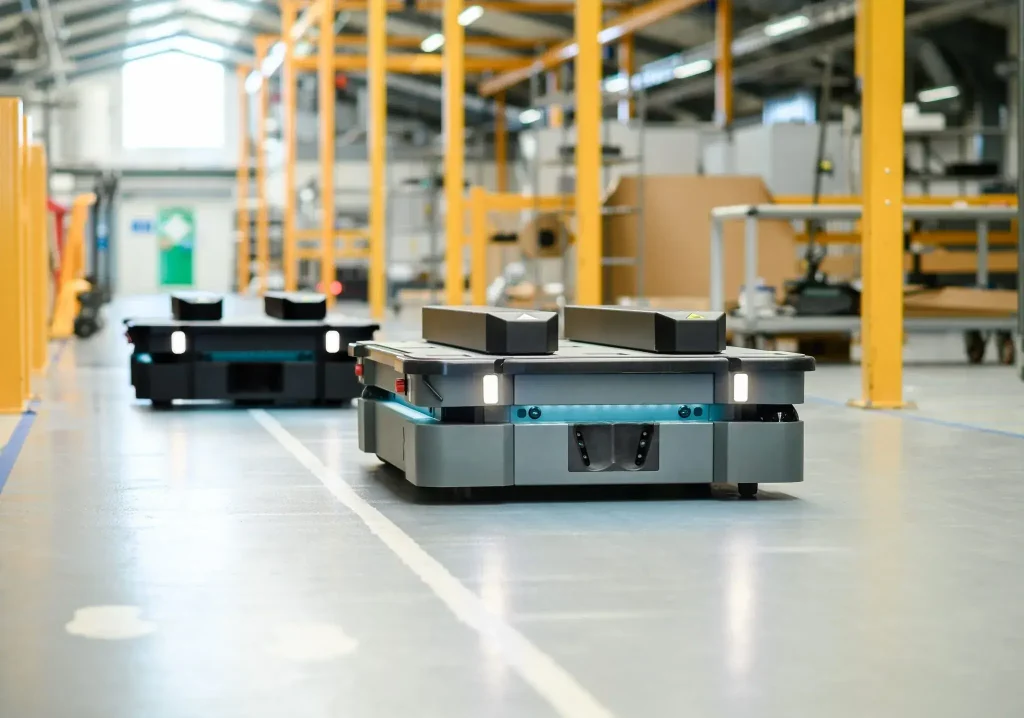
AMR stands for Autonomous Mobile Robot. It is a robot with the ability to understand and move independently within its environment. AMRs can accept human commands, execute pre-programmed routines, or act according to principles based on artificial intelligence technologies. AMRs use a complex set of sensors, AI, and machine learning techniques to compute path planning, understand the environment, and navigate within it. Equipped with cameras and sensors, if AMRs encounter unexpected obstacles while navigating, they use collision avoidance sensors and other technologies to slow down, stop, or re-route around the obstacle before continuing their task.
Recommended In-depth Reading from AI Robots Eidos
RGV (Rail Guided Vehicle) and AMR (Automated Mobile Robot) are two different mobile robot technologies. Clearly defining them is a prerequisite for accurately comparing their differences in navigation methods, applicable scenarios, costs, and future developments.
If readers are interested, please read these two detailed articles on RGV (Rail Guided Vehicle) and AMR (Automated Mobile Robot) introductions.
RGV vs AMR: Navigation
RGV
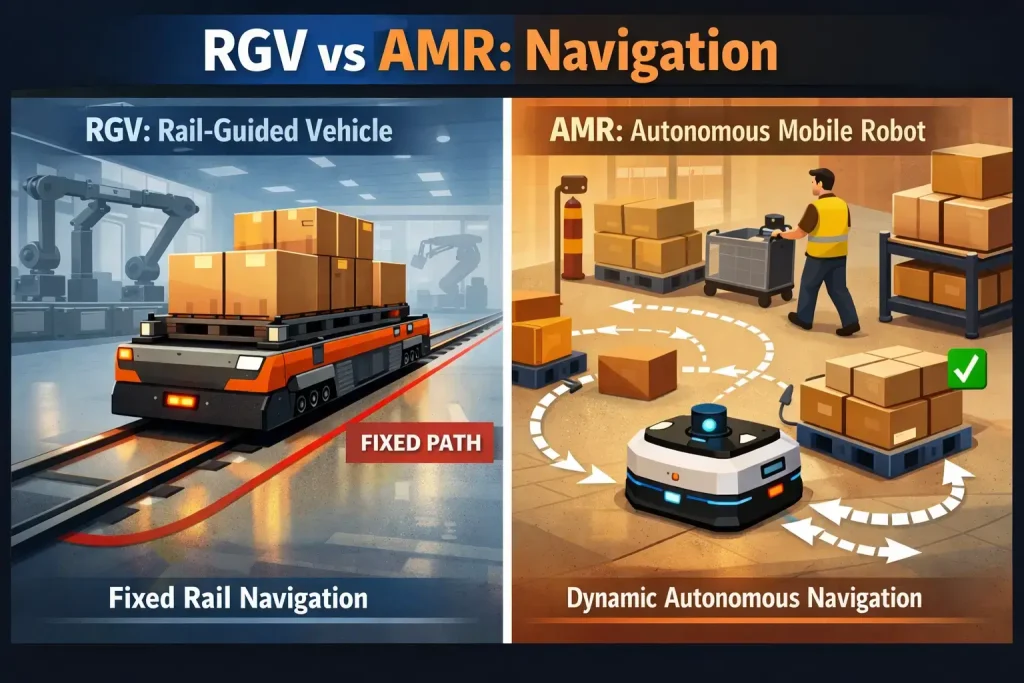
The RGV is a high-precision, heavy-load vehicle constrained by rails—hence the name “Rail Guided Vehicle.” It mainly consists of the frame, drive wheels, caster wheels, front and rear bumpers, chain conveyor, communication system, electrical system, and various covers. These components work together to give the RGV powerful handling capabilities. During operation, the RGV shuttles methodically along the fixed rails, moving goods accurately to designated positions. The operation is stable and reliable, with a precise and controllable motion trajectory (achieving ±2mm accuracy).
Because RGVs can only operate on rails, once the RGV path is determined, it is very difficult and costly to modify. Consequently, their adaptability to the operating environment and their scalability are relatively poor.
AMR
The AMR is an algorithm-driven “Autonomous Mobile Robot.” It is typically equipped with various sensors such as LiDAR, cameras, and ultrasonic radar, which act as the robot’s eyes and ears, enabling it to perceive environmental information in real time. Using intelligent algorithms, the AMR deeply analyzes the collected sensor data to form a profound understanding of the on-site environment. Based on this understanding, the AMR can autonomously choose the optimal action method and path to complete tasks efficiently.
However, AMR positioning accuracy is slightly lower than that of RGV (typically around ±5mm), and its structure is complex, leading to higher maintenance requirements.
RGV vs AMR: Comparison of Core Technical Parameters
| Dimension | RGV | AMR | Technical Impact |
| Navigation Method | Physical rail guidance | Laser SLAM/visual navigation | AMR offers high layout flexibility; RGV provides high path accuracy |
| Positioning Accuracy | ±2mm (rail-supported) | ±5mm (floor-dependent) | RGV is suitable for precision manufacturing scenarios |
| Maximum Load Capacity | 2000–3000 kg | 500–1500 kg | RGV is irreplaceable for heavy-load handling |
| Aisle Width | ≥1.8m | 1m | AMR improves space utilization by 50% |
| Path Change | Requires rail modification (40% cost increase) | Software re-planning (real-time adjustment) | AMR completely wins in layout flexibility |
| Control Architecture | Centralized control | Distributed swarm intelligence | AMR offers higher system fault tolerance |
| Expansion Cost | Adding new rail networks | Increasing number of robots | AMR enables low-cost linear scaling |
RGV vs AMR: Level of Intelligence
RGV
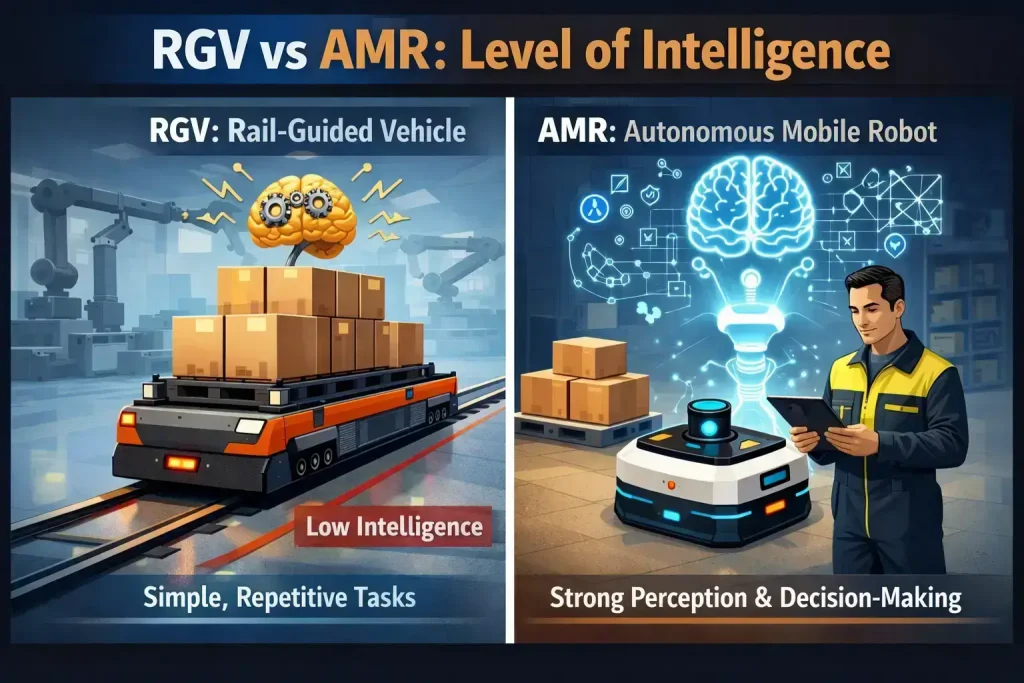
The intelligence level of RGVs is relatively low; they are better suited for performing simple, repetitive tasks. On a production line, an RGV follows preset programs and moves materials from one workstation to another along its rails, without needing to make many judgments or decisions regarding complex environmental changes. Its operation is relatively straightforward, primarily using pre-written programs and control systems for basic movement and handling functions. Its ability to handle unexpected situations or complex scenarios is quite limited.
AMR
The AMR is like a highly skilled technician with a smart brain, possessing strong perception and decision-making capabilities. It can not only perceive environmental information in real time but also deeply analyze and process this information to make sound decisions. In multi-robot collaboration scenarios, AMRs can communicate and cooperate efficiently with other robots. Based on overall task requirements and real-time conditions, they autonomously coordinate their actions to achieve optimal resource allocation and efficient task completion.
RGV vs AMR: System Complexity and Maintenance
RGV
The RGV has a relatively simple structure. This straightforward design gives it strong resistance to external environmental interference, high operational stability, and a low failure rate.
AMR
The structural design of AMRs varies depending on the navigation method and application scenario, but overall complexity is high. They integrate precision sensors such as LiDAR and IMUs, resulting in a high technical barrier for maintenance.
RGV vs AMR: Applications
Selecting the appropriate equipment based on the characteristics of the logistics task is key to realizing the benefits of automation.
Applications of RGV
–High-Density Stereoscopic Warehouses: In various types of high-density storage warehouses, RGVs are often an ideal choice. The shuttle path can be designed to any required length. When handling goods, no other equipment needs to enter the aisle, effectively improving warehouse space utilization and operational efficiency.
–Material Handling on Production Lines: In manufacturing production lines, RGVs are commonly used for precise material transport between different workstations, achieving ±2mm positioning accuracy. Their operational stability and high precision reliably support production line operations.
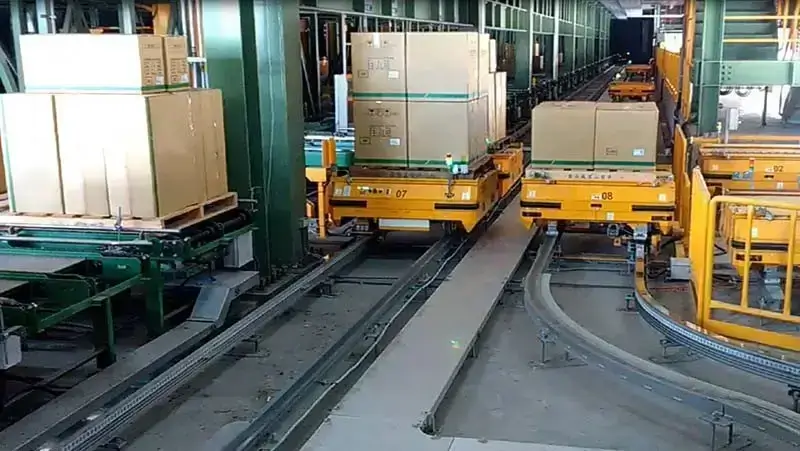
Fixed-Process, High-Frequency Task Scenarios: RGVs excel in scenarios where the operational process is fixed, handling tasks are frequent, and path accuracy is extremely high.
Applications of AMR
–E-commerce and Courier Warehousing: The e-commerce and courier industries are characterized by high-frequency, small-batch, multi-variety orders, demanding high flexibility and fast response times from warehouse logistics. AMRs can integrate closely with Warehouse Management Systems (WMS), automatically planning paths based on order information, quickly moving to shelf areas to pick items, and transporting them to packing or shipping zones, enabling an efficient “goods-to-person” picking model.
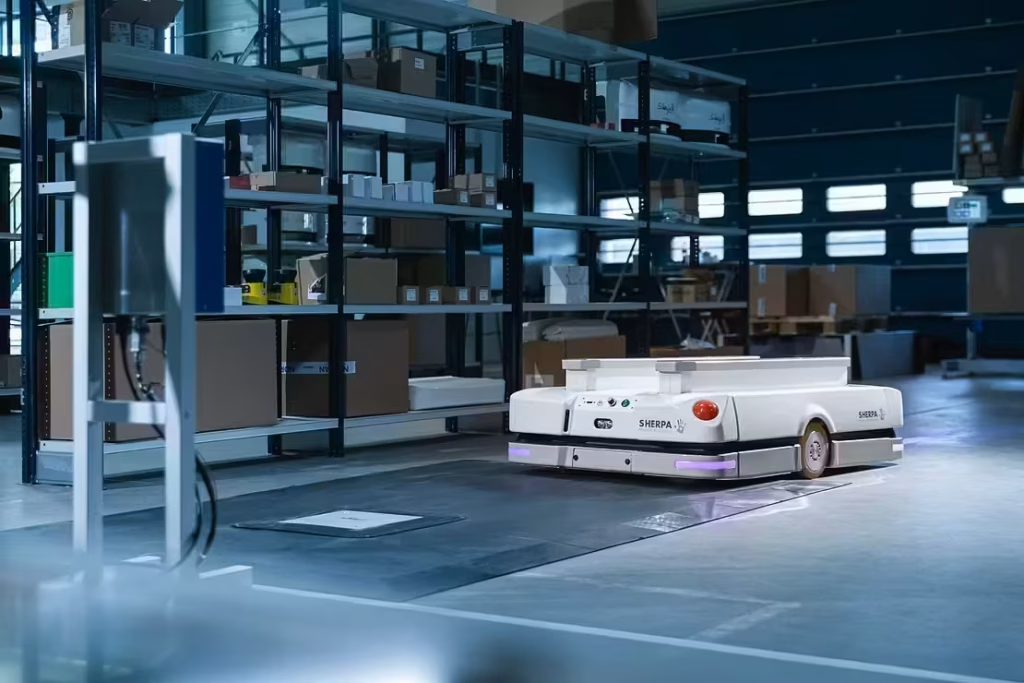
–Flexible Manufacturing in Industry: As manufacturing moves towards flexibility and customization, the need for flexibility in material handling during production is increasing. AMRs can adjust transport paths and task assignments in real time based on changes in production tasks. They seamlessly connect with production lines, assembly lines, and automation equipment to enable automated transport and delivery of raw materials, semi-finished products, and finished goods.
Operations in Special Environments: In industries with demanding environmental requirements, such as food and electronics, as well as locations with special conditions like high temperatures, low temperatures, dust, or radiation, AMRs leverage their automation and intelligence to replace manual material handling tasks, avoiding the impact of human factors on product quality and the environment.
Insight from AI Robots Eidos about RGV vs AMR
—A hybrid architecture can be designed that combines high-precision rail islands with AMR (Autonomous Mobile Robot) free zones. In critical workstations, such as precision assembly and machining tool loading and unloading, short-range RGV (Rail Guided Vehicle) tracks ensure an accuracy of ±2mm. For long-distance transportation, line-side warehouses, and finished product offloading, AMRs are used. AMRs do not need to achieve the same level of precision as RGVs; instead, they complete precision compensation in the final 50cm through end-of-arm vision or mechanical positioning devices, such as secondary grip claws.
—In the future, third-party logistics or park operators could embed standardized, modular RGV track networks (similar to power rails or water pipes) that companies can lease according to their needs, including the duration of use. The tracks themselves would become a service (Track-as-a-Service). When production lines are adjusted, companies would not bear the costs of track modification; instead, operators would provide “track reconfiguration” services.
—Currently, AMRs passively adapt to their environment. The next generation of AMRs should have the ability to “actively reconfigure their environment.” For example, when an AMR detects that a pathway is temporarily blocked by a pallet, it should not take a detour but rather automatically call another collaborative AMR or robotic arm to remove the obstacle; alternatively, it could communicate with intelligent shelves to retract legs actively and clear the pathway.
Image Credits: Daifuku & Teradyne & AI & Transcyko & Sherpa-mr