
Table of Contents
Mobile Manipulators, also known as mobile manipulator robots, are becoming a crucial pillar of intelligent manufacturing due to their innovations in structural optimization, navigation perception, and collaborative operation.
What Are Mobile Manipulators?
Mobile manipulators are a new type of robot that integrates the functions of a mobile robot and a collaborative robot into a single unit.
Its core characteristic lies in combining the flexible mobility of a mobile platform with the precise manipulation capabilities of a robotic arm (cobot). By fusing these abilities, it overcomes the situational limitations of traditional single-function robots (such as AGVs that only move or robotic arms / cobots that only operate), enabling the organic integration of large-scale movement and fine manipulation to handle complex and varied tasks like material handling, assembly, inspection, and sorting.
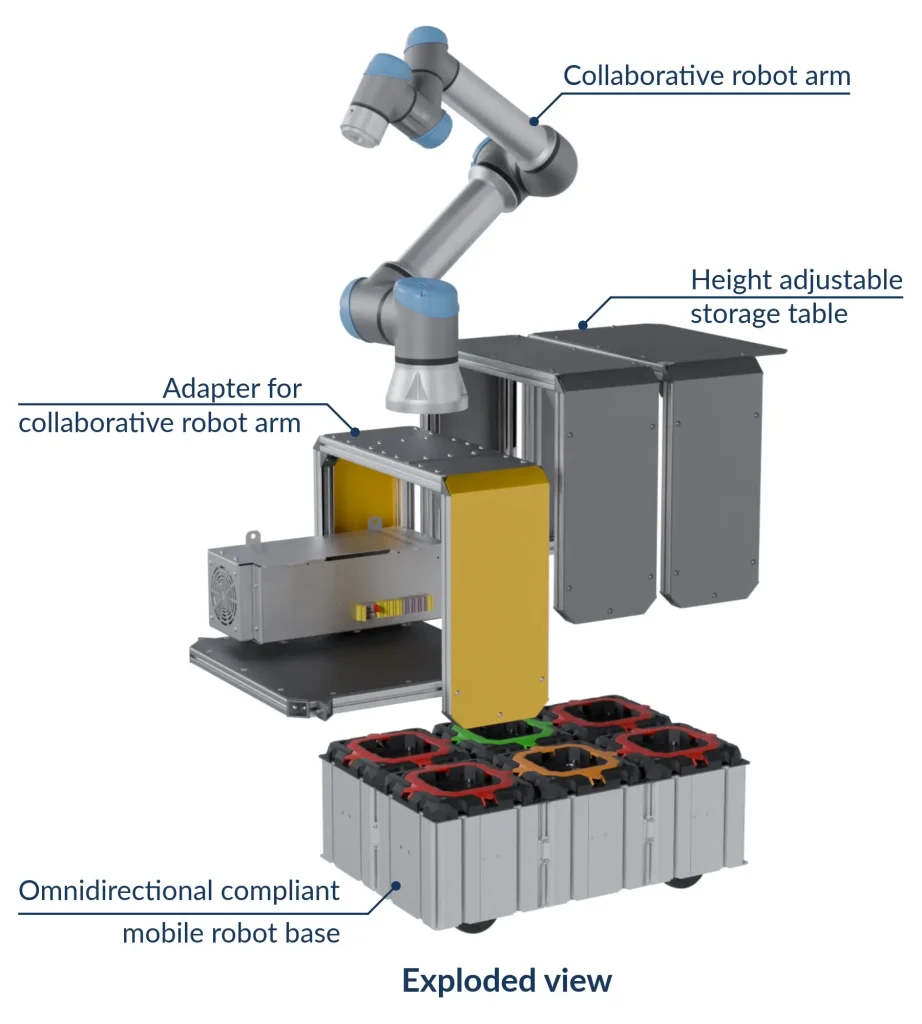
This further expands the realm of possibilities. For example, in industrial manufacturing, it’s difficult to create a fully intelligent factory with only single, fixed-station robots. Mobile manipulators can move flexibly, enabling end-to-end equipment connectivity.
Recommended Reading from AI Robots Eidos
Mobile manipulators integrate and upgrade collaborative robots (cobots) and AGVs (Automated Guided Vehicles), combining mobility, operational capabilities, and intelligent perception to perform complex tasks.
Collaborative robots (cobots) and AGVs serve as the fundamental components of composite robots, providing operational and mobility functions, respectively. Together, these three elements constitute the key equipment for automated production and services.
If you would like to learn more about collaborative robots and AGVs, please read relevant articles.
Components of Mobile Manipulators
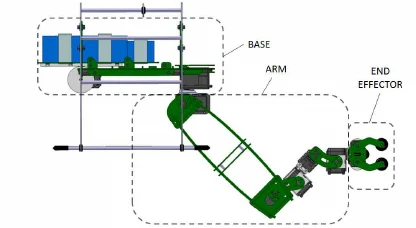
Mobile manipulators consist of a mobile base, controller systems, and a robotic arm.
Mobile Base
The mobile base of a mobile manipulator comprises a mechanical system, a power system, and a control system.
| Mechanical System: The mechanical system includes the vehicle body, wheels, steering mechanism, and safety devices. The vehicle body serves as the mounting foundation for other components, typically made of steel, requiring specific strength and rigidity. Steering mechanisms vary based on the base’s operation mode (e.g., articulated steering, differential steering, all-wheel steering), enabling forward, backward, longitudinal, lateral, diagonal, and rotational movements. The wheel design depends on the specific steering mechanism.
| Power System: The drive unit consists of drive wheels, a reducer, a brake, a drive motor, and a speed controller, forming a servo-driven speed control system. It can be controlled by a computer or manually, providing speed, direction, and braking control. The battery pack is typically an industrial battery (24V or 48V, often lithium-based) with charge/discharge control.
Control System
| AGV Control System: Typically includes an on-board controller and an off-board controller. The off-board controller sends commands via a communication system to the on-board controller, which manages manual control, safety devices, battery status, steering limits, brake release, lights, motor control, AGV charging contactors, and operational safety monitoring. The off-board controller handles AGV dispatching, command transmission, and status reception.
| AMR Autonomous Navigation: AMRs use data from cameras, built-in sensors, LiDAR, and sophisticated software to perceive their environment and choose the most efficient path to a target. They operate fully autonomously, safely navigating around obstacles using optimal alternative routes, ensuring material flow remains on schedule and optimizing productivity.
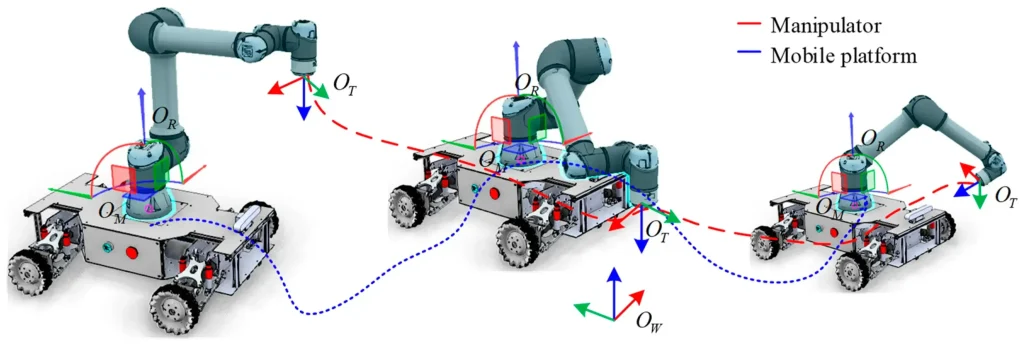
AMR autonomy relies on SLAM (Simultaneous Localization and Mapping) technology, where a robot starts from an unknown location in an unknown environment, builds a map incrementally while localizing itself within that map based on its estimated position, enabling autonomous positioning and navigation. SLAM is categorized based on primary sensors: Laser SLAM and Visual SLAM. Due to limitations of individual navigation methods, many AMR manufacturers combine laser or visual SLAM with other techniques for robust navigation in complex environments.
| Terminal Controller: Since the mobile base and robotic arm correspond to two distinct robot types, their controllers need integration. There are currently two integration approaches for the terminal controller:
Pseudo-Integration (Separate Controllers): Retains the original controllers for both the base and the arm, using a higher-level controller to coordinate their operations. The advantage is achieving both “hand” (arm) and “foot” (AGV/AMR) functions. The disadvantage is that companies often specialize in either AGV/AMR or robotic arms, potentially leading to suboptimal overall system control.
True Integration (Unified Controller): With technological progress, some companies are exploring fully integrated mobile manipulators. These use a single controller for task allocation, resulting in faster feedback and simpler operation. This represents a future trend in mobile manipulator development.
Robotic Arm
Due to application scenarios and base payload limitations, the robotic arm on a mobile manipulator is typically a lightweight, flexible collaborative robot (cobot). A cobot mainly consists of four parts: servo joints, connecting shell and safety skin, control cabinet and teach pendant, and end-effector. It uses an integrated joint design (transmission + sensing + integrated driver) combined with a controller. (Reference to collaborative robot introduction can be added here).
Advantages of Mobile Manipulators
| Mobility: By combining a mobile robot with a collaborative robot arm, mobile manipulators inherit the advantages of mobile robots, such as automating material transport and machine loading/unloading, thereby increasing labor productivity. They also enable production line flexibility, moving to subsequent workstations after completing one task.
| Precision: They can leverage the high-degree-of-freedom arm or end-effector to perform high-precision tasks, similar to collaborative robots. In industrial production, they execute tasks with high accuracy and repeatability, reducing human error, improving product consistency and stability, lowering defect rates, and enhancing production quality.
| Cost: A single mobile manipulator can replace the need for separate mobile robots and collaborative robots working together, potentially reducing overall system costs.
Technical Specifications of Mobile Manipulators (For Reference Only)
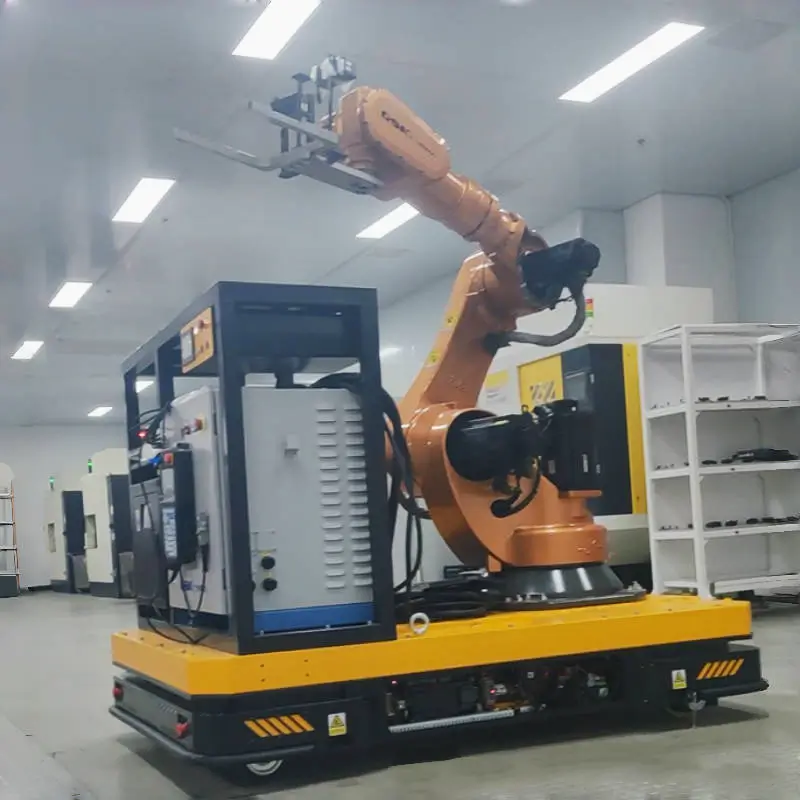
| Item | Specification |
| Product Name | Industrial Composite AMR Robot |
| Navigation Method | SLAM Laser + QR Code Navigation |
| Load Capacity | 1000-1500KG |
| Dimensions | 2000*1400*550mm |
| Safety Protection | Laser Obstacle Avoidance + Mechanical Anti-collision + Emergency Stop |
| Operation Mode | Omnidirectional In-situ Rotation |
| Drive Method | Servo Steering Wheel Drive |
| Operating Speed | 60 m/min (Adjustable) |
| Rated Voltage | 48V |
| Battery Capacity | 48V 400AH |
| Charging Method | Automatic Charging Station |
| Robotic Arm Payload | 100KG |
| Electrical Specifications | Three-phase 380V, 50Hz/60Hz, Total Power 14.23KW |
| Installation Method | Floor Mounting |
Core Technologies of Mobile Manipulators
The integration of multiple independent systems (mobile robot and collaborative robot) is the core technology behind mobile manipulators. The presence of multiple modules—differing device types, sensor types, communication protocols, and complex exception handling logic—makes controlling a mobile manipulator extremely complex.
| Technical Level: Integration difficulty stems partly from a lack of openness in underlying product architectures and partly from companies’ technical limitations. Different subsystems (navigation, positioning, etc.) often have distinct controllers and incompatible internal communication protocols. To gain market acceptance, manufacturers need to research and develop multiple technologies—mobile base, cobot, navigation—to achieve seamless multi-system integration. This is undeniably a significant challenge for most producers.
| Application Level: Multiple scenarios and process types present even greater development difficulties for integrators assembling components from various suppliers. End-user companies expect mobile manipulators to be used on flexible production lines, improving automation through multi-functionality and creating flexible workflows—a higher expectation compared to traditional robots.
Research Directions for Mobile Manipulators
Hardware
| Mobile Platform Design: Platform choice critically impacts overall performance, especially stability and navigation. The base must be robust enough to carry the arm and provide adequate maneuverability.
| Manipulator Design: Robotic arm and end-effector design must consider dexterity, reach, payload capacity, and energy efficiency. The arm’s degrees of freedom (DoF) and weight affect the system’s mobility. End-effectors are commonly grippers, suction cups, anthropomorphic hands, tools, or vision systems.
| Force Control Research: Ensuring precise control of forces applied by the manipulator during tasks like assembly or handling, requiring a balance between speed, strength, and precision.
| Object Handling Research: Handling diverse objects (rigid, flexible, soft) and performing complex tasks (assembly, disassembly, transport) requires the arm to adapt to various geometries and orientations.
| Perception and Sensing:
Visual Perception: Cameras and computer vision systems are typically used for object identification, pose estimation, and environmental understanding. Visual feedback is crucial for grasping and manipulation tasks.
Sensor Fusion: Combining data from different sensors (LiDAR, cameras, force/torque sensors) creates a more accurate environmental model and enhances robot behavior.
| Human-Robot Interaction: Collaborative Manipulation Research: Mobile manipulators may work alongside human operators in tasks like teleoperation or collaborative assembly. They must handle human unpredictability and adjust behavior accordingly.
| Safety Research: Ensuring safe operation in human-shared spaces, including human detection and collision avoidance.
Software
| Path Planning and Navigation: Developing algorithms for navigating environments and achieving manipulation goals (e.g., sampling-based algorithms like RRT, optimization-based methods).
| Localization and Mapping Research: Using sensors for Simultaneous Localization and Mapping (SLAM) to create environment maps and track robot position. Challenges increase when the arm obstructs sensors or in cluttered environments.
| Navigation Research: Ensuring autonomous point-to-point movement considering obstacles, terrain, and workspace constraints. Requires research into real-time path replanning when the environment changes. The software system must process sensory input and make real-time adjustments for navigation and manipulation, demanding advanced low-latency feedback algorithms—a current technical difficulty.
| Autonomous Decision-Making: While the hardware structure of mobile manipulators may be less complex than humanoid robots, they still possess “hands and feet” and require significant autonomous decision-making capability in dynamic environments. When encountering unexpected situations or obstacles, they must adapt flexibly. Researching the robot “brain” remains an ongoing challenge.
| Artificial Intelligence: AI algorithms, particularly deep learning, are increasingly used to help mobile manipulators learn tasks from demonstration or trial-and-error. Reinforcement Learning (RL) is commonly applied to teach complex manipulation skills.
| Task Planning Research: Developing high-level planning algorithms to generate action sequences based on robot goals, reasoning about how to optimally sequence manipulator actions and mobile navigation.
| Kinematic Model Research: Studies how the mobile base and arm interact to produce desired motion. This involves research into the integrated system’s inverse kinematics (IK) and forward kinematics (FK), as well as separate kinematic models for the arm and base.
| Dynamic Model Research: Studies how forces, torques, and velocities propagate through the base and arm to create coordinated motion. This research must account for factors like friction, payload, and center of mass.
Applications of Mobile Manipulators
| Industrial Production: With demands for modular, flexible production solutions, mobile manipulators are gaining traction. In traditional manufacturing (e.g., cosmetics, 3C electronics), they handle tasks like loading/unloading, enabling fully automated, flexible production within workshops. They automate complex tasks in assembly lines and distribution centers, including feeding, pick-and-place, metering, quality control, cleaning, polishing, screw driving, and drilling.
| Warehousing and Logistics: With the rapid growth of e-commerce, mobile manipulators are used for sorting, classifying, and transporting goods within warehouses. They are also applicable to retail inventory counting and truck unloading. Robots like Fetch Robotics’ Fetch & Freight, Boston Dynamics’ Stretch, and Robotnik’s RB-VOGUI+ are deployed in logistics, helping companies streamline operations, reduce labor, and improve efficiency.
| Domestic Service: Early research into mobile manipulators as “personal assistants” often stalled due to the complexity of home environments and human-robot interaction challenges. Recent advances in HRI and robot vision have enabled some task-specific service robots, such as Harvest Automation’s Harvey for potted plant arrangement and Hello Robot’s Stretch for tasks like playing with dogs, tidying tables, and cleaning sofas.
Notable Mobile Manipulators
| Fetch (Fetch Robotics): A classic mobile manipulator with a 7-DoF arm supporting a 6kg payload. It moves at 1.0 m/s, has an adjustable torso height for grasping items from shelves and floors at various levels, and uses an onboard ROS system.
| Handle & Stretch (Boston Dynamics): Boston Dynamics introduced Handle, a mobile manipulator targeting logistics. Nicknamed the “Transformer,” Handle leveraged experience from the company’s humanoid and quadruped robots in dynamics and mobility. It featured 10 actuated joints, a mobile base with hybrid “wheeled” and “legged” characteristics enabling jumps and fast horizontal gliding, and a 4-axis arm with a pneumatic suction cup end-effector for grasping items deep within shelves.
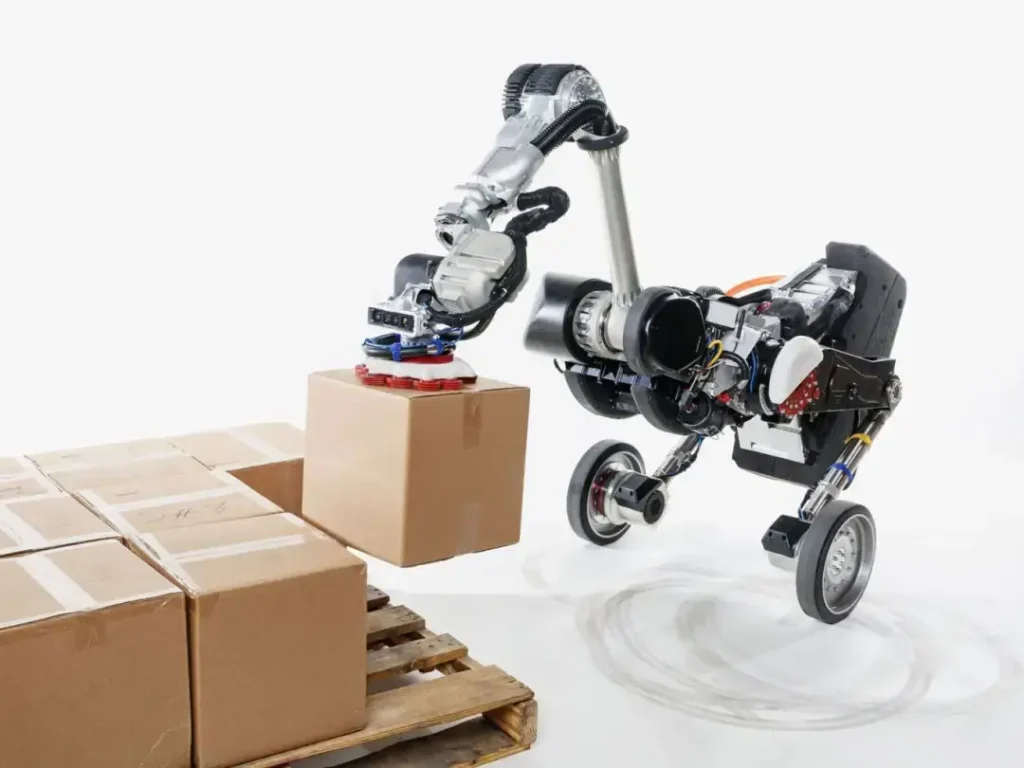
In 2019, Boston Dynamics launched Stretch, an upgraded robot focused specifically on warehouse logistics. Described as a “boring moving box,” Stretch adopted a more classic mobile manipulator form factor. Its base was boxy for improved maneuverability (turning), sacrificing jumping capabilities less relevant to warehouses for enhanced payload and runtime. The arm had 7 DoF, retained the pneumatic suction cup end-effector, and was designed primarily for truck unloading and depalletizing automation. A key change was mounting cameras and sensors on a separate mast for improved environmental awareness, rather than on the arm itself.
Insight from AI Robots Eidos about Mobile Manipulators
| The future form of mobile manipulators is an integrated decision-making driven by digital twins. In the virtual world, there will be a “digital twin” that is completely synchronized with the physical entity. Before executing tasks, the robot will first simulate the optimal path and operational posture in the virtual space through AI (addressing the problem of kinematic and dynamic coupling), and then execute it in the physical world. This not only solves the delay problem of real-time feedback but also endows composite robots with the ability for “pre-event prediction” rather than “post-event reaction.”
| Currently, although mobile manipulators integrate chassis and arms, their forms are fixed. In the future, we may see composite robots capable of “self-reconfiguration” in their forms. The chassis and mechanical arms will no longer be fixed combinations but will connect through a unified intelligent interface. When heavy load transportation is needed, it can connect to a heavy-duty chassis and powerful arm; when fine assembly is required, it can replace it with a high-precision lightweight arm and a high-magnification vision system.
| The complex SLAM (Simultaneous Localization and Mapping), path planning, and real-time inverse kinematics of the mechanical arms demand very high computing power. Future mobile manipulators will adopt a “cloud brain + edge response” separated architecture. Complex cognitive tasks will be handled by large models in the cloud, while milliseconds-level motion control and obstacle avoidance will be managed by local edge computing chips. This can significantly reduce the hardware costs of robots and genuinely enable them to handle unstructured environments.
Image Credits: Kelo-robotics & Instructables & Researchgate & Web & Mdpi